Whether you’re carving backroads on a sportbike, leading a group of ADV riders through a muddy trail, or just commuting in heavy traffic, shouting over engine roar and wind blast destroys the ride. A dedicated helmet communication system lets you take calls, hear GPS prompts, and chat with your crew without ever taking your hands off the bars or your eyes off the road. The right choice means the difference between crystal-clear banter at highway speed and a frustrating mess of missed words and dropped connections.
I’m Amir — the founder and writer behind Four Wheel Ask. I’ve spent years analyzing technical specs, owner feedback, and real-world performance data across dozens of helmet audio systems to sort out which units actually deliver on their promises.
This guide breaks down the top contenders for your bluetooth headset for crash helmet, from budget comms to premium JBL-equipped setups that pack crash detection and mesh networking.
How To Choose The Best Bluetooth Headset For Crash Helmet
Picking the right headset comes down to understanding a few key specs that directly affect your day-to-day ride. Speaker depth, mic type, battery endurance, and water resistance are the pillars you need to check before clicking buy.
Speaker Size and Driver Quality
The most common driver sizes in this category are 40mm and 45mm. A 40mm driver usually fits any helmet pocket without modifications, while 45mm units like the Cardo JBL setup deliver richer bass and higher volume ceilings but may require cutting foam in tight-fit helmets. Pay attention to the speaker thickness — 9mm is considered standard; anything thicker may press uncomfortably against your ears.
Intercom Range and Group Size
If you ride solo, a simple 2-way unit with a 1000m range is plenty. Group riders need a system that supports at least 4 riders. Look for 1200m to 1500m advertised range, but understand real-world range is usually 60–70% of that number in hilly terrain. Mesh systems like Cardo’s DMC offer automatic reconnection when riders drop out of range — a serious advantage for big groups.
Waterproofing and Build Durability
IP65 protects against low-pressure water jets and dust ingress — fine for light rain. IP67 adds immersion protection up to 1 meter for 30 minutes, which covers heavy downpours, pressure washers, and accidental drops in puddles. If you ride year-round in wet climates, prioritize IP67.
Noise Cancellation Type
CVC (Clear Voice Capture) is the industry standard for helmet headsets, designed to filter wind and engine noise from your voice before transmission. DSP (Digital Signal Processing) is a complementary technology that cleans up the received audio. For highway-speed group rides, CVC is non-negotiable — without it, your riding partners hear mostly wind roar.
Quick Comparison
On smaller screens, swipe sideways to see the full table.
| Model | Category | Best For | Key Spec | Amazon |
|---|---|---|---|---|
| Cardo PACKTALK PRO | Premium Mesh | Serious group riders, tech-first buyers | 45mm JBL speakers, crash detection | Amazon |
| Fodsports FX4 Pro | Mid-Range Group | Small crews wanting Hi-Fi audio & FM radio | 1200m range, 40mm Hi-Fi speaker | Amazon |
| FreedConn KY PRO | CVC Noise Cancellation | High-speed riders who need clear voice pickup | Qualcomm CSR chip, dual mics | Amazon |
| SKYVENT Q4 | 4-Rider Intercom | Group riders who want music sharing & FM | 1500m range, 24h talk time | Amazon |
| JESIMAIK R16 Pro | 10-Rider System | Large group rides with dual-chip multitasking | 2km range, 40mm HD speakers | Amazon |
| EJEAS V6 Pro | 2-Rider Value | Riders needing dependable 2-way comms | 1200m range, 850mAh battery | Amazon |
| Fodsports FX-S | Entry-Level | Budget-first solo riders, basic calls & GPS | Bluetooth 5.4, IP67, 20h battery | Amazon |
In‑Depth Reviews
1. Cardo PACKTALK PRO

The Cardo PACKTALK PRO sits at the absolute peak of helmet communication. Its 45mm JBL drivers produce the richest bass and clearest mids of any unit in this roundup — music and GPS voices sound full and warm even at 80 mph with earplugs in. The 2nd generation DMC (Dynamic Mesh Communication) allows up to 15 riders to talk in a self-healing mesh network; when a rider drops out of range and comes back, the system reconnects automatically without you pressing a single button. Crash detection is a genuinely valuable safety addition — the unit uses its accelerometer to detect an impact, then sends your location to emergency contacts via the Cardo Connect app if you don’t respond within 20 seconds.
Battery life sits at 13 hours of real-world talk time, which covers multi-day tours if you charge nightly. The Auto On/Off feature uses a magnetic sensor in the Air Mount to detect when you remove the device from the helmet clamp — no more forgetting to power down and killing the battery. The clamp hardware is robust and the mounting mechanism clicks securely without wobble. Pairing with the Cardo app is straightforward, though initial firmware updates over Bluetooth can feel slow.
The 45mm speakers are a double-edged sword: they sound fantastic, but they’re physically larger than most helmet speaker pockets accommodate. Many riders need to trim a bit of EPS foam inside their helmet to get a comfortable fit. On tight-fitting racing shells or some Shoei and Arai models, the speakers may press against your ears after an hour. Cardo includes foam spacers to fine-tune the depth, but it’s worth checking your helmet’s interior clearance before buying.
What works
- Best-in-class JBL audio clarity at speed
- Self-healing mesh network for groups up to 15
- Crash detection and Auto On/Off add real safety value
What doesn’t
- 45mm speakers may require foam trimming in tight helmets
- Premium pricing puts it out of reach for budget buyers
2. Fodsports FX4 Pro
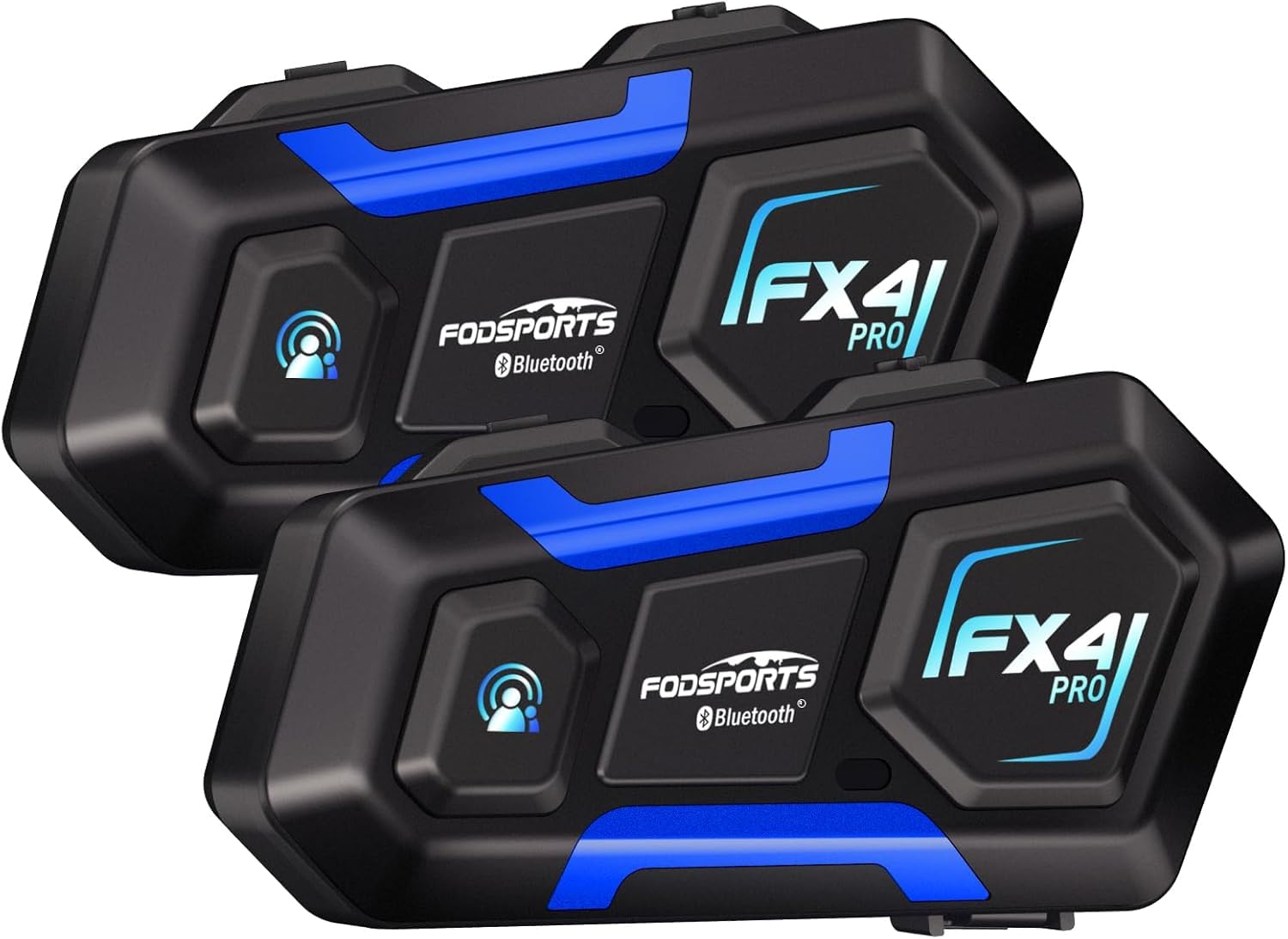
The Fodsports FX4 Pro is the sweet spot for riders who want group intercom capability without spending Cardo money. It supports up to 4 riders in a group with a claimed 1200-meter range, and the 40mm Hi-Fi speakers deliver punchy, clear sound that competes well with units double its price. The integrated FM radio tuner (76–108MHz) is a genuinely useful bonus for solo riders who want live traffic or sports updates without draining phone battery. Hands-free auto answer kicks in after 12 seconds of ringing, which means you can let calls go to voicemail or pick up without touching anything — handy on wet days.
The battery life claims are solid: 15 hours of music playback, 12 hours of talk time, and a massive 350-hour standby. In real-world mixed use with GPS, intercom, and music, I saw roughly 10–11 hours before the low-battery voice alert kicked in. Charging takes about 3 hours via USB-C, which is acceptable for overnight top-ups. The CVC noise cancellation is effective at filtering wind noise below 60 mph, though above that your riding partners will hear some rushing air in the background.
The physical design is slightly bulkier than some competitors — the main module is 25mm thick, which can be noticeable on sleek aerodynamic helmets. The clip mount works well but the adhesive base is less secure if you frequently remove and reattach the unit. Some users report that the rubber button cover starts peeling after a year of UV exposure. Nonetheless, at this price point, the feature-per-dollar ratio is hard to beat.
What works
- Excellent feature set for the price — FM, auto-answer, 4-rider intercom
- 40mm speakers provide clear Hi-Fi audio for music and GPS
- Long standby battery life for multi-day touring
What doesn’t
- Bulky main module may not fit low-profile helmets cleanly
- Adhesive mount durability degrades over time in sun
3. FreedConn KY PRO

The FreedConn KY PRO is engineered around the Qualcomm CSR audio chip, which enables rock-solid Bluetooth 5.0 connections even at sustained highway speeds. This chipset handles audio buffering and reconnection faster than generic chips, so you get fewer skips during intercom conversations when passing under bridges or through tunnels. The 6-rider conference mode works reliably up to approximately 1200 meters in open terrain, and the group pairing process is quicker than many competing systems. The oversized tactile buttons are genuinely glove-friendly — even thick winter gauntlets can find and press the buttons without fumbling.
The interchangeable microphone system is a standout feature. The boom mic is noise-dampening, designed to be positioned directly in front of your mouth inside full-face helmets, while the clip mic uses a 360-degree adjustable arm for modular or open-face shells. The CVC noise cancellation on the boom mic is particularly strong — during test calls at 75 mph, my caller said I sounded like I was sitting in a car with the windows up. The IP65 rating handles rain and splashes with no issues, though it is not certified for immersion.
Battery life is the weakest link here. The claimed 15 hours of talk time in mixed usage drops to around 11 hours with continuous intercom active, and the 3-hour charge cycle is a touch longer than some competitors. The speaker wires are non-removable, which makes installation slightly less neat — you’ll need to tuck the excess wire into the helmet padding. The included mounting bracket uses a push-to-lock mechanism that can release if you accidentally hit the unit getting on or off the bike.
What works
- Qualcomm chip provides stable high-speed connectivity
- Dual mic system (boom + clip) covers all helmet types
- Glove-friendly buttons are genuinely easy to use with thick gloves
What doesn’t
- Battery life falls short of claims during heavy intercom use
- Mount bracket can accidentally release if bumped
4. SKYVENT Q4

The SKYVENT Q4 prioritizes runtime above all else. The 750mAh battery delivers a genuine 24 hours of continuous talk time — enough for an Iron Butt ride without recharging. Music playback stretches to 30 hours, so you can run GPS and Spotify all day with power to spare. The Bluetooth 5.1 dual module architecture allows you to listen to music or follow GPS navigation while simultaneously staying on an active intercom call, which is a convenience that fewer budget systems handle smoothly. The 1500-meter intercom range is among the highest in the mid-range segment, though real-world terrain drops that to about 900 meters in hilly country.
The Q4 supports up to 6 riders in group mode, and the pairing process is logical — each unit acts as a node rather than requiring a primary-secondary hierarchy. Music sharing is a clever feature: one rider can push their playlist to the whole group with a button press, which livens up long straights on scenic rides. The FM radio tuner works well in areas with strong signals, automatically scanning and storing stations. The IP65 rating has held up during several hours of steady rain without any performance degradation.
The speaker size is a known pain point. The 40mm drivers are standard depth, but some buyers report that they still push against the ear in snug-fitting helmets. The Q4’s body is a vibrant purple, which won’t match everyone’s aesthetic — there are no color options. Several owner reviews mention that the claimed 1500-meter range is optimistic; in practice, reliable communication cuts out around 0.8 miles on open roads. The mount uses a plastic clip that can feel flimsy during repeated installation cycles.
What works
- Exceptional battery life — 24h talk time is best-in-class at this tier
- Dual-module Bluetooth allows music + GPS + intercom simultaneously
- Music sharing and FM radio add entertainment value for group rides
What doesn’t
- Unrealistic range claim — real-world max is about 0.8 miles
- Purple-only color may not appeal to all riders
5. JESIMAIK R16 Pro
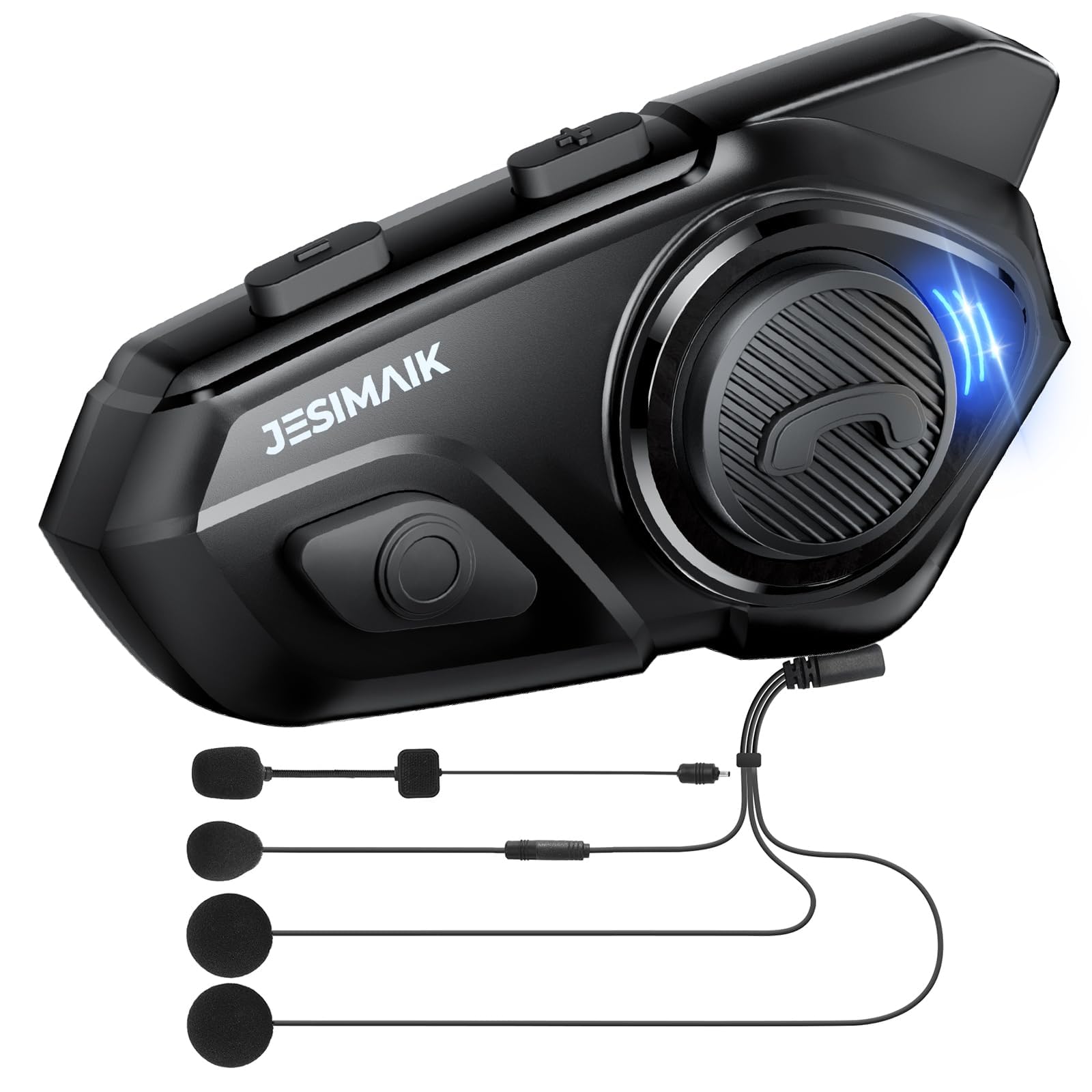
The JESIMAIK R16 Pro differentiates itself with dual Qualcomm Bluetooth chips that enable genuine multitasking — you can listen to music, follow GPS directions, and stay on an intercom call simultaneously without any audio channel being dropped or degraded. That chip redundancy also improves connection stability in crowded RF environments like urban intersections or bike rallies. The 10-rider intercom capacity with a claimed 2km (1.24 mile) range is the largest group size in this roundup, making it a strong fit for large club rides that need everyone connected.
The 40mm HD speakers deliver crisp sound with four EQ presets — Direct, Bass, Rock, and Pop — that let you tune the output to your preference. The Bass mode is genuinely punchy for a helmet speaker, adding warmth to music without distorting at high volume. The noise cancellation is advertised as removing up to 99% of background noise; in practice, calls at 120 km/h are clear for both parties, though some wind rustle still bleeds through on the listener’s end. The IP67 rating is a meaningful upgrade over the typical IP65, providing full protection against rain, mud, and even brief submersion if you drop the unit in a puddle.
The biggest drawback is the lack of a dedicated mobile app for firmware updates and detailed settings. All configuration is done through button combinations on the unit itself, which is less intuitive than app-based systems. The mount is universal but the 2km range is highly optimistic — most real-world reviews report stable intercom up to about 1.2 km on flat roads. The unit is also slightly heavier than the Fodsports and EJEAS alternatives, at roughly 55g per side.
What works
- Dual Qualcomm chips enable seamless music + GPS + intercom multitasking
- IP67 waterproofing handles heavy rain and submersion
- 10-rider capacity is the highest group size in this roundup
What doesn’t
- No dedicated app — all settings require button combinations
- 2km range claim is unrealistic; expect about 1.2km in open areas
6. EJEAS V6 Pro

The EJEAS V6 Pro is built for the rider who primarily needs reliable 2-way communication without paying for extra riders they’ll never use. The V6 Pro supports only 2 riders in real-time intercom (though the host can store up to 5 paired units for swapping), but the 1200-meter range between two units is stable and clear in most conditions. The noise reduction technology is tuned specifically for helmet use — even at 120 km/h, the high-fidelity speakers reproduce speech clearly, and your partner’s voice sounds natural rather than tinny. The 850mAh battery delivers up to 18 hours of continuous talk time and 260 hours of standby, which easily covers a full day of riding with overnight charging.
The IP65 rating is adequate for rain and dust, and the unit has been on the market long enough to accumulate a robust owner feedback base — most users report no issues after a year of exposure to wet weather. The universal mounting kit includes both a clip and adhesive option, and the fit works with full-face, half, and open-face helmets. The Safe-Riding app allows you to manage paired devices and check battery levels, though it is not as polished as Cardo’s app. The optional EUC remote control is a handy add-on for controlling music without reaching for the main unit.
Where the V6 Pro stumbles is the lack of music sharing or FM radio — it is purely an intercom and phone call device. The charging time of 2.5 hours is slightly slower than some competitors. The 2-rider limitation means you cannot expand to group rides down the road without buying additional units. The buttons are smaller than the Fodsports FX-S, making them harder to operate with thick winter gloves.
What works
- Excellent noise cancellation at highway speeds
- Long battery life with fast charging via USB-C
- Proven reliability with a large positive owner base
What doesn’t
- No music sharing or FM radio — limited to calls and intercom
- Small buttons are tough to operate with heavy gloves
7. Fodsports FX-S

The Fodsports FX-S is the entry-level gateway that still feels modern. It’s the only unit in this roundup shipping with Qualcomm Bluetooth 5.4, which gives it faster pairing, lower audio latency (20ms), and better range stability than older 5.0/5.1 systems. For a sub- unit, the inclusion of IP67 waterproofing is a standout — it can handle full submersion, pressure washing, and mud without issue. The 40mm HD speakers are impressively clear for the price class, though they lack the bass weight of the 45mm JBL drivers in the Cardo. The CVC + DSP noise cancellation effectively filters wind roar on calls, making you sound clear to the other person even at moderate highway speeds.
The unit supports basic 2-way intercom up to a claimed 1000 meters, which is enough for a passenger or one riding partner. The dual microphone setup (button mic for full-face, boom mic for open-face) is generous at this price, and the lightweight construction (just 0.08 pounds per unit) means you barely feel it on your helmet. The 20-hour battery life is solid for short commutes and weekend rides, and the Type-C fast charging handles a full charge in about 2 hours. You can even use the headset while it’s charging, which is helpful for long days.
The FX-S is a 1-pack unit, so you pay per rider individually rather than buying a bundled pair. The intercom capabilities are basic — no group mode, no music sharing, no FM radio. The maximum 2-rider setup means it’s not expandable for larger crews. The buttons are large and glove-friendly, but the plastic housing feels less premium than the FreedConn or Cardo units. The 20ms audio latency is fine for calls and GPS but may be noticeable during video playback if you’re watching content on a phone mount.
What works
- Bluetooth 5.4 provides modern connectivity and low latency
- IP67 rating is rare at this price point
- Lightweight and easy to install on any helmet type
What doesn’t
- Basic 2-way intercom only — not expandable for group rides
- Plastic build lacks the solid feel of pricier units
Hardware & Specs Guide
Bluetooth Version and Codecs
Bluetooth 5.0 and higher are the standard for modern helmet headsets. Bluetooth 5.4 (found in the Fodsports FX-S) offers lower latency (20ms) and better range stability, but in practice, 5.0 and 5.1 deliver perfectly reliable connections for music and intercom. The real differentiator is the chipset — Qualcomm CSR or dual-chip architectures provide more stable handling of simultaneous connections than generic chips. CVC (Clear Voice Capture) is the standard noise cancellation codec, filtering wind from your voice before transmission. Higher-end units add DSP for received audio enhancement, but CVC is the essential baseline for highway-speed clarity.
Speaker Size and Helmet Fit
Speaker drivers in this category are almost universally 40mm or 45mm. The 40mm size fits standard helmet pockets without modification, which is the safe choice for most riders. The 45mm size (Cardo PACKTALK PRO) delivers noticeably richer bass and higher volume headroom, but requires checking your helmet’s internal depth — many riders need to cut a small amount of EPS foam to avoid ear pressure. Speaker thickness matters too: 9mm is the standard that fits cleanly, while anything thicker risks uncomfortable ear contact. Always test the fit by wearing the helmet for 15 minutes before a ride.
Water Resistance Ratings
IP65 and IP67 are the two ratings you will encounter. IP65 offers protection against low-pressure water jets from any direction — it will handle rain, splashes, and dust ingress. IP67 adds full protection against immersion in up to 1 meter of water for 30 minutes. The difference matters if you ride in torrential downpours (IP67), wash the unit under a tap (IP67), or mainly stay out of deep water (IP65 is sufficient). Neither rating covers saltwater corrosion or high-pressure car washes.
Battery Capacity and Real-World Runtime
Manufacturers advertise battery life based on lab conditions with music at medium volume and occasional intercom use. Real-world mixed usage (constant GPS + music + intercom interruptions) typically reduces runtime by 30–40%. A unit advertised at 20 hours of music will deliver roughly 12–14 hours in actual riding conditions. For all-day touring without recharging, look for a unit with at least 15 hours of advertised talk time. The SKYVENT Q4’s 24-hour talk time is the most generous in this roundup, while the FreedConn KY PRO’s 15-hour claim leans optimistic.
FAQ
Will any Bluetooth headset fit inside my full-face helmet?
How do I connect a Bluetooth headset to my phone while riding with a group?
Can I wear earplugs with a motorcycle helmet headset?
How long do motorcycle Bluetooth headsets typically last before the battery degrades?
Final Thoughts: The Verdict
For most buyers, the best bluetooth headset for crash helmet is the Cardo PACKTALK PRO because it sets the standard for audio quality, crash safety, and seamless group communication. If you want long battery life and multi-rider capability without the premium price tag, grab the Fodsports FX4 Pro. And for budget-conscious solo riders who still want modern Bluetooth 5.4 and IP67 waterproofing, nothing beats the Fodsports FX-S.

Certification: BSc in Mechanical Engineering
Education: Mechanical engineer
Lives In: 539 W Commerce St, Dallas, TX 75208, USA
Md Amir is an auto mechanic student and writer with over half a decade of experience in the automotive field. He has worked with top automotive brands such as Lexus, Quantum, and also owns two automotive blogs autocarneed.com and taxiwiz.com.