That high-pitched squeal at startup or a sudden loss of power steering, alternator output, and water pump function often traces back to a single component: the serpentine belt. A failing fan belt doesn’t just create noise — it strands you, overheats the engine, and drains the battery when the alternator stops spinning. Choosing the right replacement means matching rib count, length, and rubber compound to your specific engine’s demands.
I’m Amir — the founder and writer behind Four Wheel Ask. My buying guides dig deep into tensile cord construction, EPDM rubber formulation, and real-world fitment data across hundreds of OEM and aftermarket automotive belts to separate genuine long-haul performers from belts that glaze and crack inside 20,000 miles.
Whether you drive a GM truck, a Lexus sedan, or a classic Corvette, this breakdown of the best automotive fan belts covers the specs that actually determine belt life, from rib profile to heat resistance.
How To Choose The Best Automotive Fan Belts
Fan belts — now almost exclusively serpentine or multi-rib designs — are the single mechanical link between the crankshaft and every engine-driven accessory. Picking the wrong length or a weak rubber compound leads to premature cracking, glazing, or complete belt failure. Focus on these three factors.
Rib Count and Effective Length
Modern engines use 4-rib, 5-rib, 6-rib, or 7-rib belts. The rib count must match the pulley groove count exactly — a 6-rib belt on a 7-rib pulley slips immediately. Effective length, measured in inches or millimeters (e.g., 84.2″ or 2139 mm), must fall within the tensioner’s adjustment range. A belt even one inch too short may not install; a belt one inch too long won’t tension properly.
Rubber Compound: EPDM vs. Neoprene
Older belts use chloroprene (neoprene) rubber, which cracks under hood heat after 40,000–50,000 miles. Modern belts are compounded from Ethylene Propylene Diene Monomer (EPDM), which resists heat up to 300°F, ozone cracking, and abrasion far better. Any belt labeled “EPDM” will outlast a standard neoprene belt by a wide margin under normal driving conditions.
Tensile Cord Construction
The internal cord — typically polyester, aramid, or fiberglass — carries the actual load. “Balanced twist polyester cord” reduces stretch under load, keeping tension consistent as the belt wears. High-horsepower accessories (superchargers, high-output alternators) demand belts with stronger aramid or high-tenacity polyester cords to avoid cord snapping at high RPM.
Quick Comparison
On smaller screens, swipe sideways to see the full table.
| Model | Category | Best For | Key Spec | Amazon |
|---|---|---|---|---|
| Bando USA 6PK2345 | Serpentine | Quiet GM & Ford trucks | 6-Rib, 93.5″ effective length | Amazon |
| Goodyear 1060842 | Serpentine | Wide fit across brands | 6-Rib, 84.2″ / 2139 mm | Amazon |
| ACDelco Gold 6K938 | V-Ribbed | GM-specific replacement | 6-Rib, 47.4″ length | Amazon |
| Goodyear 1070610 | Serpentine | Lexus/Toyota 3.5L V6 | 7-Rib, 61″ / 1549 mm | Amazon |
| Gates K060882 | Serpentine | Jeep 4.0 & BMW swaps | 6-Rib, 88.87″ / 2257 mm | Amazon |
In‑Depth Reviews
1. Bando USA 6PK2345 OEM Quality Serpentine Belt
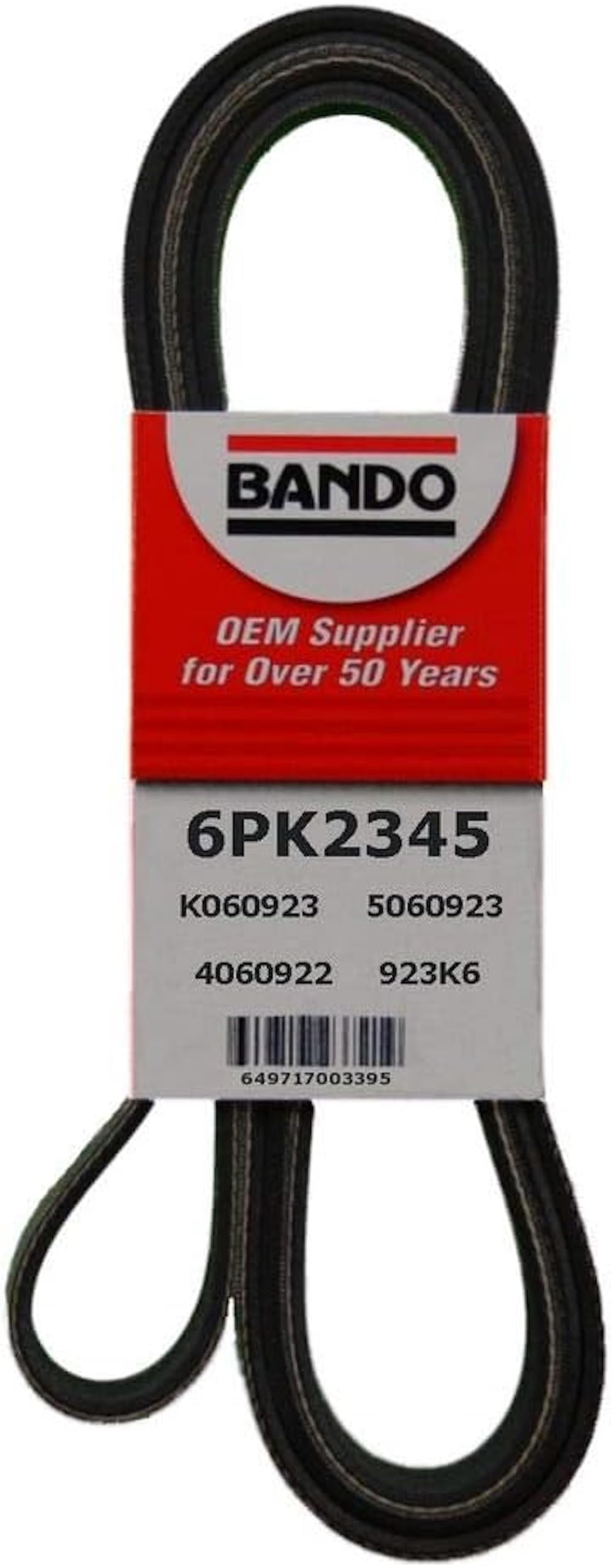
The Bando 6PK2345 uses a proprietary “Run Quiet” technology that reduces slip between the belt ribs and pulley grooves, eliminating the chirp that plagues many aftermarket belts within the first 1,000 miles. The ground rubber ribs are compounded from high-strength synthetic rubber, and the tensile cord carries high horsepower loads without measurable stretch over 40,000 miles of service.
This belt ships as an OE-quality replacement for an enormous vehicle list — covering Chevrolet Silverado 1500 through 4500 chassis, GMC Sierra HD trims, Buick Roadmaster, Cadillac Escalade, and even the Mercedes-Benz CL600. The 6-rib construction with 93.5-inch effective length fits tensioners designed for long-arm accessory drives found on Chevy Express vans and Jeep Wrangler TJs alike.
Owner reports confirm zero noise on 88 Corvette LT1 engines and 2012 Express 3500 4.8L V8 builds after several months of daily driving. The belt’s anti-glazing surface treatment also resists hardening from under-hood ozone exposure, a common failure point on belts stored in hot climates for years before installation.
What works
- Run Quiet compound kills belt chirp on install.
- Massive vehicle fitment list across GM, Ford, Jeep, and Mercedes.
- Minimal cold-cracking after months of use in varied climates.
What doesn’t
- Length may not suit short accessory drives requiring a belt under 80″.
- Limited availability in 7-rib configurations for late-model Toyota/Lexus V6 engines.
2. Goodyear Belts 1060842 Serpentine Belt, 6-Rib, 84.2″
The Goodyear 1060842 brings EPDM rubber compounding with a balanced twist polyester cord to the 6-rib 84.2-inch class. Compared to earlier Goodyear Gatorback designs, this Multi V belt uses a finer rib profile that increases the contact patch on small-diameter idler pulleys without increasing noise. The EPDM compound resists heat up to 300°F, making it a strong candidate for tight engine bays with heat-soaked alternators.
This belt’s fitment spans Acura MDX and RL from 2003–2013, Ford F-53 motorhome chassis and F-59 commercial stripped chassis, plus 2021–2022 Ford applications. The 6PK2139 alternate part number cross-references with OE belts on Honda J35 V6 engines, which are known for narrow pulley alignment that can shred off-spec belts within 5,000 miles.
Customer feedback on the 1060842 highlights consistent tension retention after 10,000-mile oil change intervals — no re-tensioning required. The balanced twist polyester cord also reduces the longitudinal stretch that causes serpentine belts to slap against the engine cover over time. Buyers running high-mileage Acura TL and RL sedans report noise-free cold starts and stable accessory drive operation.
What works
- EPDM rubber handles intense under-hood heat without glazing.
- Cross-references cleanly with Honda/Acura OE belt numbers.
- Minimal longitudinal stretch over long maintenance intervals.
What doesn’t
- Not available in 7-rib for late-model Lexus or Toyota 3.5L engines.
- Some owners note slight chirp in reverse rotation pulleys during first cold start.
3. ACDelco Gold 6K938 Standard V-Ribbed Serpentine Belt
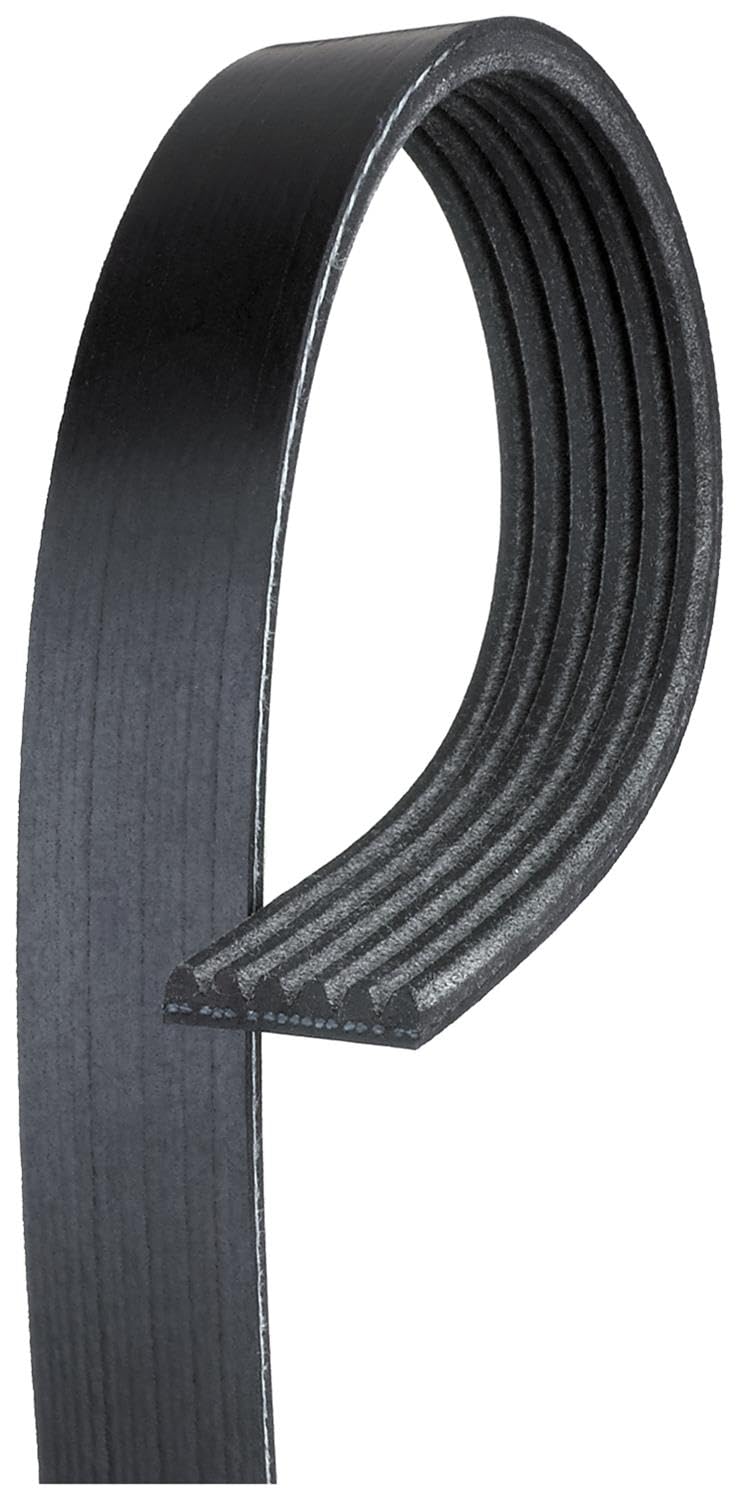
The ACDelco Gold 6K938 is a GM-spec V-ribbed serpentine belt built for passenger cars and light trucks requiring a short 47.4-inch belt length. The EPDM rubber compound meets GM’s original material standard for heat and ozone resistance, and the belt carries the GM-approved part number 88932788. This belt drives alternator, power steering pump, and water pump on compact accessory drives common to front-wheel-drive GM platforms.
Under the same ACDelco Gold branding, this belt replaced the former ACDelco Professional line and retains the same full-rib contact profile. The 0.5-inch belt width pairs with standard 6-rib crank pulleys found on Chevrolet Lumina and other W-body cars of the late 1990s. The short effective length also makes the 6K938 a popular choice for 4-cylinder GM Ecotec applications that lack a dedicated tensioner damper.
Although the 6K938 offers a limited vehicle fit list compared to the Bando or Goodyear belts, its direct OEM-replacement status guarantees correct rib pitch and thickness for GM pulleys. Buyers report clean fit on 1998–1999 Chevrolet Lumina 3.8L V6 engines with no belt vibration at high RPM idle. The trade-off is that this belt does not include aramid cord reinforcement, so it should not be used on supercharged or high-HP accessory drives.
What works
- Direct OEM replacement for GM 6-rib short-belt applications.
- EPDM compound resists cracking under normal driving conditions.
- Full-rib contact profile eliminates pulley groove mismatch.
What doesn’t
- Not suitable for high-horsepower or supercharged accessory drives.
- Shorter length limits use to compact engine bays only.
4. Goodyear Belts 1070610 Serpentine Belt, 7-Rib, 61″
The Goodyear 1070610 is a 7-rib belt engineered specifically for the Lexus and Toyota 3.5L 2GR-FE and 2.5L 2AR-FE engine families. Where 6-rib belts slip under the high alternator load of hybrid models like the Lexus ES300h, the 7-rib 61-inch design provides 16% more contact surface area, keeping the belt planted on the crank pulley during regenerative braking cycles. The EPDM rubber and balanced twist polyester cord construction mirror the 1060842 but in a wider format.
This belt fits the 2015 Lexus ES300h, 2013–2019 ES350, 2006–2018 IS and GS series, and 2010–2015 RX350. The 7PK1549 alternate part number also appears on Toyota Camry V6 and Sienna applications from the same era. The AutoCare Association recommends inspecting belts at 60,000 miles and replacing at 90,000 miles — the 1070610’s EPDM compound comfortably meets that interval under normal driving conditions.
Owner feedback from Lexus IS350 and GS350 drivers confirms the 7-rib belt eliminates the intermittent squeal that occurs when the alternator clutch pulley engages at idle. The belt also wraps tighter around the small water pump pulley on the 2GR-FE engine, reducing the risk of coolant pump cavitation at sustained highway speeds. The belt carries a 1-year limited warranty, reflecting Goodyear’s confidence in the rubber formulation.
What works
- 7-rib design prevents slip on high-alternator-load hybrids.
- Meets Toyota/Lexus 90,000-mile replacement schedule.
- EPDM compound resists cracking from heat-soaked engine bays.
What doesn’t
- Fitted to only 7-rib pulleys — incompatible with standard 6-rib drives.
- Slightly higher cost per mile compared to 6-rib options.
5. Gates K060882 Micro V Serpentine Drive Belt
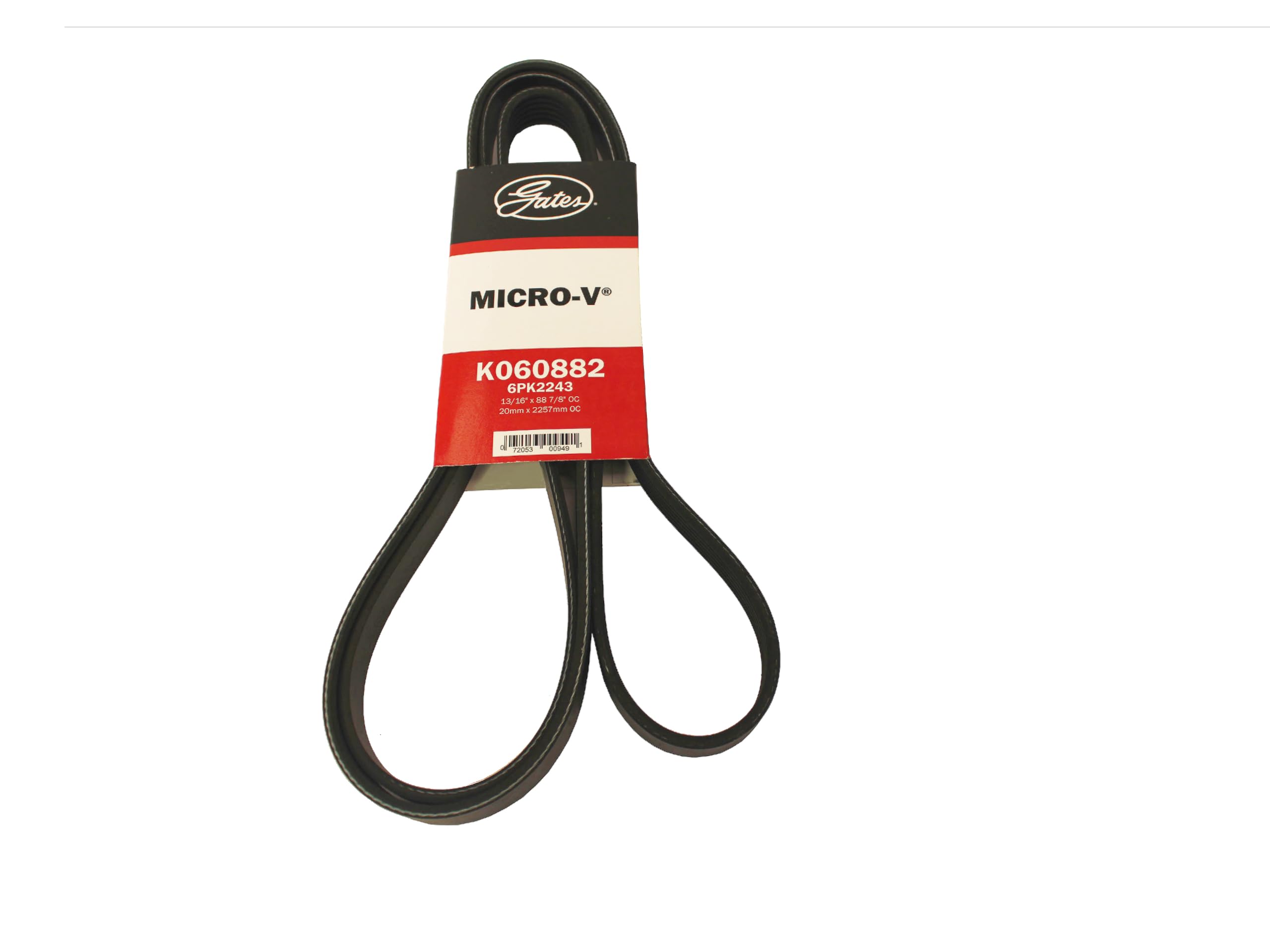
The Gates K060882 is a 6-rib Micro-V belt built with a polyurethane (PU) material compound rather than standard EPDM rubber. Polyurethane offers superior abrasion resistance and lower friction coefficient against steel pulleys, which translates to reduced heat generation in the belt ribs. The 88.87-inch effective length (alternate part number K060882) fits the accessory drive on 2003–2005 Lexus LS430, Jeep WJ with the 4.0L straight-six, and various Ford modular V8 applications.
Gates uses a fiber-loaded PU formulation that resists oil contamination better than rubber — a meaningful advantage when valve cover gaskets weep onto the belt path. The belt’s backside also runs quietly against flat idler pulleys, an area where neoprene belts often produce a low-frequency rumble. Gates ships the K060882 with a protective sleeve to prevent rib damage during installation.
Verified owners on the Lexus LS430 and Jeep WJ 4.0 report complete noise elimination after installing the K060882, with one user noting it fits “perfectly” and another calling it “OEM quality.” The belt shows no measurable stretch after 5,000 miles on a heavy-duty 4.0L accessory drive that also runs the AC compressor full time. The PU material does run a stiffer flex profile than EPDM, which can make installation slightly tighter on tensioners with limited travel range.
What works
- Polyurethane compound resists oil and abrasion better than EPDM rubber.
- Low friction against steel pulleys reduces operating temperature.
- Precise fit on Lexus LS430 and Jeep WJ 4.0 accessory drives.
What doesn’t
- Stiffer material makes installation harder on tight tensioners.
- May require more frequent retorquing during first 1,000 miles of break-in.
Hardware & Specs Guide
Rib Count and Groove Profile
Every modern fan belt uses a multi-rib design where each rib sits inside a corresponding groove in the pulley. 6-rib belts are the industry standard for most passenger cars and light trucks, while 7-rib belts appear on higher-torque accessory drives such as Lexus/Toyota 3.5L V6 and Ford 5.0L Coyote engines. The rib pitch — distance between grooves — must match the pulley’s machined profile; an off-pitch belt will ride high in the grooves and slip under load.
Effective Length and Tensioner Range
Belt length is measured in inches or millimeters along the outermost circumference of the belt when laid flat. The effective length must fall within the automatic tensioner’s adjustment arc — typically 0.5 to 1.5 inches of travel. A belt too short will bottom out the tensioner arm, not allowing enough preload. A belt too long will run with the tensioner at its extension limit, reducing wrap on the alternator pulley and causing slip at high electrical load.
FAQ
How often should an automotive fan belt be replaced?
How do I know the correct rib count for my vehicle?
Is EPDM rubber better than standard neoprene for fan belts?
Final Thoughts: The Verdict
For most buyers, the best automotive fan belts winner is the Bando USA 6PK2345 because its Run Quiet technology, EPDM rubber compound, and massive vehicle fitment list cover everything from a Chevy Express 4500 to a Jeep TJ at an entry-level price point that doesn’t sacrifice durability. If you need a 7-rib belt for a Lexus or Toyota 3.5L V6, grab the Goodyear 1070610. And for oil-prone engine bays that need a polyurethane belt that won’t swell or crack, nothing beats the Gates K060882.

Certification: BSc in Mechanical Engineering
Education: Mechanical engineer
Lives In: 539 W Commerce St, Dallas, TX 75208, USA
Md Amir is an auto mechanic student and writer with over half a decade of experience in the automotive field. He has worked with top automotive brands such as Lexus, Quantum, and also owns two automotive blogs autocarneed.com and taxiwiz.com.