A failing antifreeze reservoir tank doesn’t announce itself with a dramatic bang. It starts with a hairline crack at the neck or a milky fog inside the plastic — small signs that soon turn into steam billowing from under the hood. When that tank lets go, your engine loses its coolant buffer, air gets into the system, and a simple part replacement turns into a head-gasket or cylinder-head repair that runs four figures. The right replacement needs to handle constant thermal cycling, hold pressure without warping, and give you a clear sight line to the coolant level so you catch trouble before it finds you.
I’m Amir — the founder and writer behind Four Wheel Ask. I’ve spent years analyzing aftermarket cooling-system components, cross-referencing OEM part numbers against real-world owner reports, and studying the material science that separates a reservoir that lasts from one that fails in eighteen months.
The five picks below were selected by matching build materials (PP, PE, or aluminum), pressure ratings, vehicle-specific fitment data, and verified owner feedback. This guide covers the best antifreeze reservoir tank for common makes, universal builds, and long-haul durability.
How To Choose The Best Antifreeze Reservoir Tank
Every cooling system relies on the reservoir to capture expanding coolant as the engine warms and to return it when things cool down. Pick the wrong one and you risk air pockets, pressure loss, or a drip that slowly empties your system. Here is what matters most.
Vehicle-Specific Fitment vs. Universal Design
Most late-model cars use a vehicle-specific tank with a molded shape that bolts into one exact position. A direct replacement like the Dorman 603-100 or the BDFHYK 603-253 slots in without bracket modifications. Universal tanks, such as the EVIL ENERGY aluminum bottle, work best for swaps, hot rods, or off-road rigs where you control the mounting location and the hose routing.
Material: PP, PE, or Aluminum
Polypropylene (PP) and polyethylene (PE) are standard in OEM-style tanks. They resist coolant corrosion, handle temperature swings from cold start to 250°F, and stay translucent enough to check fluid level. Aluminum tanks dissipate heat faster and look clean in a show engine bay, but they are opaque — you cannot see the coolant level without a sight tube, and they can sweat condensation in humid climates.
Pressurized vs. Non-Pressurized Systems
A pressurized reservoir sits between the radiator and the engine, often with a cap rated to 15–21 PSI. Tanks like the EVIL ENERGY unit for the Ford Focus include a pressure cap. Non-pressurized reservoirs simply collect overflow and rely on gravity or vacuum to return fluid. Mixing them up — installing a non-pressurized tank on a pressurized system — will cause the cap to vent coolant onto the ground.
Quick Comparison
On smaller screens, swipe sideways to see the full table.
| Model | Category | Best For | Key Spec | Amazon |
|---|---|---|---|---|
| Dorman 603-100 | OEM Direct | Chevy/GMC Pickups | 1.5 lb, plastic, OE 15650373 | Amazon |
| BDFHYK 603-253 | OE Match | VW/Audi Group | 1.06 lb, PP, OE 1K0121407A | Amazon |
| EVIL ENERGY 603-382 | Pressurized | Ford Focus/Escape | 2 L, PE, 21 PSI cap | Amazon |
| EVIL ENERGY Aluminum | Universal | Custom/Race Builds | 800 ml, aluminum, 5/16″ hose | Amazon |
| A-Premium Universal Kit | Universal | Kits & Fabrications | 1 quart, PP, includes hardware | Amazon |
In‑Depth Reviews
1. Dorman 603-100 Coolant Reservoir

It replaces the factory reservoir on Chevy and GMC trucks from the GMT400 platform (1988–1998) through the GMT800 (1999–2006), covering models like the Silverado, Suburban, Yukon, and Sierra. Owners of 1994–1998 OBS trucks report identical molded-in tabs and hose barb placement, so the tank clicks into the factory bracket without zip-tie workarounds.
The plastic body is thick enough to resist the heat cycling that turns cheap tanks brittle after two summers. Reviewers consistently note that the fluid-level markings are clear and stay legible — a small detail that matters when you are checking coolant on a cold winter morning. The cap seals tightly against the neck, and the tank holds pressure without seeping at the seam.
Downsides are minor. The tank is non-pressurized (it works as a simple overflow catch on most GMT400/800 trucks), so if your application requires a pressurized cap, verify the system design first. A few owners mention that the plastic can feel slightly less dense than the original GM unit, but the fitment is identical and no leak reports surface.
What works
- Direct-fit for Chevy/GMC trucks spanning nearly 20 years
- Thick, heat-resistant plastic with clear level markings
- Backed by a century of aftermarket engineering
What doesn’t
- Non-pressurized design — not for cap-integrated systems
- Plastic density feels slightly below OEM to some owners
2. BDFHYK Coolant Expansion Reservoir

VW and Audi owners know the original plastic tanks can cloud up until you cannot see the coolant level, then crack at the seam near the turbo coolant hose. The BDFHYK 603-253 is a direct OE-match replacement that covers the 2.0T and 1.8T engines in the Mk5/Mk6 Golf GTI, Jetta GLI, Beetle, Tiguan, and the Audi A3 and TT. The PP construction feels dense, and the molded neck accepts the factory cap with a firm click.
Multiple verified owners of 2010–2013 Tiguan and 2009–2014 Jetta report a perfect shape match — no shaving tabs or bending brackets. The tank includes the lower hose barb in the correct orientation, so the hose routes naturally without kinking. The material resists the yellowing that happens after three years of constant 200°F+ underhood heat.
The most common criticism is that the tank does not include replacement o-rings for the three coolant-line connections. Reusing old o-rings is possible, but the rubber can be hard and flat after years of service. Ordering a set of viton o-rings alongside the tank is cheap insurance against a slow drip.
What works
- Exact fit for VW/Audi 2.0T and 1.8T engines
- PP material resists clouding and cracking
- Includes cap and correct hose barb orientation
What doesn’t
- No replacement o-rings included for coolant fittings
- Limited to VW/Audi platform — no universal use
3. EVIL ENERGY Coolant Reservoir Tank
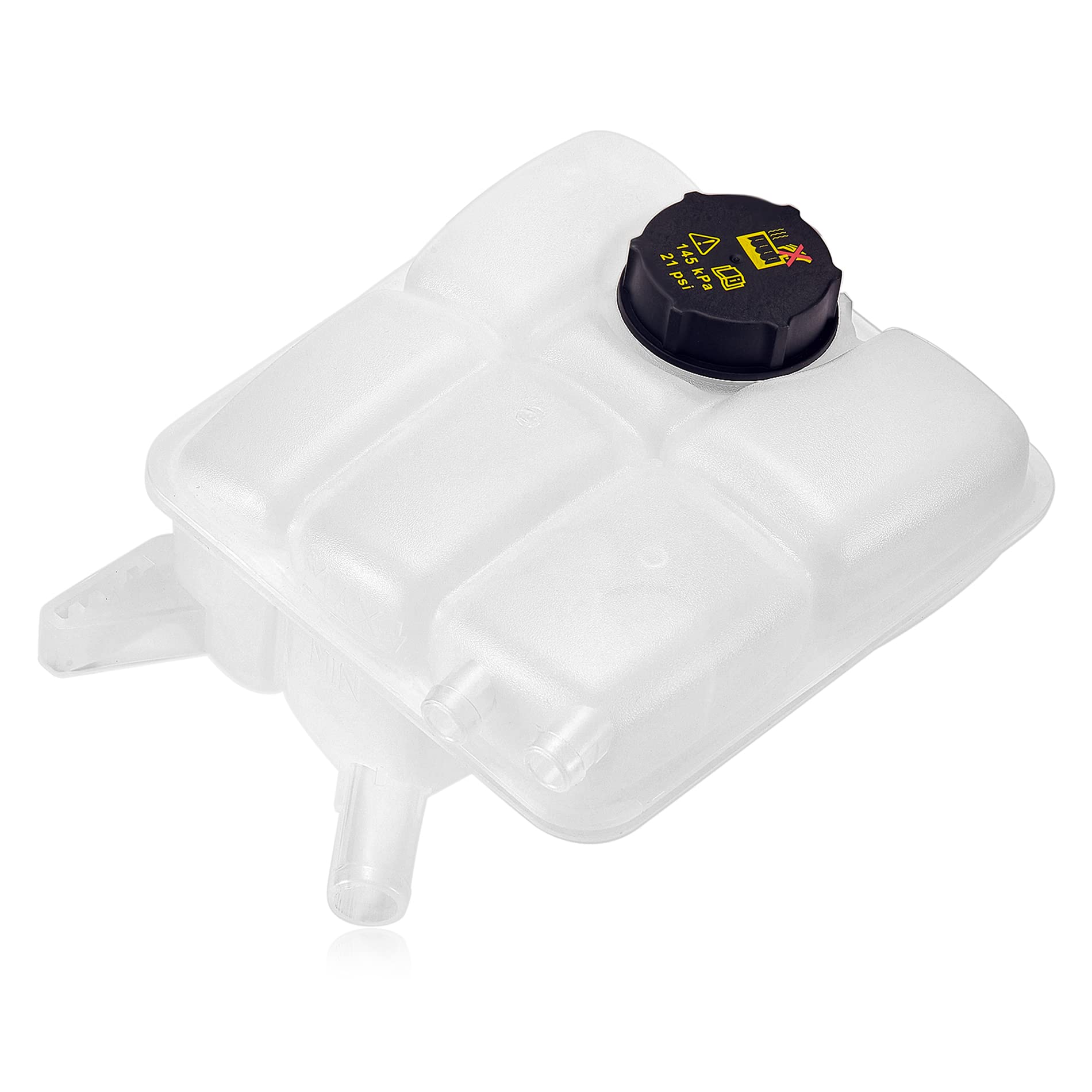
Ford owners with the 2.0L and 1.6L EcoBoost engines in the 2012–2018 Focus, 2013–2018 Escape, and 2013–2016 C-Max know the factory plastic reservoir can develop stress cracks at the cap neck. The EVIL ENERGY 603-382 replacement is molded from polyethylene (PE) and includes a 21 PSI pressure-rated cap, matching the OEM 8V618K218AC spec exactly. The tank is a pressurized unit — the cap holds system pressure and the reservoir stays an integral part of the cooling loop, not just an overflow catch.
Installation reports from Focus and Escape owners describe a drop-in replacement that takes about fifteen minutes. The hose barbs match the factory quick-connect fittings, and the lower mounting tab lines up with the chassis bracket without drilling. The PE body is slightly more flexible than rigid PP, which helps it absorb vibration without cracking at the mounting ears.
The only notable shortcoming is that the translucent PE plastic is not perfectly clear; some owners note the fluid level is visible but requires a flashlight in low-light garages. The cap’s pressure spring feels firm, but a few reports mention that after a year the cap seal can start to weep if the system runs above 18 PSI regularly. Replacing the cap separately every two years solves that.
What works
- Direct-fit for Focus, Escape, C-Max EcoBoost models
- Includes 21 PSI pressure-rated cap
- PE construction absorbs vibration better than rigid PP
What doesn’t
- Translucent plastic requires good light to read level
- Cap seal may need replacement after extended high-pressure use
4. EVIL ENERGY Aluminum Coolant Overflow Tank

When you are building a custom engine swap — like a V8 into a Miata or an LS into a drift chassis — the factory plastic tank often does not fit, or you want something that looks as clean as the rest of the bay. The EVIL ENERGY aluminum overflow bottle brings an 800ml capacity, a gloss black powder-coated finish, and a compact 7.48-inch height that fits tight corners. The 5/16-inch hose barb accepts standard heater hose, and the vented cap prevents pressure lock.
The aluminum wall thickness is substantial enough to resist dents from incidental wrench contact, and the weld bead around the hose nipple is uniform with no pinholes. The included rubber hose and mounting bracket let you position the bottle vertically in virtually any orientation. A 1/16-inch vent hole in the cap prevents vapor lock, which is critical for universal installations where the tank sits higher than the radiator fill neck.
Because the tank is opaque, you cannot see the coolant level at a glance — you have to pull the cap or trust the volume you poured. In a confined engine bay with limited access, that is an inconvenience. Additionally, the 800ml volume is on the smaller side; for a large V8 with an oversized radiator, a 1-quart or 2-liter tank would offer more expansion margin.
What works
- Smooth gloss black finish for a clean engine bay look
- O-ring seal and vented cap prevent leaks and vapor lock
- Compact size fits tight swap or race applications
What doesn’t
- Opaque aluminum — cannot see coolant level
- 800ml capacity may be low for large-displacement engines
5. A-Premium Universal Coolant Reservoir Kit
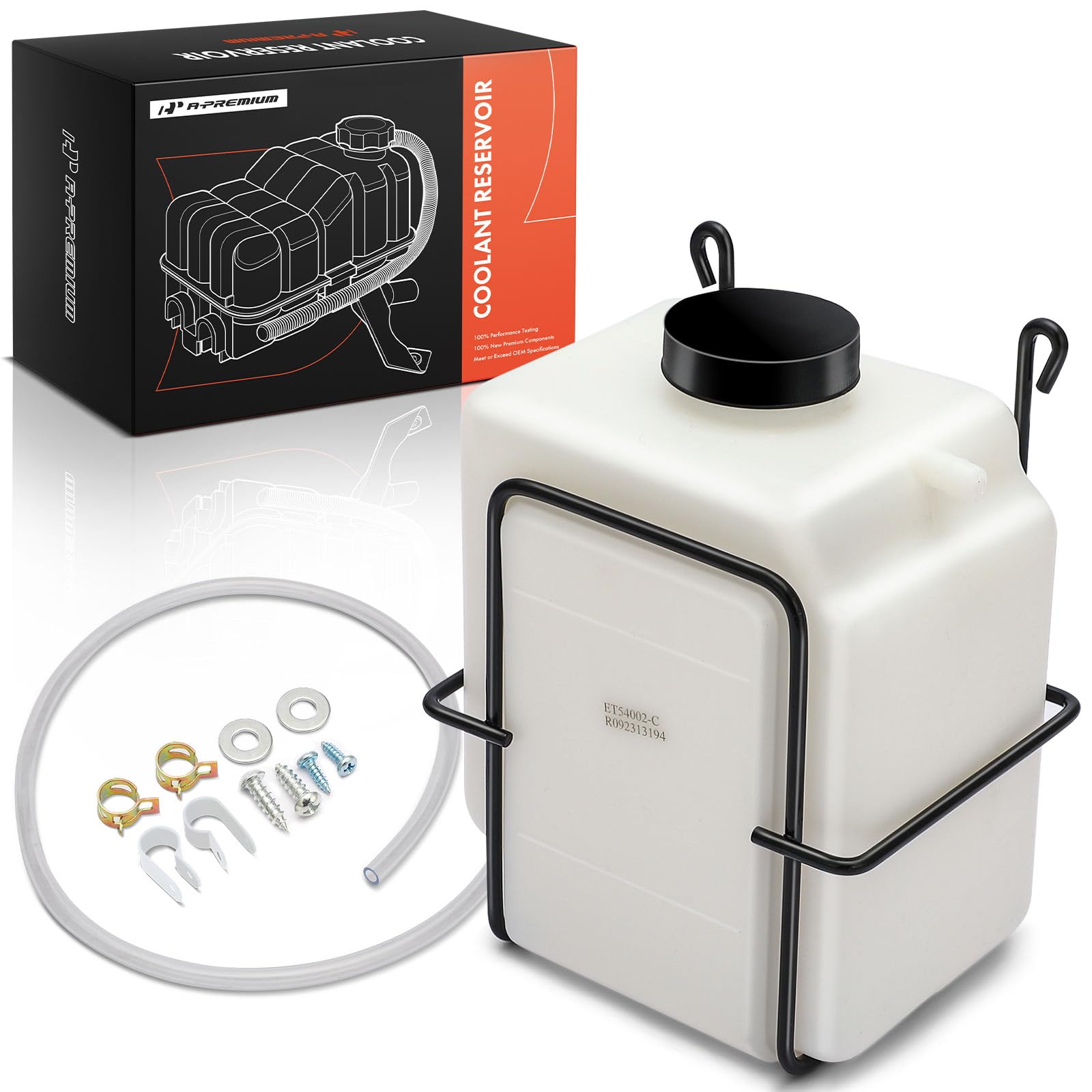
Not every cooling system needs a vehicle-specific molded tank. RVs, boats, hot rods, and off-road buggies often require a simple overflow bottle that you can mount wherever the chassis allows. The A-Premium universal kit is a 1-quart white PP reservoir that comes with four feet of clear hose, mounting clips, a cap, a gasket, clamps, and screws. You get everything needed to plumb it into any 12-volt cooling loop without a trip to the hardware store.
The PP material is the same basic formulation used in factory tanks, offering good chemical resistance to ethylene glycol and propylene glycol. The two mounting holes on the bracket are spaced to fit standard sheet-metal screws or self-tapping bolts, and the hose barbs measure 5/16-inch ID, which covers most universal radiator overflow nipples. The included clear hose lets you see coolant movement to confirm the system is burping air.
The main drawback is that the 1-quart capacity is at the low end for larger cooling systems. The white color also shows dirt and coolant stains quickly, which is cosmetic but noticeable in an open engine bay.
What works
- All-inclusive kit with hose, clamps, and mounting hardware
- PP material resists coolant corrosion
- Universal fit works for cars, boats, RVs, and trailers
What doesn’t
- 1-quart capacity is small for large engines
- White body shows grime quickly in an engine bay
Hardware & Specs Guide
Material: PP vs. PE vs. Aluminum
Polypropylene (PP) tanks are rigid, translucent, and the most common OEM choice — they resist cracking from thermal cycling but can become brittle in extreme cold. Polyethylene (PE) is softer and more flexible, making it better at absorbing vibration on engines with balance-shaft issues. Aluminum tanks dissipate heat faster and never cloud, but they add weight and do not let you see the coolant level.
Pressure Rating and Cap Type
Pressurized systems use a spring-loaded cap rated in PSI (typically 15–21). The reservoir holds pressure from the radiator, and the cap acts as the system’s release valve. Non-pressurized tanks simply catch overflow and rely on gravity or a vented cap. Never swap a non-pressurized tank into a pressurized system — the cap will not hold, and you will lose coolant on every drive cycle.
FAQ
How do I find the correct OE part number for my reservoir tank?
Can I install a universal aluminum tank on a daily-driven street car?
Why does my new plastic reservoir smell like coolant right after installation?
Final Thoughts: The Verdict
For most buyers, the best antifreeze reservoir tank winner is the Dorman 603-100 because it covers the Chevy/GMC pickup family with decades of production run, proven plastic durability, and an exact bracket fit that saves your Saturday afternoon. If you own a VW or Audi with the 2.0T and want a crack-free replacement, grab the BDFHYK 603-253 for its precise PP molding. And for a universal engine-swap or off-road build where a clean aluminum look is the priority, nothing beats the EVIL ENERGY aluminum 800ml bottle.

Certification: BSc in Mechanical Engineering
Education: Mechanical engineer
Lives In: 539 W Commerce St, Dallas, TX 75208, USA
Md Amir is an auto mechanic student and writer with over half a decade of experience in the automotive field. He has worked with top automotive brands such as Lexus, Quantum, and also owns two automotive blogs autocarneed.com and taxiwiz.com.