Torque-to-angle fastening is the most critical procedure in modern engine and drivetrain assembly, yet it remains the most misunderstood by DIY mechanics and even some shop technicians. A standard click-type torque wrench can’t measure rotational degrees after seating the fastener, which means torque-to-yield bolts — the kind found on cylinder heads, connecting rods, and crank pulleys — will fail prematurely or loosen without a dedicated tool that handles both variables simultaneously.
I’m Amir — the founder and writer behind Four Wheel Ask. I’ve dug through hundreds of calibration certificates, analyzed torque-curve data, and pored over real owner feedback on angle-degree wrenches to separate the tools that genuinely lock accuracy from those that just add a mode button and call it professional-grade.
Whether you’re rebuilding an LQ9 V8, torquing down a carbon-fiber bicycle crankset, or chasing chassis bolt specs on a German sedan, this guide lays out the strongest options for the best angle degree torque wrench based on real-world durability, readout precision, and angle-verification reliability.
How to choose the best angle degree torque wrench
Buying a torque wrench that handles angle degree function means understanding how modern fasteners actually require both torque and rotation. The market is split between digital wrenches that combine a strain gauge with an accelerometer for angle tracking and click-style wrenches that rely on a mechanical clutch. For TTY bolts — which deform slightly during tightening to create a consistent clamp load — angle measurement is non-negotiable. Here are the specific specs and design choices that separate a capable angle wrench from a tool that will leave you chasing head gasket leaks.
Torque range and angle accuracy tolerance
The wrench you choose must cover the fastener range of your primary work. A 1/2-inch drive unit spanning 25 to 250 ft-lbs suits full-size engine and suspension fasteners, while a 3/8-inch drive (10 to 100 ft-lbs) is ideal for intake manifolds, valve covers, and bicycle components. For angle accuracy, look for a tolerance of ±1% of reading — cheap units can drift by 3 to 5 degrees over a 90-degree turn, which is enough to under-clamp a head bolt. The best tools combine a ±2% CW torque tolerance with an angle sensor that updates in real time rather than relying on a post-turn reference.
Alert mechanisms: vibration, buzzer, and visual confirmation
When you are working in a tight engine bay with limited sightlines, hearing or feeling the moment your target torque-angle is reached prevents both under-torque and bolt stretching. Wrenches with a vibratory handle, a buzzer, and a flashing or red-solid LCD light give three independent confirmation channels. Tools that rely on a single beep in a noisy shop are easy to miss, leading to over-rotation of TTY bolts that have already yielded.
Flex-head vs. fixed-head design
Engine compartments and suspension areas often force you to approach the fastener at an angle. A flex-head wrench with 5 to 15 degrees of articulation lets you keep the drive square fully seated on the bolt while the handle clears obstructions. Fixed-head wrenches work fine on open workbenches or wheel faces, but for modern transverse-engine layouts or tight frame rails, flex-head articulation is the difference between a five-minute job and a struggle with wobble extensions that reduce torque transfer accuracy.
Quick comparison
On smaller screens, swipe sideways to see the full table.
| Model | Category | Best For | Key Spec | Amazon |
|---|---|---|---|---|
| ARES 43007 | Digital Flex | Peak torque-angle combo | 10-100 ft-lbs / ±2% CW / flex head | Amazon |
| GEARWRENCH 85195 | Digital Flex | Tight clearance engine work | 15° flex head / 120XP ratchet | Amazon |
| MichaelPro MP001227 | Digital Flex | High-torque angle applications | 25-250 ft-lbs / 10 presets | Amazon |
| ACDelco ARM601-34 | Combo Kit | 3/8″ + 1/2″ dual-range | 3.7-147.5 ft-lbs combo | Amazon |
| CRAFTSMAN CMMT99436 | Digital Click | High-torque heavy fasteners | 50-250 ft-lbs / LED backlit | Amazon |
| TEKTON TRQ62103 | Split Beam | Mechanical reliability | 20-100 ft-lbs / ±4% accuracy | Amazon |
| Park Tool TW-6.2 | Click Micro | Bicycle low-torque precision | 18-124 in-lbs / 0.4 Nm increments | Amazon |
| GROWNEER 3/8 | Digital Entry | Budget-friendly bike/car work | 5-99.6 ft-lbs / 6 presets | Amazon |
| SUERCUP BSM1-135 | Digital Entry | DIY scooter/motorcycle | 1.5-99.6 ft-lbs / 9 presets | Amazon |
In-depth reviews
1. ARES 43007 3/8″ Flex Head Electronic Digital Torque and Torque Angle Wrench

The ARES 43007 is the most complete angle-degree torque wrench in this comparison because it combines a flex-head ratchet with three dedicated angle modes — Peak Torque, Torque Angle, and Peak Torque Angle. The Peak Torque Angle mode is the standout: it measures the specified torque then immediately transitions to angle measurement without removing the wrench from the bolt, exactly what TTY head bolts require. The 10-100 ft-lbs range covers the vast majority of automotive and motorcycle fasteners, and the 72-tooth ratchet mechanism provides a 5-degree swing arc that fits into cramped intake and timing cover areas.
The multi-alert system — handle vibration, audible buzzer, and an LCD backlight that turns solid red at target — removes all guesswork when you are working blind. Five units of measurement (Nm, ft-lbs, in-lbs, kgf/m, kgf/cm) and 10 user presets mean you can store torque-angle combos for every recurrent job without reprogramming each time. The aluminum body keeps weight manageable at roughly 2.4 pounds, and the flex head delivers genuine articulation for offset fastener access.
What holds the ARES back from perfection is that the angle measurement is accelerometer-based rather than gyroscopic, which can introduce drift if the wrench is rotated off-axis during the pull. However, for standard in-line angle sequences on cylinder heads and connecting rods, the repeatability is consistent. The ANSI/ASME calibration certificate included with each unit adds confidence that the ±2% CW tolerance is verified before it reaches your toolbox.
What works
- Peak Torque Angle mode handles TTY fasteners in one continuous motion
- Triple-alert system works in noisy shop environments
- Flex head articulates for tight engine-bay access
- 10 presets store recurring torque-angle recipes
What doesn’t
- Accelerometer angle readout can drift with off-axis wrench rotation
- Battery life on standard AAAs could be longer for continuous shop use
2. GEARWRENCH 85195 3/8″ 120XP Flex Head Electronic Torque Wrench with Angle

The GEARWRENCH 85195 is built for the technician who regularly works on confined engine compartments where a fixed-head torque wrench simply will not fit. Its 15-degree flex teardrop head combined with the 120XP ratchet mechanism — 120 positions for a 3-degree swing arc — allows fastener engagement in areas that would force a standard wrench to use a wobble extension. The electronic torque-angle tracking delivers ±2% CW accuracy between 20% and 100% of the 100 ft-lbs capacity, and the angle readout updates digitally with ±1% of reading.
Where this GEARWRENCH distinguishes itself is the low-profile tube body and the flush-mounted on/off switch — both design choices that prevent snagging on hoses, wiring looms, or frame rails. The vibration handle and buzzer provide confirmation when the preset torque and angle values are reached, and the LCD screen shows real-time torque values as you pull. The chrome finish resists corrosion from brake fluid and coolant, which matters for shop tools that get wiped down but never fully cleaned.
One limitation is the 3/8-inch drive format — while perfect for intake manifolds, valve covers, and smaller suspension fasteners, anyone needing torque above 100 ft-lbs for crank bolts or axle nuts will need a second wrench. The angle mode works counterclockwise as well, but accuracy drops to ±3% CCW, so left-hand thread angle sequences require extra attention. Still, for its target range, the 85195 is a purpose-built angle wrench for prof- grade engine assembly.
What works
- 15-degree flex head clears engine bay obstructions effectively
- 120XP ratchet requires minimal swing arc in tight spots
- Low-profile body and flush switch prevent snagging
- Chrome finish withstands shop fluids
What doesn’t
- Limited to 100 ft-lbs max torque
- CCW angle accuracy drops to ±3%
3. MichaelPro MP001227 1/2″ Flex Head Digital Torque Wrench with Angle Function

The MichaelPro MP001227 is the highest-torque angle-degree wrench in this roundup, covering 25 to 250 ft-lbs with a ±2% CW accuracy tolerance. This range makes it the go-to choice for full-size engine builds — think LQ9 and LS connecting rod bolts, main cap fasteners, and crankshaft pulley bolts that require both a high final torque and a subsequent angle turn. The flex head with a 5-degree swing arc articulates enough to clear frame rails and suspension arms during chassis work.
Three operating modes — Peak Torque, Torque Angle, and Peak Torque Angle — mirror the ARES layout, but the MP001227 adds 10 user presets and a configurable pre-warning threshold that triggers vibration, buzzer, and red flashing light at a percentage of target you define. Owners rebuilding engines have reported that the pre-warning feature, set to 80% of the final torque-angle value, lets them slow their pull rate before the final click, reducing the chance of overshoot. The ergonomic rubberized handle is oil- and solvent-resistant, which extends its lifespan in a professional environment.
The trade-off is the weight and length: at over three pounds and roughly 25 inches long, the MP001227 is not a tool you carry around for light work. The flex head is a partial articulation rather than a full 180-degree pivot, so extreme offset fasteners still require an extension. But for anyone torquing 200+ ft-lbs with an angle follow-up — diesel injector hold-downs, large axle nuts, or heavy-equipment fasteners — this wrench keeps everything in a single tool.
What works
- 250 ft-lbs max torque covers heavy engine and chassis fasteners
- Configurable pre-warning threshold reduces overshoot risk
- Oil/solvent-resistant handle holds up in shop conditions
- Flex head clears rails and arms during suspension work
What doesn’t
- Heavy and long for storage in a standard toolbox
- Partial flex articulation won’t replace a wobble extension in extreme offsets
4. ACDelco ARM601-34 3/8″ & 1/2″ Digital Torque Wrench Combo Kit

The ACDelco ARM601-34 combo kit delivers two digital torque wrenches — a 3/8-inch (3.7 to 37 ft-lbs) and a 1/2-inch (14.8 to 147.5 ft-lbs) — in a single package that covers the full spectrum of automotive and motorcycle angle-degree work without switching tools between low and high ranges. Both wrenches feature ISO 6789 calibration with a certificate of calibration included, which is rare at this price tier. The composite housing with an ergonomic soft grip handle keeps each unit light enough for extended use on multi-fastener jobs like intake manifold bolt sequences.
The digital readout on both wrenches displays real-time torque values in ft-lbs and Nm, and a beeper sounds when the set value is reached. Users specifically note that the audible beep is loud enough to cut through shop noise, and the LCD screen is readable even in dim under-hood lighting. For angle-degree work, these wrenches track torque rather than angle directly — you would use the peak mode to seat the fastener to the initial torque value, then manually rotate the specified angle. This is less automated than a true torque-angle wrench that measures both in one pass, but for fasteners that allow a two-step process — many German and Japanese TTY procedures — it works reliably.
The main limitation is that neither wrench offers a dedicated angle mode or preset angle tracking. You are relying on your own degree marking or protractor for the rotation phase. The 3/8-inch wrench’s top end of 37 ft-lbs also falls short for larger suspension bolts. However, as a budget-conscious entry into digital torque measurement with certified accuracy, the ACDelco combo is difficult to beat for the price.
What works
- Two-wrench kit covers both low and mid-range torque duties
- ISO 6789 calibration with certificate included
- Loud beeper and clear LCD for shop conditions
- Lightweight composite body reduces hand fatigue
What doesn’t
- No dedicated angle mode — requires manual rotation tracking
- 3/8-inch wrench maxes out at 37 ft-lbs, limiting suspension work
5. CRAFTSMAN CMMT99436 1/2-Inch Digital Torque Wrench

The CRAFTSMAN CMMT99436 is a high-torque digital click-style wrench designed for heavy fasteners on ATVs, four-wheelers, motorcycle brakes, and engines where the torque specification exceeds 200 ft-lbs. The 50-250 ft-lbs range and 1/2-inch drive make it a natural choice for axle nuts, crank bolts, and large suspension fasteners. The unit converts between ft-lbs, in-lbs, and Nm with a single button press, and the LED backlit screen provides clear readout in poor lighting conditions.
This wrench operates in a peak-hold mode rather than a continuous real-time torque-angle mode. It records the maximum torque applied, which is useful for verifying that you reached the spec, but it does not track rotational degrees. For angle-degree work, you would use the click function to reach the initial torque seating value, then rely on a separate angle gauge or protractor for the rotation. The ergonomic handle is comfortable for the high leverage forces required at the top of the 250 ft-lbs range, and the storage case keeps the tool protected between jobs.
The lack of a built-in angle mode means this CRAFTSMAN is not a true all-in-one angle-degree wrench — it is a high-torque digital wrench that requires an external angle reference. Additionally, the 5-pound weight makes it cumbersome for extended use on multi-fastener sequences. For a weekend warrior who occasionally needs to torque large fasteners and can measure angle manually, it delivers reliable ASME-compliant performance.
What works
- 250 ft-lbs capacity handles heavy-duty engine and chassis fasteners
- LED backlit screen readable in dim under-vehicle positions
- Comfortable ergonomic handle for high-leverage pulls
- ASME-compliant click mechanism is audibly distinct
What doesn’t
- No built-in angle tracking requires external protractor
- Heavy at 5 pounds strains the wrist during repetitive use
6. TEKTON TRQ62103 3/8″ Drive Split Beam Torque Wrench

The TEKTON TRQ62103 uses a split-beam mechanical mechanism rather than a digital strain gauge, and it is the only non-digital entry in this list because its split-beam design offers a unique advantage for angle-degree work: it can be stored at any torque setting without losing calibration. This means you can leave it set to your most common initial torque value for TTY bolts and simply lock it in the case without backing it off. The 20-100 ft-lbs range and 3/8-inch drive are well-suited for intake manifolds, valve covers, and smaller engine fasteners.
Accuracy is ±4% across the full range, with a certificate of calibration traceable to ASME B107.300-2010. The thumbscrew adjustment mechanism is smooth and allows fine 0.1 ft-lb increments. A body-printed scale provides quick conversion from foot-pounds to newton-meters. For angle applications, you would use the split-beam wrench to achieve the initial seating torque, then mark and rotate to the specified degree — the wrench’s mechanical simplicity means no batteries, no electronics, and no sensor drift over years of use.
The limitation is obvious: this is a purely mechanical torque tool with no angle measurement capability built in. For a true angle-degree wrench that handles both variables in one tool, you need a digital unit. But as a companion tool for the initial torque step in a two-part TTY procedure, the TEKTON’s split-beam reliability and the brand’s unconditional warranty make it a long-term tool that will outlast any electronic wrench in the same shop.
What works
- Split-beam mechanism can be stored at any torque setting
- ±4% accuracy with serialized calibration certificate
- No batteries or electronics to fail over time
- Smooth thumbscrew adjustment in 0.1 ft-lb increments
What doesn’t
- No angle measurement function — requires separate degree reference
- Limited to 100 ft-lbs — not for heavy axle or crank bolts
7. Park Tool TW-6.2 Ratcheting Click Type Torque Wrench

The Park Tool TW-6.2 is a specialty click-type torque wrench engineered for the bicycle industry, where fastener torque values typically fall between 2 and 14 Nm (18 to 124 in-lbs). The 3/8-inch drive and 9-inch length keep it compact for tight frame and component access. It adjusts in 0.4 Nm (3.5 in-lb) increments and includes a conversion scale on the body for both Nm and in-lbs. The ratcheting mechanism works in both clockwise and counterclockwise directions, making it useful for left-hand thread bottom brackets and pedals.
Park Tool’s dial-adjust system allows the torque setting to be preset before use, and the tool registers for both right and left-hand threading. The ±4% accuracy is typical for analog mechanical wrenches in this range and is sufficient for bicycle components made of aluminum, carbon fiber, and titanium where overtightening can cause frame or part damage. For angle-degree work on bicycle TTY fasteners — such as certain crank bolts on high-end road groupsets — this wrench handles the initial torque setting, and you would complete the angle rotation using the witness marks on the fastener.
The TW-6.2’s range is too low for automotive engine work, and the ±4% tolerance is wider than the ±1% to ±2% offered by digital angle wrenches. It also lacks any angle tracking or electronic alert system. For pure bicycle maintenance involving torque-critical but low-force fasteners, it is a precision tool that has earned strong trust from shop mechanics and home builders alike.
What works
- Perfectly scaled for bicycle and carbon-component torque specs
- Ratcheting mechanism works for both CW and CCW threading
- Legendary Park Tool build quality and serviceability
- Compact 9-inch length fits tight frame triangles
What doesn’t
- Max torque of 14 Nm is too low for most automotive fasteners
- No angle tracking or digital readout for TTY procedures
8. GROWNEER 3/8″ Digital Torque Wrench Set

The GROWNEER digital torque wrench set is a budget-oriented entry that covers 5 to 99.6 ft-lbs with a ±2% accuracy claim, making it viable for basic automotive and motorcycle work. The kit includes the digital wrench, four sockets (14mm, 16mm, 17mm, 21mm), a 6-inch extension bar, and 1/4-inch and 1/2-inch adapters — enough to handle lug nuts, suspension bolts, and general engine work without buying additional accessories. The no-delay LCD panel updates in real time as force is applied, and the LED indicator plus buzzer provide visual and audible alerts at the preset torque.
Six preset modes (P1-P6) let you store common torque values for frequent jobs, and up to 500 sets of data can be logged in peak mode for record-keeping. The ratchet head uses a rapid replacement design that allows socket changes without tools. For angle-degree work, this wrench operates as a standard digital torque tool — you set the initial torque value, follow the beep, then rotate to the required angle using a protractor or angle gauge. It lacks a dedicated torque-angle mode that combines both measurements.
The build uses alloy steel with an unpolished finish that is functional but not as corrosion-resistant as chrome. The included batteries are AAAs, which are convenient to replace but drain faster with continuous backlight use. For the DIYer who needs an accurate digital wrench for the initial torque step of a TTY procedure and already has a means of measuring degrees, this is a solid budget-friendly starting point.
What works
- Wide range with ±2% accuracy at an accessible price point
- Kit includes sockets, extension, and adapters out of the box
- Six presets store common torque values for quick recall
- Data logging for up to 500 torque events
What doesn’t
- No dedicated torque-angle mode for combined measurement
- Unpolished alloy steel finish may rust with exposure to moisture
9. SUERCUP BSM1-135 3/8″ Digital Torque Wrench
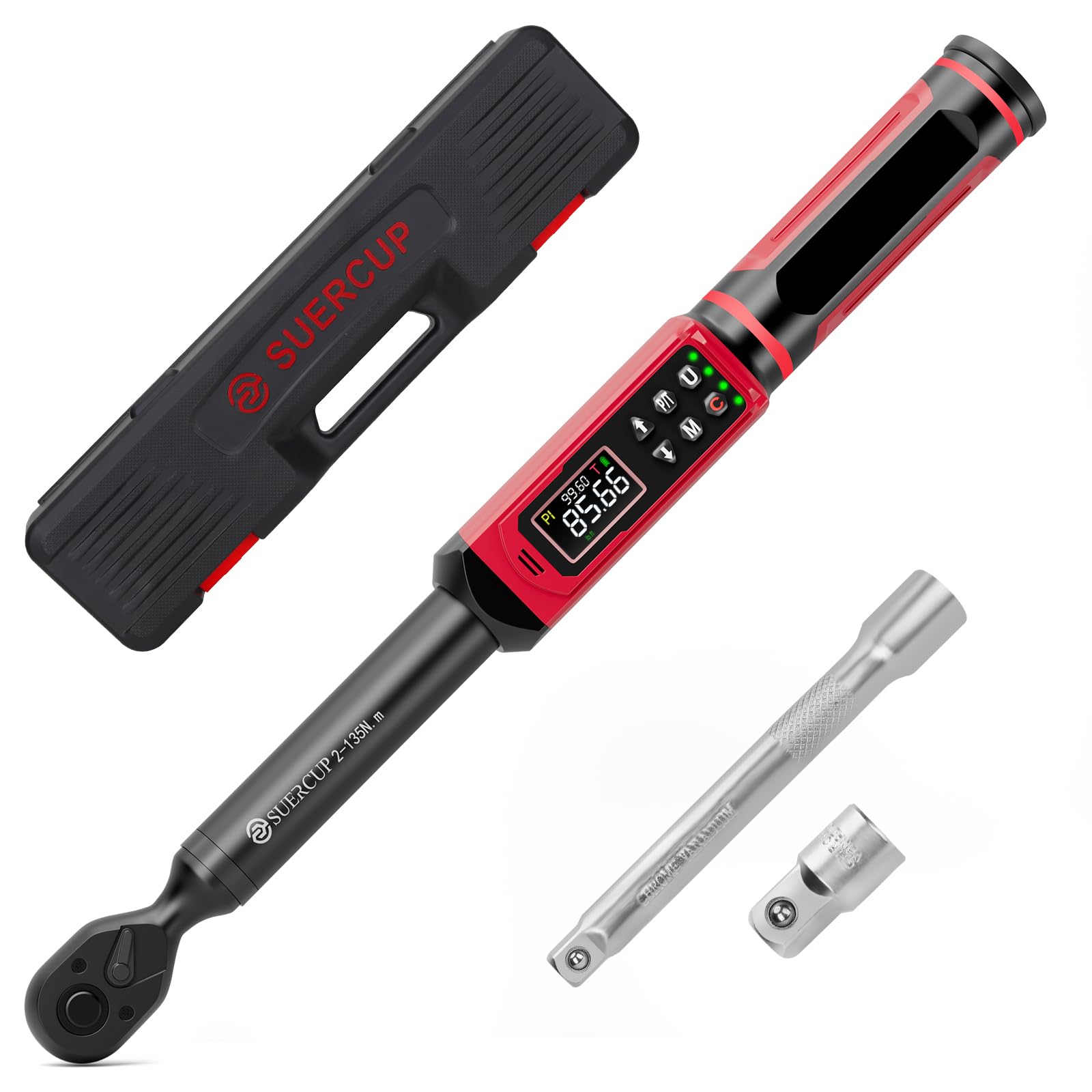
The SUERCUP BSM1-135 is a compact digital torque wrench that starts at just 1.5 ft-lbs, making it one of the few affordable options for low-torque applications like bicycle components, small engine fasteners, and scooter assembly. The 1.5 to 99.6 ft-lbs range, combined with ±1% accuracy, is impressive for the price bracket. The colorful LED digital display is large and easy to read, with a backlight that works well in dim garages or under-body positions. Nine preset modes (P1-P9) and five units of measurement add flexibility.
The overload protection system — vibration, buzzer, and LED flash — works when the preset torque is reached, preventing over-tightening of delicate fasteners. The quick-release ratchet head allows socket changes without tools, which speeds up repetitive work. The Peak mode records the maximum torque value for verification, and Track mode shows real-time torque as you apply force. For angle-degree work, this tool handles the initial torque step but, like other entry-level digitals, does not provide a built-in degree measurement — you will need an external angle gauge or protractor for the rotation phase.
Users have noted that the interface takes a few minutes to learn — the button logic for switching between modes and presets is not immediately intuitive — and the included manual could be clearer. The Chrome Vanadium Steel construction feels solid for the weight class, though the powder-coated finish is prone to chipping if dropped repeatedly. For a first digital torque wrench for light to moderate DIY duty, the SUERCUP delivers surprising precision at a minimal investment.
What works
- ±1% accuracy at an entry-level price is rare and valuable
- Nine presets handle a wide variety of fasteners without reprogramming
- Overload protection with three simultaneous alerts
- Quick-release head for fast socket swaps
What doesn’t
- No angle measurement function for TTY bolt procedures
- Powder-coated finish chips more easily than chrome finishes
Hardware & specs guide
Torque-angle measurement: accelerometer vs. gyroscopic
Digital angle-degree wrenches use one of two sensor types for rotational tracking. Accelerometer-based wrenches measure linear acceleration and calculate angle relative to gravity — they work well when the wrench is held in a consistent plane during the pull, but off-axis rotation (wobbling the handle sideways) introduces drift. Gyroscopic wrenches measure actual rotational velocity and integrate it over time, offering greater accuracy regardless of handle orientation. For engine assembly where the wrench may be held at varying angles around strut towers or frame rails, a gyro-based unit provides more reliable angle tracking. Most wrenches in the sub- range use accelerometers, while premium units above often incorporate gyroscopic sensors.
Flex head articulation and ratchet tooth count
A flex-head wrench’s articulation angle determines how far off-axis you can drive a fastener before needing an extension. Typical flex heads offer 5 to 15 degrees of movement. For tight engine compartments, 15 degrees of flex can mean the difference between a direct fit and having to add a wobble extension that degrades torque accuracy. Ratchet tooth count also matters: a 120-tooth mechanism (3-degree swing arc) allows you to tighten fasteners in very confined spaces where a 72-tooth mechanism (5-degree swing) would bind. Lower swing arcs are critical when working around exhaust manifolds or steering linkages.
FAQ
Can a standard click-type torque wrench measure angle degree?
What does torque-to-yield (TTY) mean for angle degree wrenches?
Why does flex-head articulation matter for engine bay angle work?
Final thoughts: the verdict
For most buyers, the best angle degree torque wrench is the ARES 43007 because its Peak Torque Angle mode handles the complete TTY sequence — torque seating and rotation tracking — in one continuous pull, and the flex head and triple-alert system make it adaptable to real engine bay conditions. If you need higher torque capacity for full-size engine or suspension work, the MichaelPro MP001227 covers 25-250 ft-lbs with the same three-mode flexibility and a configurable pre-warning threshold. And for the budget-conscious DIYer who wants certified accuracy without the dedicated angle mode, the ACDelco ARM601-34 combo kit gives you two calibrated digital wrenches that cover the most common fastener ranges without breaking the bank.

Certification: BSc in Mechanical Engineering
Education: Mechanical engineer
Lives In: 539 W Commerce St, Dallas, TX 75208, USA
Md Amir is an auto mechanic student and writer with over half a decade of experience in the automotive field. He has worked with top automotive brands such as Lexus, Quantum, and also owns two automotive blogs autocarneed.com and taxiwiz.com.