A 21-inch front tire is the single component that defines how a cruiser or bagger steers, tracks, and scrubs off speed. The wrong compound or carcass design turns a straight highway into a constant correction battle, while the right one delivers planted corner entry and rock-solid stability across rain grooves and expansion joints. This guide isolates the specific models that justify their place on a big twin or metric tourer, evaluated for tread life, wet-dry balance, and construction integrity.
I’m Amir — the founder and writer behind Four Wheel Ask. My research methodology aggregates dyno-compound data, real-world mileage logs from forums, and DOT compliance specs to separate marketing claims from measurable performance in 21-inch cruiser and touring applications.
The absolute best options in this segment balance a stiff sidewall with a compound that doesn’t square off after two seasons, which is why we evaluated every 21 inch motorcycle tire here against load index, ply rating, and groove pattern efficacy rather than brand reputation alone.
How To Choose The Best 21 Inch Motorcycle Tire
Selecting a 21-inch front tire for a motorcycle is a decision dictated by load capacity, carcass stiffness, and tread philosophy. A mismatched tire can cause headshake, uneven wear, or reduced braking confidence. Focus on these three factors to narrow the field.
Ply Rating and Load Index
A 21-inch tire on a heavy cruiser or touring bike must support 600–1,200 pounds of static load during cornering and braking. Higher ply counts (4-ply, 6-ply, or 12-ply) resist sidewall flex under heavy braking and prevent cupping on long straight stretches. The load index—typically 48 (374 lbs) to 79 (908 lbs)—must at least match the maximum front axle weight of your specific model.
Construction Type: Bias vs. Radial
Most 21-inch cruiser tires use bias-ply construction because the stiffer casing provides a predictable steering feel and higher load capacity with a simpler bead profile. Radial tires, while more common on sport bikes, are increasingly found on premium touring baggers and offer a cooler running temperature and better tread life at sustained highway speeds—but they require a rim designed for their specific bead and flex characteristics.
Tread Pattern and Compound
A 21-inch front tire sees more braking and steering loads than the rear, so the tread pattern must evacuate water effectively while maintaining a stable contact patch under lean. Deep circumferential grooves and siping improve wet grip; a semi-slick center section reduces rolling resistance and extends mileage. Harder compounds last longer but may sacrifice initial bite in cold or wet conditions.
Quick Comparison
On smaller screens, swipe sideways to see the full table.
| Model | Category | Best For | Key Spec | Amazon |
|---|---|---|---|---|
| Pirelli Night Dragon | Premium | High-speed stability | 120/70B21, 4-Ply | Amazon |
| MICHELIN Scorcher 11 | Premium | Agile steering, long life | 130/60B-21, Bias | Amazon |
| MICHELIN Scorcher 31 | Premium | Dry grip, semi-slick | 80/90-21, 54H | Amazon |
| Dunlop D402 | Premium | Harley touring, OEM fit | MH90-21, 3-Ply | Amazon |
| Shinko 777 Front H.D. | Mid-Range | Heavy cruiser carcass | 130/60-19, 12-Ply | Amazon |
| Tusk Dsport Adventure Set | Mid-Range | Dual-sport, on/off-road | 90/90-21, 6-Ply | Amazon |
| Bridgestone Exedra Max | Mid-Range | Touring grip, fatigue reduction | 90/90-21, Bias | Amazon |
| Shinko SR777 HD | Mid-Range | Fat-tire upgrade | 120/70-21, 68V | Amazon |
| Dunlop D404 | Mid-Range | Budget cruiser replacement | 80/90-21, 6-Ply | Amazon |
In‑Depth Reviews
1. Pirelli Night Dragon
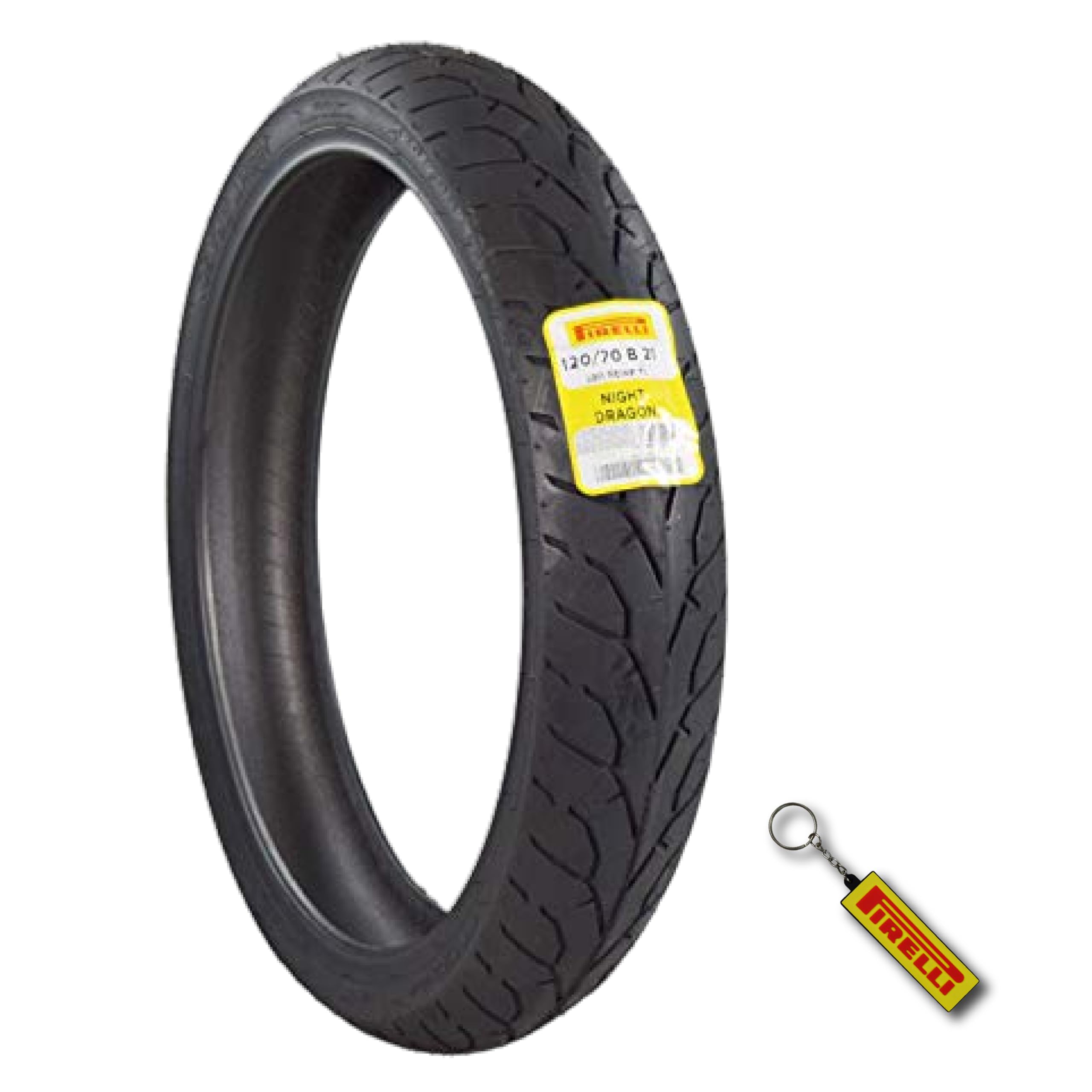
The Pirelli Night Dragon uses Enhanced Patch Technology (EPT) to optimize the contact area between the tire and road under load, translating to a planted feel during aggressive cornering and straight-line acceleration. The 120/70B21 sizing fits metric cruisers and baggers that demand a wider footprint than standard 90-section tires, and the 4-ply casing provides enough stiffness to resist cupping on long, heavy rides.
The rubber compound is engineered for balanced reliability and tire life, not soft maximum grip. Owners report consistent wear patterns across 5,000–7,000 miles on bikes like the Victory Cross Country and Harley Street Glide, with no chunking or heat-related degradation. The tread pattern includes offset grooves that reduce the dreaded front-end wander over steel-grated bridges.
There is no getting around the premium positioning—this tire commands a higher entry point than most 21-inch options. But for riders who value high-speed stability and predictable transition from lean to straight, the Night Dragon justifies every bit of its cost with construction quality and a keychain that shows Pirelli understands its audience.
What works
- EPT contact patch delivers exceptional stability under braking and turning
- Predictable wear pattern with even tread loss across the profile
- Wider 120-section footprint improves cornering clearance and feel
What doesn’t
- Premium pricing exceeds entry-level budgets
- Limited size range compared to larger competitors
2. MICHELIN Scorcher 11

The MICHELIN Scorcher 11 brings radial-derived compounds to a bias-ply casing, offering a ride quality that feels more forgiving than a standard bias tire without sacrificing load capacity. The 130/60B-21 profile is designed for the big twin custom and bagger market, where riders want both a fat front-end look and a contact patch that doesn’t track every groove in the pavement.
The semi-slick center section boosts dry-contact area, while the shoulder siping provides enough bite for damp-road confidence. Owners riding Harley CVO Breakouts and Road Glides report noticeably lighter steering effort compared to OE units, with less effort required to initiate a turn. The compound holds up well against cupping, with many users logging over 6,000 miles before the center strip shows significant flattening.
Some riders note a low-frequency hum at interstate speeds, attributed to the tread pattern’s unique groove spacing. It’s not a safety issue, but it is a minor annoyance for those who value a silent ride. The 6-year warranty from Michelin adds a layer of security that budget brands cannot match.
What works
- Lighter steering feel with radial-influenced carcass flexibility
- Strong resistance to cupping on extended highway rides
- 6-year workmanship warranty from Michelin
What doesn’t
- Noticeable tread hum at highway speeds
- Premium price point may not suit casual riders
3. Dunlop D404

The Dunlop D404 is a no-frills 21-inch front tire designed for older cruisers and metric models where fitment precision matters. The 80/90-21 sizing with a 6-ply rating offers a robust carcass that handles the weight of bikes like the Kawasaki Vulcan VN900 without feeling underbuilt. The tread compound is a balance of mileage and grip that Dunlop has honed across decades of OE supply.
Closed-course testing indicates consistent performance across a wide temperature range, with the tire reaching optimal operating grip quickly after initial rolling. The tread pattern features offset grooves that help reduce cupping—a common failure mode on narrower front tires. Owners report 4,000–5,000 miles of serviceable life on bikes weighing around 600 pounds, with predictable handling throughout the wear cycle.
It is a solid entry-level replacement that prioritizes reliability over excitement, and the price reflects that philosophy without compromising safety.
What works
- 6-ply construction provides solid load support for medium cruisers
- Dependable all-weather compound for daily commuting
- Fits a wide variety of older metric and cruiser models
What doesn’t
- Soft carcass limits aggressive cornering performance
- Limited mileage compared to premium compound tires
4. Shinko SR777 HD

The Shinko SR777 HD is a 120/70-21 heavy-duty bias tire designed for riders who want a thicker front contact patch without moving to a radial rim. The reinforced carcass provides a noticeably more planted feel than the standard SR777, reducing vagueness during hard acceleration and braking. Owners of Dyna Wide Glides and similar big-twins report a dramatic increase in cornering confidence when upsizing from a stock 80/90-21.
Functional siping and deep grooves give the SR777 HD traction in wet conditions that rivals tires costing significantly more. The V-rated speed rating indicates sustained capability at speeds up to 149 mph, which is more headroom than most cruisers will ever use. Multiple forum reports place real-world mileage between 5,000–6,000 miles on heavy bikes, with even wear and no cupping if tire pressure is maintained.
Shinko’s price strategy places this tire firmly in the budget-friendly segment, but the ride quality and longevity punch well above the price tier. The only downside is that the rubber compound is not as long-lasting as a Michelin premium compound—riders who want 8,000 miles of life may need to compromise on initial cost.
What works
- Wider footprint significantly improves cornering stability
- Functional siping provides confidence in wet conditions
- V-rated speed rating for high-speed capability
What doesn’t
- Compound wears faster than premium Michelin tires
- Requires careful pressure monitoring to avoid cupping
5. Bridgestone Exedra Max

The Bridgestone Exedra Max uses a specific rubber compound designed for long-mileage cruiser applications, with a load index of 79 (908 lbs) that accommodates fully loaded touring bikes without stressing the carcass. The unique wide profile reduces rider fatigue during long days in the saddle by spreading the contact patch more evenly across the tire face.
The tread pattern is optimized for water evacuation, with deep grooves that channel water away from the centerline and maintain grip in continuous rain. Owners of Honda Valkyries and Gold Wing trikes report that the Exedra Max holds the road well even with aggressive throttle inputs, and the tire maintains its shape without developing flat spots during extended straight-line riding.
The trade-off for that touring-focused longevity is that the compound is harder than sport-oriented tires, so initial bite in cold conditions is less immediate. Riders who live in consistently cool climates may want to let the tire warm up for a few miles before pushing hard. That aside, the Exedra Max is a benchmark for budget-conscious touring riders.
What works
- High load index supports fully loaded touring bikes
- Excellent water evacuation for sustained wet-road confidence
- Holds shape without flat-spotting on long straight highways
What doesn’t
- Hard compound requires warm-up in cold conditions
- Not ideal for aggressive cornering on a light bike
6. Tusk Dsport Adventure Set

The Tusk Dsport Adventure front tire—available as part of a rear-matching set—is a DOT-compliant, 6-ply bias tire designed for on-off road dual-sport use. The aggressive knobby tread pattern provides serious bite in loose gravel, mud, and rocky terrain, while the rubber compound is formulated to resist chunking when hitting pavement sections between trails.
The 90/90-21 sizing with a 6-ply carcass gives the tire a high load capacity (694 lbs) while maintaining enough flexibility to conform to uneven off-road surfaces. Owners report that the tire stays planted on loose-over-hardpack conditions, making it a strong choice for riders who split their time between fire roads and paved commutes. The tall knobby blocks give the bike a rugged aesthetic that matches adventure builds.
The trade-off for off-road grip is increased road noise and vibration at highway speeds—this is a true dual-sport tire, not a silent touring shoe. The tread life on pavement will also be shorter than a dedicated street tire, typically around 3,000–4,000 miles before the knobbies round off. For riders who need a capable front tire for mixed surfaces, the Dsport delivers without breaking the bank.
What works
- Aggressive knobby tread provides excellent off-road traction
- 6-ply construction resists punctures on rocky terrain
- DOT-compliant for legal road use
What doesn’t
- High road noise and vibration at highway speeds
- Shorter pavement tread life than dedicated street tires
7. Dunlop D402
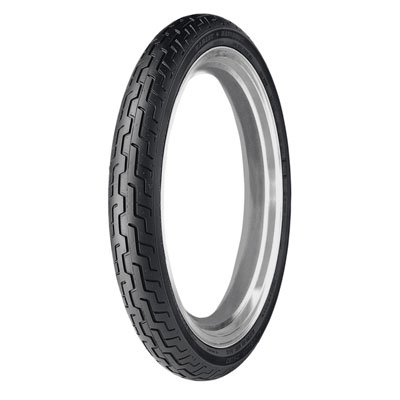
The Dunlop D402 is the only 21-inch motorcycle tire officially approved by Harley-Davidson for its Touring and Softail models, and that OE pedigree carries engineering specifics that aftermarket-only designs often miss. The three-ply polyester casing with two fiberglass belts provides a load capacity of over 1,100 pounds, making it one of the strongest options for fully loaded baggers.
The computer-optimized tread profile and offset center groove are specifically tuned to reduce front-end wander on rain grooves, expansion joints, and steel-grated bridges—conditions that unsettle many aftermarket tires. The D402 also resists cupping, a common issue on heavy front ends, by distributing braking forces evenly across the tread face. Owners routinely report 7,000–10,000 miles on the front tire of Road Glides and Street Glides.
The D402 is a premium-priced tire, and its bias-ply construction means a stiffer ride compared to radial alternatives. Riders looking for a plush, car-like feel may prefer a radial tire, but for sheer strength, OEM compatibility, and predictable wear, the D402 remains the benchmark for heavy touring use.
What works
- Harley-Davidson approved for touring and softail models
- Excellent resistance to cupping and grooved-road wander
- Very high load capacity for fully loaded baggers
What doesn’t
- Stiffer bias-ply ride compared to radial alternatives
- Premium price reflects OEM positioning
8. MICHELIN Scorcher 31

The MICHELIN Scorcher 31 uses a semi-slick tread design that maximizes the contact patch on dry pavement, inheriting compound technology from Michelin’s race-winning tires. This translates to exceptional grip during hard braking and cornering, with a rubber blend that resists heat cycling degradation. The 80/90-21 sizing is a direct replacement for many stock cruiser front ends.
The tread grooves are optimized for water evacuation, providing reliable wet grip despite the semi-slick appearance. Michelin’s bias construction maintains a stable footprint at highway speeds, and the H-rated speed rating (130 mph) gives ample headroom for most cruiser riding. Owners report lighter steering effort compared to more aggressive tread patterns, making the Scorcher 31 a solid choice for around-town and daily commutes.
The semi-slick center section means the tire will wear faster than a deeply grooved touring tire, with many riders replacing the front at around 4,000–5,000 miles. The Scorcher 31 also commands a premium price that reflects Michelin’s R&D investment. It is a high-performance front tire for riders who prioritize grip and steering feel over maximum mileage.
What works
- Exceptional dry grip from race-derived rubber compound
- Lighter steering effort than more aggressive tread patterns
- Semi-slick design maximizes contact patch for braking
What doesn’t
- Fast wear pattern on the center contact area
- Premium price with shorter service life than touring tires
9. Shinko 777 Front H.D.

The Shinko 777 Front H.D. is a 130/60-19 bias tire built with a massive 12-ply rating, making it one of the most robust carcasses available for heavy metric cruisers. This construction allows the tire to handle extreme loads without deformation, maintaining a stable contact patch even when the bike is fully loaded with passenger and luggage. The H.D. (Heavy Duty) designation means a reinforced sidewall that resists flex during hard cornering.
The rubber compound is formulated for maximum grip and comfort on V-Twin and metric cruiser models, with a tread design that includes functional siping for wet conditions. Owners of larger cruisers and trikes report that the tire provides a planted feel during low-speed maneuvering and highway cruising, with predictable handling that doesn’t require constant steering correction.
The 19-inch diameter means this tire is not compatible with standard 21-inch rims, so buyers must confirm their specific fitment before purchasing. The 12-ply construction also creates a stiffer ride that may feel harsh over rough pavement. That said, for riders who prioritize maximum load capacity and sidewall strength above all else, the Shinko 777 Front H.D. offers unbeatable value.
What works
- 12-ply construction provides extreme load capacity
- Reinforced sidewall prevents flex on heavy bikes
- Predictable handling even at low speeds with full load
What doesn’t
- 19-inch diameter limits compatibility with 21-inch front ends
- Stiff carcass creates a harsh ride on rough pavement
Hardware & Specs Guide
Load Index and Ply Rating
The load index on a 21-inch motorcycle tire ranges from 48 (374 lbs) to 79 (908 lbs) and directly determines how much weight the tire can carry at maximum inflation pressure. A higher ply count (6-ply, 12-ply) indicates more layers of rubber-coated fabric in the casing, which increases load capacity and resistance to punctures but also adds weight and stiffness. For heavy touring bikes, a load index of at least 65 (694 lbs) combined with a 6-ply casing is recommended.
Speed Rating and Construction
Speed ratings for 21-inch bias cruiser tires typically range from H (130 mph) to V (149 mph), indicating the maximum sustained speed the tire can handle. Bias-ply construction remains dominant in this size because the stiffer sidewall provides predictable steering feel and high load capacity. Radial tires, while offering cooler running temperatures and longer tread life, are less common due to the specific bead and rim compatibility required.
FAQ
Can I run a 120/70-21 tire on a bike that came with 80/90-21?
Should I bias ply or radial for a 21-inch front tire on a heavy tourer?
How do I prevent cupping on my 21-inch front tire?
What does the H in 54H mean on a motorcycle tire?
Final Thoughts: The Verdict
For most buyers, the 21 inch motorcycle tire winner is the Pirelli Night Dragon because its EPT technology and 120/70B21 footprint deliver stability that transforms the ride quality of any big twin. If you want a semi-slick front end with race-bred grip and lighter steering, grab the MICHELIN Scorcher 11. And for a heavy-duty touring tire that eliminates grooved-road wander with a proven OE design, nothing beats the Dunlop D402.

Certification: BSc in Mechanical Engineering
Education: Mechanical engineer
Lives In: 539 W Commerce St, Dallas, TX 75208, USA
Md Amir is an auto mechanic student and writer with over half a decade of experience in the automotive field. He has worked with top automotive brands such as Lexus, Quantum, and also owns two automotive blogs autocarneed.com and taxiwiz.com.