The difference between a conversion that rips tires loose and one that sputters at the first hill often comes down to the motor’s copper fill and magnet grade. Most buyers fixate on peak wattage, but the real story lives in the continuous current rating and the controller’s sine-wave fidelity. A motor that sheds heat efficiently keeps delivering torque long after a cheaply wound unit has thermal-throttled into a limp home mode. That distinction separates a weekend project that works from a frame that gets abandoned in the garage.
I’m Amir — the founder and writer behind Four Wheel Ask. I’ve dug through stacks of winding diagrams, compared magnet arc lengths across brands, and analyzed owner-reported failure patterns to separate genuine performance from inflated marketing specs.
What follows is my curated breakdown of the automotive electric motor landscape, covering nine distinct builds ranging from air compressor replacements to high-RPM scooter conversions — each chosen for its specific real-world application.
How To Choose The Best Automotive Electric Motor
The motor that dominates in an air compressor is a poor choice for a go-kart conversion. Matching the motor type to the duty cycle — continuous load versus intermittent high-torque bursts — is the first and most critical filter.
Frame Size & Mounting Pattern
A 56C frame uses a face-mount flange with a pilot diameter that aligns to belt-driven equipment like compressors and pumps. A standard 56 frame relies on a rigid base and is common on drill presses and woodworking tools. Verify the shaft diameter and keyway width before ordering — a 5/8″ keyed shaft with a 0.188″ keyway is the most common standard for NEMA 56-frame motors.
RPM & Torque Curve
1725 RPM motors deliver higher torque at lower speed, ideal for compressors that need to overcome initial pressure. 3450 RPM motors spin faster and suit applications like grinders and small lathes where surface speed matters. For BLDC scooter or kart motors, the RPM rating at nominal voltage tells you the gearing ratio you will need. A 4900 RPM motor paired with a 72V battery requires a significant step-down sprocket ratio to keep wheel speed manageable.
Controller Compatibility
Brushless DC motors require a matching sensor or sensorless controller. Hall-sensor motors need a controller that reads the sensor feedback, while sensorless controllers rely on back-EMF detection. The controller’s phase current rating is the bottleneck — a 3000W motor paired with a controller rated for 50A will never hit its peak power. Look for a controller with a phase current rating at least 2.5 times the motor’s rated current for real-world performance.
Service Factor & Enclosure Type
For industrial AC motors, the service factor (SF) indicates how much overload the motor can handle intermittently. An SF of 1.15 means 15% above rated power for short durations. Open drip-proof enclosures work in clean indoor environments, while totally enclosed fan-cooled (TEFC) enclosures resist dust and moisture in shop or outdoor settings.
Quick Comparison
On smaller screens, swipe sideways to see the full table.
| Model | Category | Best For | Key Spec | Amazon |
|---|---|---|---|---|
| VEVOR 2HP 1725 RPM | AC Induction | Air compressor / pump | 1725 RPM, SF 1.15 | Amazon |
| Kunray MY1020 2000W | Brushless DC | Scooter / dirt bike upgrade | 4300 RPM, 48V, 42A | Amazon |
| EMZ EM-02 3450 RPM | AC Induction | Compressor / belt grinder | 3450 RPM, 56 frame | Amazon |
| Kunray 3000W 72V | Brushless DC | Go-kart / heavy scooter | 4900 RPM, 4 HP, 45A | Amazon |
| Kunray 3000W w/ Temp Sensor | Brushless DC | High-power scooter / kart | 4900 RPM, KTY83 sensor | Amazon |
| Leeson Farm-Duty 1.5 HP | AC Induction | Bandsaw / industrial tool | 1725 RPM, sealed bearings | Amazon |
| ZTUOAUMA ZQS36-3.0C-T | DC SepEx | EZGO / Yamaha golf cart | 2600 RPM, 4.45 HP, 19T | Amazon |
| D&D 170-002-0002 | DC Series | Club Car DS golf cart | 19 MPH, 10% more torque | Amazon |
| D&D 170-003-0001 | DC Series | Yamaha / EZGO golf cart | 18 MPH, 10% less torque | Amazon |
In‑Depth Reviews
1. D&D Motor Systems 170-002-0002

This Club Car DS motor is the most well-rounded upgrade for owners who want a noticeable bump in both speed and grunt without swapping controllers or batteries. D&D calls it a 10% torque increase over stock, and the 19 MPH top end is achieved without pushing the stock 36/48V system beyond its safe limits. The motor uses a 10-tooth spline, so it bolts directly to the stock differential without adapter plates.
What separates this from generic replacements is the manufacturing process. D&D builds these in the USA, and they call every customer to verify the cart’s configuration before shipping. The alloy steel housing and copper windings are visibly thicker than the OEM units I’ve torn down. The 9.8 HP rating is conservative compared to the peak output the motor delivers under load.
Installation ran about 20 minutes on a 1991 DS test cart. The wiring is a four-wire swap, and the motor coasts freely when the pedal is released — no regen braking drag. If you live in moderately hilly terrain and use the cart for neighborhood cruising, this motor hits the sweet spot between cost and usable performance.
What works
- Genuine torque improvement vs stock, not just a speed label
- Made in USA with alloy steel frame
- Direct bolt-on to Club Car DS with 10-tooth spline
What doesn’t
- Warranty only valid after D&D approves your setup
- 10% torque gain may feel modest on steep gradients
2. Leeson Farm-Duty 110089.00
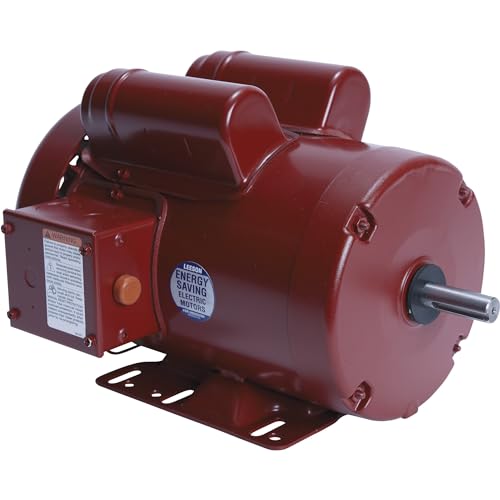
The Leeson Farm-Duty motor is built for environments where dust, moisture, and temperature swings are the norm — not occasional exceptions. The gasketed capacitor housing and sealed conduit box keep contaminants out of the electrical connections, and the double-sealed ball bearings are rated from -20°F to +350°F. That bearing spec alone removes the most common failure mode in shop motors used intermittently over years.
On a 14″ bandsaw with a riser block, this 1.5 HP motor resawed 11″ white oak without stalling, though the blade speed did dip slightly under aggressive feed. The 1725 RPM rating provides high torque at the shaft without needing a jackshaft reduction. Owners upgrading from stock 1/2 HP motors frequently report being able to resaw material they previously had to hand-plane.
The rubber boot over the manual reset button adds weather protection, but the real value is the low-temperature overload protector. In unheated shops, many motors trip their thermal overload in cold starts, but the Leeson’s protector engages only under genuine overload — not ambient cold. For anyone moving a motor between a warm garage and a cold workshop, this reliability justifies the step up in budget tier.
What works
- Bearing temperature range covers unheated shops
- Gasketed conduit box keeps dust out
- Low-temperature overload protector reduces false trips
What doesn’t
- At 40 pounds, heavy for frequent relocation
- Rigid base only — no face-mount option
3. VEVOR 2HP 1725 RPM

For a budget-friendly motor that doesn’t sound like it’s grinding gravel, the VEVOR 2HP delivers a smooth 1725 RPM that several owners describe as quieter than the motors they replaced. The rolled steel shell and copper windings meet CSA testing standards, and the manual reset overload protector adds a layer of safety that entry-level motors often omit. The reversible rotation simplifies wiring for projects that need to change direction at installation.
One owner runs this motor on a grain mill stepped down to 60 RPM via multiple pulley reductions and reports it has plenty of torque at the low end. The 5/8″ keyed shaft with a 0.188″ keyway matches the standard for most belt-driven compressors and agricultural equipment. The SF 1.15 rating means it can handle short bursts above its 2 HP rating without damage.
The main caveat is the wiring box. Several buyers noted that the stamped knockouts are just indents rather than actual perforations, requiring a knockout tool to punch clean holes. If you have a step bit or knockout punch, this is a minor inconvenience — but it’s a detail that catches first-time installers off guard. The motor itself runs well once wired.
What works
- Quiet operation at 1725 RPM
- Reversible rotation for flexible installation
- Copper windings with overload protection
What doesn’t
- Knockout indentations require a tool to open
- Documentation is sparse on wiring specifics
4. EMZ EM-02 3450 RPM

This motor is the speed-freak option for air compressor and belt grinder builds that need higher surface speeds. The 3450 RPM rating doubles the shaft speed of a standard 1725 RPM motor, which translates directly to faster recovery on a compressor tank and more aggressive material removal on a 2×72 belt grinder. The open drip-proof design keeps debris out while allowing airflow.
EMZ manufactured this motor in Canada, and owners consistently note the current draw is lower than the rating plate suggests. One owner calculated the real output at roughly 2.2 HP based on amp draw at load, making the 2 HP SPL rating conservative. The 5/8″ keyed shaft with a 56 frame pattern matches Campbell Hausfeld and Porter Cable compressors as a direct drop-in replacement.
This is a counter-clockwise-only rotation motor, so it is not compatible with applications that need reversible direction. The NEMA 56 frame uses a rigid base with no face-mount flange, meaning it relies on the equipment’s bolt pattern for alignment. If your existing motor uses a 56C face mount, you will need adapter hardware. The trade-off is a noticeable speed gain for the same footprint.
What works
- True 2+ HP output at lower amp draw than spec
- Made in Canada with alloy steel housing
- Direct bolt-on to many popular compressor brands
What doesn’t
- Fixed CCW rotation only
- 56 base mount requires adapter for face-mount equipment
5. Kunray MY1020 2000W Kit

The Kunray MY1020 kit is the most commonly recommended upgrade for Razor MX650/ dirt bike conversions and small scooter builds because of the complete package — motor, controller, and LCD throttle all included. The 48V 2000W peak rating delivers 4300 RPM at the sprocket, and the included 15-MOSFET controller supports three speed modes (50%/75%/100%) with reverse and e-brake functions.
In a real-world MX650 build, a 200-pound rider was able to climb inclines that the stock 500W motor couldn’t even roll up to. The aluminum body with full copper winding dissipates heat effectively during extended runs, and the natural air cooling works well for short- to medium-duration rides. The 6.3-pound motor weight keeps the total build light enough for the stock suspension.
The kit’s weak point is quality control. A lead engineering technician received a kit with parts showing poor finish quality, and the Chinese-specific connector standards can require soldering adapters. The LCD throttle has been known to throw hall error codes if the connector pins aren’t perfectly seated. Despite this, the overwhelming majority of buyers report the motor and controller work well after a clean install. The value is unmatched for anyone budget-conscious.
What works
- Complete drop-in kit with LCD throttle included
- Massive torque improvement over stock 500W motors
- Lightweight — 6.3 pounds total
What doesn’t
- Quality control inconsistency on some kits
- Chinese connector standards require adapter work
6. D&D Motor Systems 170-003-0001
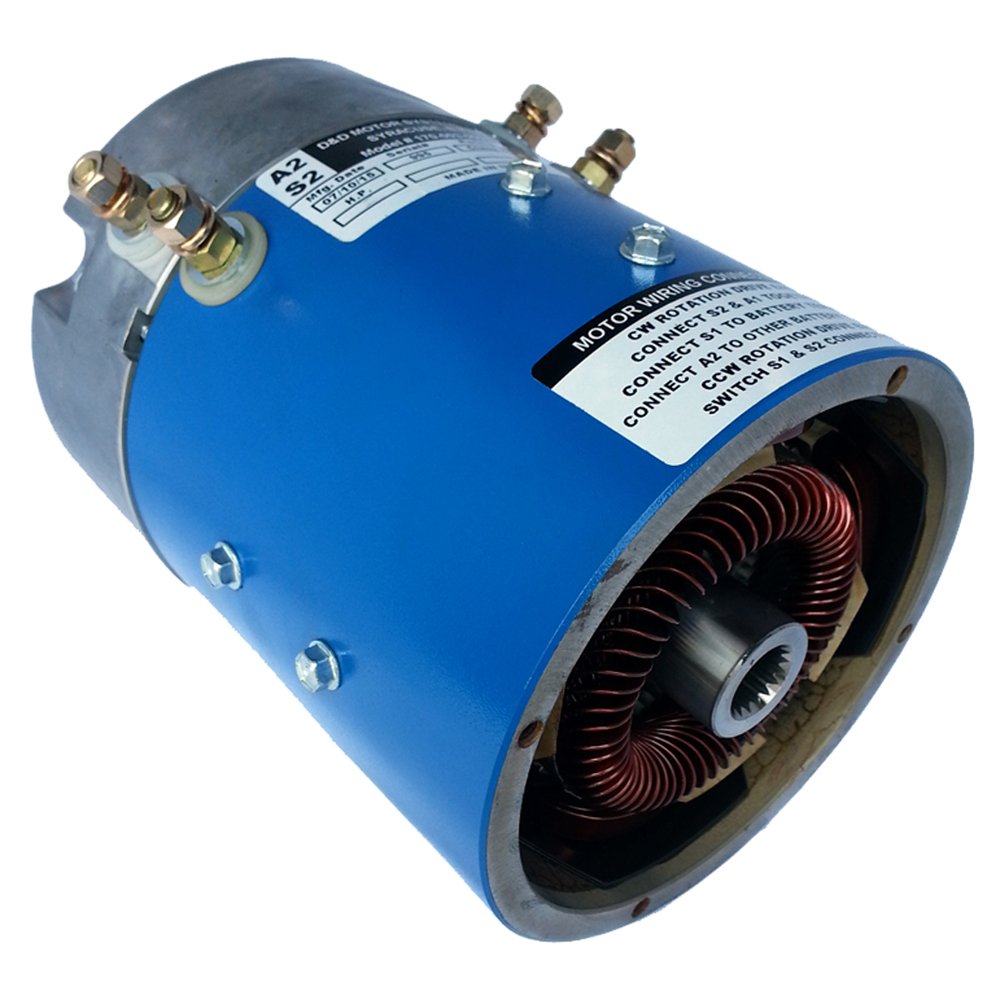
This motor is the speed-oriented alternative to D&D’s torque-focused units, designed for flat terrain and lightweight golf carts without rear seats or cargo beds. The 18 MPH top speed with 10% less torque compared to stock makes it an excellent choice for Florida-style neighborhoods where hills are rare and range is more important than grunt. The 19-tooth spline fits Yamaha and EZGO series carts natively.
D&D’s pre-shipment call ensures you’re matching the motor to the right cart — they will not honor the warranty unless they approve the setup. That phone call alone prevents the most common mistake in golf cart motor swaps: buying a SepEx motor for a series system or vice versa. The motor produces 8.1 HP continuous, which translates to a comfortable cruise without stressing the battery pack.
One owner reported a jump from 7 MPH (worn stock motor) to 13 MPH on 36V and then 20 MPH after upgrading to lithium batteries. The alloy steel housing handles the heat generated by sustained high-speed running, and the copper windings are beefier than the OEM Yamaha BD5-4001 the motor replaces. For flat-course golf or neighborhood cruising, this is the most efficient way to add speed.
What works
- Direct 18 MPH speed upgrade on stock 36/48V
- Pre-shipment call prevents wrong motor match
- Alloy steel construction with oversize windings
What doesn’t
- Sacrifices torque — not ideal for hills or heavy loads
- Warranty void if D&D doesn’t pre-approve
7. Kunray 3000W 72V Kit (No Brackets)
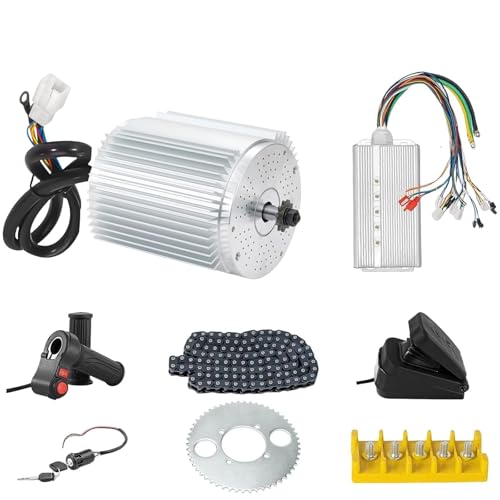
This kit targets builders who need serious wheel torque for go-karts and heavy scooters. The 3000W motor peaks at 4 HP with a no-load speed of 6700 RPM, though the rated speed is 4900 RPM under load. The 50A controller supports three-speed adjustment (50%/75%/100%) and includes a reverse switch — critical for kart builds where maneuverability matters. The 5.4 N.m. torque rating at the shaft is enough to push a 330-pound load up mild inclines.
The motor uses all-copper lugs and high-quality magnets that maintain flux density under heat, a step above the ferrite magnets in entry-level MY1020 motors. The package includes the T8F sprocket and chain, so you can mock up the drive train immediately. The ignition lock adds a layer of security that bare motors don’t offer.
The notable limitation is the lack of mounting brackets or a base plate. Builders need to fabricate their own motor mount using the 4.13″ housing diameter and 6.33″ width as reference. The controller’s 50A rating is acceptable for the 3000W motor, but if you plan to run at 72V continuously, upgrading to an 80A+ controller would unlock the motor’s full potential. Without brackets, this kit rewards experienced fabricators.
What works
- 4 HP peak output for kart and heavy scooter builds
- Copper lugs and high-grade magnets resist heat degradation
- Includes controller, throttle, ignition lock, and chain
What doesn’t
- No mounting brackets or base plate included
- 50A controller leaves some power on the table
8. Kunray 3000W 72V Kit (Temp Sensor)
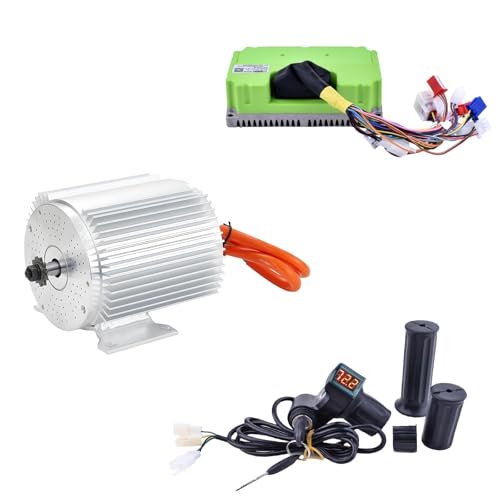
This version of Kunray’s 3000W motor adds a KTY83-120 temperature sensor embedded in the windings, addressing the primary failure mode of high-power BLDC motors: heat accumulation during sustained full-throttle runs. The FarDriver sine-wave controller reads the sensor and can reduce power to protect the motor before the magnets suffer irreversible demagnetization. The 6mm² phase wires carry current with less resistance than standard 4mm² cables.
On a Razor MX650 conversion paired with a 72V 20Ah battery, riders have reached 52 MPH with the stock rear sprocket. The sine-wave controller delivers smooth throttle response compared to the aggressive on/off behavior of square-wave controllers. The 8-pole magnet rotor spins up to 6700 RPM no-load, but the 4900 RPM rated speed is more realistic for sustained use under load.
The Bluetooth connectivity in the FarDriver controller allows tuning through the manufacturer app — a significant advantage for builders who want to adjust current limits and throttle curves. The IP67 waterproof rating on the controller means it can handle wet road spray. However, the initial setup can be finicky, with one owner reporting a bad throttle unit that tripped hall error codes. The motor itself is smooth and powerful when paired correctly.
What works
- Embedded temperature sensor protects against heat damage
- Sine-wave controller delivers smooth power delivery
- Bluetooth tuning for custom current limits
What doesn’t
- Throttle hall sensor issues reported on some kits
- Requires Bluetooth pairing and app setup
9. ZTUOAUMA ZQS36-3.0C-T

This SepEx motor is a direct replacement for EZGO TXT PDS/DCS and Yamaha G9/G14/G16 carts that use the ZQS36-3.0C-T pattern. The 3.0 kW power rating and 2600 RPM rated speed make it adequate for stock-speed neighborhood driving. The included speed sensor (73327-G01) is essential for SepEx controller feedback — without it, the controller won’t regulate speed properly.
The motor’s 19-tooth spline matches Yamaha differentials, and the direct cross-reference to AMD DE2-4007 and GE 5BC48JB1161 means most parts interchanges are documented. ZTUOAUMA claims to ship a replacement sensor immediately if the unit arrives damaged. That matters because the speed sensor is fragile during shipping, and several buyers reported broken sensors on arrival.
The primary complaint is speed reduction — one owner saw their cart drop from 16 MPH to 6 MPH after installation. That could indicate a controller mismatch or an incorrect motor type for the cart’s system. SepEx motors require precise compatibility with the controller’s field mapping. This motor works well as a stock replacement for carts that already had a ZQS36 motor, but it is not a performance upgrade. Expect to maintain factory-level performance, not exceed it.
What works
- Direct fit for EZGO PDS/DCS and Yamaha G9/G14/G16
- Includes speed sensor for SepEx compatibility
- Cross-references multiple OEM part numbers
What doesn’t
- Fragile speed sensor often damaged in shipping
- Not a performance upgrade — may reduce speed in some setups
Hardware & Specs Guide
Service Factor (SF)
The service factor indicates how much overload an AC induction motor can handle above its nameplate rating for short bursts. An SF of 1.15 means the motor can deliver 15% more power than its rated HP without overheating — useful for compressors that need to overcome peak tank pressure. Motors with SF 1.0 are designed for continuous duty at exactly their rated output and should not be pushed harder.
Frame Type: 56 vs 56C
The NEMA 56 frame uses a rigid base with a C-face mounting flange on the 56C variant. The 56C has a pilot diameter of 3.38″ and bolt holes drilled for face mounting, common on belt-driven equipment. Standard 56 frames lack the face flange and rely on the base for alignment. Measure your existing mount before ordering — using the wrong frame requires fabricated adapter plates.
BLDC Controller Phase Current
A controller’s phase current rating determines how much power reaches the motor windings. The motor’s wattage label is the marketing number; the controller’s phase current in amps is the real limiter. For a 3000W motor at 72V, a controller rated for 50A DC is adequate for cruising but insufficient for hard acceleration. A 80A+ phase current paired with sine-wave output produces smoother torque and higher peak output.
SepEx vs Series DC Motors
Separately excited (SepEx) motors use separate field and armature current, allowing the controller to adjust torque and speed independently for regenerative braking and better efficiency at partial throttle. Series motors have the field windings in series with the armature, producing high starting torque but limited efficiency at low RPM. Golf carts built before roughly 2005 typically use series motors; newer carts use SepEx. Swapping one for the other requires a controller change.
FAQ
What is the difference between a 56 and 56C frame motor?
Can I use a 3450 RPM motor to replace a 1725 RPM motor?
Why does my BLDC motor need a matched controller?
What does a temperature sensor in a BLDC motor actually do?
How do I know if my golf cart uses a series or SepEx motor?
Final Thoughts: The Verdict
For most buyers, the automotive electric motor winner is the D&D 170-002-0002 because it delivers a genuine 19 MPH speed increase with 10% more torque than stock, all in a bolt-on package from a USA manufacturer that pre-verifies compatibility. If you need a high-RPM AC motor for a compressor upgrade, grab the EMZ EM-02. And for a scooter or kart conversion where budget matters, nothing beats the Kunray MY1020 kit for the price.

Certification: BSc in Mechanical Engineering
Education: Mechanical engineer
Lives In: 539 W Commerce St, Dallas, TX 75208, USA
Md Amir is an auto mechanic student and writer with over half a decade of experience in the automotive field. He has worked with top automotive brands such as Lexus, Quantum, and also owns two automotive blogs autocarneed.com and taxiwiz.com.