A fuel gauge that reads half a tank when you’re on empty isn’t just an annoyance—it’s a risk. Whether you’re running a diesel tractor, cruising a bass boat, or restoring an old pickup, an inaccurate reading can leave you stranded or force you to carry spare fuel you don’t need. The fix isn’t a new sending unit alone; it starts with a gauge that understands your specific resistance range and holds its calibration through engine vibration, temperature swings, and electrical noise.
I’m Amir — the founder and writer behind Four Wheel Ask. I’ve spent years analyzing aftermarket automotive instrumentation, cross-referencing resistance maps, sender compatibility, and real owner feedback to identify which gauges actually deliver steady, repeatable readings in harsh environments.
Replacing a broken or mismatched gauge doesn’t have to be a guessing game. In this guide I break down the critical specs—ohm range, bezel material, lighting flexibility, and mounting dimensions—so you can confidently choose the best aftermarket fuel gauge for your ride.
How To Choose The Best Aftermarket Fuel Gauge
Buying the wrong gauge is the most common mistake. It either pegs at full, never moves from empty, or bounces erratically. Three specs control this: resistance range, mounting hole size, and voltage compatibility.
Resistance Range — The Only Spec That Matters First
Every fuel sending unit outputs a variable resistance as the float moves. The most common standard in modern American vehicles and marine applications is 240 ohms at empty, 33 ohms at full. European systems often run 0-90 ohms or 10-180 ohms. If you buy a gauge locked to 240-33 and your sender outputs 0-90, the needle will never show a correct reading. Multi-signal gauges that let you toggle between four or five resistance curves are worth the small premium because they adapt to almost any sender without rewiring.
Hole Size, Bezel Material, and IP Rating
Most aftermarket gauges fit a 2-1/16-inch (52mm) hole. Confirm your dash aperture before ordering—a gauge that’s too small leaves a gap, and one that’s too large won’t seat. In marine or outdoor installations a stainless steel bezel resists corrosion far better than chrome-plated plastic, and an IP67 rating means the gauge is fully sealed against dust and temporary submersion. For dry cabin or dash use, plastic housings are fine and lighter on the wallet.
Lighting and Readability
Backlight color matters more for night vision than aesthetics. A gauge that lets you switch between red, green, blue, and white gives you the option to match factory dash lighting or use red to preserve night adaptation on a boat or off-road rig. Also look for anti-glare curved glass or polycarbonate lenses—flat lenses produce reflections that wash out the needle position in direct sunlight.
Quick Comparison
On smaller screens, swipe sideways to see the full table.
| Model | Category | Best For | Key Spec | Amazon |
|---|---|---|---|---|
| Bosch SP0F000048 | Premium | Restoration & classic dash | White dial, 60° sweep | Amazon |
| 100TECH YBUAB | Mid-Range | Marine & high-vibration | 8 color LED, IP67 | Amazon |
| ARTILAURA AR-CX6147B | Mid-Range | Budget multi-color build | 316L bezel, 7 color LED | Amazon |
| KUS CPFR-WW | Mid-Range | UTV & compact installs | Screw-on ring, IP67 | Amazon |
| Sierra 57902P | Mid-Range | OEM replacement (boats) | Black dial, red marks | Amazon |
| AODITECK B08RBN82D4 | Premium | Complete sender upgrade | 10mm resolution sender | Amazon |
| Sucicago XQ240-C6 | Premium | Reed switch replacement | 6” sender, stainless | Amazon |
In‑Depth Reviews
1. Bosch SP0F000048 Style Line 2″ Fuel Level Gauge

Bosch engineered this gauge for the restoration and street-rod market, and it shows in every detail. The white dial face uses clear E/1/4/1/2/3/4/F markings with a full 60-degree needle sweep, so you get a much wider usable arc than most budget gauges. It requires a 240-ohm empty / 33-ohm full sender and a 12-volt negative ground system—no multi-voltage flexibility, but Bosch sticks to one standard and executes it perfectly.
The chrome bezel includes a detachable chrome mounting panel that simplifies dash installation, and the 12-volt internal backlighting provides even illumination through the dial perimeter. At 2 inches for a 2-1/16-inch opening, the fit is precise if your dash already has an OEM sender. Owners using this in classic cars and 4×4 restorations consistently report stable readings and no needle flutter.
What holds it back is the fixed 240-33 ohm input—if your sending unit operates on a different curve, you need an adapter or a replacement sender. It also lacks multi-color backlight options, so you’re stuck with the factory white/amber tint. For a purist looking for an OEM-plus upgrade in a 1970s truck or vintage boat, this is the cleanest option available.
What works
- High-quality chrome bezel with removable mounting panel
- Clear white dial with wide 60° sweep for easy reading
- Even perimeter backlighting for night visibility
What doesn’t
- Fixed 240-33 ohm input only; no signal adjustment
- Single backlight color—no red or green option
2. 100TECH YBUAB Boat Fuel Gauge

The 100TECH gauge stands out because of its programmable signal input. You can select from five resistance ranges—240-33, 0-190, 240-30, 0-180, and 10-180 ohms—by holding the mode button for three seconds. This one gauge can match a US-style sender, a European sender, or an older aftermarket unit, making it the most versatile option on this list.
The IP67-rated casing uses a 316 stainless steel bezel and anti-fog glass, so it handles salt spray, rain, and pressure washing without internal fogging. Vibration resistance is built into the needle assembly, which solves the bouncing problem common with cheap gauges on outboard motors or diesel generators. The 8-color backlight cycles through red, green, blue, white, yellow, yellow-green, orange, and purple, and there’s an auto-cycling mode if you can’t pick a favorite.
Installation requires a 2-1/16-inch (52mm) hole and a 9-32V DC supply, so it works on both 12V and 24V systems. A few owners noted that the initial calibration to the correct ohm range takes a close read of the manual, but once set it holds steady. If you’re swapping a gauge into a vehicle with a non-standard sender, this is the headache-free choice.
What works
- Five programmable resistance ranges fit almost any sender
- IP67 waterproof with 316 stainless steel bezel
- Anti-vibration needle for stable readings in rough conditions
What doesn’t
- Manual calibration requires careful reading
- Default 240-33 setting must be changed for other senders
3. ARTILAURA AR-CX6147B 52mm Fuel Gauge
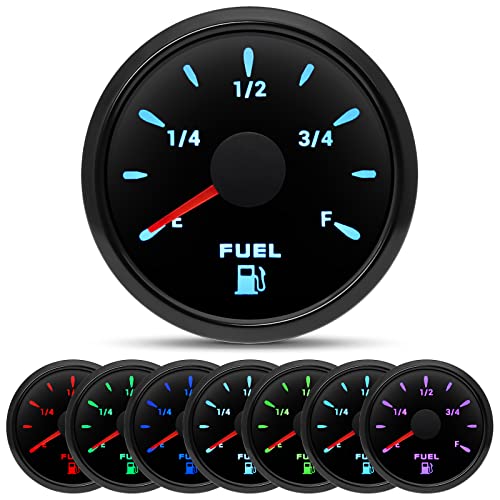
ARTILAURA brings a compelling mix of material quality and low cost. The 316L stainless steel bezel and scratch-resistant curved glass lens are features typically found on gauges costing significantly more. The 7-color backlight (red, green, blue, yellow, olivine, orange, purple) is controlled by a simple button press, making it easy to match factory dash lighting.
This gauge is locked to the 240-33 ohm range, so it’s best suited for vehicles or boats that already use the US standard sender. The snap-together harness connector prevents loosening from vibration, which is a thoughtful touch for marine and off-road installations. Owners installing it on tractors, golf carts, and small fishing boats report no performance differences compared to more expensive units.
The main trade-off is the fixed resistance curve—if your sender is 0-90 or 10-180 ohms, this gauge won’t work without also swapping the sender. It also lacks an IP rating on the packaging, so while the bezel is stainless, the rear casing may not be fully waterproof. For a dry-dash install on a standard 240-33 sender, this is the best entry-level option.
What works
- 316L stainless steel bezel at a budget-friendly price point
- Seven backlight colors for dashboard matching
- Anti-vibration harness connector
What doesn’t
- Fixed 240-33 ohm input only
- No official IP rating for marine use
4. KUS CPFR-WW 52mm Fuel Level Gauge
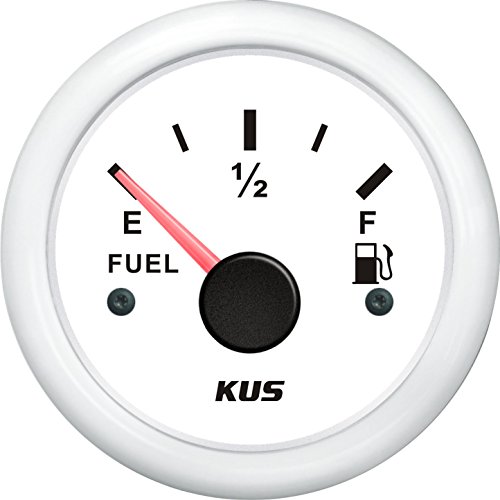
KUS specializes in marine instrumentation, and the CPFR-WW reflects that focus. The IP67 rating covers the entire gauge—not just the front bezel—so you can mount it on an open helm without worrying about rain or spray. The mounting system uses a screw-on retaining ring instead of the traditional bracket, which is much easier to tighten in tight dash spaces.
The gauge accepts 240-33 ohm senders and runs on both 12V and 24V systems. A side-mounted button lets you cycle through backlight colors, and the white LED is bright enough to read in direct sun. Owners swapping older malfunctioning gauges on 1990s runabouts, Yanmar diesel tanks, and side-by-side UTVs highlight the simple three-wire hookup as the main time-saver.
A minor complaint is that the outer lip diameter is barely larger than the mounting hole, so on worn or oversized dash cutouts the gauge can pull through without adhesive reinforcement. The bezel is plastic rather than stainless, which is fine for dry installations but less ideal for constant saltwater exposure. For price-sensitive buyers who need IP67 protection, this delivers.
What works
- Full IP67 protection for exposed marine use
- Screw-on retaining ring simplifies installation
- Works on both 12V and 24V systems
What doesn’t
- Plastic bezel less durable than stainless steel
- Lip is barely wider than the mounting hole
5. Sierra 57902P Amega 2″ Fuel Gauge

Sierra’s Amega 2″ gauge is a direct drop-in replacement for many factory boat gauges, especially Skeeter, Sea Ray, and MasterCraft models from the early 2000s. The black dial with white numerals and red graduations gives excellent contrast, and the vivid white pointer staff stands out even in low light. The scratch-resistant curved glass lens is a step up from the flat acrylic found on OEM gauges of the same era.
It uses both perimeter and through-dial lighting, so the entire face is evenly illuminated without hot spots. The 12V DC requirement matches nearly every outboard and inboard electrical system. Owners consistently mention that the gauge matches the factory hole size perfectly and that the wiring colors align with standard harnesses, making it a 15-minute swap.
The limitation is the fixed 240-33 ohm input and the lack of multi-color backlighting. If you need a red-only night mode, you’ll have to add a separate dimmer or LED filter. Several veterans recommend buying a new sending unit at the same time, because an old sender can make even a new gauge read incorrectly. For a true OEM-style replacement that prioritizes readability, this is hard to beat.
What works
- Perfect OEM replacement for many 2000s-era boats
- Curved glass lens resists scratching better than acrylic
- Even perimeter and through-dial lighting
What doesn’t
- Single-color backlight only
- Works only with 240-33 ohm senders
6. AODITECK 7″ Fuel Sending Unit (240-33 ohms)

AODITECK’s sending unit is a reed-switch design rather than a traditional float arm with a thick-film resistor. Reed switches use a magnet sliding past sealed contacts, which means no moving wiper to wear out or corrode. The 10mm resolution on the 7-inch version is nearly double the 21mm resolution found on cheaper competitors, giving you much finer fuel-level tracking.
The entire assembly is built with SUS 316 stainless steel and heavy-duty reed switches rated for millions of cycles. It uses the SAE 5-hole mounting pattern and comes with an NBR gasket and metric screws. The 240-33 ohm non-linear output matches standard American gauges, including the Bosch and Sierra units on this list.
Installation requires careful measurement—the sender must be at least 1 inch shorter than a plastic tank’s depth or 0.5 inch shorter than a metal tank’s depth to avoid bottoming out. Some users found the included screws slightly too long for thin tank walls and had to cut them. If your existing sender is failing and you want to eliminate future drift, pairing this sender with a compatible gauge gives you a fully refreshed system.
What works
- Reed-switch design eliminates wiper wear and corrosion
- 10mm resolution for finer fuel-level tracking
- 316 stainless steel construction for marine durability
What doesn’t
- Requires precise depth measurement before ordering
- Included screws may need trimming for thin tank walls
7. Sucicago 6″ Marine Fuel Sending Unit (240-33 ohms)

Sucicago’s offering uses the same reed-switch principle as the AODITECK but in a 6-inch (150mm) length, which is a more common size for smaller boat tanks, camper tanks, and generator reservoirs. The stainless steel body and NBR gasket resist fuel corrosion, and the 240-33 ohm non-linear output integrates cleanly with most aftermarket fuel gauges.
One smart design element is the improved resolution gradient: for tanks shorter than 7 inches, Sucicago uses 10mm spacing between reed switches, while taller tanks use 21mm spacing. This matches the sensitivity to the tank depth rather than applying one spacing to all lengths. Owners replacing OEM lever-style senders on 1999 MasterCraft ski boats and military-grade generator sets report immediate improvement in gauge stability, especially in rough water where lever senders bounce wildly.
Downsides mirror the AODITECK—you must measure your tank depth and subtract the appropriate clearance. The metric mounting screws are also slightly longer than ideal for some tanks, though the included gasket is high-quality. For a dedicated sender replacement that pairs with a separately purchased gauge, Sucicago offers strong value with a 1-year warranty and free technical support.
What works
- Reed-switch design stops needle bounce in rough conditions
- Variable resolution based on tank depth
- 1-year warranty with free lifetime tech support
What doesn’t
- Only available in 6-inch length
- Mounting screws may need trimming
Hardware & Specs Guide
Resistance Range (Ohms)
The resistance value at empty and full defines sender compatibility. 240-33 ohms is the US standard. 0-90 ohms is common on European vehicles. 10-180 ohms appears on some older aftermarket systems. Multi-signal gauges like the 100TECH allow switching between five ranges without replacing the sender.
Mounting Diameter
Almost all aftermarket gauges use a 2-1/16-inch (52mm) hole. Verify your dash cutout with a caliper before ordering. The Bosch gauge includes a removable chrome panel to help fit slightly larger openings, while the KUS uses a screw-on ring that requires a precise 52mm hole.
IP Rating & Bezel Material
IP67 means the gauge is dust-tight and can survive immersion in 1 meter of water for 30 minutes—essential for open-helm boats and off-road vehicles. 316 stainless steel bezels resist saltwater corrosion. Plastic or chrome-plated bezels are fine for dry cabins but will pit in marine environments.
Backlight & Needle Visibility
Multi-color LEDs allow you to match factory dash lighting or switch to red for night vision preservation. Perimeter lighting illuminates the dial edge, while through-dial lighting backlights the markings themselves. Anti-vibration needle assemblies prevent the pointer from bouncing at idle or over rough terrain.
FAQ
Can I use a 240-33 ohm gauge with a 0-90 ohm sender?
Do I need to replace the sending unit when changing the gauge?
Why does my new gauge bounce at idle or on rough water?
Will an aftermarket gauge work with a 24V military or truck system?
Final Thoughts: The Verdict
For most buyers, the aftermarket fuel gauge winner is the Bosch SP0F000048 because of its clean white dial, precise 60-degree sweep, and chrome bezel that looks right at home in classic dashes. If you’re dealing with a non-standard sending unit and need maximum compatibility, grab the 100TECH YBUAB with its five programmable resistance ranges. And for a full sender-gauge refresh on a boat or RV where vibration ruins accuracy, nothing beats pairing the AODITECK reed-switch sender with any 240-33 ohm gauge on this list.

Certification: BSc in Mechanical Engineering
Education: Mechanical engineer
Lives In: 539 W Commerce St, Dallas, TX 75208, USA
Md Amir is an auto mechanic student and writer with over half a decade of experience in the automotive field. He has worked with top automotive brands such as Lexus, Quantum, and also owns two automotive blogs autocarneed.com and taxiwiz.com.