Building a custom exhaust system from scratch demands precise, consistent bends that maintain a smooth inner diameter. A pipe with a crushed or wrinkled section creates a bottleneck that chokes airflow, robs horsepower, and alters the exhaust note. Getting the right material—whether stainless or mild steel—and the right tube geometry is the difference between a professional-grade fabrication and a restrictive mess.
I’m Amir — the founder and writer behind Four Wheel Ask. I’ve spent years analyzing thousands of automotive product specifications, studying owner feedback on weldability and fitment, and comparing the real-world performance data of exhaust components across different vehicle platforms.
Whether you are repairing a rusted section on a truck or piecing together a custom setup for a project car, choosing the right 2 inch exhaust tubing comes down to understanding wall thickness, bend radius, and material composition rather than just picking the cheapest option on the shelf.
How To Choose The Best 2 Inch Exhaust Tubing
Selecting the right tubing for your custom exhaust build hinges on three interconnected factors: the material’s corrosion resistance, the wall thickness that dictates weldability and longevity, and the precision of the bends themselves. A poor choice here means cutting, re-welding, and buying replacement sections down the road.
Material: Mild Steel vs. Stainless Steel
Mild steel is significantly easier to weld, especially for beginners using a MIG welder, and it is more forgiving when you tack it up before final welding. Its downside is surface rust, which means any bare steel exposed to road salt or moisture requires coating. Stainless steel, particularly T304 grade, resists corrosion far better and holds up to high heat without scaling, but it requires a different welding technique (slower travel speed, lower amperage) to avoid burn-through on thin walls. For a daily driver in a dry climate, mild steel is cost-effective. For an off-road truck or a vehicle exposed to winter salt, stainless is the smarter long-term investment.
Wall Gauge: 16 vs. 18
Wall thickness is measured in gauge numbers where a lower number means thicker steel. 16-gauge tubing (roughly 0.0625 inches) is notably heavier and more resistant to denting from road debris or from the weight of the exhaust system itself. It holds up better to repeated welding and grinding. 18-gauge tubing (about 0.048 inches) is lighter, easier to bend by hand for minor adjustments, and requires less heat to weld, but it is more prone to cracking at welded joints if not perfectly aligned. For a turbocharged application with high exhaust pressure, 16-gauge provides a safety margin. For naturally aspirated builds where weight matters, 18-gauge is sufficient.
Mandrel Bending vs. Crush Bending
A mandrel bend uses an internal support that prevents the pipe from collapsing or flattening on the inside radius of the turn. This preserves a consistent inside diameter throughout the curve, which keeps exhaust velocity high and prevents turbulence. A crush bend, which is common on budget pre-bent sections, creates a restrictive oval shape at the bend that acts as a bottleneck. Every mandrel-bent 90-degree section listed here maintains full 2-inch internal flow, which is essential for scavenging and peak torque.
Quick Comparison
On smaller screens, swipe sideways to see the full table.
| Model | Category | Best For | Key Spec | Amazon |
|---|---|---|---|---|
| DNA MOTORING ZTL-20SS | Stainless Kit | Corrosion-resistant builds | 16 Pcs / 304 Stainless | Amazon |
| YOLANDO 16-Piece Kit | Mild Steel Kit | Heavy-duty 16-gauge builds | 16 Pcs / 16-Gauge | Amazon |
| DNA MOTORING ZTL-20RAW | Mild Steel Kit | Maximum tubing length | 16 Pcs / 32 ft total | Amazon |
| LCGP 8-Piece Mild Steel Kit | Mild Steel Kit | Budget-friendly starter kit | 8 Pcs / Mild Steel | Amazon |
| DNA MOTORING 8-Piece Kit | Mild Steel Kit | Compact DIY fabrication | 8 Pcs / 18-Gauge | Amazon |
| FGJQEFG 3-Piece Kit | Stainless Kit | Small repairs & tight spots | 3 Pcs / T304 | Amazon |
| LCGP Single Straight Pipe | Single Pipe | Simple replacement sections | 48″ / Stainless Steel | Amazon |
In‑Depth Reviews
1. DNA MOTORING 16Pcs Stainless Steel Kit (ZTL-20SS)

This 16-piece kit from DNA MOTORING delivers the best of both worlds: the corrosion resistance of T304 stainless steel with the convenience of a comprehensive mandrel-bent assortment. The set includes four straight pipes, four each of 45-degree, 90-degree, and 180-degree U-bends, all in 18-gauge wall thickness. The 2-inch outside diameter is consistent across every piece, and the flared slip-fit ends allow you to mock up the entire exhaust route without a single tack weld if you prefer.
Owner feedback consistently praises the clean mandrel bends that show no internal collapse, which is critical for maintaining exhaust velocity. Welders familiar with stainless note that the 18-gauge wall requires a steady hand on a TIG setup, but the material accepts fusion welds cleanly without excessive sugaring. The kit provides roughly 32 feet of total tubing length, giving you enough material to build a full system from the header collector to the tailpipe on most cars and light trucks.
The 304-grade formulation resists pitting from road salt and high-temperature oxidation better than mild steel, making this kit ideal for daily drivers in wet climates or off-road vehicles that see mud and water crossings. The only real tradeoff is the higher skill requirement for welding stainless compared to mild steel, but the long-term durability payoff is substantial.
What works
- Comprehensive 16-piece selection covers nearly any routing configuration
- Mandrel bends maintain full internal diameter for unrestricted flow
- 304 stainless steel resists corrosion far better than coated mild steel
What doesn’t
- Light 18-gauge walls can warp if too much heat is applied during welding
- Slip-fit ends require precise alignment before final welding
2. YOLANDO 16-Piece Mild Steel Kit

The YOLANDO kit stands out for its 16-gauge wall thickness, which is noticeably heavier than the 18-gauge tubing found in most competitor kits. This thicker material provides superior resistance to denting from road debris and holds up better under the thermal stress of a turbocharged exhaust system. The computerized mandrel bends are smooth and free of ripples, and the expanded slip-fit ends make dry-fitting a full system simple.
Each of the four straight pipes measures 40 inches, and the four 90-degree, four 45-degree, and four 180-degree U-bends give you the same variety as the DNA MOTORING kits but in a heavier gauge. The 16-gauge wall is more forgiving when welding — it dissipates heat better, reducing the risk of burn-through that plagues thinner tubing. This makes it an excellent choice for beginners who are still developing their welding technique.
The obvious tradeoff is weight: with a total package weight of 38 pounds, this kit is substantially heavier than stainless alternatives. The mild steel surface will develop surface rust quickly unless coated with high-temperature paint or ceramic coating. For a project car that lives in a garage and sees dry pavement, the thicker wall translates to a system that will outlast thin tubing by years.
What works
- Thick 16-gauge walls provide excellent dent resistance and welding stability
- Mandrel bends are smooth with no internal deformation
- Slip-fit ends ease the mock-up process before welding
What doesn’t
- Heavy overall weight adds significant mass to the vehicle
- Bare mild steel requires immediate coating to prevent rust
3. DNA MOTORING 16Pcs Mild Steel Kit (ZTL-20RAW)

This second DNA MOTORING kit offers the same 16-piece quantity and 18-gauge mild steel construction, but with different pipe lengths optimized for total coverage. The four straight pipes measure 47 inches each, and the bends are paired with specific dimensions: 19-inch legs on the 90-degree bends, 16-inch legs on the 45-degree bends, and 24-inch legs on the 180-degree U-bends. When joined using the 2.5-inch-deep slip-fit ends, the total assembled piping reaches approximately 32 feet.
The advantage of longer bend legs is that you can cut each piece down to fit without waste, rather than needing to weld multiple short sections together to span a long distance. For a full-size truck with a long wheelbase, this kit allows a single straight section from the muffler exit to the rear bumper. The 18-gauge mild steel is easy to cut with a bandsaw or angle grinder and welds cleanly with a standard MIG setup using ER70S-6 wire.
Customer reports highlight the consistency of the mandrel bends and the tight fit of the flared ends, which are expanded evenly without splitting. The mild steel does require a coat of high-temp paint to prevent surface rust, but the included quantity of pipe means you will likely have leftovers for future projects. The tradeoff is that the thinner 18-gauge wall is more susceptible to cracking if the exhaust system lacks proper hangers and flexible mounts.
What works
- Long 47-inch straight sections reduce the number of weld joints needed
- Consistent mandrel bends with no internal collapse
- Slip-fit ends allow easy repositioning before final welding
What doesn’t
- 18-gauge walls require careful welding to avoid warping
- Mild steel needs protective coating against corrosion
4. LCGP 8-Piece Mild Steel Exhaust Tubing Kit
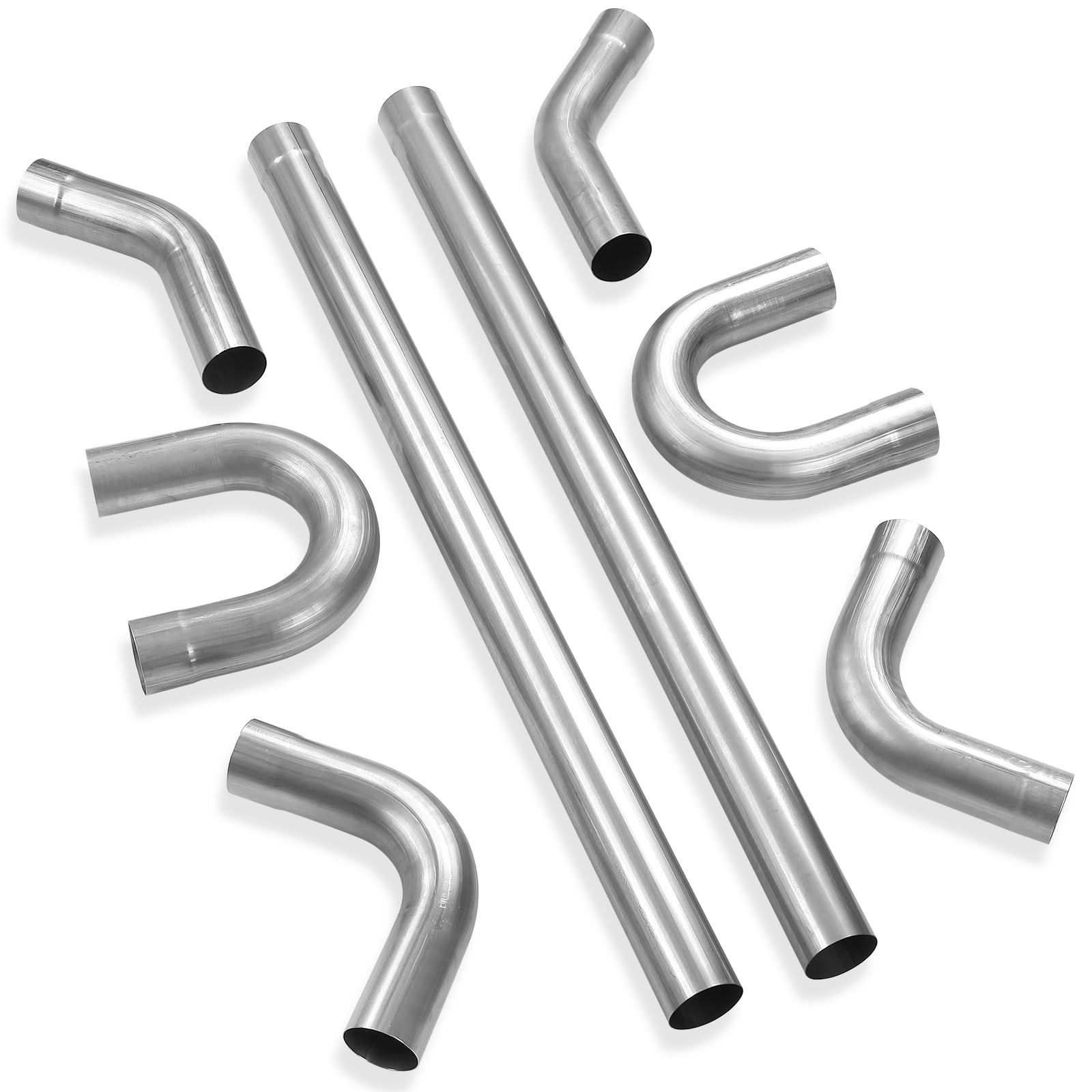
LCGP delivers a compact eight-piece kit that covers the most common fabrication needs without the excess material that forces you to pay for unused tubing. The package includes two straight tubes, two 90-degree bends, two 45-degree bends, and two 180-degree U-bends, all in mild steel with computer-controlled mandrel bends. This is a perfect starter set for someone building an exhaust on a small four-cylinder vehicle, an ATV, or a tractor.
Verified buyers praise how easily this mild steel accepts welds, with one customer noting that they were able to re-pipe an entire tractor with the included pieces. The flared ends facilitate slide-fitting, and the wall thickness feels substantial enough for a non-turbo application. The mandrel bends are clean and free of internal wrinkles, which means even a short section of 90-degree pipe maintains its full 2-inch internal cross-section.
The limitation here is the piece count: you get fewer straights and bends than the 16-piece kits, so if your routing requires more than two long straight sections, you will need to order additional pipe. The mild steel surface is bare and will flash-rust quickly if left uncoated, but for the price, this kit offers excellent value for a focused, smaller fabrication job.
What works
- Excellent weldability with standard MIG and flux-core welders
- Clean mandrel bends maintain full ID for unrestricted flow
- Slip-fit ends allow easy test-fitting before final assembly
What doesn’t
- Limited to eight pieces, which may not cover a full exhaust system
- Bare mild steel requires immediate coating or painting
5. DNA MOTORING 8-Piece Mild Steel Kit (ZTL-20RAW-8P)
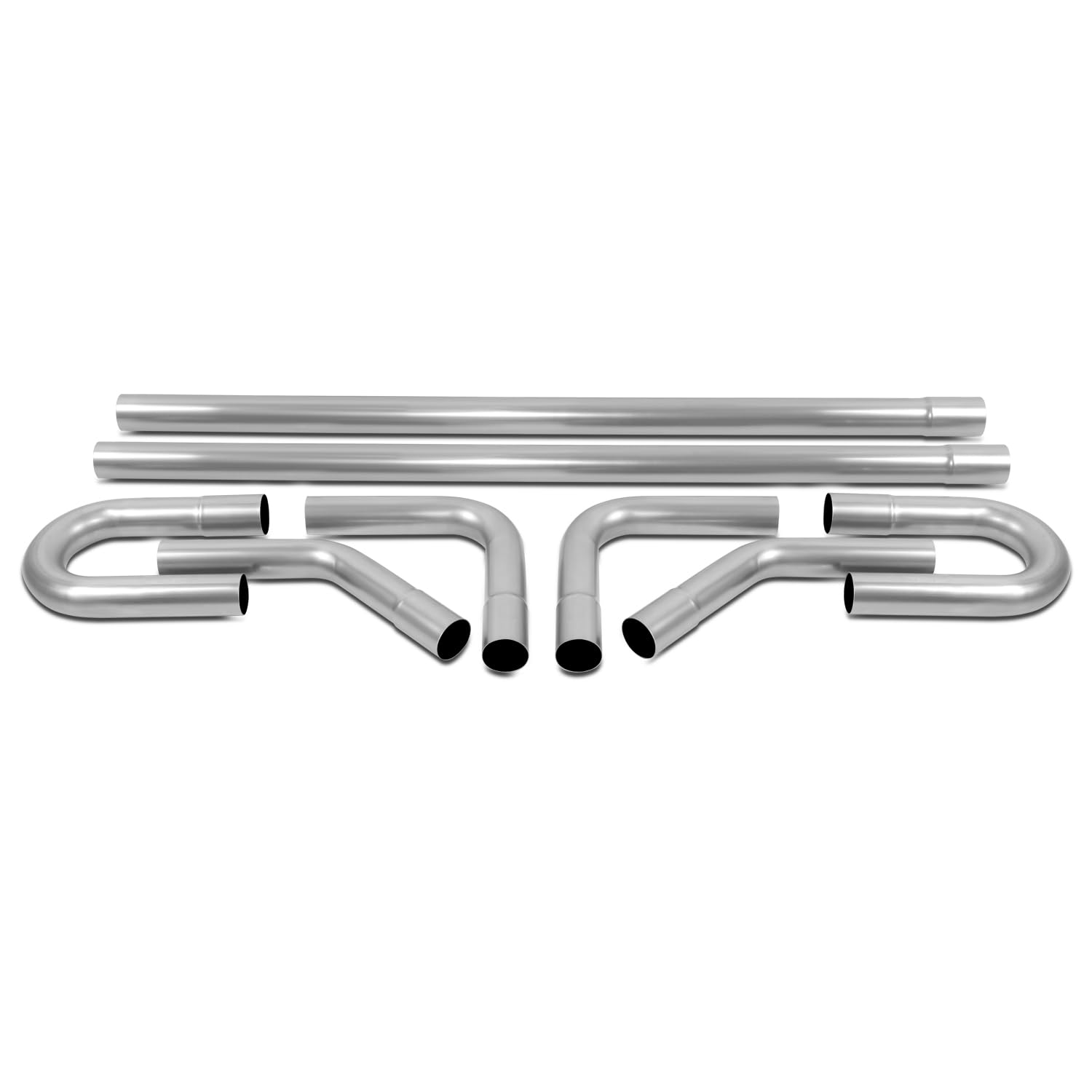
This eight-piece DNA MOTORING kit mirrors the configuration of the LCGP set, but adds a few thoughtful touches: the straight pipes measure 48 inches each, and the 18-gauge wall is uniform across all components. The 2-inch outside diameter is consistent, and the computerized mandrel bends show clean radii without the flat spots that plague cheap press-bent tubing. The expanded slip-fit ends are deep enough to provide a snug fit that holds alignment temporarily without clamps.
Buyer reviews highlight the convenience of having pre-flared ends that make it easy to rotate and adjust each joint before committing with a weld. One owner built a complete exhaust for an LS-swapped 1980 Trans Am using this kit, reporting that even a small dent on one cut end was easily knocked out. The 18-gauge mild steel is thin enough to cut with a standard pipe cutter, though most builders will still use a cut-off wheel for clean edges.
The main difference from the LCGP kit is the brand reputation and slightly longer straight pipes. DNAs quality control is consistent across their line, and this kit arrives well-packed with padding between each piece. The same limitations apply: if you need more than two straights or more than two of any bend angle, you will need to supplement the kit with additional pipes.
What works
- Long 48-inch straight pipes reduce the number of weld joints
- Uniform 18-gauge wall thickness across all bends
- Slip-fit ends allow easy rotation during test-fitting
What doesn’t
- Limited piece count requires supplemental pipes for full systems
- Mild steel will rust without high-temperature coating
6. FGJQEFG 3-Piece T304 Stainless Steel Kit

This three-piece kit from FGJQEFG targets the smallest fabrication tasks: a straight pipe, a 45-degree bend, and a 90-degree bend, all in T304 stainless steel with a polished finish. The 2-inch outside diameter is uniform, and the mandrel bends maintain the full internal cross-section without collapsing. For someone repairing a single rusted section or building a short extension, this kit avoids buying an entire 16-piece set.
The T304 alloy provides excellent corrosion resistance and a clean appearance that stays shiny long after installation. The polished finish is smooth enough that it resists carbon buildup better than a rough surface, and the material thickness feels consistent with 18-gauge standard. The straight pipe measures 40 inches, giving you a decent length for a mid-pipe or an over-axle section when combined with one of the bends.
The obvious constraint is the piece count. Three pieces will not build a full system, so this is best suited for patching an existing exhaust or adding a small section. The stainless steel is harder on cutting blades than mild steel, requiring a fresh abrasive disc for clean cuts. Welders should also account for the need to use a tri-mix or 100% argon gas for MIG welding stainless.
What works
- T304 stainless resists corrosion far better than mild steel
- Polished finish looks clean and resists carbon buildup
- Mandrel bends preserve full internal diameter
What doesn’t
- Only three pieces, insufficient for a complete exhaust system
- Stainless requires more careful welding technique and specialized gas
7. LCGP Single Straight Stainless Steel Pipe (48″)

LCGP offers this single 48-inch straight section in stainless steel for the simplest possible repair: replacing a straight section of rusted or damaged exhaust pipe. The tube is constructed from high-quality stainless steel with a consistent 2-inch outside diameter and a uniform inner bore. This is purely a straight section with no bends, so it is intended for mid-pipe replacements, muffler inlet extensions, or joining two sections with a straight connector.
The stainless steel construction means this pipe will not deteriorate quickly from moisture or road salt, and it offers a clean appearance that blends seamlessly with existing stainless components. The wall thickness is appropriate for a 2-inch exhaust application, and the ends are cut cleanly without burrs. Installation is straightforward: measure, cut to length using a stainless cutting disc, and weld or clamp in place.
The limitation of this product is its single-purpose nature. It is a straight pipe only — no bends, no flare, no slip-end expansion. For a simple repair where you already have bends from another kit or you are replacing a straight section between existing components, this is the budget-friendly solution that avoids paying for angles you do not need. For a full system build, you will need to order additional pieces separately.
What works
- Cost-effective solution for replacing a single straight section
- Stainless steel construction resists corrosion long-term
- 48-inch length provides enough material for most straight spans
What doesn’t
- No pre-expanded slip-fit ends require careful measurement
- Single piece only — not a full system solution
Hardware & Specs Guide
Mandrel Bending
The internal support rod (mandrel) used during the bending process prevents the pipe wall from collapsing inward on the tight radius. This preserves a consistent 2-inch inner diameter throughout the entire curve, which is critical for maintaining exhaust gas velocity and preventing reversion pulses. Cheaper crush-bent pipes reduce the internal area by up to 30% at the bend, which creates a measurable restriction.
Slip-Fit Ends
Most DIY exhaust kits feature expanded ends on each tube, where the terminal inch or two is slightly flared outward. This allows one pipe to slide inside another, creating a lap joint that can be tack-welded. The depth of the flare determines how much overlap you get — typically 2 to 2.5 inches — so you must deduct that overlap from your usable piping length when planning your route.
T304 vs. Mild Steel
T304 stainless steel contains 18% chromium and 8% nickel, which forms a passive oxide layer that resists corrosion, oxidation, and scaling up to roughly 1500°F. Mild steel (low carbon steel) has no such protection and will begin rusting within hours of exposure to moisture unless coated. Mild steel welds significantly easier because it conducts heat away from the weld pool more slowly, allowing better fusion at lower amperage.
Wall Gauge (16 vs. 18)
16-gauge tubing measures approximately 0.0625 inches thick, while 18-gauge measures about 0.048 inches. The thicker 16-gauge material resists denting, supports more weight without sagging, and allows more heat input during welding without burn-through. The thinner 18-gauge is lighter, easier to bend by hand for fine adjustments, and requires less filler material, but it is more prone to cracking at vibrating mounts if not properly braced.
FAQ
Can I weld mild steel exhaust tubing with a flux-core MIG welder?
How do I prevent rust on mild steel exhaust tubing after installation?
What is the difference between O.D. and I.D. when measuring 2-inch tubing?
Final Thoughts: The Verdict
For most builders, the 2 inch exhaust tubing winner is the DNA MOTORING ZTL-20SS 16-Piece Stainless Steel Kit because it combines the corrosion resistance of 304 stainless with the variety needed to route an entire system in one purchase. If you prefer a heavier wall for durability and easier welding, grab the YOLANDO 16-Piece 16-Gauge Kit. And for a budget-friendly repair on a single straight section, nothing beats the LCGP 48-Inch Stainless Steel Pipe.

Certification: BSc in Mechanical Engineering
Education: Mechanical engineer
Lives In: 539 W Commerce St, Dallas, TX 75208, USA
Md Amir is an auto mechanic student and writer with over half a decade of experience in the automotive field. He has worked with top automotive brands such as Lexus, Quantum, and also owns two automotive blogs autocarneed.com and taxiwiz.com.