An RV trailer battery is the silent heart of every off-grid adventure, yet most owners discover too late that their lead-acid unit simply cannot keep the lights on, the water pump running, and the furnace fan spinning through a full weekend away from shore power. The frustration of waking up to a dead house battery system, scrambling for a generator, or cutting a trip short because the fridge switched to propane mode is a pain that only a properly matched deep-cycle battery can solve. Choosing the right chemistry and capacity for your trailer isn’t an add-on; it is the single most important decision that determines whether you boondock in comfort or constantly fight voltage sag.
I’m Amir — the founder and writer behind Four Wheel Ask. I’ve spent years analyzing deep-cycle battery specifications, comparing discharge curves, BMS logic, and cycle-life data across hundreds of marine and RV battery models to understand what separates a true long-term investment from a short-term stopgap. My research focuses on real owner-reported duty cycles and lab-verified capacity retention rather than marketing claims.
Whether you run a small teardrop or a 40-foot fifth-wheel, finding the right battery for rv trailer means balancing amp-hour capacity, physical footprint, weight, and charging compatibility with your existing converter or solar setup — a calculation that directly dictates your freedom on the road.
How To Choose The Best Battery For RV Trailer
Selecting a house battery for your RV trailer requires understanding three tightly linked variables: battery chemistry, usable amp-hour capacity, and the physical size that fits your existing battery box. Your choice determines how many nights you can stay off-grid, how quickly you can recharge, and whether your converter or solar charge controller can safely replenish the bank.
Chemistry: LiFePO4 vs. AGM vs. Flooded Lead-Acid
Lithium iron phosphate (LiFePO4) batteries offer roughly three times the usable capacity of an equivalent amp-hour AGM battery because they can be discharged to 80-100% depth-of-discharge (DoD) without damage, whereas AGM batteries should stop at 50% DoD to avoid premature failure. LiFePO4 also weighs 50-60% less than AGM, charges significantly faster, and delivers 3,000-15,000 cycles versus 500-1,000 cycles for AGM. The trade-off is higher upfront cost, and some older RV converters do not have a lithium charging profile and may require a DC-DC charger or converter upgrade to reach the 14.4-14.6V absorption voltage LiFePO4 needs.
Capacity Sizing: Amp-Hours and Daily Load Calculation
To estimate capacity requirements, add up the watt-hour draw of every 12V device in your trailer — lights, water pump, furnace fan, fridge control board, USB chargers, and inverter loads — multiplied by the hours of expected daily use. Divide the total daily watt-hours by 12V to get amp-hours, then multiply by the number of off-grid days you want between charges. For a small to mid-size trailer with modest loads, a 100Ah battery is a solid minimum; larger rigs with a residential fridge or inverter-driven microwave often need 200Ah of LiFePO4 or 300-400Ah of AGM.
Physical Fit: BCI Group Size and Terminal Type
Most RV trailers use Group 24, Group 27, or Group 31 battery boxes. Group 24 batteries measure roughly 10.25″ x 6.8″ x 8.9″ and are common in smaller campers. Group 27 is slightly longer at about 12″ x 6.8″ x 9″, while Group 31 is the largest standard size at roughly 13″ x 6.8″ x 9.5″. Always measure your existing battery tray and check the terminal height clearance — lithium batteries are often shorter than lead-acid counterparts, which can leave too much slack in the hold-down bracket. Use marine-grade terminals (M8 or 5/16″) for secure, corrosion-resistant connections.
BMS Features and Low-Temperature Protection
A quality LiFePO4 battery includes a Battery Management System (BMS) that prevents overcharge, over-discharge, overcurrent, short circuits, and cell imbalance. The most critical feature for RV trailer owners is low-temperature charging protection: charging a LiFePO4 cell below 32°F (0°C) causes permanent damage. A BMS with a built-in temperature sensor will automatically block charging current below that threshold and resume charging once the cells warm up. If you regularly camp in freezing conditions, confirm the battery has this feature or pair it with a heated blanket pad.
Quick Comparison
On smaller screens, swipe sideways to see the full table.
| Model | Category | Best For | Key Spec | Amazon |
|---|---|---|---|---|
| Battle Born 100Ah LiFePO4 | LiFePO4 | Long-term reliability | 100Ah, 3,000-5,000 cycles, 31 lbs | Amazon |
| Renogy 12V 100Ah Core Mini | LiFePO4 | Tight spaces | 100Ah, Group 22NF, 50% smaller, 24 lbs | Amazon |
| Litime 12V 100Ah Bluetooth | LiFePO4 | Real-time monitoring | 100Ah, Group 27, Bluetooth 5.0, 22.9 lbs | Amazon |
| Power Queen 12V 100Ah | LiFePO4 | High cycle count | 100Ah, Group 31, 15,000 cycles, 24.3 lbs | Amazon |
| ECO-WORTHY 12V 100Ah Bluetooth | LiFePO4 | App-based integration | 100Ah, Group 27, Bluetooth/SOC display, 25.1 lbs | Amazon |
| SUPER EMPOWER 12V 100Ah Mini | LiFePO4 | Budget lithium entry | 100Ah, Group 24, 15,000 cycles, 21.6 lbs | Amazon |
| VMAX MR127 AGM | AGM | High-power trolling motor | 100Ah, Group 27 AGM, 68 lbs, 1000+ cycles | Amazon |
| WEIZE 12V 100Ah AGM | AGM | Heavy-duty solar storage | 100Ah, Group 31 AGM, 63 lbs, 1150A max | Amazon |
| Newport 12V 50Ah AGM | AGM | Lightweight marine/trolling | 50Ah, AGM, 32 lbs, sealed/leak-proof | Amazon |
In‑Depth Reviews
1. Battle Born 100Ah LiFePO4
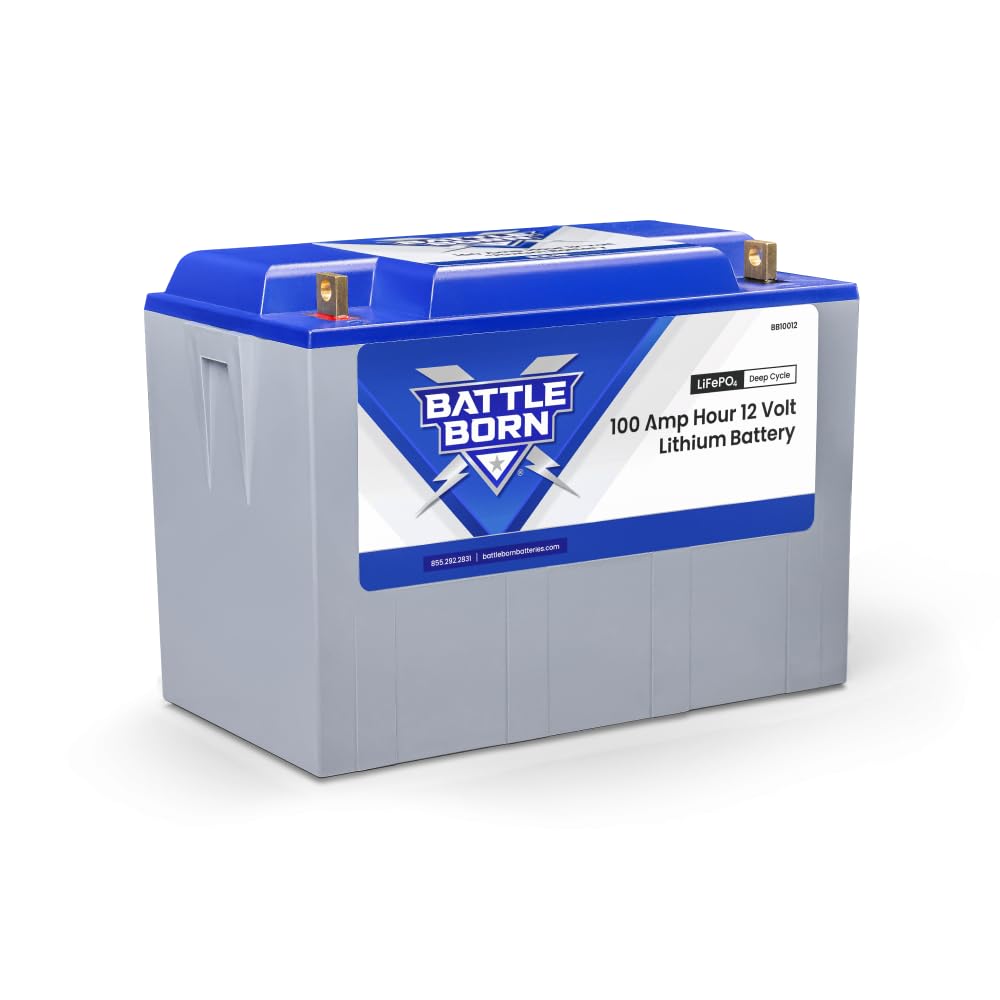
The Battle Born BB10012 has earned its reputation as the gold standard in the RV trailer battery space through sheer consistency. Its LiFePO4 chemistry delivers the full 100Ah of usable capacity daily, unlike AGM batteries that must leave half their capacity untouched to avoid damage, and its internal BMS includes low-temperature charging protection, high/low voltage cutoffs, and short-circuit prevention. Weighing only 31 pounds, this is a drop-in replacement for any Group 27 or 31 battery tray, and its rugged ABS casing handles the vibration and road shock of a travel trailer without issue.
With a cycle life rated at 3,000 to 5,000 deep discharges — translating to roughly 10 to 15 years of typical seasonal RV use — the BB10012 outperforms AGM alternatives by a factor of five to ten in lifespan. The built-in BMS also actively balances the four internal prismatic cells, preventing the gradual capacity drift that plagues cheaper lithium packs without cell-level management. This battery pairs flawlessly with most modern RV converters set to lithium mode, though owners with older converters should install a DC-DC charger for proper absorption voltage.
Customer feedback consistently highlights the battery’s ability to run a 12V fridge, LED lighting, water pump, and furnace fan for a full weekend without dropping below 30% state-of-charge, then recharging in under three hours with a 30A charger. The only real compromise is the premium price, but the 10-year warranty backs up the investment — Battle Born ships replacement units quickly if a BMS or cell failure occurs.
What works
- Full 100Ah usable capacity with 3,000+ deep cycles
- Extremely robust BMS with low-temp charge protection
- Lightweight 31 lbs simplifies handling and installation
- 10-year warranty provides unmatched long-term security
What doesn’t
- High upfront cost relative to entry-level lithium packs
- Requires lithium-compatible charger or converter for optimal charging
2. Renogy 12V 100Ah Core Mini

Renogy’s Core Mini series solves a specific but widespread problem: the battery compartment in teardrop trailers, small campers, and pop-up truck campers is barely large enough for a Group 24 battery, let alone a full-size Group 31. This 12.8V 100Ah LiFePO4 battery measures just 9.02″ x 5.43″ x 8.39″ — roughly 50% smaller in volume than a standard Group 31 — while still delivering the same usable capacity. The Group 22NF form factor fits spaces that previously forced owners to downsize to a 50Ah lead-acid.
Despite the compact dimensions, Renogy packed a 100A BMS with full protection against low-temperature charging (cutoff below 32°F), overcurrent, overvoltage, and short circuits. The IP65-rated casing is splash-resistant, making it a viable choice for marine applications or exposed battery trays. Optional remote monitoring via a Renogy battery shunt and DC Home app allows you to check voltage and state-of-charge from your phone, though the shunt is sold separately.
The EV-grade prismatic cells sit inside metallic spacers that prevent movement during rough towing, and the terminals accept standard M8 marine connectors. Owners report successfully fitting two of these side-by-side in a single Group 27 battery tray to create a 200Ah bank, doubling boondocking capacity without cutting or modifying the compartment. The 5-year warranty is solid, though the separate shunt cost for monitoring is a minor annoyance.
What works
- Drastically smaller footprint fits tight RV compartments
- Full 100A BMS with low-temp charge protection
- Splash-resistant IP65 casing for exposed installations
- Pairs seamlessly with Renogy solar ecosystem
What doesn’t
- Bluetooth monitoring requires separate shunt purchase
- Smaller case may leave gaps in standard battery hold-down brackets
3. Litime 12V 100Ah Bluetooth
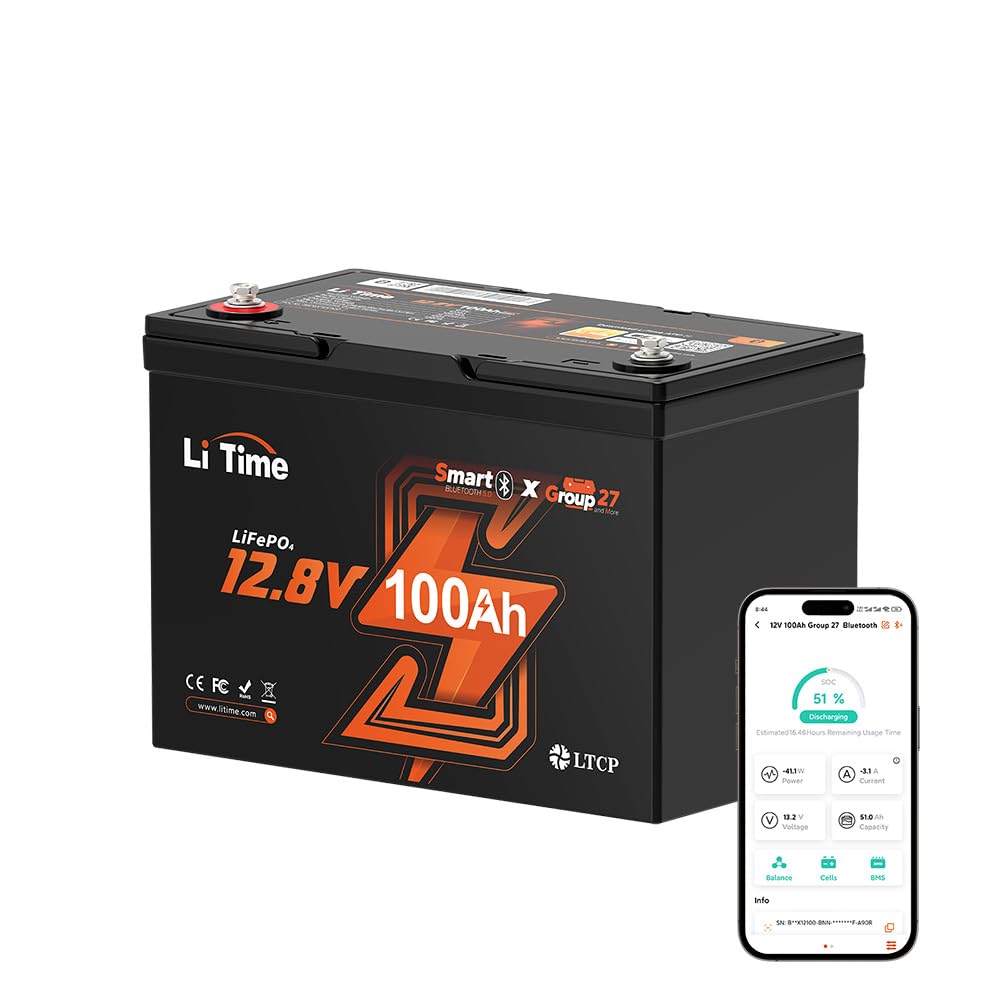
Litime’s Group 27 Bluetooth battery brings smart monitoring directly to the RV owner’s smartphone without requiring an external shunt. The integrated LiTime App displays real-time voltage, current, state-of-charge, and individual cell voltages, giving you the visibility to adjust your power consumption before the battery dips into dangerous deep-discharge territory. The 100A BMS includes a 30-second overload recovery timer, which prevents nuisance shutdowns from high-inrush loads like a water pump or power awning.
With 4,000+ cycles at 100% depth-of-discharge, this battery significantly outlasts AGM alternatives while weighing just 22.9 pounds — less than half the weight of an equivalent AGM unit. The low-temperature charging cutoff protects the cells in freezing weather, and the salt-spray and damp resistance make it suitable for coastal RV trips or humid environments. Up to 16 batteries can be connected in parallel for a 20.48kWh bank, though most trailer owners will stop at two for a 200Ah system.
RV-specific testing confirmed the battery fits perfectly in Brinkley Z 2900 and Four Winds 22E battery compartments, but any standard Group 27 tray will accept it. Owners note the Bluetooth connection holds strong up to about 30 feet through an RV wall. The only drawback is that older chargers may struggle to activate the BMS on first use — a quick charge with a lithium profile charger is recommended before connecting to an unknown converter.
What works
- Built-in Bluetooth eliminates need for separate shunt
- Group 27 size fits most common RV battery boxes
- 4,000 cycles at 100% DoD offers exceptional lifespan
- Salt-spray and damp resistance for harsh environments
What doesn’t
- May not activate with older lead-acid chargers
- No low-temp discharge protection (only charge protection)
4. Power Queen 12V 100Ah
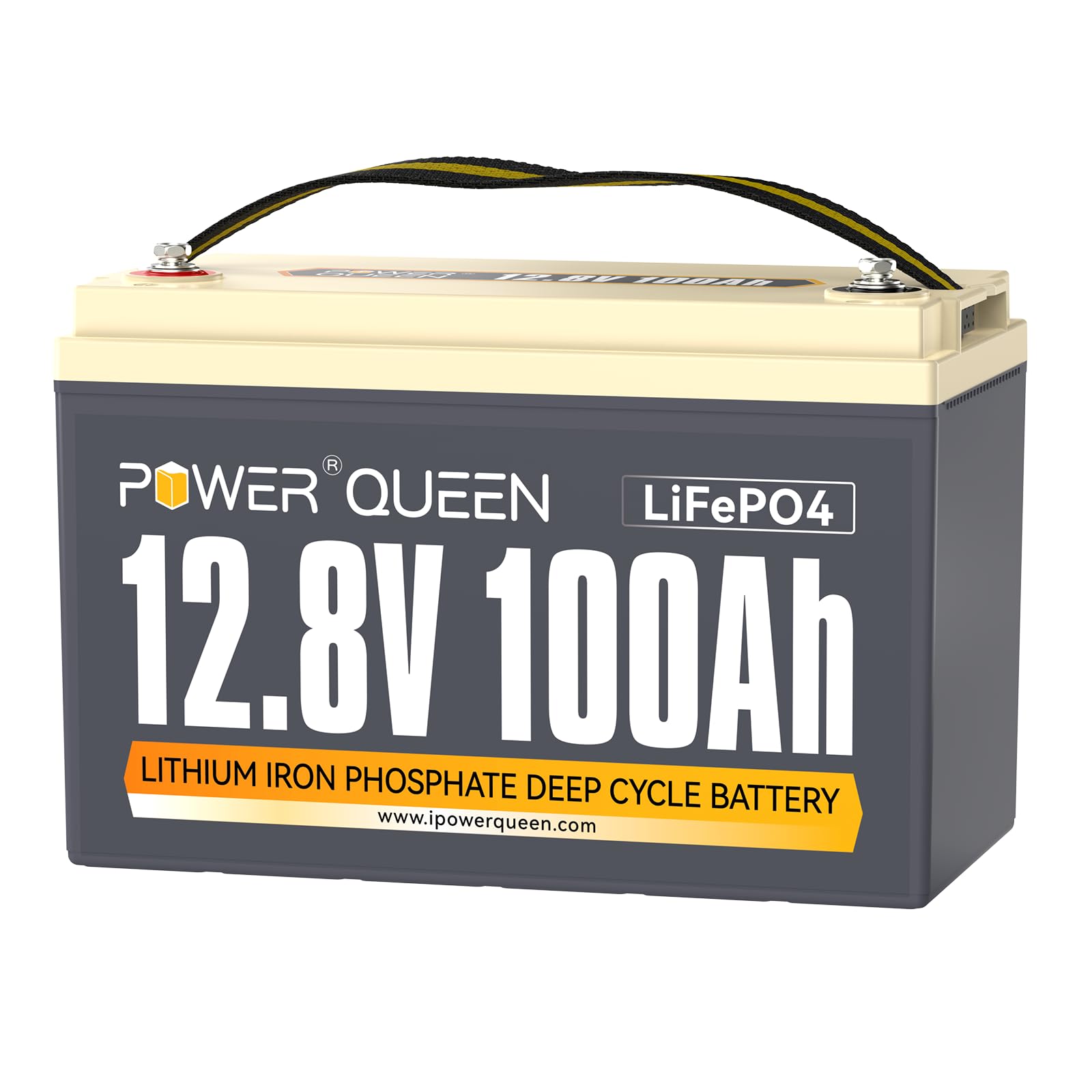
Power Queen’s Group 31 battery stakes its claim with an advertised 15,000 cycles at 60% depth-of-discharge, which translates into a theoretical service life that most RV owners will never exhaust. Even at 100% DoD, the Grade-A LiFePO4 cells hold up for roughly 4,000 cycles — still several times the lifespan of the best AGM batteries. The 100A BMS provides the standard protection suite, and the battery’s 24.25-pound weight makes it easy to handle during installation or seasonal removal.
The Group 31 dimensions (12.99″ x 6.77″ x 8.5″) are a perfect fit for trailers with standard Group 31 trays, and the M8 terminals accept crimped or ring-terminal lugs without adapters. Power Queen supports up to 4S4P configuration for large voltage or capacity arrays, though most RV applications keep it at 12V 200Ah using two in parallel. Owners consistently report strong performance driving 30-70lb thrust trolling motors for full-day outings, which indicates the battery handles sustained discharge loads without voltage sag.
The battery’s self-discharge rate of only 3% per month means it can sit through the winter storage season without needing a trickle charger, though the BMS does draw a tiny parasitic load. Some owners mention that the initial capacity out of the box measured slightly under 100Ah, which is common for LiFePO4 until full balancing occurs after the first complete charge-discharge cycle. The 5-year warranty is competitive at this price level.
What works
- Extremely high cycle life (15,000 at partial DoD)
- Lightweight at 24.25 lbs reduces tongue weight impact
- Group 31 form factor for standard RV trays
- Very low 3% monthly self-discharge for storage
What doesn’t
- No built-in Bluetooth for state monitoring
- Capacity balancing takes a complete initial cycle
5. ECO-WORTHY 12V 100Ah Bluetooth
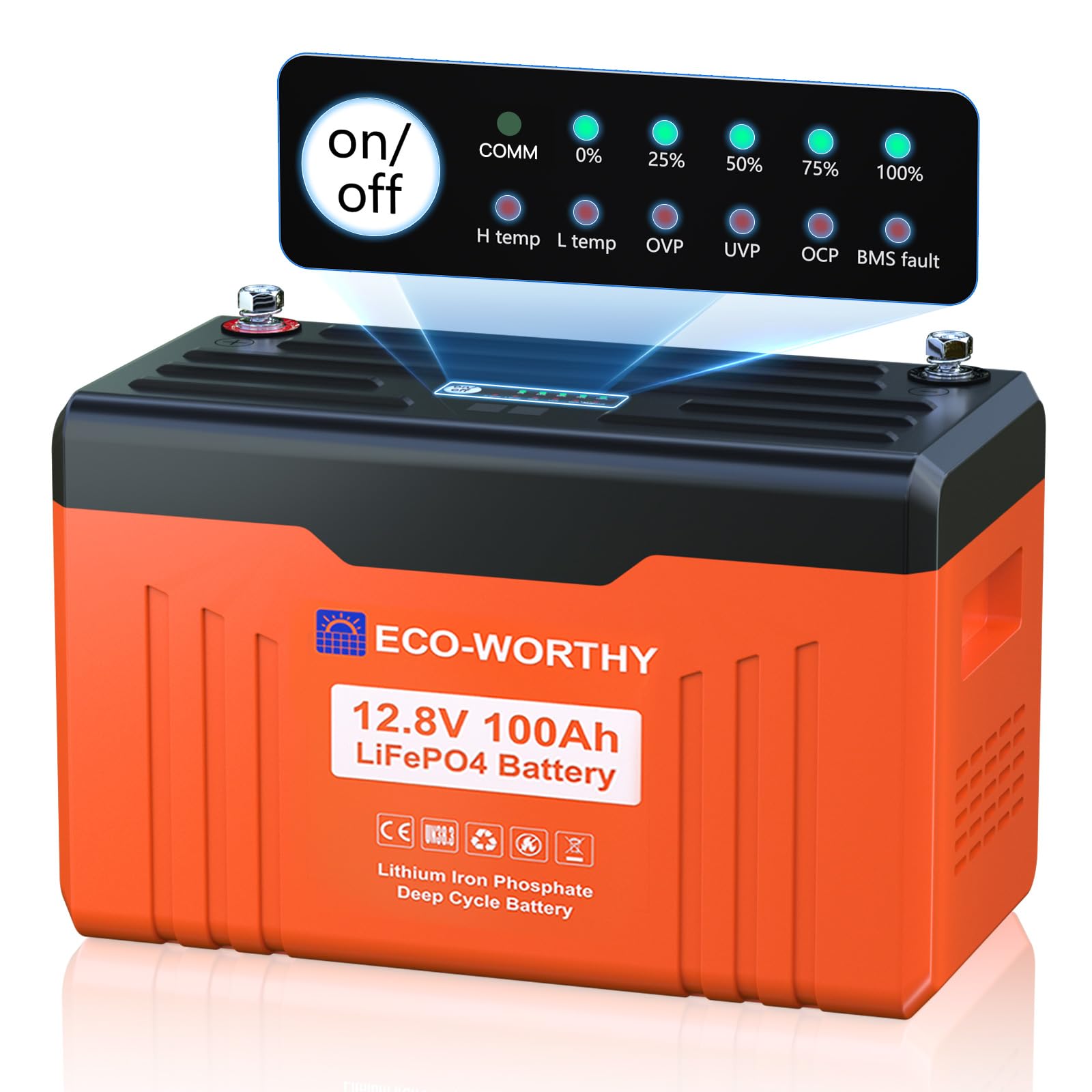
ECO-WORTHY’s 12V 100Ah LiFePO4 battery offers a rare combination: both a built-in Bluetooth module and a physical LED panel that displays state-of-charge directly on the battery case. This dual interface means you can check battery status at a glance without pulling out your phone, then dive into per-cell voltages, current, and runtime via the ECO-WORTHY App for deeper analysis. The Bluetooth range is rated at 98 feet, which comfortably covers the distance from a tow vehicle to the battery compartment in most trailers.
A unique feature is the buzzer alarm that sounds when the BMS detects a fault condition — overcurrent, over-temperature, or a severe imbalance — providing an immediate audible warning that an app notification might miss. The internal metallic cell spacer fixture prevents cell swelling and maintains structural integrity during vibration and thermal cycling, which extends service life. The battery supports 4P2S expansion up to 10.24kWh, giving growing solar systems room to scale.
At 25.1 pounds and measuring Group 27 size (11.8″ x 6.9″ x 8.7″), this battery is a direct replacement for existing lead-acid units in standard RV compartments. Some users experienced activation difficulty on first use with non-lithium chargers, requiring a dedicated LiFePO4 charger to wake the BMS. The 3-year warranty is shorter than some competitors, but the mid-range price point with Bluetooth and SOC display makes it a strong value proposition for tech-oriented owners.
What works
- Built-in Bluetooth plus LED SOC display for quick checks
- Audible BMS fault alarm provides instant safety alerts
- Metallic cell spacers prevent long-term physical damage
- Group 27 size fits common RV trays without modification
What doesn’t
- Initial activation may require lithium-specific charger
- 3-year warranty is shorter than premium alternatives
6. SUPER EMPOWER 12V 100Ah Mini
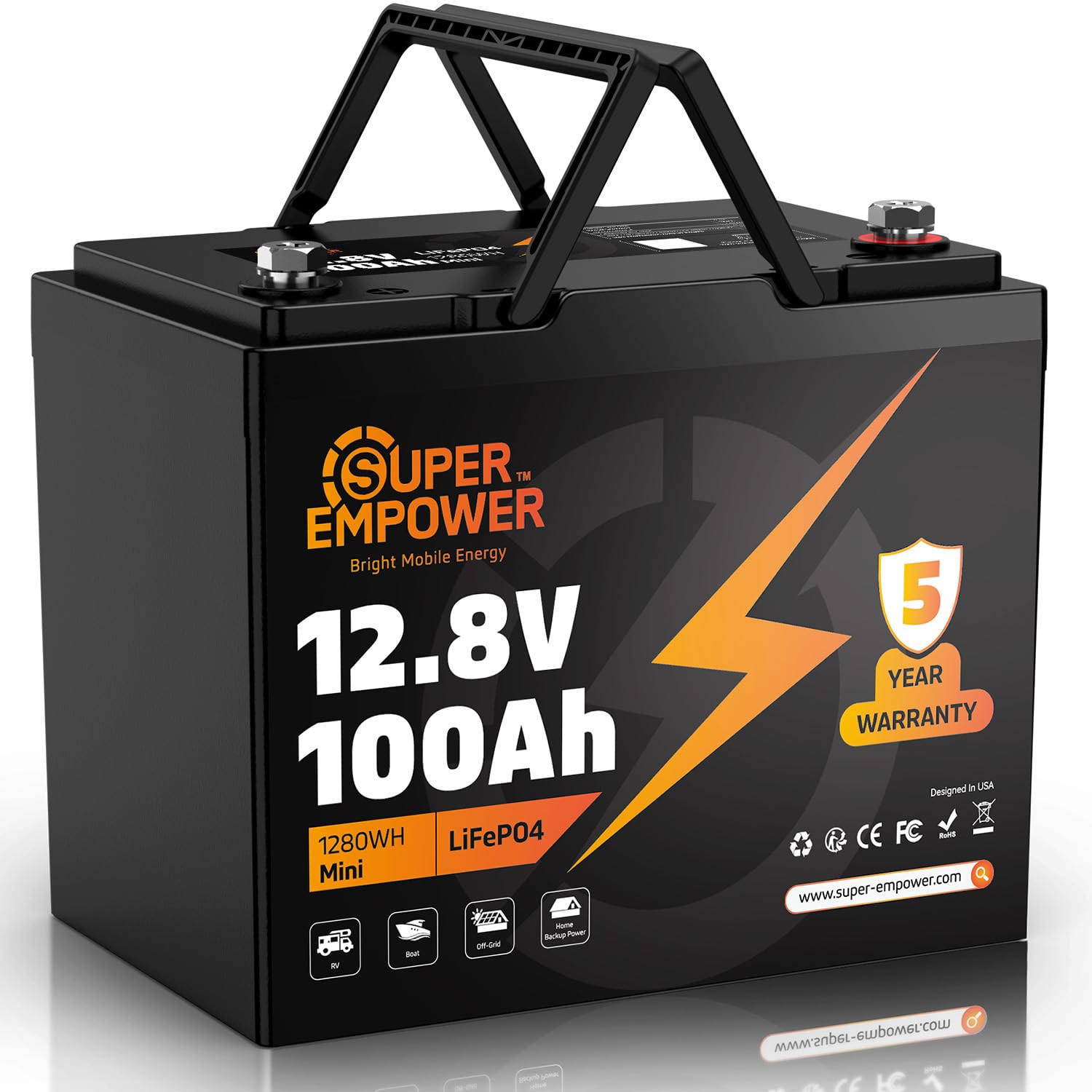
SUPER EMPOWER’s Group 24 mini LiFePO4 battery is the entry-level lithium champion for RV trailer owners who want to ditch lead-acid without spending premium-tier money. At just 21.6 pounds — the lightest 100Ah pack in this lineup — it slashes 30+ pounds compared to even a compact AGM, which directly reduces tongue weight and improves trailer handling. The Grade A+ cells are UL and FCC listed, and the 100A BMS manages standard protections along with low-temperature charging cutoff.
With 5,000 cycles at 100% DoD (and up to 15,000 cycles at 60% DoD), the lifespan dramatically outpaces any lead-acid replacement, and the 5-year warranty provides solid coverage. The M8 terminals accept standard 5/16″ ring lugs, and the dimensions (6.49″ x 10.24″ x 8.98″) fit most Group 24 battery boxes. Supporting 4S4P configurations allows expanding the bank to a 51.2V 400Ah system if you later upgrade to a hybrid inverter setup.
Real-world reports from RV owners show the battery easily powers basic boondocking loads — lights, water pump, 12V TV — for three days with a 200W solar panel. The one catch is the low-temperature protection: charging is disabled below 32°F, and discharge stops at -4°F, which is fine for most camping but requires attention if you winter in freezing climates. A few users noted the terminal bolts are a bit short for stacked lugs, so consider longer M8 bolts if adding multiple connections.
What works
- Lightest 100Ah pack at 21.6 lbs reduces RV tongue weight
- UL and FCC certified for safety compliance
- 5-year warranty matched by few entry-level batteries
- Extremely high cycle life for the price bracket
What doesn’t
- Short terminal bolts make multi-lug connections tight
- No Bluetooth monitoring included
7. VMAX MR127 AGM

For RV trailer owners who prefer AGM chemistry — or whose converter is not easily upgraded to lithium — the VMAX MR127 remains a benchmark for heavy-duty AGM performance. This Group 27, 100Ah battery uses a high-porosity absorbed glass mat (AGM) electrolyte suspension system without silica gels, delivering tight voltage regulation and very low internal resistance for high-current loads like trolling motors or inverter-fed appliances. The heavy-duty lead-tin alloy grids withstand repeated over-discharge better than standard AGM designs, extending service life in cyclic applications beyond what typical marine batteries achieve.
At 68 pounds, the MR127 is undeniably heavy, but the built-in carrying handles help with installation. The marine terminals accept both 1/4″ and 5/16″ hardware, and the leak-proof sealed construction means no off-gassing, no water refills, and safe installation inside enclosed battery compartments. VMAX rates the battery for 1,000+ cycles at 50% DoD, and owners report consistent 6-hour trolling runs at moderate throttle with a 55lb Minn Kota.
The primary limitation is capacity compared to lithium: because AGM should not be discharged below 50%, the usable capacity is effectively 50Ah despite the 100Ah label. If you run a 24V trolling motor system, two MR127s in series deliver 24V 100Ah effectively.
What works
- Excellent power delivery for high-current loads like trolling motors
- Fully compatible with any basic RV charger or converter
- Off-gassing sealed AGM design safe for interior compartments
- Built-in handles simplify heavy 68-lb installation
What doesn’t
- Effectively only 50Ah usable if protecting cycle life
- Very heavy at 68 pounds compared to lithium alternatives
- Only 1-year warranty reflects AGM lifespan limits
8. WEIZE 12V 100Ah AGM

WEIZE’s Group 31 sealed lead-acid AGM battery is the workhorse option for RV owners who need maximum capacity at the lowest upfront cost and are willing to accept the weight penalty. With a 1150A maximum discharge current, this battery can handle the high surge demands of large inverters or electric jacks without voltage drop. The dimensions (12.99″ x 6.73″ x 8.34″) fit standard Group 31 trays, and the polarity marking is clearly labeled on the red/black terminals.
The 100Ah rating provides approximately 50Ah of usable capacity when following the 50% DoD guideline for AGM longevity. Owners with off-grid solar setups commonly pair two WEIZE batteries in parallel for 200Ah total (100Ah usable), and reports confirm they can run a furnace fan, fridge, and LED lights for two to three days on solar recharge alone. The 3% self-discharge rate means the battery holds its charge well through winter storage without a maintainer.
At 63 pounds, this is not a battery you want to move frequently, and the lack of a built-in handle makes carrying it awkward — consider adding a strap or using a battery carrier. The 1-year warranty is standard for AGM, and while some owners report excellent 2-to-3-year performance, AGM chemistry inevitably degrades faster than lithium under cyclic use. This battery is best suited for owners with lead-acid-configured solar charge controllers who prioritize low entry price over lifespan.
What works
- Very low cost per amp-hour compared to lithium
- 1150A max discharge handles high-inrush loads easily
- Long shelf life with minimal self-discharge
- Fits standard Group 31 trays without adapter kits
What doesn’t
- 63-pound weight makes handling and installation difficult
- No built-in handle for carrying
- Usable capacity limited to roughly 50Ah to preserve cycle life
9. Newport 12V 50Ah AGM
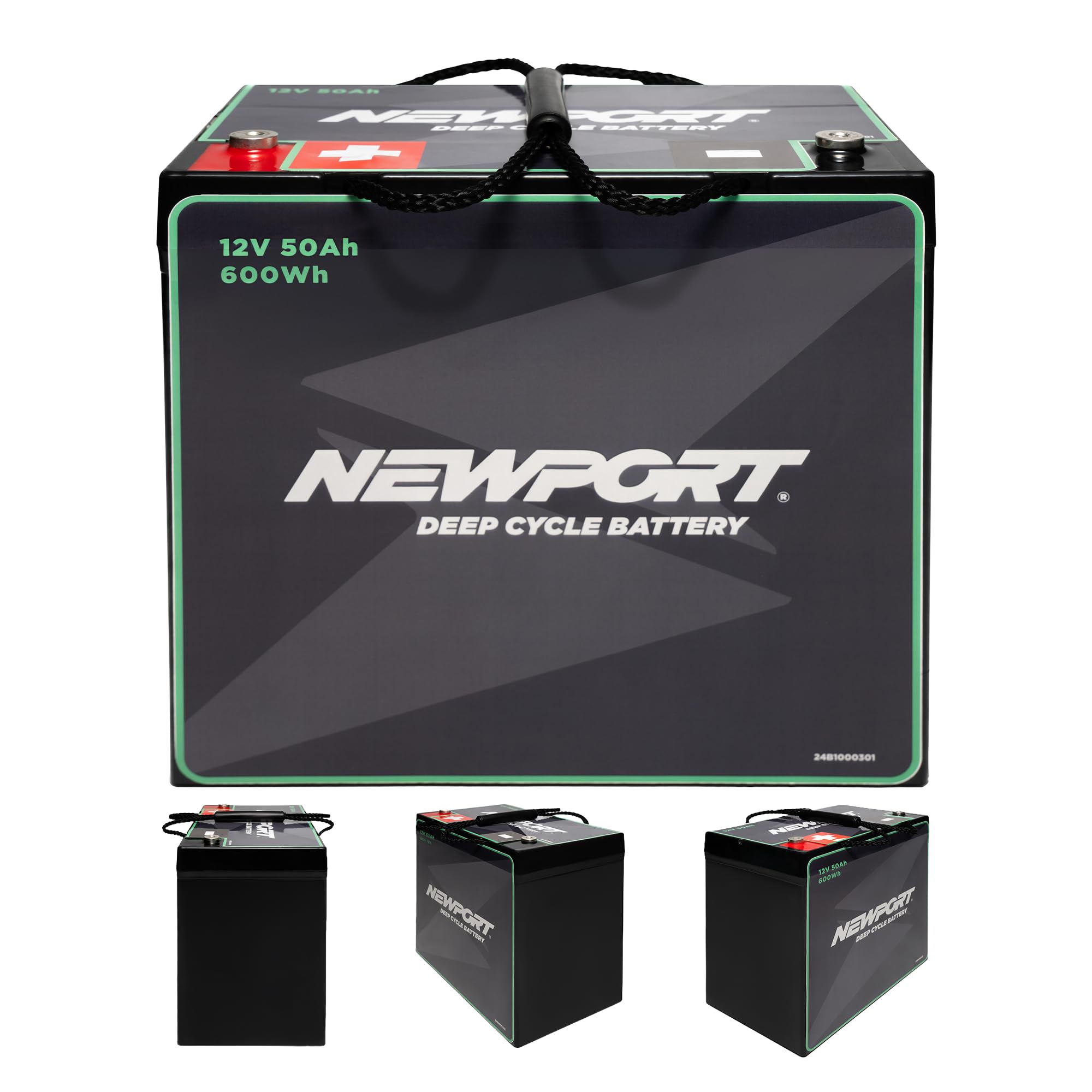
Newport’s 12V 50Ah AGM battery is the budget-friendly entry point specifically designed for lightweight RV setups, small pop-up campers, or as a secondary trolling motor battery. At 32 pounds, it is dramatically easier to lift and install than full-size 100Ah batteries, and the sealed AGM construction eliminates terminal corrosion and off-gassing worries. The 50Ah capacity translates to about 25Ah of usable power under the 50% DoD rule for AGM, which is sufficient for a night of minimal lighting and water pump use in a small teardrop trailer.
The marine terminals are compatible with standard trolling motor plugs and RV battery connectors, and the battery arrives fully charged and ready for installation. Customer feedback consistently praises the battery’s durability under demanding trolling motor loads — one owner reported a full 6-hour fishing run and still had over 50% charge remaining. The lightweight nature also makes it practical for seasonal removal and storage without needing a dolly or second person.
Where this battery falls short for larger RVs is simple capacity: 50Ah (25Ah usable) cannot sustain a furnace fan, fridge, and water pump for even one full night, and running a small inverter would drain it quickly. It is best viewed as a supplementary battery for specific tasks or for very small campers with extremely modest power needs. The 1-year warranty is standard, and the price point makes it an accessible first step into deep-cycle battery ownership.
What works
- Very lightweight at 32 lbs — easiest option to carry and install
- Sealed AGM design eliminates leaks and maintenance
- Excellent performance for dedicated trolling motor use
- Low price point ideal for budget-conscious beginners
What doesn’t
- 50Ah capacity insufficient for full RV house loads
- Usable capacity only ~25Ah due to AGM DoD limits
- 1-year warranty reflects entry-level expectations
Hardware & Specs Guide
Battery Chemistry Types
RV trailer batteries fall into three primary chemistries. Flooded lead-acid (FLA) batteries are the traditional affordable option but require monthly water refills, vent to release explosive hydrogen gas, and tolerate only 50% DoD before sulfation shortens life. AGM batteries are sealed, spill-proof, and maintenance-free, with the same 50% DoD limitation but better vibration resistance and faster recharge acceptance. LiFePO4 lithium batteries offer 80-100% usable capacity, weigh roughly one-third of AGM equivalents, charge up to three times faster, and last 3,000 to 15,000 cycles — but require a lithium-compatible charging source (14.4-14.6V absorption voltage).
BCI Group Size Dimensions
Standard Battery Council International (BCI) sizes ensure your new battery fits the existing tray. Group 24 measures about 10.25″ x 6.8″ x 8.9″ and is common in smaller campers and boats. Group 27 is roughly 12″ x 6.8″ x 9″ and is the most popular RV house battery size. Group 31 is the largest standard footprint at about 13″ x 6.8″ x 9.5″, offering the highest capacity in lead-acid. Niche sizes like Group 22NF (Renogy Core Mini) and Group 31 (Power Queen) exist; always measure your tray depth and width before ordering.
Amp-Hours vs. Usable Capacity
An AGM battery labeled 100Ah provides only 50Ah of usable energy if you want to maintain cycle life beyond 500 cycles. A LiFePO4 battery rated 100Ah delivers 90-100Ah usable daily because the BMS cuts off discharge before cell damage occurs. This means a 100Ah LiFePO4 battery effectively replaces a 200Ah AGM for the same runtime. When comparing battery labels, always mentally apply the chemistry-specific DoD multiplier: 0.5 for AGM/flooded, 0.9+ for LiFePO4.
BMS and Low-Temperature Protection
The Battery Management System in a LiFePO4 battery monitors individual cell voltages, balances them, and shuts down the battery if any parameter leaves the safe window. The most critical BMS feature for RV use is low-temperature charging protection: lithium cells cannot accept charge below 32°F (0°C) without suffering irreversible damage. A BMS with a built-in temperature sensor prevents charging below that threshold and resumes automatically when the cells warm to roughly 41°F (5°C). Pairs well with a battery heater pad if you winter-store the trailer in freezing conditions.
FAQ
How many amp-hours do I need for my RV trailer?
Can I replace my lead-acid battery with LiFePO4 in my RV trailer?
Do I need a special charger for a LiFePO4 RV trailer battery?
Will a LiFePO4 battery freeze and stop working in cold weather?
How long does a 100Ah LiFePO4 battery last in an RV trailer?
Final Thoughts: The Verdict
For most buyers, the battery for rv trailer winner is the Battle Born 100Ah LiFePO4 because it combines a 10-year warranty, proven 3,000+ cycle lifespan, and full 100Ah usable capacity in a drop-in package that fits nearly every standard RV tray. If you need the smallest possible footprint for a tight compartment, grab the Renogy 12V 100Ah Core Mini — its Group 22NF size fits where nothing else does. And for the best balance of smart monitoring and price, nothing beats the Litime 12V 100Ah Bluetooth with its integrated app and 4,000-cycle endurance.

Certification: BSc in Mechanical Engineering
Education: Mechanical engineer
Lives In: 539 W Commerce St, Dallas, TX 75208, USA
Md Amir is an auto mechanic student and writer with over half a decade of experience in the automotive field. He has worked with top automotive brands such as Lexus, Quantum, and also owns two automotive blogs autocarneed.com and taxiwiz.com.