The difference between a mini 4 wheeler that gets parked after a week and one that becomes a daily obsession comes down to a single number: motor torque measured against the rider’s weight. Too many parents buy on looks alone, only to watch their kids outgrow the power curve before the battery finishes its first charge cycle. A proper build must scale the drivetrain, suspension damping, and terrain clearance to the actual environment — grass versus gravel versus hardpack dirt — because each surface exposes a different weak point in the wrong spec.
I’m Amir — the founder and writer behind Four Wheel Ask. I’ve spent the last decade cross-referencing motor KV ratings, battery discharge curves, sidewall lug depth, and chassis flex patterns across hundreds of mini off-road machines to separate the genuinely capable rigs from the mall-crawler shells.
This guide narrows the field to nine builds that earn their keep, and ends with a clear verdict on the best mini 4 wheeler for your specific terrain, rider age, and budget ceiling.
How To Choose The Best Mini 4 Wheeler
A mini 4 wheeler is a multi-year investment in outdoor play, not a disposable impulse buy. The wrong choice means a machine that bogs on a grassy slope, dies halfway through an afternoon, or sits unused because the seat height doesn’t match your child’s growth curve. Focus on these three specs first.
Motor Voltage and Drivetrain Configuration
The 12V versus 24V split is the single biggest performance divider in the electric segment. A 12V system delivers around 50–80 watts per motor and struggles on any incline above 10 degrees, especially with a rider over 50 pounds. A 24V system — with four individual motors in a true 4×4 layout — produces roughly double the torque and maintains climbing ability on loose dirt or damp grass. Look for switchable 2WD/4WD as a bonus: 2WD preserves battery on flat pavement, while 4WD digs in when traction gets thin. For gas-powered builds, the displacement (99cc to 110cc) dictates torque delivery; a 99cc four-stroke with a 3HP rating can move a 220-pound rider but won’t pull the same grade as a 110cc without a lower gear set.
Battery Chemistry and Real-World Runtime
Sealed lead-acid (SLA) batteries are common in entry-level builds because they’re cheap to replace, but they suffer from voltage sag under sustained load and take 8–12 hours to fully recharge. A 24V 7Ah SLA pack on a 400W motor train typically yields 45–60 minutes of mixed-terrain riding before performance drops off noticeably. Lithium-ion packs are lighter and hold steady voltage until the last 10 percent of charge, but they cost more upfront and require specific charger profiles. The real number to watch is not the manufacturer’s “up to X hours” claim — that’s measured on flat concrete at low speed — but the discharge time under realistic throttle use: expect 50–75 percent of the advertised figure on grass or dirt with a rider near the weight limit.
Tire Size, Tread Pattern, and Ground Clearance
A mini 4 wheeler with 10-inch or smaller wheels and shallow tread will spin out on loose gravel and high-center on ruts deeper than two inches. Machines with 14-inch or larger wheels, aggressive directional lugs, and at least four inches of ground clearance can handle grass, packed dirt, and moderate mud without constant intervention. The sidewall construction matters too: multi-ply rubber resists punctures from sticks and rocks, while single-ply toy-grade tires are the first component to fail on rocky trails. If the primary use is pavement or hard-packed playground paths, smaller tires with a tighter tread pattern are quieter and more stable at higher speeds.
Quick Comparison
On smaller screens, swipe sideways to see the full table.
| Model | Category | Best For | Key Spec | Amazon |
|---|---|---|---|---|
| Burromax TT250 | Gas-Style Electric | Older kids wanting real dirt bike geometry | 250W motor, 14 mph top speed, 150 lb limit | Amazon |
| FRP GMB100 | Gas Mini Bike | Teens and adults on trails | 99cc 4-stroke, 28 mph, 220 lb limit | Amazon |
| ANPABO 24V 4×4 | Electric 4WD | Big kids who need adjustable seating | 4x200W motors, 5 mph, 130 lb capacity | Amazon |
| First Ride On Bronco Raptor | Licensed Ride-On | Siblings sharing a premium 2-seater | 24V dual drive, 4.3 mph, 3-point belts | Amazon |
| JOYRACER 2-Seater | Electric 2-Seater | Young siblings with remote control needed | 4x200W motors, 5 mph, 110 lb capacity | Amazon |
| Hikiddo Shark ATV | Electric 4WD | Terrain switching with 2WD/4WD selection | 4x200W motors, 5.6 mph, 14.4″ tires | Amazon |
| ELEMARA 24V 2-Seater | Electric 2-Seater | Two kids sharing a budget-friendly ride | 4x100W motors, 5 mph, 130 lb capacity | Amazon |
| RJV 24V ATV | Electric Single-Seat | First-time riders learning twist-throttle | 24V battery, twist-grip throttle, LED lights | Amazon |
| Okay Run 4-Seater | Multi-Passenger UTV | Playdates and group riding | 24V, 4-seater, 220 lb max, 4.4 mph | Amazon |
In‑Depth Reviews
1. Burromax TT250 Electric Dirt Bike
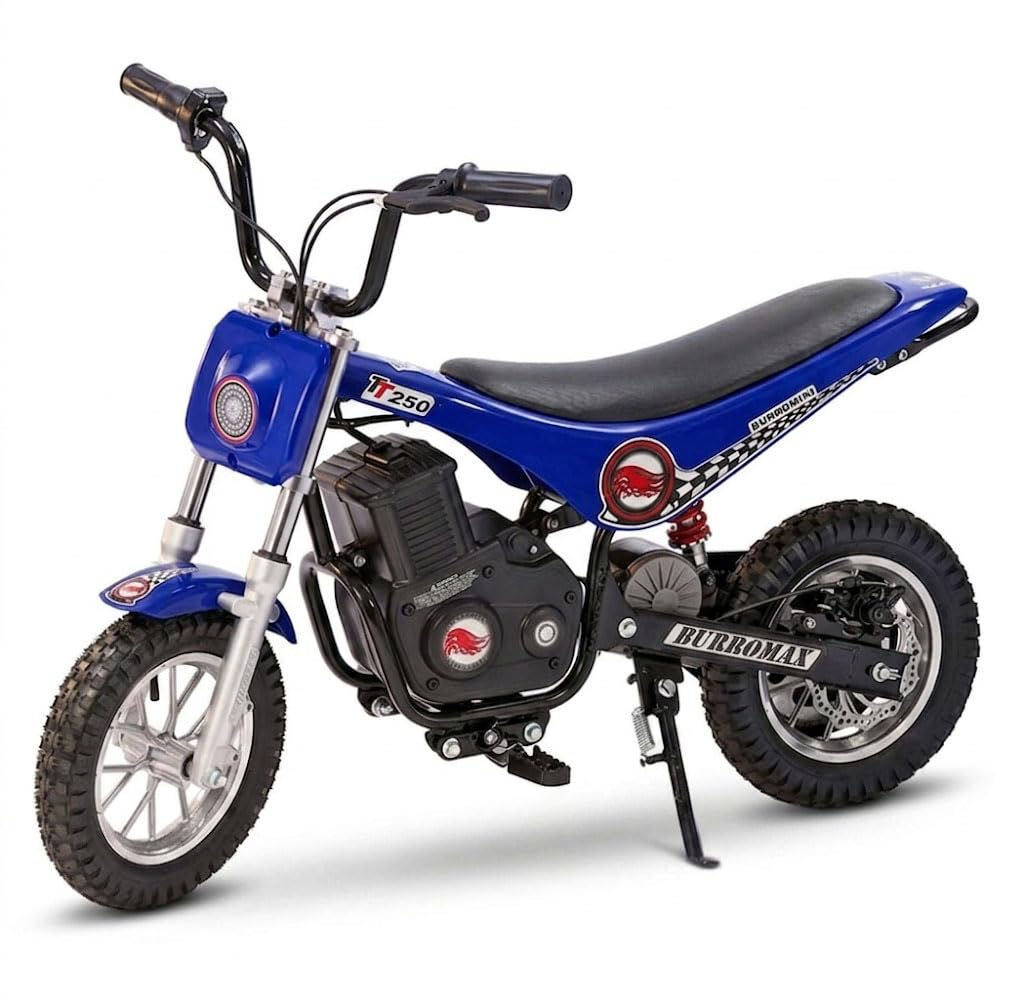
This is the machine that bridges the gap between a toy-grade ride-on and a proper off-road machine. The TT250 uses a high-torque 250W motor paired with a 24V SLA battery that delivers up to 120 minutes of continuous run time — or about 45 minutes if you’re running at the full 14 mph on loose dirt. The full-suspension motocross frame geometry, hand-operated rear disc brake, and 12.5-inch knobby tires with spoked wheels give it handling characteristics that mimic a real dirt bike scaled down for riders aged 6–10.
The two-speed setting is where this build earns its place: the low-speed mode locks at 7 mph for beginners still learning clutchless throttle modulation, while the high-speed mode opens up the full 14 mph for confident riders. The chain-drive rear end delivers noticeably more traction than any belt-driven electric quad at this price point, and the high-strength carbon steel frame with reinforced footpegs withstands repeated drops without developing play in the suspension mounts.
Burromax stocks every replacement part — from brake pads to handlebar risers — and offers bolt-on plug-n-play upgrades so the bike can grow with the rider. The trade-off is the SLA battery’s 8-hour recharge window and the fact that the bike arrives partially assembled (handlebar clamping and tire inflation required). But for a child who has outgrown 5 mph quads and wants actual dirt bike ergonomics, this is the most capable electric option under four figures.
What works
- Full motocross geometry with front and rear suspension soaks up bumps that would bounce a plastic quad sideways
- Chain-drive rear end provides better traction than any belt-driven competitor at this price
- Two-speed mode (7 mph / 14 mph) lets absolute beginners learn on low without outgrowing the bike too fast
What doesn’t
- SLA battery takes a full 8 hours to recharge after a hard ride, limiting multi-session days
- No remote control for parents — this is a fully independent rider machine, not a watch-and-steer toy
2. FRP Mini Dirt Bike GMB100
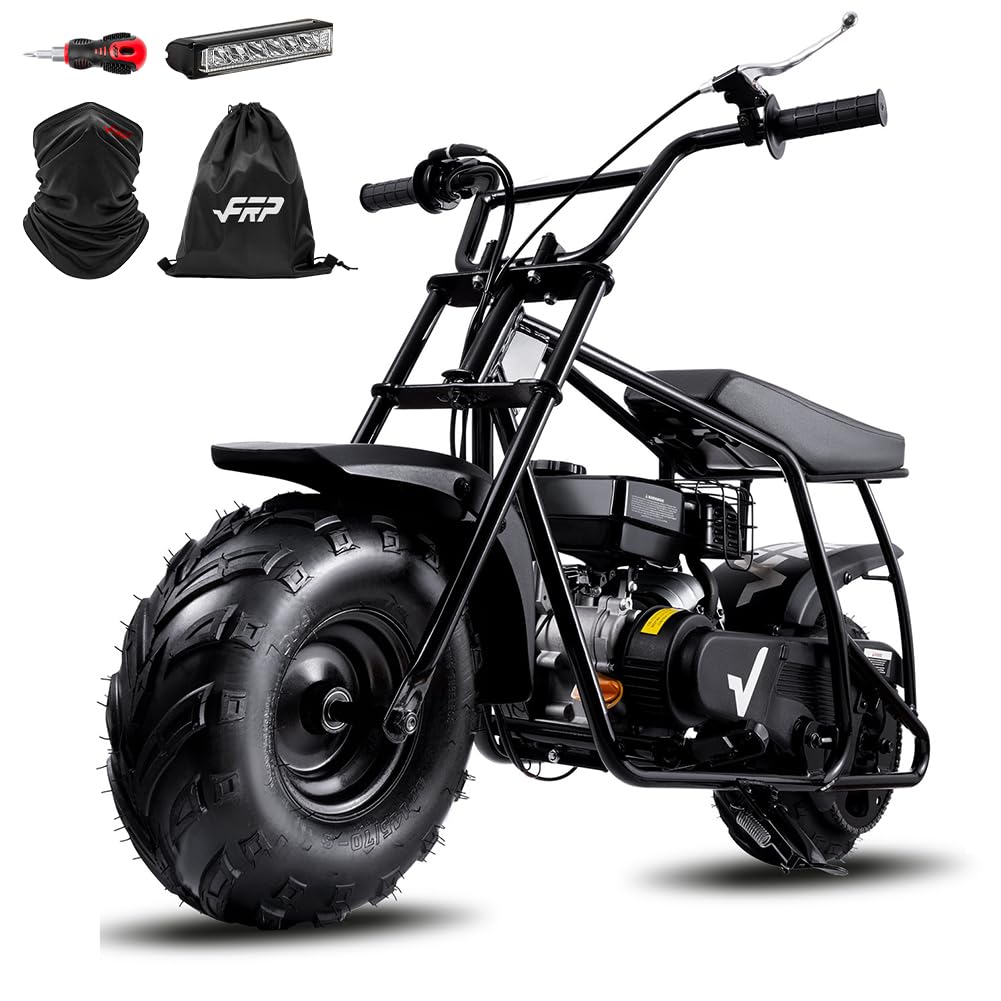
Gasoline changes the math entirely. The FRP GMB100 packs a 99cc four-stroke engine that produces roughly 3 HP — enough to push a 220-pound rider to 28 mph on flat ground — and delivers a 30-mile range on a single 0.36-gallon tank. That’s roughly three to four times the runtime of any 24V electric quad at a comparable price. The kick-start mechanism requires a pull-start that usually fires within three pulls, and the single-speed automatic transmission eliminates clutch anxiety for beginners.
The frame uses a high-strength steel backbone with a rear disc brake and a chain-tensioning system that genuinely prevents derailment under load — a common failure point on cheaper gas mini bikes. The 15W-40 oil specification is non-negotiable: running standard 10W-30 causes the engine to overheat within 20 minutes of sustained high-RPM riding. The included rechargeable LED headlight and neck gaiter are thoughtful additions, but the real story is the torque curve. This engine pulls from idle without stalling, so riders can crawl over roots and rocks at walking speed then crack the throttle open on a straightaway.
The main compromises are noise (it’s loud enough that suburban neighbors will notice) and maintenance (oil changes every 10 hours, chain lubrication, and valve checks). The recommended minimum age is 13, and the bike is physically larger than any electric option in this guide — the 50-inch length and 79.5-pound dry weight require a dedicated storage area. For a teen or small adult who wants a legit trail bike without spending thousands on a Honda or Yamaha, the GMB100 is the only true off-road weapon in this list.
What works
- 30-mile range on a quarter-gallon of fuel — three times the runtime of any electric machine here
- 99cc four-stroke pulls from idle without stalling, giving true trail-crawling capability at walking pace
- Chain tensioner stays tight under load, unlike the derailed chains common on sub- gas bikes
What doesn’t
- Engine noise and exhaust smell limit riding in close-proximity neighborhoods or shared parks
- Requires regular maintenance (oil changes, chain lube, valve adjustments) that electric owners never deal with
3. ANPABO 24V 4×4 Ride On ATV

The ANPABO solves the single biggest pain point in the electric kids quad category: seat sizing. Most ride-ons offer a fixed seat position that fits a 3-year-old perfectly but becomes cramped by age 5. This machine uses a three-position adjustable seat with a 3.14-inch range, so the same chassis can accommodate a child as they grow from age 3 into the early teen years without the cramped leg position that causes kids to lose interest. The 15.8-by-13.8-inch seat is also wider than any competitor at this price tier.
Under the seat, the 24V battery feeds four 200W motors through a switchable 2WD/4WD transfer case. In 2WD mode the machine conserves battery on pavement and hardpack, while 4WD engages all four motors for loose dirt and grassy slopes. The 14-inch wear-resistant tires with multi-ply sidewalls and four large spring suspensions (two at each axle) give it genuine off-road composure that the single-spring quads lack. The metal frame — not the injection-molded plastic shell found on budget machines — resists cracking when the chassis twists over uneven terrain.
The 2.4 GHz remote control includes an emergency P button that stops the vehicle instantly, which is the best safety feature for parents of newly confident riders. The front tow handle is a welcome addition for the inevitable dead-battery walk home. The downsides are predictable: at 70.6 pounds this is a heavy machine to lift into a car trunk, and the 3.1–5 mph speed band feels slow to kids who have already experienced a 14 mph dirt bike. But for a 4×4 electric quad that actually fits a growing child, this is the most thoughtfully designed option in its segment.
What works
- Three-position adjustable seat grows with the rider from age 3 to early teens, not a one-season fit
- Switchable 2WD/4WD and metal frame provide real off-road durability that plastic shells can’t match
- Parent remote with emergency P button gives instant override for unexpected obstacles or steep grades
What doesn’t
- 5 mph top speed feels underwhelming for older kids who have already experienced faster machines
- 70-pound curb weight makes trunk transport difficult without a second person or a ramp
4. First Ride On Ford Bronco Raptor 24V

Ford’s official licensing means this isn’t just a generic buggy with a sticker slapped on — the front grille, fender flares, and tailgate trim mirror the actual Bronco Raptor design, which matters to kids who recognize the real truck. The 21-inch dual seat fits two children comfortably, and the three-speed system (2.0, 2.7, and 4.3 mph) gives parents a way to restrict speed for indoor garage driving while opening it up for outdoor cul-de-sac runs. The 98-foot remote control range is generous enough for most front yards.
Safety hardware is a step above the generic competition: two individual three-point seat belts (not a single lap belt that lets kids slide around), anti-slip seat material that actually keeps the rider planted during cornering, and rear shock absorbers that reduce the pitching motion common on long-wheelbase 2-seaters. The soft-start technology ramps up power delivery instead of lurching, which prevents the neck-snap launch that scares timid toddlers. The battery life ranges from 50 minutes to 2 hours depending on speed setting and terrain grade.
The dual-drive 24V system uses two motors rather than four, which limits low-speed creeping traction compared to the 4WD builds above. On dry pavement this isn’t noticeable, but on dewy grass the rear wheels can spin out if the rider stomps the pedal from a standstill. The entertainment suite — Bluetooth, radio, built-in music — is the most complete in this comparison, and the adjustable volume means parents aren’t forced to listen to the same nursery rhyme on loop at maximum gain. For the household that values style and sibling riding over raw trail performance, this Bronco is the clearest winner.
What works
- Official Ford Bronco Raptor design with authentic trim details that stand out from generic buggy bodies
- Three-point seat belts on both seats keep riders secure during sharp turns or unexpected stops
- Soft-start acceleration prevents jerky launches that can startle young or first-time drivers
What doesn’t
- Dual-motor drivetrain lacks the creeping traction of 4-motor 4WD builds on wet grass or loose gravel
- 4.3 mph top speed feels restrictive for a 7- or 8-year-old who’s ready for more pace
5. JOYRACER 24V 2-Seater ATV
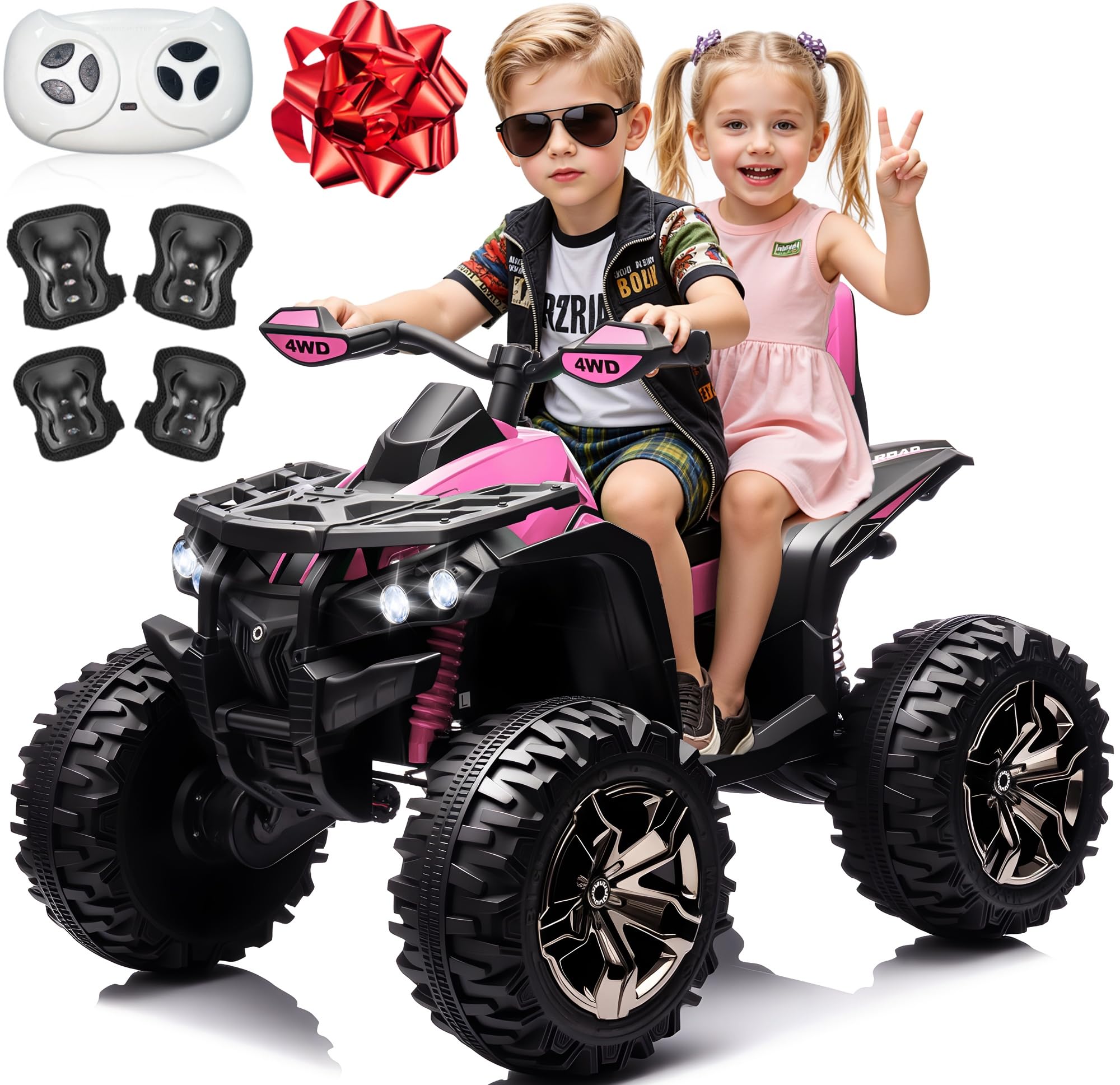
The JOYRACER differentiates itself with a 24V 9Ah battery that delivers a genuine 1–2 hours of mixed-terrain riding — at the higher end of the electric quad runtime spectrum. The four 200W motors draw from that capacity efficiently because the chassis defaults to a progressive pedal curve rather than an on-off switch, so the motors aren’t constantly pulling full current. The 2.4 GHz remote control offers three speed caps (1.8, 2.85, and 5 mph), which gives parents granular control as their child’s confidence and ability develop.
The dual-seat layout includes a backrest that prevents the passenger from leaning backward during acceleration — a detail that most 2-seater builds overlook, resulting in the rear rider sliding off on hills. The ASTM-certified anti-slip tires are notably more compliant on hard surfaces than the foam-filled toy wheels on budget quads, and the shock-absorption suspension system uses grease-lubricated metal sleeves rather than dry plastic bushings that squeak after two months. The included knee and elbow pads are functional enough for driveway riding, though they won’t survive a proper off-road crash.
Bluetooth integration, a TF card slot, and a radio let kids play their own music rather than being stuck with the preloaded tracks. The 1-year parts warranty from JOYRACER is better than the 30-day coverage most generic brands offer. The downsides are the 8–12 hour recharge window for the lead-acid pack and a 110-pound weight limit that two growing children will reach faster than expected. If you’re buying for two kids who weigh a combined 90 pounds or less, this is the most versatile 2-seater in the mid-range.
What works
- 1–2 hours of actual ride time on a full charge, besting most electric quads in this price bracket
- Remote control with three speed caps lets parents increase limit gradually as skills improve
- Backrest on both seats prevents the passenger from sliding off during uphill climbs
What doesn’t
- 110-pound combined weight limit means older siblings or heavier kids will max out the capacity quickly
- Lead-acid battery takes 8–12 hours to fully recharge, limiting back-to-back riding sessions on the same day
6. Hikiddo Shark Kids ATV 24V 4WD
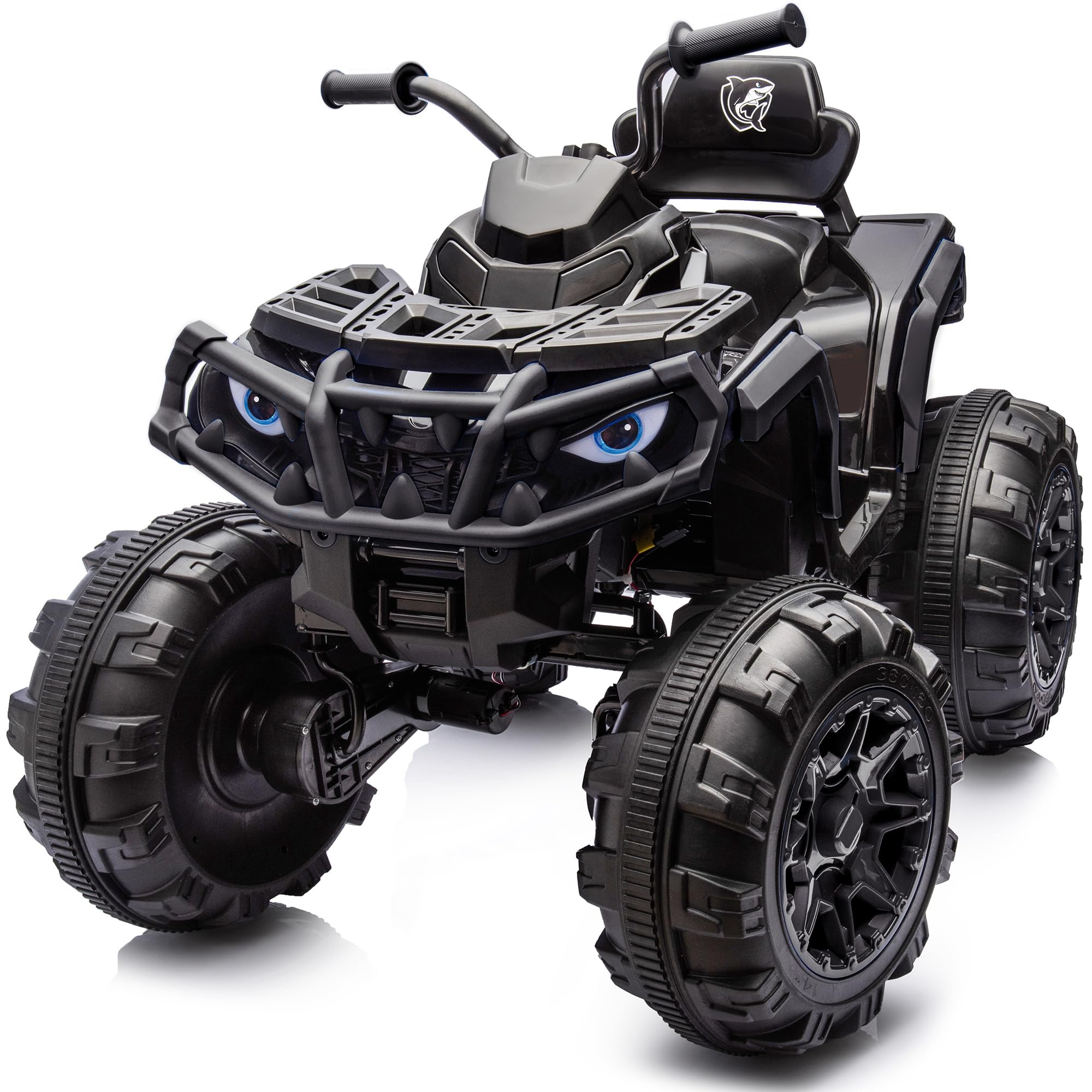
The Hikiddo Shark is built around a single feature that most quads this size don’t offer: a 14.4-inch tire diameter. That’s two inches larger than the standard 12-inch wheels on comparable 24V machines, which translates directly to better rollover clearance over roots, rocks, and uneven lawn transitions. The 2WD/4WD switchable mode is genuine — not a marketing gimmick — and the difference is immediately noticeable when climbing a grassy slope: 2WD spins the rear tires on damp mornings, while 4WD pulls evenly with all four motors engaged.
The four 200W motors produce a combined 800W peak output that pushes the 66-pound weight limit rider to 5.6 mph, which is marginally faster than the 5 mph cap on most competitors. The 24V battery delivers a true 60+ minutes of continuous playtime under mixed throttle use, and the rubber tires provide better sidewall flex on hardpack than the hollow-plastic wheels found on entry-level machines. The assembly time is genuinely 15 minutes — the main chassis comes pre-assembled, and you only need to bolt on the handlebar assembly and front wheels.
The shark-themed body styling is more aggressive than the generic rounded quads, which appeals to kids who want a tough-looking machine. The LED headlights and realistic engine sounds add to the immersion. The main limitation is the 66-pound maximum rider weight, which is lower than the 110–130 pound limits on the 2-seater builds — a single child near the upper weight limit will feel the performance margin shrink. For a solo rider between 37 and 66 pounds who wants genuine 4WD capability and the largest tire footprint in this price tier, the Shark delivers precisely that.
What works
- 14.4-inch tires clear obstacles that stop 12-inch wheels cold, especially on uneven lawn transitions
- Genuine switchable 2WD/4WD makes a real traction difference on wet grass versus single-surface setups
- 15-minute assembly time out of the box is the quickest setup of any machine in this list
What doesn’t
- 66-pound rider weight limit is the lowest in the mid-range category and limits long-term usability
- 5.6 mph top speed is only marginally faster than cheaper 5 mph quads, not a meaningful upgrade for older kids
7. ELEMARA 24V 2-Seater ATV

The ELEMARA takes the basic 2-seater formula and strips away the non-essentials to hit a price point that undercuts most dual-passenger quads by a significant margin. The 18-inch extended seat accommodates two children side by side with a combined 130-pound capacity, and the 4×100W motors provide enough torque for flat pavement and gentle grass inclines at up to 5 mph. The spring suspensions on the front wheels — two independent shock-absorbing springs — reduce the chassis pitching that makes budget 2-seaters feel unstable when the rear rider leans.
The tread pattern on the four large wheels is more aggressive than the smooth-roller tires on ultra-budget machines, giving it adequate grip on packed dirt and asphalt. The LED headlights, pedal accelerator, forward/reverse function, and integrated music system cover the essential features without adding complexity that drives up the failure rate. The soft-start technology prevents the initial lurch that can throw an unprepared passenger backward, and the battery indicator takes the guesswork out of knowing when to head home.
The most obvious trade-off is motor power: 4×100W motors produce half the peak wattage of the 4×200W builds above, so this machine slows noticeably on any incline steeper than 8 degrees with two riders aboard. The 5 mph top speed is fine for a 3- or 4-year-old but feels glacial to a 6-year-old who has already experienced faster rides. The 42.3-pound weight is manageable for a parent to drag through a gate, but the plastic-heavy construction means the chassis won’t survive repeated abuse on rocky trails. For a first electric quad intended for flat suburban driveways and sidewalk cruising, the ELEMARA delivers solid value without overpromising.
What works
- 130-pound combined capacity supports two smaller kids simultaneously without sagging or bogging
- Front spring suspensions absorb driveway bumps better than the rigid-axle alternatives at the same low price
- Soft-start acceleration and battery gauge are practical safety features that budget quads often omit
What doesn’t
- 4×100W motors lack the climbing torque for slopes over 8 degrees with two riders on board
- Plastic-heavy frame won’t tolerate rocky trails or repeated drops like a metal-chassis build
8. RJV 24V Kids Ride On ATV
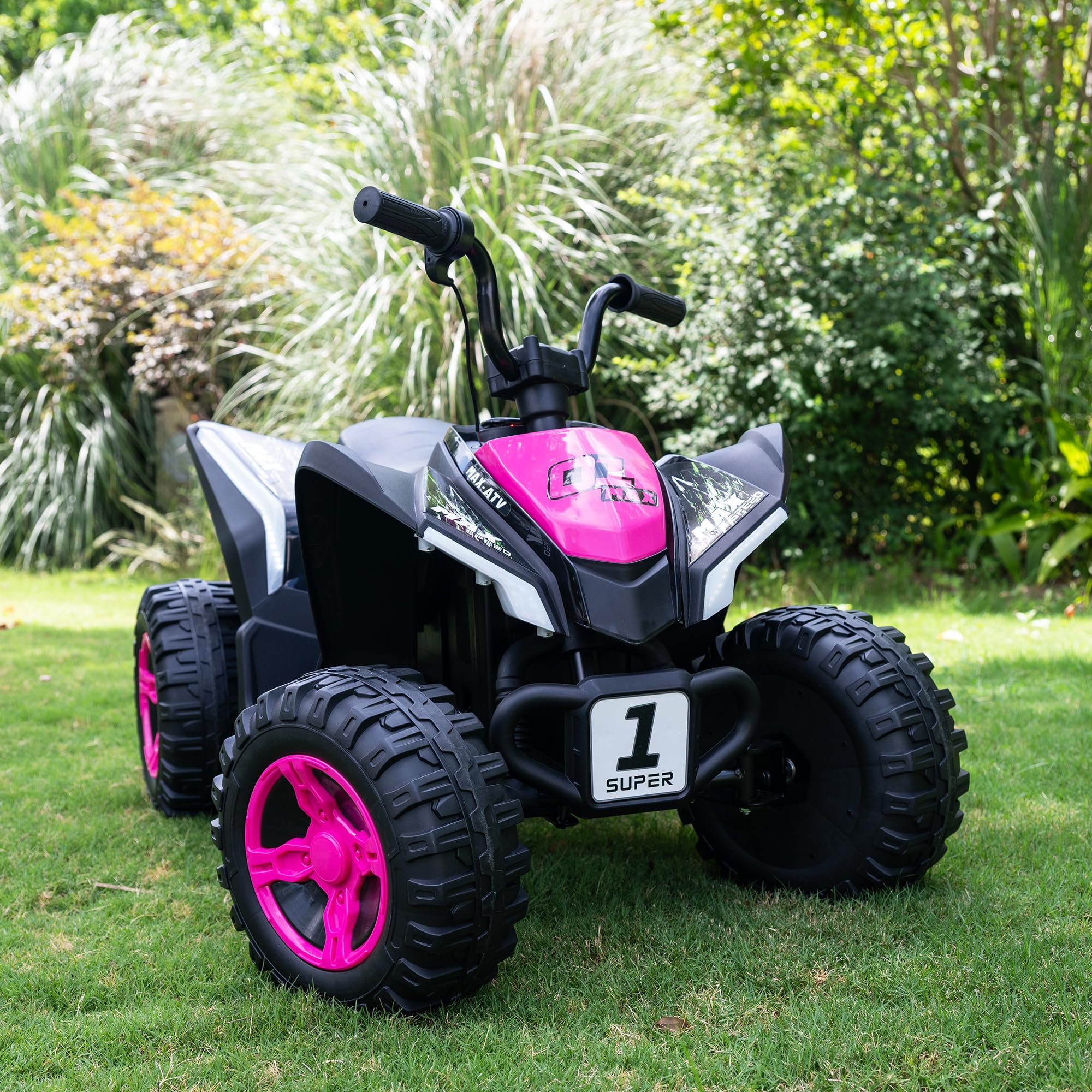
The RJV breaks from the 2-speed switch convention by using a motorcycle-style twist-grip throttle that gives the rider variable speed control rather than a binary off/high choice. This is the most important design decision for skill development: a twist grip requires fine motor modulation — rolling on and off smoothly — while a foot pedal or toggle switch encourages stomp-and-go behavior. Paired with the forward/reverse function, a child can learn to feather the throttle for low-speed maneuvering and gradually increase input as confidence grows.
The 24V battery system delivers consistent voltage across the discharge curve, so the last 20 minutes of a ride don’t feel dramatically slower than the first 20 minutes — a common complaint with 12V toys where the machine becomes unusable at half battery. The built-in LED lights, music system, and volume control keep the experience engaging, and the realistic button start adds a layer of authenticity that the key-turn ignitions lack. The foot pedal acts as a brake when released, giving a natural one-pedal driving feel.
The primary limitation is the single-seat configuration and the minimum age rating (3 years) combined with a maximum age of 8 years — this machine won’t last as long as the adjustable-seat builds if your child is already on the taller side. The pink colorway is the only option listed, which limits appeal if your rider prefers other colors. For a parent who cares more about developing throttle control instincts than about top speed or passenger capacity, the twist-grip setup on the RJV is the best teaching tool in the under- segment.
What works
- Twist-grip throttle teaches variable speed modulation instead of the on/off behavior that foot pedals encourage
- 24V battery holds consistent torque near the end of a ride unlike 12V toys that fade dramatically
- One-pedal braking system is intuitive for young riders and reduces the risk of forgetting to brake
What doesn’t
- Single-seat layout and max 8-year age range mean the rider outgrows both the seat and the 5 mph speed limit
- Only available in pink — no alternative color option for riders who prefer a different aesthetic
9. Okay Run 24V 4-Seater Electric Car
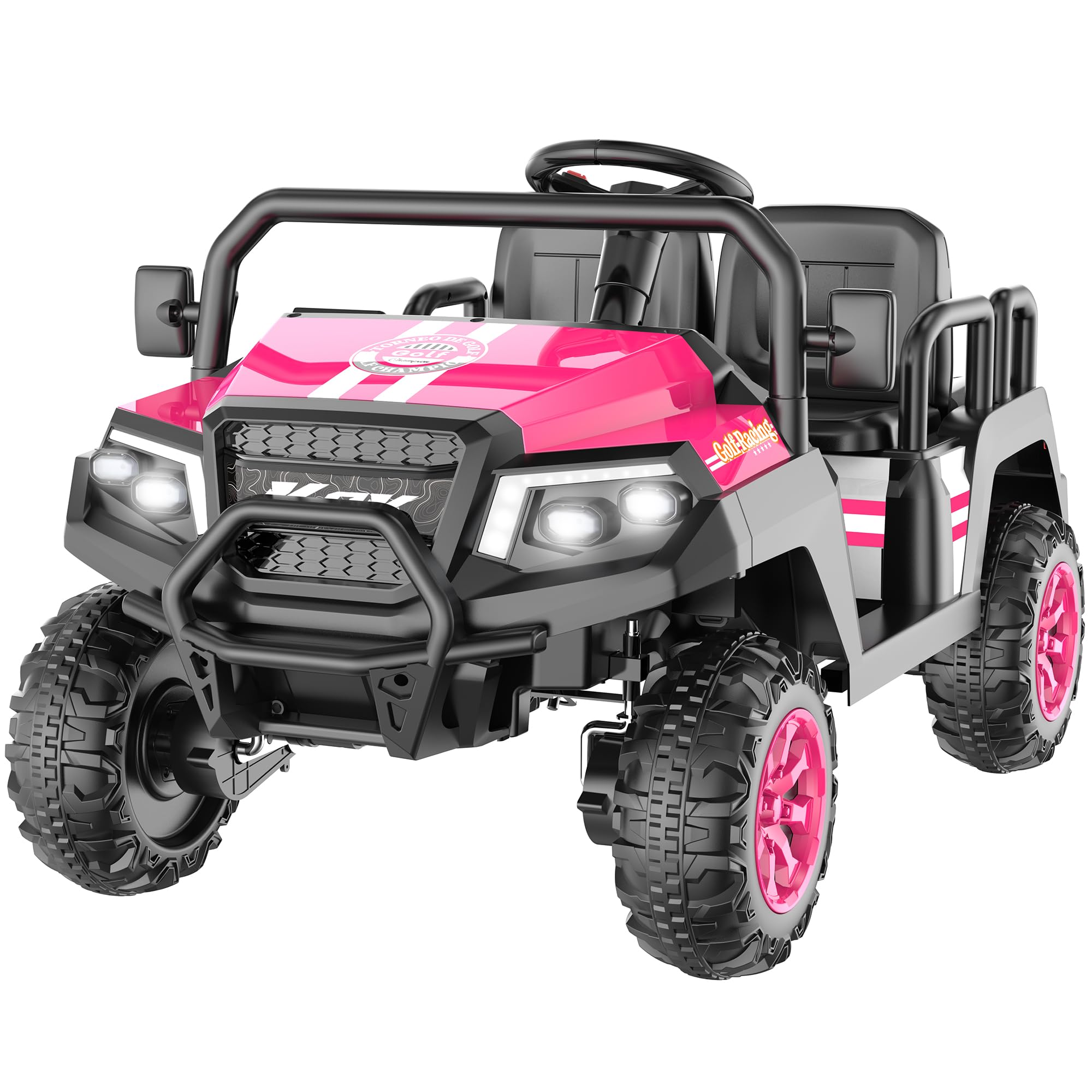
If you need to transport three or four children simultaneously — not buy a machine for each kid — the Okay Run 4-seater is the only option in this guide that solves that problem. The 51-inch-long chassis seats four children side by side on four independent seats, each equipped with its own seat belt, and the 220-pound total weight capacity means four average 4-year-olds (roughly 40 pounds each) fit within the safety margin. The 24V power plant drives four motors that reach a maximum of 4.4 mph, which is deliberately conservative to prevent instability at higher speeds with a full passenger load.
The remote control offers three speed settings and a 100-foot range, and the slow-start technology prevents the lurch that would be especially dangerous with four unrestrained bodies. The spring-based suspension system on all four wheels dampens the bouncing that a fully loaded 4-seater naturally produces over uneven ground. The entertainment suite — music, stories, FM radio, USB connectivity — keeps all four riders engaged, and the decorative rearview mirror and LED lights add realism without affecting drivability.
The compromises are considerable if you’re not running a full passenger load. The 4.4 mph top speed feels frustratingly slow for a single rider, and the 4×4WD system is not a true all-wheel-drive but rather four independent motors spinning at the same rate — there’s no differential, so tight-radius turns on pavement cause tire scrub. The ASTM F963 certification is genuine and documented, which matters for parents who require formal safety compliance. For daycare centers, large families, or neighborhood playgroups where the priority is moving multiple kids safely rather than delivering performance, this UTV-style machine is a unique fit.
What works
- Four independent seats with individual belts and 220-pound capacity handle a full playgroup at once
- ASTM F963 certification provides verified safety compliance that unregulated toys lack
- Slow-start and 4.4 mph speed cap reduce the risk of rollovers or collisions with a loaded vehicle
What doesn’t
- No differential means the tires scrub on tight pavement turns, wearing the tread faster than a geared axle would
- 4.4 mph top speed is too restrictive for a single older child who wants pace rather than passenger capacity
Hardware & Specs Guide
Motor Architecture and Torque Delivery
The number of motors and their wiring configuration determines how a mini 4 wheeler climbs. Single-motor machines use a gearbox to split torque to both rear wheels, which works on flat pavement but loses traction when one wheel lifts. Two-motor builds (one per rear wheel) improve independent spin. Four-motor builds — with a motor at each wheel — provide true 4WD because each wheel can dig in independently. A 4×200W setup (800W peak) moving a 50-pound rider produces roughly 8 ft-lb of wheel torque per motor at the axle, enough to climb a 20-degree grass slope. Manufacturers advertise motor count prominently, but the battery discharge rate (C-rating) determines whether the motors can actually sustain peak torque — a 24V 7Ah battery with a 2C discharge rate can deliver 14 amps sustained, while a 4×200W motor train at full load draws closer to 20 amps, leading to voltage sag. If the spec sheet doesn’t list the battery’s discharge capability, expect the motors to run at reduced power after the first 10 minutes of hard riding.
Lead-Acid vs Lithium Battery Realities
Sealed lead-acid (SLA) batteries dominate the sub- segment because they cost roughly per amp-hour versus per amp-hour for lithium. But SLA suffers from Peukert’s Law: the effective capacity drops as the discharge current increases. A 24V 9Ah SLA pack driving a 400W load delivers only about 6Ah of usable energy, reducing runtime by a third under full throttle. Lithium iron phosphate (LiFePO4) packs maintain nearly 100 percent of rated capacity regardless of load but require a dedicated charger and a battery management system — components most budget Chinese manufacturers won’t include. A third option emerging in the premium segment is the 24V 7Ah lithium-ion pack with built-in BMS that cuts power when voltage drops below 21V, preventing the deep-discharge damage that kills SLA packs. Always check the charging time: SLA requires 8–12 hours; lithium charges in 3–5 hours. If the unit doesn’t specify battery chemistry in the product description, assume it’s SLA.
FAQ
Can my 3-year-old use a 24V mini 4 wheeler safely?
How much assembly is required for most electric mini 4 wheelers?
What type of terrain is best for a gas-powered mini 4 wheeler?
Final Thoughts: The Verdict
For most buyers, the best mini 4 wheeler winner is the Burromax TT250 because it scales real dirt-bike ergonomics down to a 250W electric platform that teaches proper riding posture, braking technique, and throttle modulation — and it can be upgraded as the rider’s skills grow. If you want a gas-powered trail bike with a 30-mile range and true 28 mph top speed, grab the FRP GMB100. And for a family with two small kids who need a 4WD electric quad with an adjustable seat that lasts for years, nothing beats the ANPABO 24V 4×4.

Certification: BSc in Mechanical Engineering
Education: Mechanical engineer
Lives In: 539 W Commerce St, Dallas, TX 75208, USA
Md Amir is an auto mechanic student and writer with over half a decade of experience in the automotive field. He has worked with top automotive brands such as Lexus, Quantum, and also owns two automotive blogs autocarneed.com and taxiwiz.com.