Nothing ruins the start of a new season like a carburetor clogged with varnish or a fuel system corroded by degraded ethanol. A quality gas stabilizer is the only thing standing between your stored engine and a costly repair bill. This guide breaks down the top chemical treatments that keep gasoline fresh, prevent gum formation, and protect fuel system components for months or even years of inactivity.
I’m Amir — the founder and writer behind Four Wheel Ask. I spend my time analyzing automotive chemical formulations, studying real-world owner reports, and cross-referencing lab data to identify which stabilizers actually deliver on their claims.
Whether you’re winterizing a boat, storing a classic car, or putting away a generator for emergencies, choosing the right gas stabilizer means the difference between a one-pull start and a shop visit.
How To Choose The Best Gas Stabilizer
Selecting the right stabilizer hinges on your specific storage duration, engine type, and fuel blend. A one-size-fits-all approach can leave you with stale gas and clogged passages.
Protection Duration And Shelf Life
Stabilizers advertise protection windows from 12 months up to 24 or 36 months. If you store equipment seasonally, a 12-month formula like Sea Foam works fine. For long-term collector vehicle storage, a 24-month product like STA-BIL Storage provides a wider safety margin. Also check the opened-bottle shelf life — some formulas degrade after two years on the shelf.
Ethanol Tolerance And Corrosion Prevention
Modern gasoline often contains 10% ethanol (E10), which attracts moisture and can cause phase separation — the fuel splitting into layers of gas, water, and ethanol. A good stabilizer includes anti-corrosion agents and detergents that neutralize ethanol’s hygroscopic effects. Products like K-100 MG are specifically formulated to emulsify water and prevent phase separation in ethanol blends up to E85.
Dosage Concentration And Cost Per Gallon
The treatment ratio matters. A bottle that treats 80 gallons at 1 oz per 2.5 gallons offers more value than one that treats 40 gallons at the same volume. Higher concentration formulas mean you buy fewer bottles over time. For large fuel tanks in boats or RVs, look for stabilizers with a high gallon-per-ounce ratio to keep annual costs down.
Multifunction Capabilities
Some stabilizers only preserve fuel, while others double as fuel system cleaners, injector lubricants, or water emulsifiers. Sea Foam, for example, functions as a fuel stabilizer, injector cleaner, and oil crankcase treatment in one. If you want to simplify your maintenance routine, a multifunctional product reduces the number of additives you need to stock.
Quick Comparison
On smaller screens, swipe sideways to see the full table.
| Model | Category | Best For | Key Spec | Amazon |
|---|---|---|---|---|
| STA-BIL Storage | Economy | General seasonal storage | 24 months protection | Amazon |
| Quicksilver Quickstor | Marine OEM | Boats and marine engines | 2-year stability, 1 oz/5 gal | Amazon |
| Mercury Quickstor | Marine Premium | Mercury outboard storage | NMMA certified, 2-year stability | Amazon |
| K-100 MG | Water Remover | Ethanol phase separation | Emulsifies water in fuel | Amazon |
| Sea Foam Motor Treatment | Multi-Function | Fuel system cleaning + stabilization | 3-in-1 fuel, oil & stabilizer | Amazon |
In‑Depth Reviews
1. Sea Foam Motor Treatment

Sea Foam Motor Treatment is the most versatile additive on this list, functioning as a fuel stabilizer, fuel system cleaner, and oil crankcase treatment in one bottle. Its ability to preserve ignition vapors and prevent gum formation for up to two years makes it a legitimate stabilizer, but its real strength lies in simultaneously cleaning injectors, carburetors, and combustion chambers. The 16 oz three-pack provides enough volume for multiple treatment cycles across a fleet of vehicles or equipment.
Formulated for both gasoline and diesel blends including E10 and E85, Sea Foam helps restore lost power and smooth out rough idle by removing fuel residue deposits. Owners consistently report improved throttle response and easier cold starts after a single tank treatment. The product also serves as an oil additive — pour a portion into the crankcase before an oil change to dissolve sludge and varnish buildup in critical engine areas.
The main consideration is cost per gallon treated — Sea Foam’s recommended dose of 1 oz per gallon for cleaning treatments adds up faster than dedicated stabilizers that only require 1 oz per 2.5 gallons. However, the added cleaning and lubricity benefits justify the premium for buyers who want comprehensive engine maintenance from a single product. The three-pack offers the best per-ounce value for regular users.
What works
- Triple-function as stabilizer, cleaner, and oil treatment
- Works with gasoline, diesel, E10, and E85 blends
- Two-year fuel preservation with consistent owner results
What doesn’t
- Higher cost per gallon as a dedicated stabilizer
- Single 16 oz can treats only 16 gallons for cleaning doses
2. K-100 MG All-in-One Gasoline Fuel Treatment
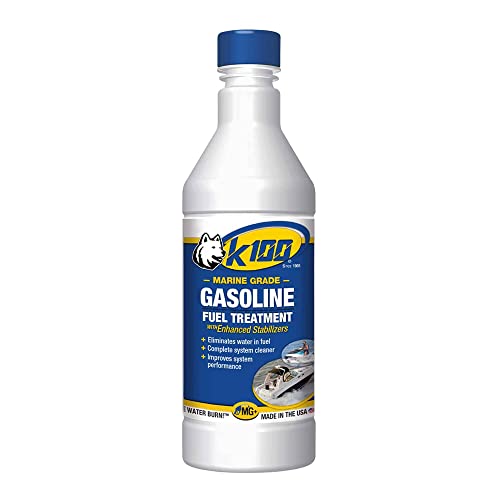
K-100 MG stands apart from conventional stabilizers because its primary mechanism is water emulsification — it breaks down large water droplets in the fuel tank into microscopic particles that the engine can safely burn. This is critical for ethanol-blended fuels that attract moisture and undergo phase separation, leaving a layer of water and ethanol at the bottom of the tank. K-100 prevents that separated layer from causing corrosion or stalling the engine.
In addition to water control, K-100 stabilizes gasoline for extended storage periods and cleans the fuel system by dissolving gum and varnish deposits. Owners of snowmobiles, lawn mowers, chainsaws, and generators report engines starting immediately after 12 to 14 months of inactivity. The 32 oz bottle treats approximately 160 gallons of fuel, making it one of the most concentrated formulas available per ounce.
The product is specifically designed for cars, trucks, motorcycles, and ATVs, but users caution against spilling it on painted surfaces or plastic fuel tanks as it can cause discoloration. Some owners note that for pure stabilization without water issues, a simpler formula may suffice. However, for anyone storing equipment in humid environments or running ethanol-heavy fuel, K-100’s water-fighting ability is unmatched.
What works
- Emulsifies water to prevent phase separation damage
- High concentration — 32 oz treats 160 gallons
- Engines start reliably after 14 months of storage
What doesn’t
- Can discolor painted or plastic surfaces if spilled
- Overkill for dry storage conditions with pure gasoline
3. STA-BIL Storage Fuel Stabilizer

STA-BIL Storage is the most recognized name in fuel stabilization, with a legacy spanning over 30 years of consistent performance. Its proprietary formula of antioxidants, anti-corrosives, and detergents keeps gasoline fresh for up to 24 months, making it the go-to choice for winterizing lawn equipment, boats, and vehicles. The 32 oz bottle treats up to 80 gallons at a ratio of 1 oz per 2.5 gallons, delivering strong value for large fuel systems.
The product prevents gum, varnish, rust, and corrosion from forming in the fuel tank and system components. It is safe for all gasoline engines including 2-cycle engines, and works effectively with ethanol blends from E10 through E85. Owners report that treating fuel before storage eliminates the need to drain tanks and prevents the dreaded springtime no-start condition that plagues carbureted small engines.
One limitation is that STA-BIL Storage is purely a stabilizer — it does not clean existing deposits or emulsify water like K-100 or Sea Foam. If your fuel system already has varnish buildup, you will need a separate cleaner. The opened bottle has a shelf life of two years, so users should mark the date on the bottle to ensure potency. Despite these narrow parameters, its reliability and low cost per gallon make it the top choice for routine seasonal storage.
What works
- Proven 30-year track record with millions of satisfied users
- 24-month storage protection at a low cost per gallon
- Safe for all gasoline engines including 2-cycle
What doesn’t
- No water emulsification or cleaning capability
- Opened bottle degrades after two years on the shelf
4. Mercury Quickstor Fuel Treatment and Stabilizer
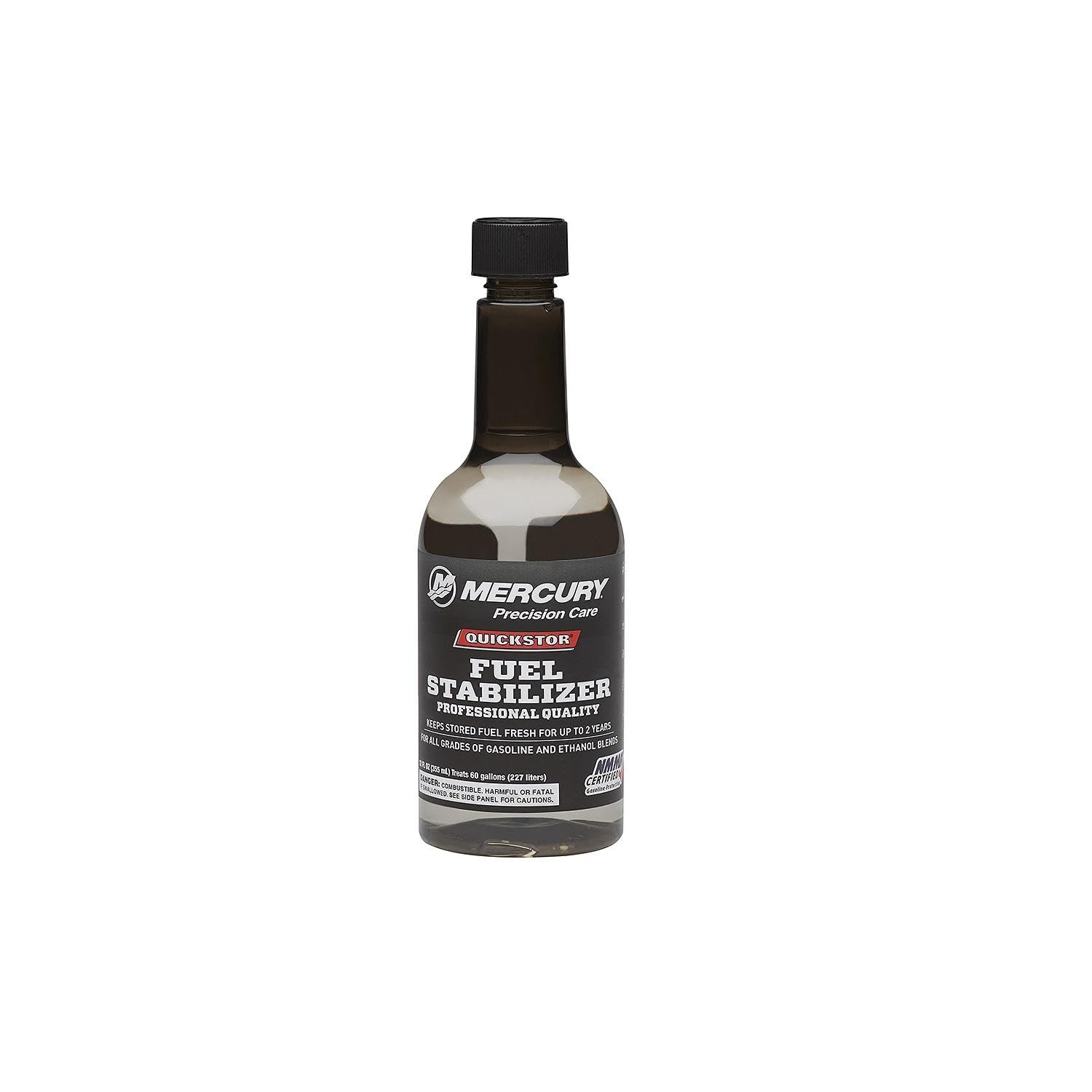
The Mercury Quickstor is an OEM-grade stabilizer designed specifically for marine engines, carrying NMMA (National Marine Manufacturers Association) certification through its Gasoline Protection Program. This certification means it has been independently tested to protect fuel systems from the corrosive effects of ethanol and moisture that are especially aggressive in marine environments. The 12 oz bottle treats up to 60 gallons at a ratio of 1 oz per 5 gallons.
Mercury Quickstor prevents regular and ethanol-blended fuel from breaking down and oxidizing, and it actively prevents gum and varnish from settling in fuel lines, tanks, carburetors, and injectors. The formula also helps keep injectors and carburetors lubricated, which is critical for outboard engines that sit for months between uses. Owners of Mercury and non-Mercury outboards alike report trouble-free spring startups after winter storage.
The primary drawback is that Mercury Quickstor costs more per ounce than general-purpose stabilizers like STA-BIL. It is also less effective as a multi-purpose additive — it does not clean existing deposits or act as an oil treatment. For boat owners who prioritize OEM-spec protection and NMMA certification, the premium is justified, but land-based equipment users may find better value in broader formulas.
What works
- NMMA certified for marine fuel protection
- Prevents gum, varnish, and injector deposits
- Lubricates fuel system components during storage
What doesn’t
- Higher cost per ounce than general stabilizers
- No cleaning or water emulsification features
5. Quicksilver Quickstor Fuel Treatment and Stabilizer

Quicksilver Quickstor is the aftermarket-branded version of the Mercury Quickstor formula, produced to the same Mercury Marine OEM specifications at a lower entry point. It stabilizes fuel for up to two years and prevents regular and ethanol-blended gas from breaking down and oxidizing. The treatment ratio of 1 oz per 5 gallons means the 12 oz bottle covers 60 gallons of fuel, offering solid coverage for mid-size boat tanks.
This stabilizer is designed primarily for long-term storage of boats, generators, lawnmowers, and other powersports equipment. Owners who use it for winterizing their vessels consistently report zero starting issues the following spring. The formula prevents gum and varnish formation in fuel lines and carburetors, which is the leading cause of small-engine fuel system failure after prolonged inactivity.
The main limitation is that Quicksilver Quickstor is essentially the same active chemistry as the Mercury-branded bottle but packaged under the lower-cost Quicksilver label. Some users report that the Mercury version feels more concentrated or performs better in severe conditions, although the product literature suggests identical specs. For cost-conscious boat owners, this represents the best entry into OEM-grade marine stabilization.
What works
- Mercury OEM formula at a lower price point
- Two-year stabilization for marine and powersports use
- Consistent spring startup performance reported by owners
What doesn’t
- Same formula as Mercury Quickstor with perceived potency difference
- 12 oz bottle covers fewer gallons than larger economy options
Hardware & Specs Guide
Fuel Oxidation And Stabilization Chemistry
Gasoline begins to oxidize the moment it is exposed to air, forming gums and varnishes that clog carburetor jets and injectors. Stabilizers use antioxidants that interrupt the free-radical chain reaction that causes fuel to degrade. The best formulas also contain metal deactivators that prevent copper and iron in the fuel system from catalyzing oxidation, extending fresh fuel life from weeks to 24 or 36 months.
Ethanol Phase Separation
Ethanol is hygroscopic, meaning it pulls water vapor from the air into the fuel. When the water content exceeds approximately 0.5%, the ethanol separates from the gasoline and sinks to the bottom of the tank with the water. This phase-separated layer can stall engines and corrode fuel system components. Stabilizers with emulsifiers like K-100 MG keep the water dispersed in tiny droplets that burn harmlessly in the combustion chamber rather than pooling at the tank bottom.
FAQ
Can I use a gas stabilizer in ethanol-free fuel?
How much stabilizer should I add for a full fuel tank?
Will a gas stabilizer fix an engine that already has clogged carburetors?
Final Thoughts: The Verdict
For most buyers, the gas stabilizer winner is the Sea Foam Motor Treatment because its triple-action formula provides stabilization, fuel system cleaning, and oil treatment in one bottle — reducing the number of additives you need to manage. If you want a dedicated water emulsifier for humid storage conditions, grab the K-100 MG. And for pure seasonal storage at the lowest cost per gallon, nothing beats the time-tested STA-BIL Storage.

Certification: BSc in Mechanical Engineering
Education: Mechanical engineer
Lives In: 539 W Commerce St, Dallas, TX 75208, USA
Md Amir is an auto mechanic student and writer with over half a decade of experience in the automotive field. He has worked with top automotive brands such as Lexus, Quantum, and also owns two automotive blogs autocarneed.com and taxiwiz.com.