Coil springs store enough energy to launch a steel component through a garage wall. The wrong spring compressor turns a routine strut swap into a trip to the ER. That is the stake in the ground for any DIY mechanic or professional technician shopping for this tool: the decision is not about brand preference, it is about whether the tool bends, slips, or shatters under the load of a compressed spring.
I’m Amir — the founder and writer behind Four Wheel Ask. I have spent thousands of hours analyzing suspension tool designs, digging into manufacturer engineering data, and cross-referencing owner feedback on load capacities, thread hardness, and hook geometry so you do not have to learn the hard way which compressors fail at the worst possible moment.
This guide breaks down the critical differences in build quality, safety features, and real-world performance of the best models available today, so you can confidently choose the right car spring compressor for your specific vehicle and budget.
How To Choose The Best Car Spring Compressor
Choosing a coil spring compressor is a high-stakes decision where material science and mechanical advantage meet. Beginners often default to the cheapest hook-style unit, only to discover stripped threads and bent rods halfway through a job. Focus on four core pillars to avoid that outcome.
Load Capacity and Build Material
The single most important number is the maximum load capacity per pair, measured in kilograms or pounds. Budget compressors often sit around 1000 kg per pair, which might work for compact sedans but will struggle with heavy truck or SUV springs. Premium units reach 4500 kg or more. The material matters just as much — look for #45 heat-treated steel or equivalent hardened alloys that resist bending under the high lateral forces generated during compression.
Safety Mechanisms and Impact Wrench Compatibility
Spring compressors are inherently dangerous tools. Look for models that include safety lips on the jaws to prevent the spring from walking out, protective sleeves to guard against scratches and snagging, and overload protection pins that break cleanly before the main spindle fails. Some premium units are designed to be driven with an impact wrench, which drastically reduces the labor time but demands a shear-pin safety system. Never use an impact wrench on a compressor not explicitly rated for it.
Interchangeable Jaws and Fork Compatibility
No single jaw size fits every coil spring. Compressors that offer three or more interchangeable yoke sets — typically covering spring diameters from about 65 mm up to 212 mm — provide the widest vehicle coverage. The yokes must also be deep enough to fully seat around the spring coil without contacting the shock body. Check that the yoke clamping mechanism uses robust hex bolts or set screws rather than cheap stamped retainers.
Thread Quality and Rod Hardness
The threaded rod is the most stressed component in any spring compressor. Cheap compressors use unhardened rods that gall, strip, or bend after a few uses. Premium rods are heat-treated and sometimes chrome-plated for corrosion resistance. Always grease the threads before each use to reduce friction and prevent galling, and avoid cross-threading by hand-starting the nut before applying torque.
Quick Comparison
On smaller screens, swipe sideways to see the full table.
| Model | Category | Best For | Key Spec | Amazon |
|---|---|---|---|---|
| Amerbm Heavy Duty | Impact-Rated | Impact wrench speed & safety | 4500 kg / 9921 lbs capacity | Amazon |
| OTC 6494 Clamshell | Clamshell | Safest enclosed design | Enclosed cage, no slipping | Amazon |
| OTC 7045B | Self-Aligning Plate | RWD domestic coil springs | 4 case-hardened aligning plates | Amazon |
| VEVOR Strut Set | 3-Fork Interchangeable | Broad vehicle coverage | 4500 kg capacity, 3 yokes | Amazon |
| 8MILELAKE Kit | 3-Jaw Interchangeable | Entry-level all-rounder | SGS-tested to 4487 kg force | Amazon |
| Neilsen CT3611 | Hook-Style Brace | Manual brace safety | 1200 kg capacity per pair | Amazon |
| Shankly Heavy Duty | Hook-Style | Budget-friendly large cars | 1000 kg capacity per pair | Amazon |
In‑Depth Reviews
1. Amerbm Heavy Duty Macpherson Strut Spring Compressor Tool
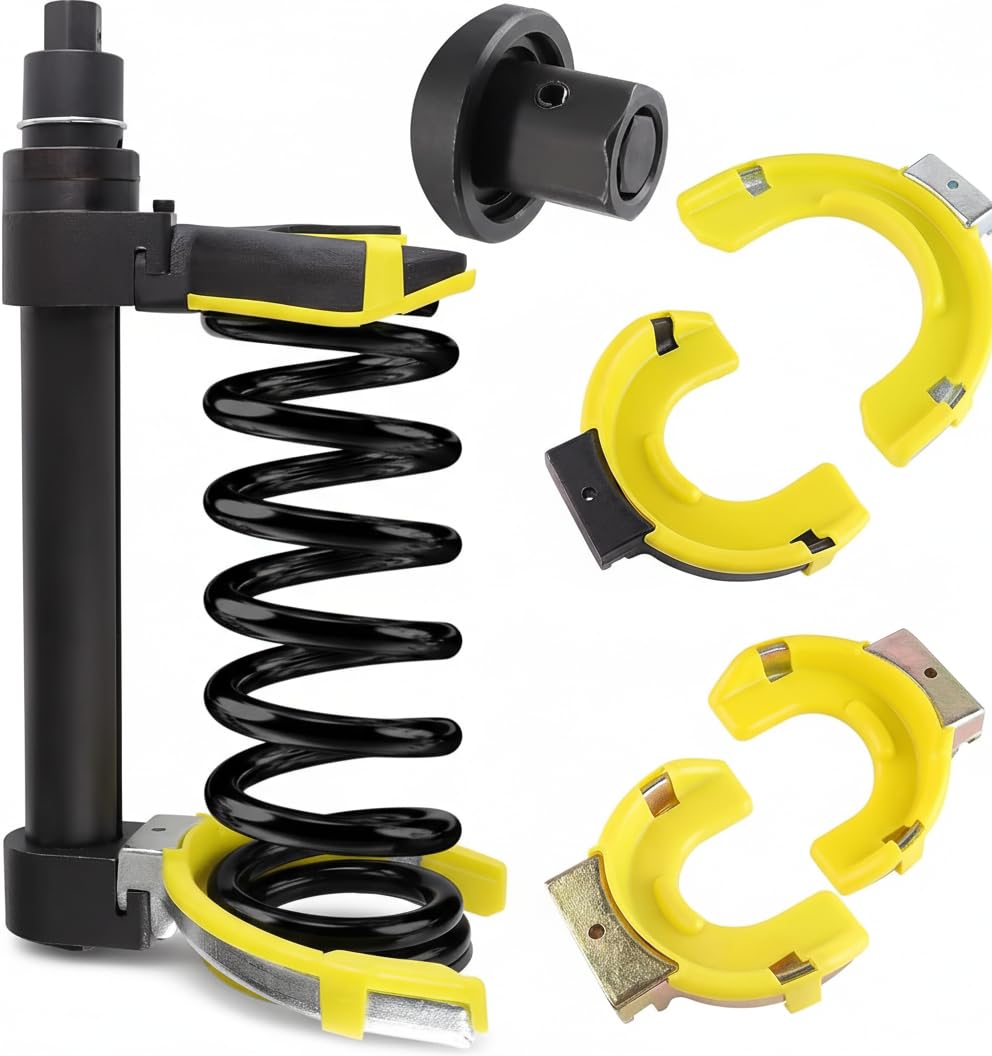
The Amerbm Heavy Duty unit redefines what a mid-range compressor can do by integrating an overload-protection shear pin that allows safe impact wrench operation — a feature previously reserved for expensive shop-grade tools. The #45 heat-treated steel construction and 9921-pound load capacity mean it handles full-size truck springs without the rod bowing or the yokes spreading. Mechanic reviews with decades of experience consistently call it the safest spring tool they have used, which is high praise in a category where fear of spring ejection is constant.
The three interchangeable yoke sets cover spring diameters from 2.6 inches up to 8.3 inches, ensuring compatibility with compact cars, SUVs, and even UTVs. The safety lips on each fork lock the spring coil in place and prevent the sideways walk-out that plagues cheaper hook-style compressors. At 32 pounds, the tool has a reassuring heft that translates directly to structural confidence under load.
A few users noted that the retaining pin for the top hex fitting can work itself loose during repeated use, requiring occasional reinsertion. Also, the heavy carrying case takes up significant drawer space. However, for the DIY mechanic who values speed and safety equally, the Amerbm delivers impact-rated performance at a fraction of the pro-tool cost.
What works
- Impact-wrench ready with overload shear pin protection
- Massive 4500 kg load capacity for trucks and SUVs
- Three yoke sizes with secure safety lips
What doesn’t
- Retaining pin for hex fitting can drift out during use
- Heavy kit takes up considerable storage space
2. OTC Clamshell Strut Spring Compressor 6494

The OTC 6494 clamshell is a completely different breed of spring compressor. Instead of using external hooks or forks that grab the spring from the sides, it encapsulates the spring inside a two-piece cage that threads together, eliminating any possibility of the spring slipping sideways or ejecting. For the home mechanic who is nervous about spring tension — and every experienced mechanic knows that fear is rational — this design offers unmatched peace of mind.
The tool works by placing the strut assembly inside the clamshell and turning the central threaded rod to compress the spring evenly. Because the spring is fully enclosed, there is no risk of the compressor jaws slipping off a tapered or oddly shaped coil. BMW M5 and Toyota 4Runner owners have reported successful strut rebuilds with zero drama. The tool is substantially safer than any open-hook design and is the safest option for the reluctant DIYer doing a one-time strut replacement.
On the downside, the clamshell design is vehicle-specific regarding spring diameter and strut height. It will not work with every spring, particularly very short or very large-diameter coils. It is also among the most expensive options on the market. For anyone who values absolute safety over speed and universal fitment, the OTC 6494 is worth every cent.
What works
- Spring fully enclosed eliminates walk-out risk
- Extremely safe for nervous first-time users
- High-quality US manufacturing
What doesn’t
- Limited to specific spring diameters and strut heights
- Premium price point
3. OTC 7045B Front Coil Spring Compressor

The OTC 7045B is the gold standard for compressing front coil springs on late-model rear-wheel-drive domestic vehicles, including Crown Victorias, Chevy trucks, and Chevelle muscle cars. Instead of side-mounting hooks, this tool uses four case-hardened self-aligning plates that seat inside the spring coils from above and below, distributing the load evenly across the spring circumference. That design eliminates the bending moment that causes hook-style compressors to bow and slip.
Veteran mechanics with 30 years of experience repeatedly cite this as the safest and easiest spring compressor they have ever used for RWD applications. The plates compress the spring straight down without any lateral skew, which is critical when dealing with big-block springs that store enormous potential energy. The tool includes two 3-3/8-inch ID plates and two 4-inch ID plates, giving it a useful range for most domestic coil springs.
The major limitation is vehicle fitment: it explicitly does not work on Mercedes-Benz vehicles and is not designed for MacPherson strut applications. It is a front-coil-spring-only tool for vehicles with a traditional upper and lower control arm setup. For owners of that specific drivetrain, it is arguably the safest tool on the market, but it has zero utility for strut-based suspensions.
What works
- Self-aligning plates eliminate bending and slipping
- Extremely safe for high-tension RWD springs
- Lifetime limited warranty
What doesn’t
- Only works on RWD domestic front coil springs
- Not compatible with MacPherson struts or Mercedes
4. VEVOR Strut Spring Compressor Set

VEVOR has built a reputation for offering pro-level specifications at a home-gamer price, and this strut spring compressor set is a textbook example. The 4500 kg load capacity is identical to far more expensive units, and the three interchangeable yokes — gold 2.6-4.9-inch, black 3.4-6.3-inch, and silver 4.9-8.3-inch — cover the vast majority of passenger cars, SUVs, and light trucks on the road. Owners have successfully used it on BMW X3s, 2014 F-150s, and 2004 Corollas.
Safety features include spring-retaining tongues on each yoke that prevent the coil from detaching under compression, plus yellow protective sleeves that shield the shock body from scratches. The 7/8-inch hex bolt compresses with a standard socket, and the threaded rod is heat-treated #45 steel.
A few users note that the tool can be finicky with struts that have very few coil spirals — the yokes need a certain number of wraps to seat securely. Also, the budget price comes with a slight trade-off in thread smoothness compared to the premium OTC units. But for the vast majority of strut work, the VEVOR delivers exceptional value.
What works
- 4500 kg capacity at a mid-range price
- Three yoke sizes cover most vehicles
- Spring-retaining tongues and protective sleeves
What doesn’t
- Struggles with springs that have few coil wraps
- Thread smoothness lags behind premium brands
5. 8MILELAKE Macpherson Strut Spring Compressor Kit

The 8MILELAKE kit has been a consistent favorite among DIY mechanics since 2016, thanks to its SGS-tested maximum force of 4487 kg and three interchangeable jaw pairs covering 65-125 mm, 88-160 mm, and 126-212 mm. The tool uses a center-threaded rod design that compresses the spring evenly without the side-load flex that plagues the two-bolt hook compressors. Experienced users report that the tool feels solid and inspires confidence compared to traditional widowmaker-style tools.
The kit includes a compression rod, an adjustment hook, and six fixing screws, making it a complete package out of the box. The wide jaw range means it works on everything from compact cars to full-size Jeeps. The SGS certification provides an objective load rating that many budget compressors lack, giving the buyer a verifiable safety margin.
The primary concern is manufacturing consistency. A small number of units arrive with casting defects that cause the tool to snap on the first use, particularly at the jaw-to-rod connection point. This appears to be a quality-control issue rather than a design flaw, but it means the buyer should inspect the tool thoroughly before putting it under load. For the price, it remains a strong entry point into strut work.
What works
- SGS-certified force rating for verifiable safety
- Three jaw pairs offer wide vehicle coverage
- Center-thread design reduces side-load flex
What doesn’t
- Inconsistent manufacturing quality control
- Occasional casting failures reported
6. Neilsen CT3611 Heavy Duty Coil Spring Compressor with Brace
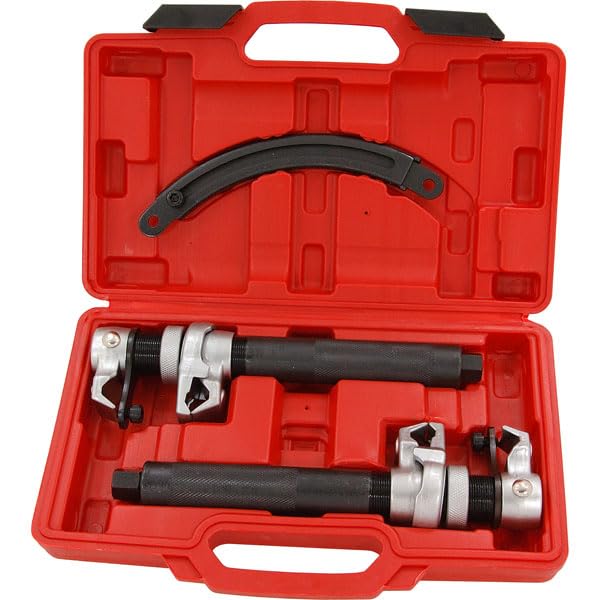
The Neilsen CT3611 is a hook-style spring compressor with an integrated brace that keeps the two compression arms operating in parallel throughout the stroke. This brace is a critical safety feature — it prevents the arms from spreading apart under load, which is the primary failure mode of cheap hook-style compressors. The jaws have a 23-280 mm capacity, and the tool uses a 19 mm hex socket or wrench for compression.
At 1200 kg capacity per pair, the CT3611 is best suited for passenger cars and smaller SUVs rather than heavy-duty truck applications. European users in particular praise the build quality, noting that the threaded bars feel durable and that the included blow-molded case keeps everything organized. The tool requires thorough greasing before first use to reduce friction and prevent thread damage.
The biggest limitation is the manufacturer’s explicit warning against using an impact wrench — this is a hand-tool-only unit. That makes it slower for shops doing multiple strut jobs, but for the home mechanic doing one or two cars, the manual operation is perfectly adequate. The compact size also makes it easier to store than the larger fork-style kits.
What works
- Integrated brace keeps arms parallel for safety
- Compact and easy to store
- Good build quality for passenger car applications
What doesn’t
- 1200 kg capacity limits use to cars and smaller SUVs
- Not compatible with impact wrenches
7. Shankly Heavy Duty Coil Spring Compressor Tool

The Shankly spring compressor is a no-frills hook-style tool designed for the budget-conscious DIYer who needs to compress coil springs on large cars and trucks without paying for fork-style or clamshell safety features. It has a 1000 kg maximum capacity per pair and a wide jaw range of 23-280 mm, making it physically capable of handling full-size truck springs like those on a 2009 Silverado 1500 or Ram 1500.
The tool uses hex nuts to tighten the hooks against the spring coils, and the hardened hook construction provides reasonable grip. Users who have successfully used this tool emphasize that it requires careful technique — greasing the threads thoroughly, applying even pressure with a ratchet wrench, and never using an impact gun. Many experienced mechanics note that the two-piece hook design inherently carries more risk of shifting than fork-style compressors.
The critical drawback is the inherent instability of hook-style designs under high tension. Even positive reviews emphasize taking extreme caution, and the tool has a reputation among experienced mechanics as being “shady as heck to use.” For the small budget where this tool fits, it can get the job done, but the safety margin is thinner than any other option on this list.
What works
- Wide jaw capacity fits large car and truck springs
- Very low entry price point
- Hardened hooks provide decent grip
What doesn’t
- Hook-style design inherently less stable than fork or clamshell
- Requires extreme caution and manual-only operation
Hardware & Specs Guide
Load Capacity (Per Pair)
The load capacity rating per pair is the maximum safe compressive force the tool can apply without permanent deformation. Budget hook-style units typically rate around 1000 kg, which is sufficient for most passenger car springs but leaves little margin for seized or corroded springs. Fork-style units in the mid-range start around 4500 kg, providing a massive safety buffer for truck and SUV springs. Never exceed the rated capacity — exceeding it can cause the threaded rod to bend or the yokes to fracture, releasing the spring with lethal force.
Thread Hardness and Rod Diameter
The threaded rod is the most fatigue-critical component. Look for rods made from #45 steel or equivalent that have been heat-treated to a hardness of HRC 38-45. The rod diameter is also important — thicker rods (typically 18-22 mm) resist bending better under eccentric loads. Chrome-plated rods offer additional corrosion resistance and smoother nut travel. Cheap rods use unhardened steel that grooves and strips within a few uses, especially if operated dry.
Yoke/Jaw Geometry and Depth
The yoke depth determines how securely the tool seats around the spring coil. Deeper yokes (typically 40-60 mm) provide more contact surface area and reduce the risk of the spring walking out during compression. The jaw opening width must match the spring wire diameter — too wide and the yoke can slip, too narrow and it will not seat at all. Interchangeable yoke sets with three sizes offer the best coverage across different vehicle platforms.
Safety Mechanisms
Look for three specific safety features: retaining tongues or lips on the yokes that physically block the spring from sliding out, overload shear pins that break before the main spindle, and protective sleeves that prevent the shock body from being scratched. The shear pin is particularly important for impact-rated compressors because it provides a controlled failure mode if the tool is overloaded. The best safety feature, however, is proper thread lubrication and even pressure application — no mechanical safeguard replaces correct technique.
FAQ
Can I use an impact wrench on any spring compressor?
What is the difference between a hook-style and a fork-style spring compressor?
How do I know if a spring compressor fits my vehicle?
Final Thoughts: The Verdict
For most buyers, the car spring compressor winner is the Amerbm Heavy Duty because it delivers impact-wrench speed and 4500 kg of load capacity at a price that undercuts traditional pro-grade tools by a wide margin. If you want the absolute safest enclosed design for occasional strut work, grab the OTC 6494 Clamshell. And for high-tension RWD domestic coil springs where alignment plates prevent all side-load bending, nothing beats the OTC 7045B.

Certification: BSc in Mechanical Engineering
Education: Mechanical engineer
Lives In: 539 W Commerce St, Dallas, TX 75208, USA
Md Amir is an auto mechanic student and writer with over half a decade of experience in the automotive field. He has worked with top automotive brands such as Lexus, Quantum, and also owns two automotive blogs autocarneed.com and taxiwiz.com.