Prying a ball joint loose with a standard pickle fork and a hand sledge is a recipe for bruised knuckles and a stalled project. The real efficiency gain comes when you pair a forged steel fork with a pneumatic hammer, converting brute force into rapid, controlled impacts that shock the taper loose without destroying the boot. Finding the right tool for this job means looking past the marketing and focusing on steel quality, shank compatibility, and fork geometry.
I’m Amir — the founder and writer behind Four Wheel Ask. I’ve analyzed hundreds of suspension tool sets, cross-referencing heat-treat grades, thread tolerances, and real-world owner reports to separate the tools that deliver consistent separation from those that fatigue and fail under impact.
The market serves up everything from multi-piece kits to dedicated pitman arm pullers, and choosing the air hammer pickle fork that matches your typical work envelope, shank standard, and budget tier makes the difference between a 10-minute job and a trip to the torch.
How To Choose The Best Air Hammer Pickle Fork
Not all pickle forks transfer pneumatic energy the same way. The threads that connect the fork to the air hammer adapter handle, the steel grade, and the fork’s taper angle all affect how cleanly the joint separates. Before you buy, understand these three decision points.
Steel Grade and Heat Treatment
AISI 1045 medium-carbon steel that has been heat-treated to a through-hardened state resists the edge deformation that leads to a stuck fork. Cheaper variants made from ungraded bar stock tend to mushroom at the fork tips after a few impacts, wedging the tool deeper into the joint rather than driving it apart. Look explicitly for terms like “heat-treated alloy steel” or “forged heavy-duty steel” in the product description.
Shank and Thread Compatibility
Nearly all pneumatic hammers in the automotive space use a .401-inch shank. The adapter handle on the pickle fork set must accept that shank and thread securely into the fork body. Sets with loose thread tolerances can bind when struck, causing the fork to separate from the handle mid-job — a dangerous failure. Knurled handles with full thread engagement are a reliable indicator of better machining.
Fork Geometry and Size Range
The three most common fork sizes for passenger cars and light trucks are 11/16-inch, 15/16-inch, and 1-1/8-inch. A set that includes at least these three covers tie rod ends, upper and lower ball joints, and pitman arms on most North American vehicles. Deeper forks (around 3 inches) offer better reach on recessed joints, while shallower forks concentrate impact force directly at the taper.
Quick Comparison
On smaller screens, swipe sideways to see the full table.
| Model | Category | Best For | Key Spec | Amazon |
|---|---|---|---|---|
| OTC 4559 | Premium | Air hammer + manual versatility | 0.068 oz weight, 3 fork sizes | Amazon |
| Astro 78807 | Premium | One-piece solid forks, 5 sizes | 5 forks, 1-5/8″ max opening | Amazon |
| OTC 7314A | Specialty | Stubborn pitman arms only | 1-5/16″ jaw spread | Amazon |
| Lisle 41500 | Mid-Range | Dual-handle air/manual kit | 3.15 lbs, 3 forks | Amazon |
| Orion Motor Tech 5-Piece | Mid-Range | AISI 1045 steel, 5 fork sizes | 5 forks, zinc coated | Amazon |
| MAXPOWER 5-Piece | Mid-Range | Heavy-duty 2 kg kit | 2.04 kg, zinc plated | Amazon |
| DURATECH 5-Piece | Budget | Compact case, light vans | 4.53 lbs, 40# steel | Amazon |
In‑Depth Reviews
1. OTC 4559 Manual/Pneumatic Pickle Fork Set

The OTC 4559 is the benchmark for any mechanic who values a single kit that works with both a hand sledge and a .401-inch shank air hammer. The three forks — 11/16-inch, 15/16-inch, and 1-1/8-inch — cover the vast majority of tie rod and ball joint work on passenger cars and light trucks. What separates this set from lower-tier competitors is the thread engagement between the handle and the forks: the threads are cut clean enough that even after repeated air hammer cycles, the connection does not loosen or gall.
OTC’s heat-treated alloy steel resists the tip mushrooming that plagues budget forks, and the knurled manual handle gives you a second option when the air hammer drives the fork too deep without separating the joint. Owners working on Jeep Wrangler and Chevrolet Yukon suspension projects have noted that the 1-1/8-inch fork handles lower ball joints without needing to switch to a puller. The compact blow-molded case keeps the set organized, though some users found the pneumatic adapter threads could strip if the tool is not seated fully square before impact.
If you only buy one pickle fork set for your air hammer, the 4559’s combination of OTC’s lifetime warranty, precise threading, and dual-use handles justifies the investment for both shop and driveway work. It is the most versatile single purchase in this category.
What works
- Threads stay tight under repeated pneumatic impacts
- Heat-treated steel resists tip deformation
- Compact case keeps three forks and two handles organized
What doesn’t
- One-piece design means no backup fork if one breaks
- Pneumatic handle thread can strip if struck at an angle
2. Astro 78807 5-Piece Pickle Fork Ball Joint Separator Set

The Astro 78807 uses a one-piece solid construction for each fork, meaning there are no threaded handles to loosen under vibration. The five fork openings range from 11/16-inch up to 1-5/8-inch, with depths between 2-3/8 inches and 3-1/8 inches, giving you more reach on recessed joints than most three-fork kits. The steel alloy is noticeably thicker than the mid-range competitors, and the plain finish avoids the chipping that sometimes occurs with plated surfaces on high-impact tools.
Actual owner reports consistently highlight that these forks never bend or flex even under heavy pneumatic hammer use on light truck suspension components. The knurled handles are machined from the same bar as the fork body, removing any weak point where a handle could separate. The hard plastic storage case is more robust than the typical blow-molded cases, though a couple of users mentioned the handle lengths could be longer for better leverage when working under a tight fender.
This set is ideal for the tech who works on a wide range of vehicle sizes and needs fork depths that reach into deep control arm pockets. The 1-5/8-inch fork alone makes the Astro 78807 worth considering for full-size trucks and SUVs where standard forks cannot span the joint taper.
What works
- One-piece forged forks eliminate threaded failure points
- Widest size range in the lineup at five openings
- Fork depth exceeds three inches for deep-joint access
What doesn’t
- Heavier and bulkier than three-fork kits
- Plain steel finish shows surface rust faster in humid shops
3. OTC 7314A Pitman Arm Puller

The OTC 7314A is not a pickle fork — it is a dedicated puller designed specifically for removing pitman arms from steering boxes on passenger cars and light trucks. The forged steel jaws spread to 1-5/16 inches, and the puller uses a forcing screw rather than impact to separate the arm, which eliminates the risk of mushrooming the pitman arm threads. This tool is the better choice when the pitman arm is frozen or when the steering shaft taper is too tight for a fork to wedge between.
OTC’s construction uses drop-forged steel with a corrosion-resistant finish that holds up to shop solvent and brake cleaner exposure. The screw mechanism applies steady, controlled pressure, making it less likely to damage the steering box seal than a pickle fork driven by an air hammer. Because it is a single-purpose tool, it occupies minimal drawer space and does not require a pneumatic hammer to function.
For technicians who regularly service steering systems, the 7314A fills a gap that even the best pickle fork set cannot cover. If your primary need is pitman arm extraction rather than ball joint separation, this puller outperforms any fork-based approach on both speed and safety.
What works
- Forged steel jaw resists spreading under high screw torque
- Pull-on design avoids damage to steering box seals
- Compact size stores easily in any tool box
What doesn’t
- Single-use tool limited to pitman arms only
- Not compatible with air hammer for rapid removal
4. Lisle 41500 Pickle Fork Kit

Lisle’s 41500 kit offers the same dual-handle concept as the OTC 4559 at a noticeably lower entry point. The three forks (11/16-inch, 15/16-inch, 1-1/8-inch) interchange with both a hammer-style handle and a .401-inch shank air hammer adapter. The alloy steel forgings are heat-treated, and the threaded ends are machined to a hex profile that accepts a wrench if the fork gets stuck and needs to be twisted free — a detail missing from many competitors.
Owners using the air hammer handle on Toyota Sienna and vintage car front ends report that the forks separate joints cleanly without damaging the ball joint boots, though the hammer handle can mushroom slightly after extended impact. The set lacks a storage case, which is a drawback for mobile techs, but the weight at 3.15 pounds keeps the kit portable. Several users noted the threads between fork and handle could bind if not fully tightened before striking.
This kit is a strong choice for the home mechanic who wants air hammer capability without paying premium-tier prices. The replaceable nature of the forks means a damaged fork can be swapped individually rather than scrapping the whole set.
What works
- Hex profile on fork allows wrench-assisted removal
- Heat-treated forgings resist edge deformation
- Lightweight kit at just over three pounds
What doesn’t
- No storage case included
- Hammer handle can mushroom with repeated heavy strikes
5. Orion Motor Tech 5-Piece Pickle Fork Tool Set

Orion Motor Tech uses AISI 1045 medium-carbon steel that has been heat-treated and zinc-coated, giving the forks a corrosion barrier that extends service life in humid garage environments. The five fork openings — 3/4-inch, 1-inch, 1-2/3-inch, 1-15/32-inch, and 1-3/32-inch — include metric-friendly sizes that cover Asian and European suspension components often missed by SAE-only sets. The one-piece solid construction means there are no threads to loosen, and the knurled handles integrate directly into the fork body.
Owner feedback on Jeep Wrangler TJ and truck suspension work confirms the forks drive through rusted joints without bending, though the handle length makes it difficult to strike squarely when the joint is tucked under the control arm. The foam cutout in the included case holds each fork securely and prevents rattling. A few users noted that the zinc coating can wear off at the impact point, exposing bare steel, which is cosmetic rather than functional.
This set makes sense for the DIYer who works on a mix of domestic and import vehicles and wants a single case that covers both SAE and metric joint sizes without needing adapter handles. The 1-2/3-inch fork is particularly useful on larger truck ball joints.
What works
- AISI 1045 steel holds up to repeated impacts
- Zinc coating protects against corrosion in storage
- Five sizes include metric-friendly openings for imports
What doesn’t
- Handle length is short for deep-reach applications
- Zinc coating can wear off at striking surface
6. MAXPOWER 5-Piece Pickle Fork Tool Set
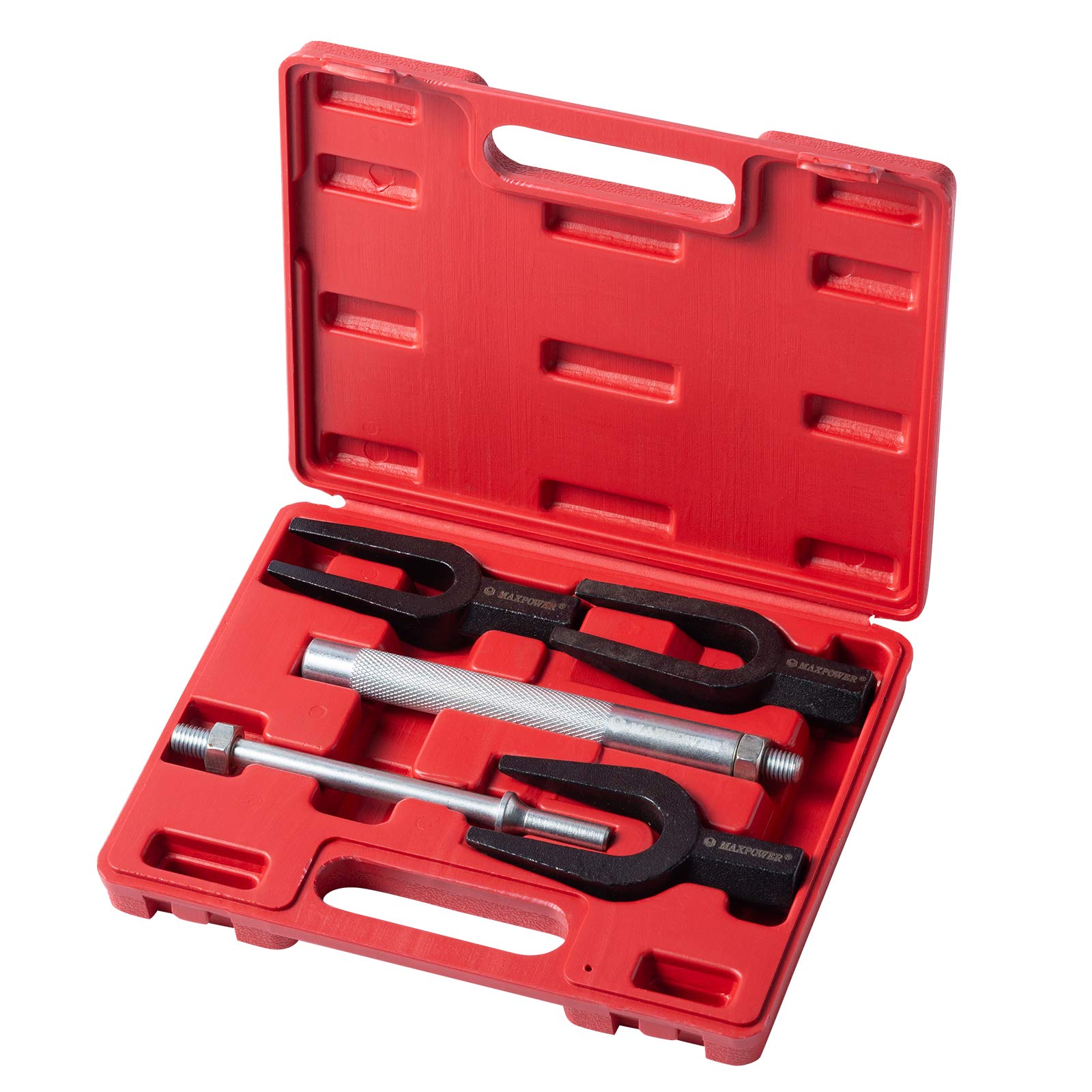
The MAXPOWER set provides the standard three fork sizes (11/16-inch, 15/16-inch, 1-1/8-inch) plus both a manual hammer handle and a pneumatic adapter handle, all packed in a durable nylon tool roll rather than a hard case. The alloy steel construction is heat-treated and zinc-plated, and the set weighs just over two kilograms, giving it a solid feel that suggests good impact absorption. The red powder coating on the handles adds visibility in a cluttered toolbox.
User experiences here are split: many DIYers report the forks work well for occasional ball joint and tie rod work, while one heavy-use reviewer on a Kubota tractor encountered a fork that spread and wedged, requiring a plasma cutter for removal. This suggests the steel hardness may vary between production batches. The pneumatic adapter handle threads cleanly into all three forks, but some users found the smaller forks did not accept full thread depth before tightening.
For the weekend mechanic who needs an affordable kit that covers the three standard sizes and stores compactly, the MAXPOWER set delivers acceptable performance. However, technicians working daily on farm equipment or heavily corroded suspension should consider a premium-tier set with tighter process controls.
What works
- Zinc plating resists rust in storage
- Nylon roll is more packable than a rigid case
- Red powder coating improves tool visibility
What doesn’t
- Fork hardness can vary between production batches
- Smaller forks may not accept full thread depth
7. DURATECH 5-Piece Ball Joint Separator Set

DURATECH’s entry-level kit brings five SAE-standard forks — 11/16-inch, 15/16-inch, and 1-1/8-inch, plus a track rod fork and a pitman arm fork — along with both a knurled striking handle for manual hammers and an adapter handle for .401-inch shank air hammers. The steel is 40# material that has been forged and heat-treated, then chrome-plated for corrosion resistance. The set includes a blow-molded suitcase that organizes each component and makes transport convenient.
Owners consistently report that this set accomplishes ball joint and tie rod removal quickly on cars and light vans, with several noting that the different fork lengths provide better access in tight spaces. The chrome plating holds up well in light shop use, though heavy impact will eventually chip it. A few users mentioned that the adapter handle threads could be tighter; ensuring the fork is fully seated before engaging the air hammer prevents thread binding.
This is the most budget-conscious way to get a full five-fork set with both manual and pneumatic capability. It is well-suited for the home mechanic who needs occasional access to multiple fork sizes without spending on a premium brand, provided the joint corrosion is not severe.
What works
- Five forks cover almost all SAE joint sizes
- Chrome plating resists shop chemical exposure
- Suitcase case keeps everything organized and portable
What doesn’t
- Adapter handle threads can feel loose before tightening
- Chrome may chip under heavy pneumatic use
Hardware & Specs Guide
Fork Steel and Heat Treatment
The most common steel grades found in this category are AISI 1045 medium-carbon steel (heat-treated to a hardness around HRC 45-50) and generic 40# forging steel. Heat-treated alloy steel maintains its edge geometry under repeated pneumatic impacts, while untreated steel will mushroom at the fork tips, causing the tool to wedge tighter into the joint. The treatment also affects thread longevity on multi-handle sets — case-hardened threads resist stripping better than through-hardened threads on thinner sections.
.401-Inch Shank Compatibility
The universal standard for automotive air hammers is the .401-inch shank diameter. Any pickle fork kit that includes a pneumatic handle must accept this shank depth. Sets with a quick-release collet system are rare in this price tier; most use a threaded adapter that screws into the fork handle. The thread pitch is typically 5/8-18 on higher-end sets, while budget sets may use finer threads that are more prone to galling under side-load. Verify that the adapter handle seats fully into the fork before the first impact.
FAQ
Can I use an air hammer pickle fork on tie rod ends without damaging the boot?
What causes a pickle fork to get stuck between ball joint and control arm?
How do I know if my air hammer shank fits a pickle fork adapter handle?
Final Thoughts: The Verdict
For most buyers, the air hammer pickle fork winner is the OTC 4559 because it combines dual-handle versatility, precise thread machining, and heat-treated alloy steel that holds up to both manual and pneumatic impact without galling. If you need the widest fork range and one-piece solid construction that eliminates threaded failure points, grab the Astro 78807. And for the pitman arm jobs where no fork should go, the OTC 7314A puller is the only correct choice.

Certification: BSc in Mechanical Engineering
Education: Mechanical engineer
Lives In: 539 W Commerce St, Dallas, TX 75208, USA
Md Amir is an auto mechanic student and writer with over half a decade of experience in the automotive field. He has worked with top automotive brands such as Lexus, Quantum, and also owns two automotive blogs autocarneed.com and taxiwiz.com.