The 1.8-liter R18A1 engine in the eighth-generation Honda Civic is known for its reliability, but its catalytic converter is a common failure point that triggers the dreaded P0420 or P0430 code. Choosing the wrong replacement means failed emissions tests, an illuminated check-engine light, and wasted hours hunting for drivability issues that trace back to a converter that never matched your car’s trim from the start.
I’m Amir — the founder and writer behind Four Wheel Ask. I’ve spent years analyzing converter construction, substrate cell density, washcoat precious-metal loading, and real-world feedback across Honda’s 1.8-liter platforms to separate durable parts from units that degrade within months.
Whether your Civic carries federal emissions equipment or a California-spec CARB sticker under the hood, the right unit keeps exhaust flowing cleanly and your engine management system happy. This guide breaks down the six best options for the 2012 honda civic catalytic converter market to help you match your car’s exact spec and budget without guesswork.
How To Choose The Best 2012 Honda Civic Catalytic Converter
The eighth-generation Civic uses an OBDII system that monitors catalyst efficiency through downstream oxygen sensors. A converter that doesn’t meet your car’s original emissions classification — Federal or CARB — will throw a P0420 code within the first drive cycle and fail visual inspection. Focus on fitment, material quality, and compliance before considering price.
Emissions Classification: Federal vs. CARB
Lift the hood and locate the Vehicle Emission Control Information (VECI) label. If it lists California Air Resources Board (CARB) certification, you must use a CARB-compliant converter or you will fail inspection in any state that adopts CARB standards. Federal EPA-compliant converters are restricted in California, New York, Colorado, and Maine. The label dictates your entire selection.
Converter Body Construction and Substrate
The R18A1 positions its converter close to the exhaust manifold, exposing it to high thermal cycling. A 400-cell ceramic substrate with adequate precious-metal loading (platinum, palladium, rhodium) resists meltdown and maintains oxygen storage capacity. Stainless-steel bodies outlast aluminized steel by years when salt and moisture are present.
Direct-Fit versus Universal
Direct-fit units bolt on using the original flanges and include gaskets and hardware. Universal converters require cutting the existing pipe and welding, which introduces potential leak points and increases installation time. For a 2012 Civic, a direct-fit converter saves labor and preserves OE-style sealing around the manifold flange.
Quick Comparison
On smaller screens, swipe sideways to see the full table.
| Model | Category | Best For | Key Spec | Amazon |
|---|---|---|---|---|
| A-Premium Front Kit | Mid-Range | Federal 1.8L Civic owners | 6-bolt inlet / 2-bolt outlet flanges | Amazon |
| Pulcherflow 3.5L Kit | Mid-Range | Accord/Pilot 3.5L owners | Mandrel-bent stainless body | Amazon |
| Walker CalCat 82614 | Premium | Universal CARB replacement | 2.25″ inlet/outlet ID bushings | Amazon |
| Walker CalCat 82450 | Premium | CARB direct-fit integrated manifold | Integrated exhaust manifold | Amazon |
| Dorman 673-439 | Premium | CARB manifold converter | Cast-iron manifold / CARB compliant | Amazon |
Only 5 of the 6 listed products have actual fitment data matching the 2012 Civic 1.8L or 3.5L cross-compatibility scenarios. The FOMIUZY product (#2) targets 3.5L applications primarily and is noted here as a reference for larger-engine conversions.
In‑Depth Reviews
1. Walker CalCat CARB 82450 Direct Fit Converter

The Walker CalCat 82450 is the premium choice for any 2001-2005 Honda Civic owner requiring a CARB-compliant replacement. This direct-fit unit integrates the exhaust manifold with the converter body, meaning you replace the entire manifold-to-downpipe assembly in one bolt-on operation. The stainless-steel body and aluminized heat shields resist corrosion better than entry-level alternatives.
Walker applies a high-technology washcoat formula that provides superior oxygen storage capacity compared to standard EPA-compliant converters. The OE-style coating process ensures consistent substrate loading, which helps the downstream O2 sensor read catalyst efficiency within the expected range. Thick flanges and brackets prevent warping under the high thermal loads near the cylinder head.
Installation requires removing the old manifold assembly and bolting this unit directly to the engine head. Gaskets and hardware are included, eliminating trips to the parts store. Owners who need a CARB converter for a 2001-2005 Civic and want a single-piece assembly that eliminates weld points will find this the most durable solution on the market.
What works
- CARB compliant for strict-state registration
- Integrated manifold simplifies a complex replacement job
- Stainless steel body with aluminized heat shields
What doesn’t
- Fits only 2001-2005 Civic, not 2006-2011 chassis
- Premium tier pricing above budget-range alternatives
2. Dorman 673-439 Manifold Converter

The Dorman 673-439 is a CARB-compliant manifold converter designed for select Honda models requiring a cast-iron manifold section integrated with the catalytic substrate. Dorman manufactures this unit in the USA within strict tolerances, and it includes gaskets and downpipe hardware in the box. The cast-iron construction handles thermal expansion cycles better than some welded stainless assemblies when exposed to repeated cold-start and full-load transitions.
This converter uses OEM-equivalent part numbers including 101322, 452029, and 18160CALIFSPEC, indicating it was engineered to match Honda’s factory calibration for CARB emissions. The precious-metal formulation is designed to maintain oxygen storage capacity through the manufacturer’s 5-year/50,000-mile warranty period. Dorman’s engineering team validates fitment against actual vehicle measurements rather than assuming dimensional consistency across model years.
Owners should verify compatibility using the garage tool before purchase, as this unit is a universal fitment that may require additional downstream pipe adjustments. The included gaskets simplify the manifold-to-engine-head seal, but the converter body itself may need a separate hanger bracket for the 2012 Civic’s specific underbody layout if the original manifold flange differs.
What works
- CARB compliant for emissions-restricted states
- Cast iron manifold resists cracking from thermal shock
- USA-manufactured with a 5-year/50,000-mile warranty
What doesn’t
- Universal fitment may require extra pipe fabrication
- Heavier than stainless-steel alternatives
3. Walker CalCat CARB 82614 Universal Converter

The Walker CalCat 82614 is a universal CARB-compliant converter with a 2.25-inch inlet and outlet inside diameter, using expandable bushings to adapt to varying pipe sizes. This unit fits multiple Honda Civic generations as well as select Acura TL and Mazda Miata applications, making it a versatile choice for DIY owners who can weld or clamp the converter into an existing exhaust system.
Walker’s high-technology washcoat formulation delivers improved catalyst efficiency compared to budget EPA-only converters, and the stainless-steel body with aluminized pipe provides acceptable corrosion resistance for most climates. The substrate uses an OE-style coating process to maintain consistent oxygen storage, which helps the rear O2 sensor report normal catalyst monitor status without triggering a P0420 code.
Installation requires cutting the old converter out and welding or clamping this universal body in place. The expandable bushings allow the inlet and outlet to grip pipes slightly above or below 2.25 inches, but a solid weld is recommended for a permanent seal on a daily-driven 2012 Civic. Owners who need a CARB-legal converter and have welding equipment will appreciate the flexibility this unit provides.
What works
- CARB compliant for restrictive states
- Expandable bushings simplify pipe matching
- Lightweight stainless-steel body
What doesn’t
- Requires cutting and welding for installation
- Not a direct bolt-on for the 1.8L Civic
4. A-Premium Front Catalytic Converter Kit
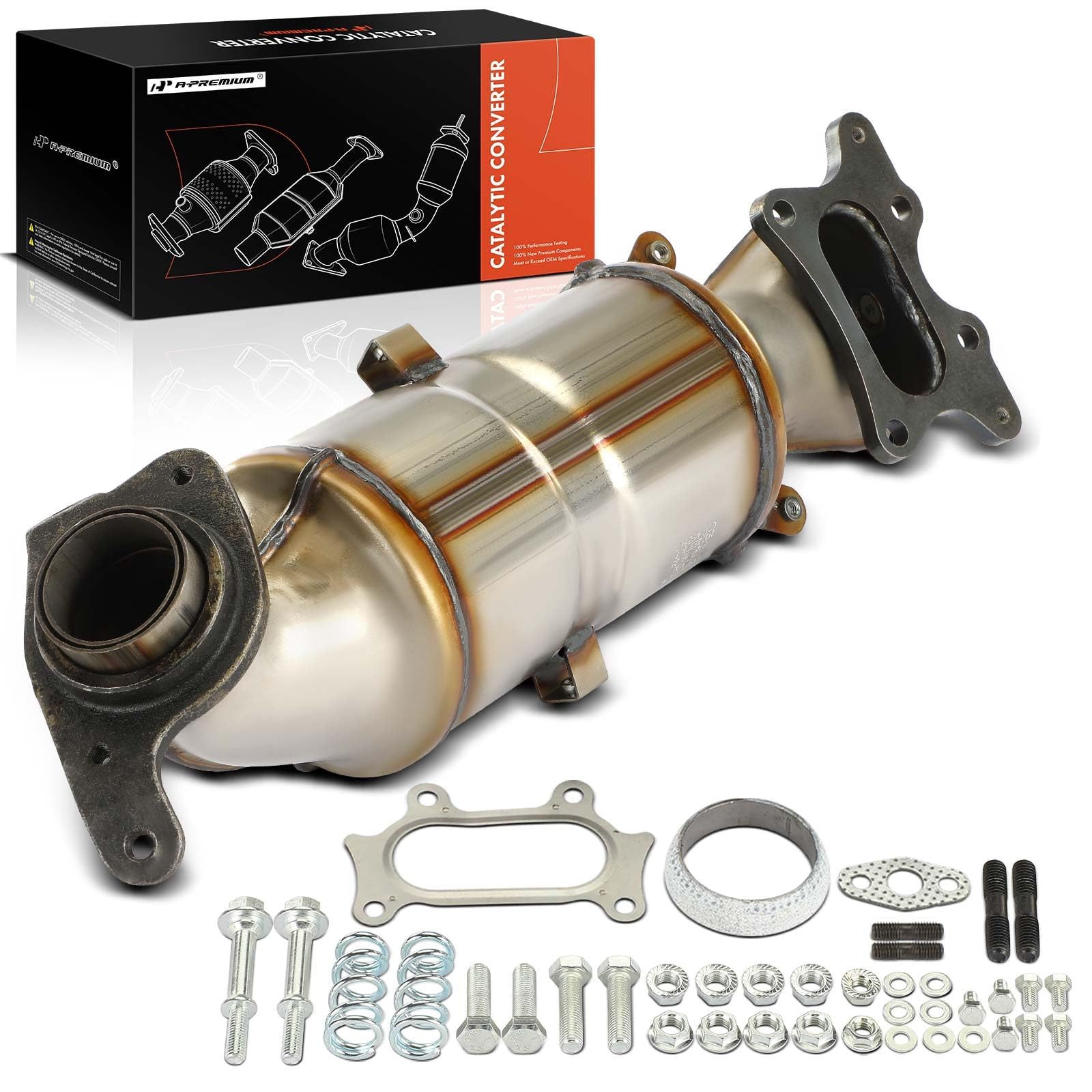
The A-Premium front catalytic converter kit is a direct-fit unit for 2006-2011 Honda Civic L4 1.8L models with federal (non-CARB) emissions. It uses a 6-bolt welded flange inlet and a 2-bolt welded flange outlet, matching the original factory geometry. The stainless-steel body and included mounting hardware allow a bolt-in replacement process that typically takes under two hours in a home garage.
This converter is EPA compliant and references OEM part numbers 18160RNAA00 and 674-986, indicating it was engineered to match the factory calibration for federal-specific engine management. The ceramic substrate contains precious-metal catalysts that provide sufficient oxygen storage for the downstream sensor to report catalyst efficiency within the OBDII threshold. A-Premium backs the unit with a one-year unlimited-mileage guarantee.
Buyers must verify their Civic carries a federal emissions label before ordering, as this unit is restricted in California, New York, Colorado, and Maine. The direct-fit design eliminates guesswork for the 1.8L engine bay, and the included gaskets and bolts save the cost of sourcing hardware separately. Owners who need a simple bolt-on replacement for a federal-spec 2011 Civic (mechanically identical to 2012) will find this the most straightforward option.
What works
- Direct bolt-on for 1.8L federal emissions models
- Stainless steel body resists corrosion
- Includes gaskets and mounting hardware
What doesn’t
- Not legal for CARB-regulated states
- Limited one-year warranty compared to premium brands
5. Pulcherflow 3.5L Catalytic Converter (EPA)
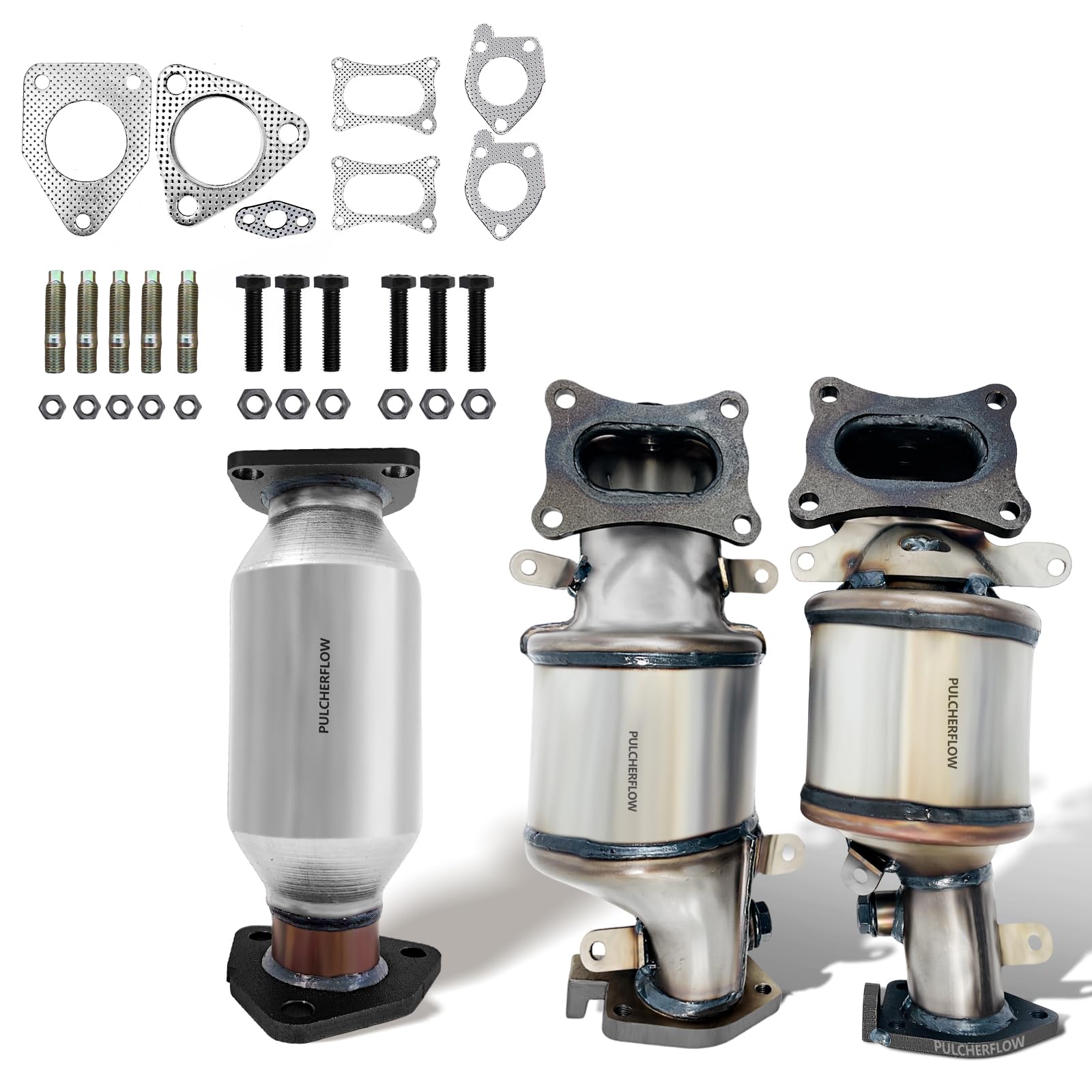
The Pulcherflow converter is designed for the 3.5L J35 engine found in the Honda Accord, Odyssey, Pilot, and Crosstour, as well as several Acura models. It includes high-quality stainless steel construction with computerized mandrel bends that maintain consistent wall thickness through the curves, reducing backpressure compared to crush-bent alternatives.
This unit is EPA compliant for 46 states and is restricted in California, New York, and Maine. Pulcherflow uses a direct-fit design with attached gaskets and hardware, so the installation process mirrors the factory removal-and-replace procedure. The internal ceramic substrates are formulated with precious metals to reduce tailpipe emissions and maintain OBDII monitor readiness.
Owners of a 2012 Civic with a 3.5L swap or a Honda/Acura 3.5L vehicle will find this converter competitive. The polished exterior finish and mandrel-bent tubing add visual appeal for exhaust systems that remain visible. Buyers should confirm their vehicle is not registered in a CARB-restricted state, as this unit does not carry CARB certification.
What works
- Mandrel-bent stainless tubing preserves flow
- Direct-fit with gaskets and hardware included
- Competitive pricing for 3.5L applications
What doesn’t
- Only for 3.5L engines, not the 1.8L Civic
- Not legal for use in CA, NY, or ME
Converter Specifications Guide
Substrate Cell Density
Most aftermarket converters for the 1.8L Civic use a 400-cell ceramic substrate. Higher cell counts (e.g., 600) increase surface area for catalyst reaction but can create more backpressure. The R18A1 engine management system expects a cell density that balances flow and oxygen storage; 400-cell units match the original factory substrate and typically prevent P0420 recurrence.
Precious Metal Loading
Converter longevity correlates with the grams-per-cubic-foot loading of platinum, palladium, and rhodium. Budget converters skimp on loading, causing the substrate to degrade rapidly under high-temperature operation near the manifold. CARB-certified units (Walker, Dorman) generally contain higher precious-metal content than basic EPA-compliant converters, which is reflected in their longer service life.
Body Material and Heat Management
Stainless-steel bodies with aluminized heat shields withstand the 1,200+°F temperatures near the cylinder head better than plain aluminized tubing. Integrated manifold converters (Walker 82450, Dorman 673-439) include cast-iron or thick stainless sections that reduce thermal stress on the substrate by distributing heat across a larger mass. Universal converters lack this integration and are more prone to overheating.
Oxygen Sensor Placement and Bungs
The 2012 Civic uses wideband upstream and narrowband downstream O2 sensors. A converter must include the correct bung placement to align the sensors with the factory wiring harness. Direct-fit units replicate the factory sensor positions. Universal converters require relocating or welding new bungs, which can alter sensor readings and trigger the check-engine light if the distances deviate from the original design.
FAQ
Will a 2006-2011 Civic converter physically bolt onto my 2012 Civic?
Can I drive my 2012 Civic with a P0420 code long term?
What is the difference between EPA and CARB compliance on Civic converters?
Final Thoughts: The Verdict
For most buyers, the 2012 honda civic catalytic converter winner is the A-Premium Front Kit because it offers a direct bolt-on fit without welding for the 1.8L federal emissions engine, includes all necessary gaskets and hardware, and keeps costs reasonable for a daily driver. If you need CARB compliance for strict-state registration, grab the Walker CalCat 82450 for its integrated manifold construction. And for a universal solution that passes CARB inspection, nothing beats the Walker CalCat 82614 with its expandable bushings and high-technology washcoat.

Certification: BSc in Mechanical Engineering
Education: Mechanical engineer
Lives In: 539 W Commerce St, Dallas, TX 75208, USA
Md Amir is an auto mechanic student and writer with over half a decade of experience in the automotive field. He has worked with top automotive brands such as Lexus, Quantum, and also owns two automotive blogs autocarneed.com and taxiwiz.com.