A 500-watt amplifier sits at the sweet spot of car audio — enough grunt to drive a respectable subwoofer or a full set of mids and highs without draining your electrical system or blowing your budget. The market is flooded with options that claim 500W but deliver far less under real load, while others under-rate their output and punch well above their weight class. Sorting the real performers from the inflated numbers requires a close look at RMS ratings, impedance flexibility, and thermal management.
I’m Amir — the founder and writer behind Four Wheel Ask. I’ve spent countless hours cross-referencing amplifier bench test data, customer durability reports, and real-world installation feedback to identify which 500W amps actually deliver clean power over the long haul.
After comparing nine of the most interesting mono and multi-channel amplifiers on the market, here is the definitive guide to choosing the right 500 watt amp for your vehicle and listening habits.
How To Choose The Best 500 Watt Amp
Selecting the right amplifier is about matching its output and features to your subwoofer, electrical system, and sound goals. Here are the key factors to evaluate before you buy.
RMS Power & Impedance Matching
The RMS (Root Mean Square) rating tells you the continuous clean power an amp can deliver. A 500W RMS rating is only meaningful if you know the impedance — measured in ohms — at which that power is produced. Mono subwoofer amps typically make full power at 1 ohm or 2 ohms, while multi-channel amps do so at 2 ohms per channel or bridged. Always check your subwoofer’s voice coil configuration so the amp’s stable impedance range aligns with your load.
Class D Efficiency & Thermal Management
Nearly all modern 500W car audio amplifiers use Class D topology, which converts DC power to AC output at over 80% efficiency. This means less energy is wasted as heat, allowing smaller heatsinks and more compact chassis. That said, installation location still matters — an amp crammed into a sealed glovebox or under a seat with poor airflow can still overheat and enter protection mode, even with a Class D design.
Crossover, Filtering & Tuning Control
A subwoofer amp should include a variable low-pass filter (35Hz–250Hz range) and ideally a subsonic filter (15Hz–30Hz) to prevent the sub from trying to reproduce inaudible frequencies that waste power and cause mechanical distortion. For full-range amps, look for switchable high-pass and low-pass filters. Bass boost circuits are common, but use them sparingly — excessive boost at a single frequency can clip the signal and damage speakers.
Build Quality & Protection Circuitry
Look for amplifiers with thermal, over-current, short-circuit, and DC offset protection. These circuits automatically shut down the amp before damage occurs. A double-sided epoxy PCB, conformal coating for moisture resistance, and quality端子 blocks for power and speaker wire connections are signs of a well-constructed unit that will survive years in a vehicle environment.
Quick Comparison
On smaller screens, swipe sideways to see the full table.
| Model | Category | Best For | Key Spec | Amazon |
|---|---|---|---|---|
| Rockford Fosgate R2-500X1 | Premium Mono | Subwoofer with C.L.E.A.N. setup | 500W RMS x 1 @ 2Ω | Amazon |
| Kicker 47KEY5001 | Premium Mono | Auto-EQ integration | 500W RMS + 40-band EQ | Amazon |
| PIONEER GM-D8701 | Mid-Range Mono | High S/N ratio & 1-ohm stable | 500W RMS x 1 @ 2Ω | Amazon |
| Polk Audio PA D1000.1 | Mid-Range Mono | High headroom for bass | 500W RMS @ 4Ω | Amazon |
| Alpine S-A60M | Mid-Range Mono | Factory radio integration | 600W RMS x 1 @ 2Ω | Amazon |
| Sundown Audio SAM-500D | Value Mono | 1-ohm stable micro amp | 500W RMS x 1 @ 1Ω | Amazon |
| Rockville dB12 | Value Mono | Budget subwoofer amp | 500W RMS @ 2Ω | Amazon |
| Kicker 46CXA4001 | Mid-Range Mono | Compact & flexible install | 400W RMS @ 2Ω | Amazon |
| Rockford Fosgate R2-500X4 | Premium 4-Ch | Full-range speaker system | 75W RMS x 4 @ 4Ω | Amazon |
In‑Depth Reviews
1. Rockford Fosgate R2-500X1 Prime 500-Watt Mono Amplifier

The Rockford Fosgate R2-500X1 is the benchmark for a no-compromise 500W mono amplifier in this class. It delivers 300 watts RMS at 4 ohms and the full 500 watts RMS at 2 ohms, making it a perfect match for a single 2-ohm or dual 4-ohm subwoofer. The Class D design keeps the chassis compact at just under 2 inches tall, and the P.O.W.E.R. supply increases output as your vehicle’s voltage rises, a real benefit with a high-output alternator.
C.L.E.A.N. circuitry is the standout feature here — it uses clip-detection LEDs to guide your gain setting so you never push the amp into distortion. This takes the guesswork out of tuning and protects both the amp and your subwoofer. The variable infrasonic filter (15Hz–40Hz) and remote level control give you precise command over bass extension without muddying the midbass.
Build quality is typical Rockford Fosgate: a cast aluminum heatsink, stainless steel hardware, and sealed potentiometers that resist vibration. The 1-year warranty backs a unit that regularly outlives its warranty period in daily-driven vehicles. It is not the cheapest option, but for reliability and sound quality, few 500W mono amps compete at this price point.
What works
- C.L.E.A.N. gain setup prevents clipping
- Stable 500W RMS at 2 ohms
- Compact chassis fits tight spaces
- Infrasonic filter for ported boxes
What doesn’t
- Not 1-ohm stable; limits subwoofer options
- No speaker-level inputs without adapter
2. Kicker 47KEY5001 500-Watt Mono Channel Amp with Start/Stop Capability
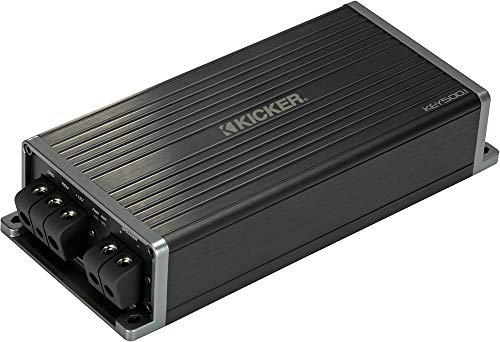
The Kicker 47KEY5001 is not just an amplifier — it is a digital signal processing solution built into a mono subwoofer amp. Its internal microphone and computer perform an automatic in-car analysis, then apply a 40-band equalizer and 24dB/octave crossover to correct for your vehicle’s acoustic flaws. The result is bass that integrates seamlessly with factory speakers without the muddy overlap most aftermarket subs create.
This amp is specifically designed with start-stop vehicle systems in mind, handling voltage drops from 12V down to 6V during engine restart without cutting out. The 500W RMS output is rated at 2 ohms, and the unit includes both high-level and low-level inputs with auto-sensing turn-on, so you can tap into any factory speaker wire. The remote subwoofer level control is included.
The chassis is larger than a standard mono amp to accommodate the DSP board, but it remains compact enough for under-seat mounting. The auto-EQ process takes about 60 seconds and dramatically improves soundstage for listeners who want clean, integrated bass rather than maximum SPL. For factory system upgraders, this is the most straightforward path to high-quality low end.
What works
- Auto DSP simplifies factory integration
- Runs reliably on start-stop vehicles
- 40-band EQ transforms soundstage
- High-level inputs with auto turn-on
What doesn’t
- Premium pricing for the DSP features
- Larger footprint than basic mono amps
3. PIONEER GM-D8701 500W Mono Class D AMP

Pioneer’s GM-D8701 punches above its mid-range price with a signal-to-noise ratio of 100dB, which means fundamentally silent background noise and clearer bass at any volume. It produces 300 watts RMS at 4 ohms, 500 watts at 2 ohms, and peaks at 800 watts RMS at 1 ohm — making it one of the few 500W-class amps that can handle a 1-ohm load without complaint. This gives you the flexibility to run a single D2 sub or multiple D4 coils.
The variable low-pass filter (40Hz–240Hz) and subsonic filter (20Hz–120Hz) are unusually wide for a mono amp, but the subsonic filter’s lower range is more useful for sealed enclosures. The amplifier uses a conventional Class D layout with a robust aluminum heatsink and screw terminals that accept up to 4 AWG power wire. The included remote bass control lets you dial in the sub level from the driver seat.
Pioneer has a long history of bombproof reliability at this power level, and the GM-D8701 continues that tradition with protection circuits for thermal, over-current, and speaker shorts. The main caveat is the lack of a high-pass crossover for full-range operation, but as a pure subwoofer amp, it delivers excellent performance for the money.
What works
- 100dB S/N ratio for clean output
- 1-ohm stable for flexible sub pairing
- Wide adjustable crossover range
- Compact footprint at 12.9 inches long
What doesn’t
- Subsonic filter min of 20Hz limited for ported boxes
- No high-level inputs included
4. Polk Audio PA D1000.1 Class D MOSFET Monoblock

Polk Audio rates the PA D1000.1 conservatively at 500 watts RMS at 4 ohms, with higher figures at 2 ohms (800W RMS) and 1 ohm (1200W RMS). This means even if your electrical system isn’t optimal, you still get a solid 500 watts into a standard 4-ohm sub, and the headroom is massive for dynamic bass peaks. The Class D MOSFET power supply keeps efficiency high despite the generous power reserve.
The amp includes a variable low-pass filter (40Hz–120Hz), a subsonic filter, and a 12dB bass boost circuit. The build quality is stout with a multi-material chassis of titanium, polymer, and aluminum that dissipates heat effectively. Polk includes a remote subwoofer level control and both high-level and low-level inputs, making it compatible with factory radios without a line output converter.
One nuance is the physical size — the chassis is nearly 17 inches long, which can make under-seat or trunk-wall mounting tight. The gain adjustment is sensitive and requires careful setting to avoid clipping. However, for listeners who want a 500-watt amp that can drive a high-power subwoofer in the future, the PA D1000.1 offers rare future-proofing at its price tier.
What works
- High headroom with 1200W peak capability
- Works with factory radios via high-level inputs
- Robust multi-material build
- Remote level control included
What doesn’t
- Long chassis requires ample mounting space
- Sensitive gain adjustment
5. Alpine S-A60M S Series Class D Monoblock Amplifier

The Alpine S-A60M is rated at 600 watts RMS at 2 ohms, slightly above the 500W target, but it is still a direct competitor in the entry-level subwoofer amplifier space. At 4 ohms it delivers 330 watts RMS, which is a clean match for a single 4-ohm sub. The amp accepts both preamp-level and speaker-level inputs, so you can connect it directly to a factory radio’s speaker outputs without an adapter.
The variable bass boost and low-pass filter allow straightforward tuning, and the S/N ratio of 85 dBA is acceptable for the price tier. Alpine’s build quality is reliable — the heatsink is finned aluminum for effective passive cooling, and the protection circuitry covers thermal, overload, and short circuits. The chassis is compact at roughly 11 inches wide, fitting under most seats.
The biggest appeal here is the brand trust and the ability to upgrade a factory system with no additional components. The amp does not include a subsonic filter, which means it is best suited for sealed subwoofer enclosures where very low frequencies are naturally rolled off. For a simple, reliable, and straightforward 500W-class upgrade, the S-A60M is hard to fault.
What works
- Built-in speaker-level inputs for factory systems
- Compact chassis fits under many seats
- Alpine reputation for reliability
- 600W RMS gives headroom at 2 ohms
What doesn’t
- No subsonic filter for ported enclosures
- Not 1-ohm stable
6. Sundown Audio SAM-500D Monoblock 500W RMS Micro Amplifier

Sundown Audio built its reputation on high-end SPL competition gear, and the SAM-500D brings that engineering into a micro footprint. Despite its tiny size, it delivers 200 watts RMS at 4 ohms, 350 at 2 ohms, and a full 500 watts RMS at 1 ohm. The double-sided SMT epoxy PCB with painted conformal coating resists moisture and vibration better than many larger amps.
Efficiency is rated at 86% at 4 ohms, which means this amp generates very little waste heat and can be mounted in tight spaces. The 12dB/octave variable crossover, 0-9dB bass boost, and multi-way protection (thermal, over-current, speaker short, DC) are all present. Input sensitivity ranges from 0.5V to 15V, accommodating both low-voltage aftermarket head units and high-voltage factory signals.
The main trade-off is the 10-gauge power connectors — they are sufficient for 500 watts but require a reduction fitting if your power wire is 8-gauge or larger. The included manual is minimal, so first-time installers should research proper gain setting. For those building a compact system that needs real 1-ohm power, this micro amp is a revelation.
What works
- True 500W RMS at 1 ohm in a micro chassis
- Conformal coated PCB for durability
- 86% efficiency for minimal heat
- Wide input voltage range
What doesn’t
- 10-gauge power terminals limit wire size
- Basic documentation for installation
7. Rockville dB12 2000 Watt Peak/500w RMS Mono 2 Ohm Amplifier

The Rockville dB12 delivers 500 watts RMS at 2 ohms and 300 watts RMS at 4 ohms, making it a workable option for a single 2-ohm subwoofer. The peak power rating of 2000 watts is typical budget marketing, but the real-world RMS figure is honest for the entry-level price. It includes a remote dashboard subwoofer control, LED-illuminated logo, and RCA line output for daisy-chaining additional amplifiers.
The adjustable 12dB/octave crossover and subsonic filter (15Hz–55Hz) give you useful tuning tools, and the MOSFET power supply is standard for this class. The protection circuitry covers overheating, under/over-voltage, and short circuits. The chassis is aluminum with a moderate heatsink, and the overall length of 13 inches is manageable for trunk mounting.
Build quality is not in the same league as Rockford Fosgate or Alpine — the potentiometers feel looser, and the power terminals are less robust. However, for a strict budget build where every dollar counts, the dB12 provides adequate power and features. It works best with a simple sealed subwoofer in a basic system where absolute refinement is secondary to getting bass into the car.
What works
- Low entry price for 500W RMS capability
- Includes remote bass knob
- Subsonic filter good for ported boxes
- RCA line output for amp stacking
What doesn’t
- Build quality and component feel budget-level
- Only 2-ohm stable; no 1-ohm support
8. Kicker 46CXA4001 CXA4001 400-Watt Mono Class D Subwoofer Amp

The Kicker 46CXA4001 is rated at 400 watts RMS, sitting just below the 500W threshold but included here for its relevance to budget-minded subwoofer installations. It is stable down to 1 ohm, which allows you to run multiple subwoofers or a single D2 voice coil configuration. The variable 12dB crossover, KickEQ 6dB bass boost, and 24dB subsonic filter give you ample control over the low end.
A standout feature is the wide input voltage tolerance — the amp works with as little as 9 volts of battery power and accepts up to 40 volts of speaker-level input signal. This makes it remarkably adaptable to both weak factory electrical systems and high-output aftermarket head units. The chassis includes vertical and horizontal mounting hardware, so you can tuck it in narrow spaces.
The power is slightly below 500W, which matters if you are trying to drive a subwoofer that truly needs the full 500 watts RMS. It runs cool and reliably, with Kicker’s reputation for durability in harsh environments. Consider this if your subwoofer’s RMS rating is 400 watts or less and you want a proven amp with flexible mounting.
What works
- 1-ohm stable for flexible sub wiring
- Accepts 9V to 40V input range
- Vertical or horizontal mounting options
- Kicker reliability at a mid-range price
What doesn’t
- 400W RMS is under 500W target
- Lower power limits subwoofer pairing
9. Rockford Fosgate R2-500X4 Prime 500-Watt 4-Channel Amplifier
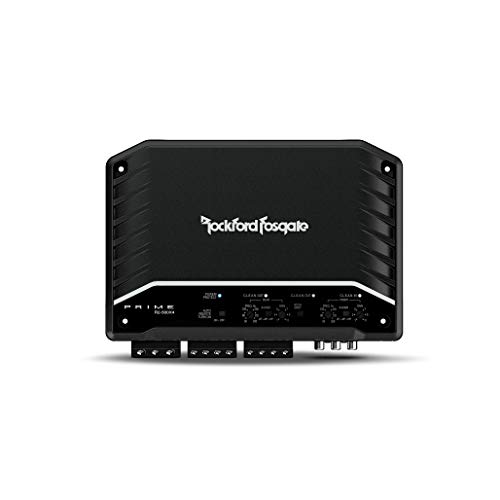
The Rockford Fosgate R2-500X4 shifts the 500-watt concept to full-range 4-channel amplification, delivering 75 watts RMS per channel at 4 ohms, 155 watts at 2 ohms, or 250 watts bridged into two channels. It is a versatile amp for powering a complete speaker system — front and rear coaxials or components, with the option to bridge channels for a subwoofer. The Class D design keeps efficiency high, and the C.L.E.A.N. setup LEDs ensure distortion-free gain setting on all channels.
Fully adjustable 12dB/octave high-pass and low-pass Butterworth crossovers let you bi-amp or tri-amp a component set. Balanced differential inputs with RCA pass-through outputs make chaining multiple amps easy, and the high-level input capability allows integration with factory radios. The auto turn-on circuit detects DC offset or signal sense, so it powers up automatically with the stereo.
The chassis is longer than the mono R2-500X1 to accommodate four channels, at about 10 inches. The thermal performance is excellent, with the aluminum chassis dissipating heat effectively even under continuous load. For anyone building a complete system with a 500-watt total budget, the R2-500X4 delivers clean, controlled power to every speaker in the car.
What works
- Four channels with flexible bridging options
- C.L.E.A.N. setup for distortion-free tuning
- High-level and auto turn-on inputs
- Butterworth crossovers for precise filtering
What doesn’t
- Per-channel power lower than a dedicated mono amp
- Larger chassis than mono alternatives
Hardware & Specs Guide
RMS Power vs. Peak Power
RMS (Root Mean Square) is the continuous power an amplifier can deliver cleanly over time. Peak power is the maximum burst it can handle for milliseconds — often 2x to 4x the RMS figure. A 500W RMS rating means the amp can sustain 500 watts of clean output without distortion or thermal stress. Always match your subwoofer’s RMS rating to the amp’s RMS at the impedance you plan to run. Ignore peak ratings; they are a marketing number.
Impedance and 1-Ohm Stability
Impedance (ohms) is the load the subwoofer presents to the amplifier. A mono amp rated for 500W at 2 ohms will produce roughly half that at 4 ohms, and may or may not be stable at 1 ohm. An amp that is 1-ohm stable gives you flexibility to run multiple voice coils or multiple subwoofers. Running an amp below its minimum stable impedance can trigger protection or destroy the output stage. Always verify the minimum impedance rating in the manual before wiring.
FAQ
What size power wire do I need for a 500 watt amp?
Can I run a 500 watt amp with my factory alternator?
What is the difference between a mono and a 4-channel 500 watt amp?
How do I set the gain on a 500 watt amp without distortion?
Final Thoughts: The Verdict
For most buyers, the 500 watt amp winner is the Rockford Fosgate R2-500X1 because it combines reliable 500W RMS power at 2 ohms with the C.L.E.A.N. setup system that prevents clipping — a critical feature for long-term subwoofer health. If you want automatic EQ integration with your factory stereo, grab the Kicker 47KEY5001. And for a full-range system that powers all four speakers with 500 total watts, nothing beats the Rockford Fosgate R2-500X4.

Certification: BSc in Mechanical Engineering
Education: Mechanical engineer
Lives In: 539 W Commerce St, Dallas, TX 75208, USA
Md Amir is an auto mechanic student and writer with over half a decade of experience in the automotive field. He has worked with top automotive brands such as Lexus, Quantum, and also owns two automotive blogs autocarneed.com and taxiwiz.com.