The 12V auxiliary power socket in your dashboard — often called the cigarette lighter port — has evolved from a simple heating coil into the primary gateway for keeping your devices alive on the road. Whether you need to top off a flagship smartphone, power a dashcam, or run a portable air compressor, the performance of your charger determines how quickly your gear gets back to full strength.
I’m Amir — the founder and writer behind Four Wheel Ask. I’ve spent countless hours parsing output specs, connector standards, and real-world owner feedback on dozens of USB power adapters and socket replacements to separate the genuinely fast circuits from the marketing hype.
This guide will walk you through the critical electrical specs to look for and highlight the top-performing models to help you select the best auto cigarette lighter for your specific vehicle and device needs in 2025.
How To Choose The Best Auto Cigarette Lighter
Not all 12V adapters and socket replacements are equal. The key is matching the electrical output of the device to the power demands of your gadgets. Focusing on a few core specs will ensure you get a charger that actually delivers the speed it promises.
Wattage and Port Configuration
The total wattage a charger can output is the first hard number to check. A dual-port charger with 42W total output is better than a single 10W port, but if you need to charge two fast devices simultaneously, look for models that push 78W or more. Port configuration matters too: a mix of USB-C PD and USB-A QC 3.0 ports gives you the flexibility to charge a modern phone and an older tablet at their respective top speeds.
Charging Protocol Compatibility
Physical connection is only half the story. The charger must speak your device’s language. Power Delivery (PD) is the standard for iPhones, iPads, and many laptops, while Quick Charge (QC) 3.0 is common on Android flagships. A unit that supports both protocols, along with PPS (Programmable Power Supply) for Samsung devices, will automatically negotiate the fastest safe voltage and current for whatever you plug in.
Build Quality and Installation Type
Consider where the charger will live. A simple plug-in adapter is fine for a daily driver, but if you’re outfitting an RV, boat, or off-road rig, a panel-mount socket replacement with a waterproof cover, a power switch, and an inline fuse offers much better durability. Look for aluminum or reinforced plastic enclosures and wiring that includes a dedicated fuse to protect your vehicle’s electrical system.
Quick Comparison
On smaller screens, swipe sideways to see the full table.
| Model | Category | Best For | Key Spec | Amazon |
|---|---|---|---|---|
| Hapytrip 78W 4 Port | Socket Replacement | Multi-device installations | 78W total output | Amazon |
| Belkin BoostCharge 42W | Plug-in Adapter | Premium phone fast charging | 30W USB-C PD 3.0 | Amazon |
| Qidoe 2-in-1 with Voltmeter | Socket Replacement | Monitoring battery voltage | 150W-300W 12V socket | Amazon |
| Anker 323 52.5W | Plug-in Adapter | Reliable dual device charging | 30W USB-C PowerIQ 3.0 | Amazon |
| Hapytrip 78W 2-Pack | Socket Replacement | Equipping multiple vehicles | 78W total per unit | Amazon |
In‑Depth Reviews
1. Hapytrip 78W 4 Port 12V USB Outlet Car Charger

This panel-mount socket replacement packs an enormous punch for its size, with two USB-C PD 30W ports and two USB-A QC 3.0 18W ports sharing a total of 78W. In practice, that means an iPhone 15 Pro can hit 65% charge in half an hour while the passenger simultaneously pumps a Galaxy device from the QC port. The push-button power switch is a clever touch that prevents parasitic battery drain when the engine is off, and the included 60cm fused wire makes DIY installation straightforward.
The enclosure is a durable plastic rated for 12/24V DC systems, making it suitable for cars, boats, motorcycles, and golf carts. The shared-output architecture means you won’t hit the full 30W on both USB-C ports simultaneously, but for typical two-device use it still outpaces most premium plug-in adapters. The waterproofing adds a layer of security for exposed installations.
For anyone upgrading a factory blanking plate or replacing a worn-out lighter socket, this unit delivers the highest USB charging bandwidth per dollar in a single-gang form factor. The four-port layout future-proofs against any device and the switch eliminates the worry of a dead battery from an always-hot circuit.
What works
- Two PD 30W + two QC 18W ports for maximum flexibility
- Integrated power switch prevents battery drain
- Wide 12-24V compatibility for marine and RV use
What doesn’t
- Total wattage is shared across all four ports
- Plastic enclosure feels less premium than aluminum options
2. Belkin BoostCharge 42-Watt Dual Port Fast Car Charger

Belkin brings a refined approach to the classic plug-in adapter with its BoostCharge 42W model. The headline feature is the 30W USB-C PD 3.0 port that can push an iPhone 16 from 0 to 50% in just 21 minutes. It also supports PPS technology, which dynamically adjusts voltage and current to match the exact needs of Samsung Galaxy S25 and Pixel 10 devices, reducing heat buildup and preserving long-term battery health.
The second port is a 12W USB-A, which is slower than QC 3.0 but still adequate for legacy devices or powering a dashcam. The housing is made from post-consumer recycled content, and the build quality feels notably solid. The 2-year warranty and connected equipment warranty add significant peace of mind. This is a charger that prioritizes safety and compatibility over raw port count.
If your priority is the fastest possible charge for a single flagship phone without worrying about protocol negotiation, this Belkin unit is the most polished option. The compact design sits flush in the socket and doesn’t block adjacent accessories.
What works
- 30W PD 3.0 with PPS for Samsung and Google fast charging
- Excellent safety testing and 2-year warranty
- Compact, low-profile plug design
What doesn’t
- USB-A port is limited to 12W
- Total 42W is lower than competing multi-port adapters
3. Qidoe Cigarette Lighter Socket with PD 20W and Voltmeter

The Qidoe unit is a hybrid that combines a 150W-300W 12V socket with a PD 20W USB-C port, a QC 3.0 18W USB-A port, and a built-in LED voltmeter. The voltmeter lets you monitor your vehicle’s battery voltage in real time, which is invaluable for diagnosing charging system issues or checking the health of a deep-cycle battery in an RV. The entire housing is machined aluminum with a power switch and a waterproof rating.
The 12V socket is rated for 150W continuous with a 300W peak, which is enough to run a small tire inflator or a seat heater. The USB-C port delivers 20W PD, which charges an iPhone 13 to 55% in about 35 minutes. The 23.6-inch pigtail comes with a 15A inline fuse for easy installation. The aluminum construction feels much more robust than plastic alternatives and dissipates heat better during prolonged high-current draws.
For users who need both a traditional 12V accessory plug and fast USB charging in a single panel cutout, this Qidoe is the most space-efficient solution. The voltmeter is a standout feature that turns a simple power port into a useful diagnostic tool.
What works
- All-metal aluminum housing for durability and heat dissipation
- LED voltmeter helps monitor battery health
- High-power 150W-300W 12V socket for accessories
What doesn’t
- USB-C PD limited to 20W
- Only two USB ports total
4. Anker 323 USB-C Car Charger Adapter 52.5W
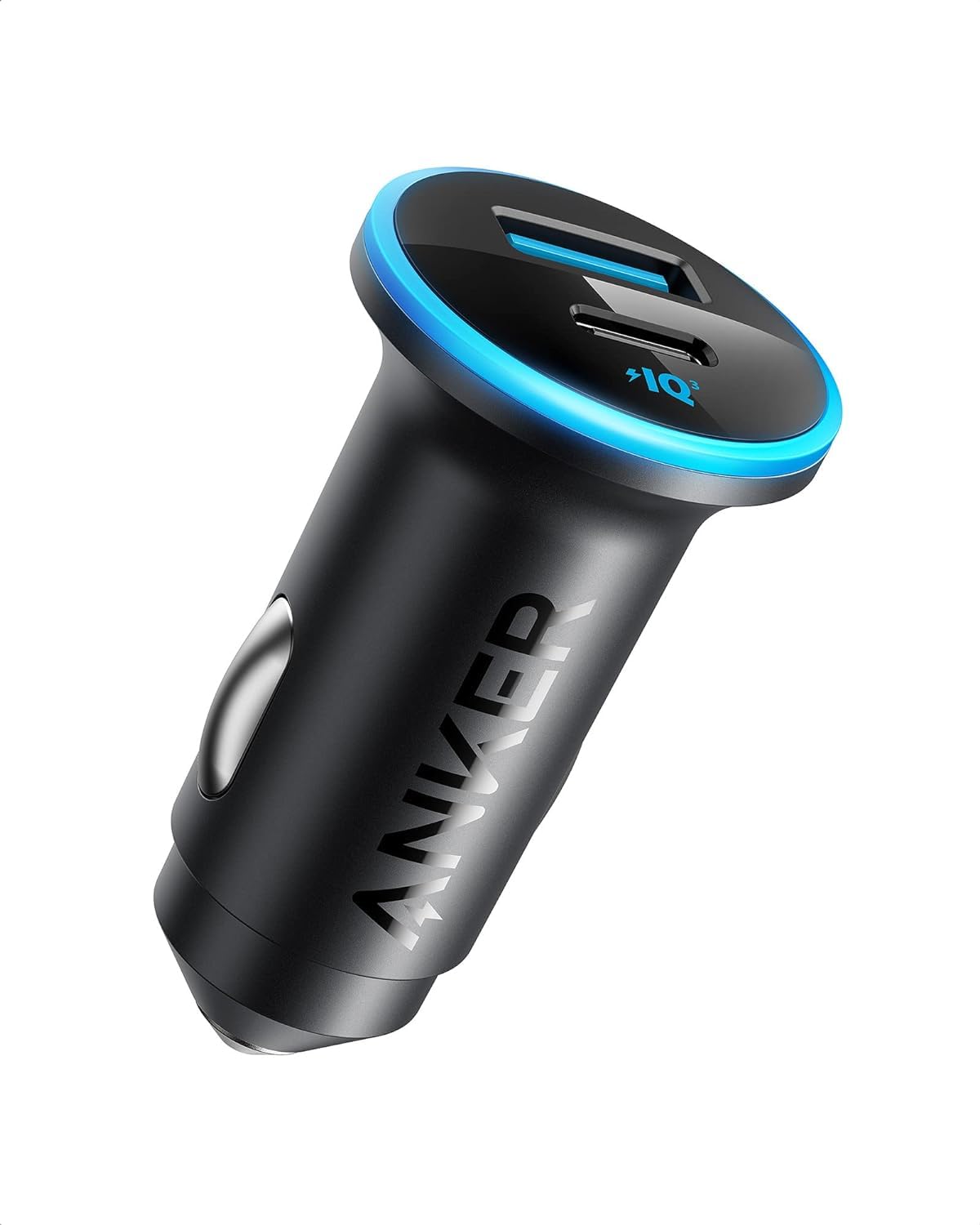
Anker’s 323 adapter is a straightforward, well-engineered plug-in charger that focuses on doing two things well. The USB-C port pushes 30W via PowerIQ 3.0, which is enough to take an iPhone 14 Pro to 50% in 25 minutes. The USB-A port delivers up to 22.5W, which beats the 12W of many competitors. Together, the combined 52.5W output is one of the highest in the compact plug-in category.
ActiveShield 2.0 is Anker’s proprietary temperature monitoring system that intelligently reduces power if the charger gets too hot, protecting both the charger and your devices. The unit is compact and fits snugly in most sockets without wobbling. Its compatibility list is massive, covering iPhones, Samsungs, Pixels, and USB-C tablets. The 18-month warranty is a nice bonus.
This is the ideal pick for drivers who want a simple, no-installation-required upgrade that charges two modern devices at near-maximum speed. The high-quality electronics and thermal management make it a safer choice than no-name alternatives.
What works
- 30W USB-C + 22.5W USB-A for fast dual charging
- ActiveShield 2.0 thermal protection
- Plug-and-play simplicity with broad compatibility
What doesn’t
- No power switch to prevent parasitic draw
- Single USB-C port only
5. Hapytrip 78W 4 Port 12V USB Outlet 2-Pack

This is the same 78W four-port socket replacement as the single-pack reviewed above, but sold in a two-pack. Each unit has two USB-C PD 30W and two USB-A QC 18W ports, a push-button power switch, and a 60cm fused wiring pigtail. The value proposition is clear: you can upgrade the factory socket in two different vehicles, or outfit a boat and a tow vehicle, for a lower per-unit cost than buying singles.
The shared 78W limit per unit still applies, but for most daily driving scenarios where two phones and a tablet are the max load, the performance is identical to the single-pack version. The installation is the same straightforward red-to-positive, black-to-negative wiring. The plastic enclosures and waterproofing are consistent across both packs.
If you own multiple 12V vehicles or plan to install these in both a car and a camping trailer, this two-pack is the most economical way to get high-output USB charging in all of them. The consistency across units ensures the same user experience everywhere.
What works
- Two complete units for multiple installations
- Identical 78W 4-port performance as the single
- Includes fuses and terminals for each unit
What doesn’t
- Plastic enclosure on both units
- Not needed if you only have one vehicle
Hardware & Specs Guide
USB Power Delivery (PD)
PD is a fast-charging protocol that allows a charger and device to negotiate higher voltages (up to 20V) over a USB-C connection. For a car lighter adapter, a port labeled PD 20W or 30W can charge a compatible iPhone from 0 to 50% in roughly 20-35 minutes. PPS (Programmable Power Supply) is an enhancement of PD that allows even finer voltage control, particularly beneficial for Samsung Galaxy devices to reduce charging heat.
QC 3.0 (Quick Charge 3.0)
Qualcomm’s Quick Charge 3.0 uses Intelligent Negotiation for Optimum Voltage (INOV) to dynamically select the best voltage between 3.6V and 20V. In a 12V socket adapter, a QC 3.0 port typically delivers up to 18W, charging a compatible Android phone about four times faster than a standard 5V/1A charger. It is backward compatible with QC 2.0 and 1.0 devices.
FAQ
Can I plug a laptop into a car cigarette lighter charger?
Is it safe to leave a USB charger plugged into the lighter socket overnight?
What is the difference between a plug-in adapter and a socket replacement?
Final Thoughts: The Verdict
For most buyers, the best auto cigarette lighter winner is the Hapytrip 78W 4 Port because it offers the highest USB charging bandwidth in a panel-mount form factor with a power switch to protect your battery. If you want the most refined plug-and-play experience for a single flagship phone, grab the Belkin BoostCharge 42W. And for a space-saving combo that includes both a high-power 12V socket and a voltmeter, nothing beats the Qidoe 2-in-1 with Voltmeter.

Certification: BSc in Mechanical Engineering
Education: Mechanical engineer
Lives In: 539 W Commerce St, Dallas, TX 75208, USA
Md Amir is an auto mechanic student and writer with over half a decade of experience in the automotive field. He has worked with top automotive brands such as Lexus, Quantum, and also owns two automotive blogs autocarneed.com and taxiwiz.com.