When you are out on a trail or maintaining small engines, the last thing you need is a gas can that leaks, vents fumes inside your trunk, or pours fuel everywhere except the tank. The market is flooded with cheap plastic cans that warp, nozzles that dribble, and seals that fail after one season. Finding a 1/2 gallon gas can that actually holds fuel safely and pours cleanly requires looking past the shelf at the auto parts store.
I’m Amir — the founder and writer behind Four Wheel Ask. I spend my time analyzing small-engine fuel system specs, container material durability ratings, and the real-world leak-point failures that owners report across hundreds of reviews.
After sorting through dozens of options ranging from ultralight backpacking bottles to OSHA-rated safety cans, I narrowed the field to the containers that genuinely seal, vent, and dispense without drama. This guide covers the best 1/2 gallon gas can choices for every scenario from the garage to the campsite.
How To Choose The Best 1/2 Gallon Gas Can
Selecting a small fuel container is not just about finding something that holds liquid. The wrong can will evaporate fuel through porous plastic, dribble gasoline down the side of your equipment, or fail a safety inspection. Here are the three factors that separate a useful tool from a frustrating liability.
Material Construction and Chemical Resistance
Aluminum bottles resist corrosion and won’t degrade from ethanol-blended fuels, but they can dent if dropped and conduct heat quickly. High-density polyethylene (HDPE) is lightweight and impact-resistant, but cheap HDPE can swell or crack when exposed to extended fuel contact. Galvanized steel offers the best impact and fire resistance but adds significant weight. For a 1/2 gallon portable can, aluminum delivers the best strength-to-weight ratio if you need to carry it in a backpack, while HDPE works fine for stationary garage storage if the plastic is thick enough.
Spout Design and Pour Control
A flexible nozzle or rotating spout makes a huge difference when filling a chainsaw, trimmer, or camp stove with a narrow filler neck. Look for a spout that includes a self‑venting mechanism — this prevents the glug‑glug effect that causes fuel to splash back. Type II safety cans with a downward‑rotating spout offer the most controlled dispensing, while cylindrical bottles with a ring‑handle lid require more careful tipping to avoid overfilling.
Safety Certifications and Venting
If you store the can in a workshop, garage, or vehicle, OSHA and NFPA compliance matters. A flame arrestor inside the spout prevents external ignition from reaching the fuel vapors. A self‑closing cap or automatic venting gasket reduces the risk of pressure buildup and vapor leaks. Containers intended for camping fuel (white gas, kerosene) may not carry the same certifications as a Type I or Type II safety can designed for gasoline, so match the certification to your actual use environment.
Quick Comparison
On smaller screens, swipe sideways to see the full table.
| Model | Category | Best For | Key Spec | Amazon |
|---|---|---|---|---|
| Eagle UI10FS | Safety Can | Workshop & garage gasoline storage | 1 gallon, galvanized steel, flame arrestor | Amazon |
| Surecan SUR2SFG2 | Rotating Spout | Controlled dispensing into tight fill necks | 2 gallon, HDPE, self-venting, 9″ hose | Amazon |
| wdcfxy Aluminum Bottle | Portable Bottle | Backpacking & camp stove fueling | 750 ml, aluminum alloy, leak‑proof seal | Amazon |
| Misakomo 691993 | Replacement Tank | Fixing leaky lawn mower & tiller fuel systems | 1 gallon, plastic, shut‑off valve included | Amazon |
| Tuff Jug 1.25 Gal | Multi‑Purpose | Water, coolant, non‑fuel fluid transfer | 1.25 gallon, HDPE, auto‑stop spout | Amazon |
In‑Depth Reviews
1. Eagle 1 Gallon Type I Red Safety Gas Can
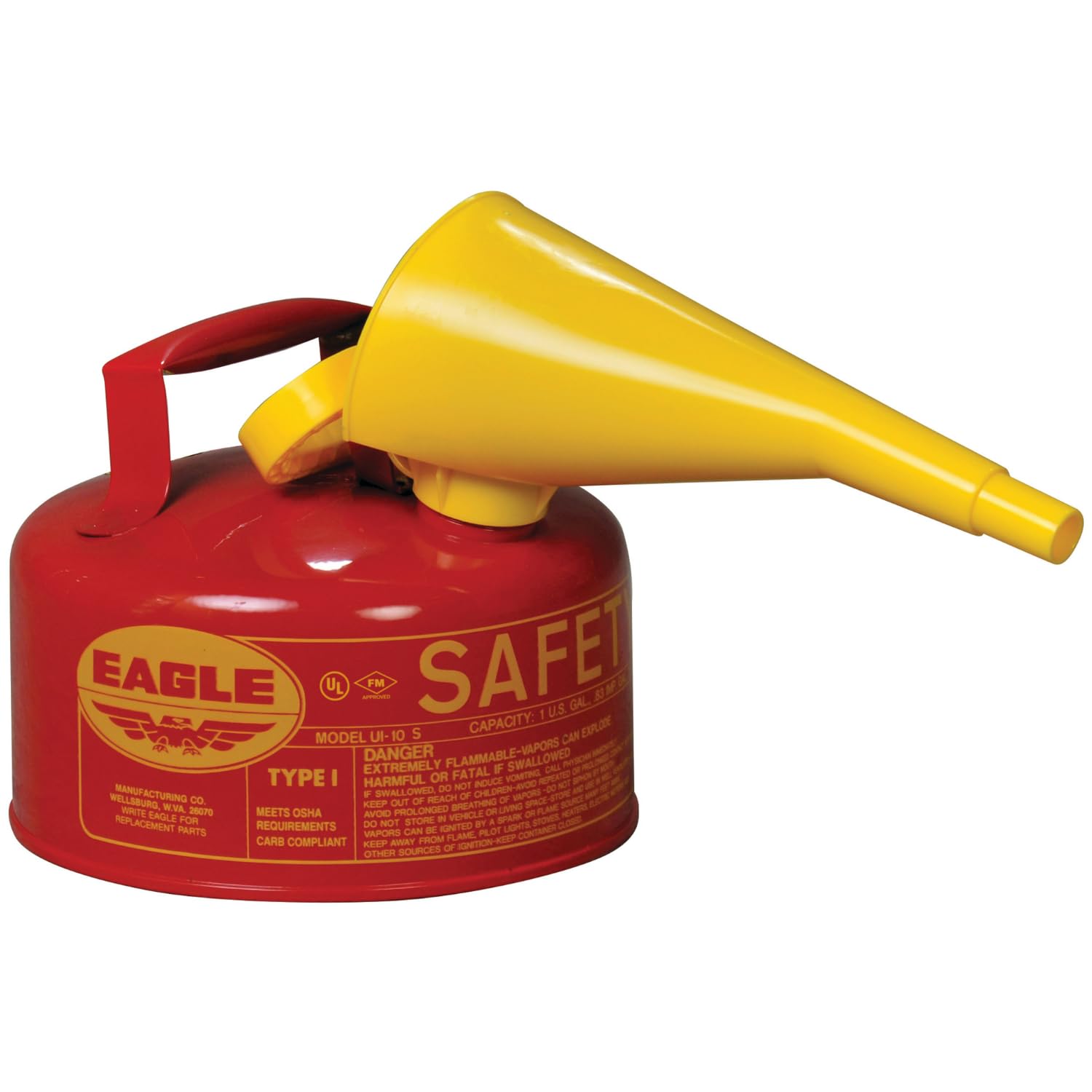
The Eagle UI10FS is the benchmark for small‑engine fuel storage. Constructed from 24‑gauge galvanized steel with a hot‑dipped lead‑free coating, it resists rust and dents far better than any plastic container. The Type I design uses a single opening for both fill and pour, and the gasketed spout cap self‑closes automatically to prevent vapor leaks. A non‑sparking flame arrestor sits inside the spout to stop external ignition from reaching the fuel, meeting OSHA, NFPA, FM, and UL standards.
In practical use, the included F‑15 funnel helps guide fuel into chainsaws and trimmers without splashback. The fixed steel handle feels solid when carrying a full gallon, and the baked‑on powder coat finish resists scratches from rough workshop surfaces. The 3.5‑pound weight is noticeable but expected for a metal safety can — this is not a backpacking bottle, but a garage tool built to last decades.
One minor trade‑off is that the rigid spout does not rotate, so you must tilt the entire can to pour into awkwardly positioned fuel necks. The self‑venting mechanism works reliably, but some users find the cap assembly slightly stiff when opening one‑handed. For anyone who values compliance, durability, and zero leaks, this remains the gold standard.
What works
- Galvanized steel construction shrugs off drops and corrosion
- Flame arrestor and self‑closing lid meet full OSHA/NFPA compliance
- Powder coat finish holds up to years of garage wear
What doesn’t
- Heavy for its size at 3.5 pounds empty
- Fixed spout requires careful angling for tight filler necks
- Only 1 gallon capacity exceeds the strict 1/2 gallon target
2. Surecan 2 Gallon Type‑II Safety Container

The Surecan SUR2SFG2 redefines what controlled dispensing looks like in a fuel container. Its Type‑II design features a downward‑rotating spout that pivots to direct flow exactly where you need it, combined with an ergonomic thumb‑trigger system that lets you modulate the pour rate. The built‑in self‑venting mechanism eliminates the surging and splashing that plagues cheaper cans, and the 9‑inch hose reaches deep into filler necks without removing the can from a raised position.
Constructed from high‑density polyethylene (HDPE), this 2‑gallon container is lighter than steel and resists corrosion from ethanol‑blended fuels. The rotating spout makes it especially useful for filling mowers, snow blowers, and generators where the fuel cap sits recessed. The 3‑year limited warranty adds peace of mind for a container that sees frequent use in dirty environments.
The obvious downside is the 2‑gallon capacity — far larger than the 1/2 gallon ideal for backpacking or small engine topping off. The HDPE body, while durable, can absorb odors over time and may develop micro‑cracks if stored in direct sunlight. Still, for a garage or workshop can that prioritizes spill‑free pouring, the Surecan design is hard to beat.
What works
- Rotating spout with thumb trigger gives exceptional pour control
- Self‑venting design prevents fuel surge and splashback
- Lightweight HDPE won’t rust or dent like metal cans
What doesn’t
- 2‑gallon capacity is excessive for portable carry
- HDPE can absorb fuel odors permanently
- Not backpack‑friendly — no carry strap or secure seal for transport
3. wdcfxy Aluminium Fuel Bottle 750ml

The wdcfxy aluminum bottle is the closest match to a true 1/2 gallon carrier. The body is formed from a single piece of aluminum alloy with no welded seams, which eliminates the most common leak point found on cheap fuel bottles. A ring handle on the lid lets you clip it to a backpack or tool belt, and the sealing cap uses a gasket that minimizes evaporation and fuel odor.
During handling, the cylindrical shape fits easily into a backpack side pocket or tool bag. The seamless construction inspires confidence when storing mixed fuel, and the aluminum resists corrosion from ethanol and two‑stroke oil blends. The bottle is also rated for kerosene and petrol, making it versatile for lanterns and stoves beyond just small engines.
The primary limitation is the small capacity — you will need to refill frequently if using it for a lawn mower or tiller. The lid seal, while effective, is not a ratcheting or locking mechanism, so a hard drop could unseat the gasket and cause leakage. For ultralight campers or anyone who needs a true portable fuel bottle rather than a garage can, this aluminum option delivers solid value.
What works
- Seamless aluminum body eliminates welded leak points
- Ring‑handle cap clips easily to packs and belts
- Corrosion‑resistant alloy handles mixed fuel without degradation
What doesn’t
- Only holds ~0.2 gallons, far less than a true half‑gallon
- Cap seal can dislodge on hard impact
- No venting mechanism — requires careful pouring to avoid glugging
4. Misakomo 691993 Fuel Tank 1 Gallon

The Misakomo 691993 is not a portable can in the traditional sense — it is a direct replacement fuel tank designed for lawn mowers, tillers, log splitters, and snow blowers. The 1‑gallon (4‑quart) plastic tank includes a pre‑installed shut‑off valve and fuel cap, making it a simple swap for aging OEM tanks that have developed cracks or seam leaks. The top‑mounted brackets allow secure bolt‑on installation, and the aluminum valve insert resists cracking at the fuel line connection.
In practice, this tank solves the problem of a leaking original unit without the cost of a dealership part. The plastic body is thick enough to handle ethanol fuel without swelling, and the shut‑off valve lets you isolate the fuel supply during storage or maintenance. It fits a wide range of garden machines and includes everything needed for a weekend repair project.
The trade‑offs are clear: this is a stationary tank, not a portable carrier. There is no handle designed for carrying, no sealed spout for safe transport of loose fuel, and no compliance certification for storage in a vehicle or living space. It belongs bolted to equipment, not tossed in a trunk. For its intended purpose as a repair replacement, the value is excellent.
What works
- Complete replacement kit with valve and cap included
- Thick HDPE resists ethanol‑blend fuel swelling
- Universal bolt‑on brackets fit most garden tractors
What doesn’t
- Not designed for portable fuel carrying or pouring
- No safety certification for vehicle or indoor storage
- Plastic can still crack if overtightened on mounting studs
5. Tuff Jug 1.25 Gallon Multipurpose Container

The Tuff Jug stands apart because it is explicitly not intended for fuel use — the manufacturer states this clearly. However, it earns a place in this guide for buyers who need a 1/2‑gallon‑adjacent container for water, coolant, windshield washer fluid, or other non‑flammable liquids. Made in the USA from high‑density polyethylene, the jug features an auto‑stop spout that shuts off fluid flow when the receiving tank is full, and a wide mouth that pours up to 500% faster than competing designs.
For the overflow of a cooling system refill or a quick top‑off of a lawn mower’s hydraulic reservoir, the no‑fuss spout design eliminates guesswork. The container is sturdy enough to survive drops on concrete, and the white color makes it easy to distinguish from gasoline containers — which is a genuine safety advantage when storing multiple fluids in a workshop.
The major caveat is that you cannot legally or safely use this jug for gasoline, kerosene, or any flammable liquid — the HDPE is not rated for fuel vapor containment, and the auto‑stop mechanism may not resist chemical breakdown. If your need is strictly for non‑fuel workshop fluids, the Tuff Jug is a well‑built, high‑flow container. For fuel storage, look elsewhere.
What works
- Auto‑stop spout prevents overfilling any container
- Rapid pour rate saves time on multi‑quart refills
- USA‑made HDPE construction with excellent impact resistance
What doesn’t
- Explicitly not designed or certified for gasoline or fuel use
- 1.25 gallon size is overkill for small engine topping off
- White color can stain easily with dark fluids
Hardware & Specs Guide
Flame Arrestors and Self‑Closing Mechanisms
A flame arrestor is a mesh screen inside the spout that dissipates heat, preventing an external flame from igniting fuel vapors inside the can. This is a mandatory safety feature for any container used to store gasoline in a workshop or vehicle. The self‑closing lid, typically spring‑loaded, seals automatically when released, reducing the chance of vapor escape if the can tips over. On the Eagle UI10FS, both features work together to meet OSHA and NFPA compliance. On portable aluminum bottles or utility jugs, these safety elements are usually absent because the containers are not intended for regulated gasoline storage.
Material Thickness and Fuel Compatibility
Galvanized steel (24‑gauge, as used on the Eagle can) offers the best resistance to impact, puncture, and chemical attack from ethanol blends. HDPE containers must be at least 1.5 mm thick to resist swelling and stress cracking from prolonged fuel contact — many budget‑tier cans use thinner plastic that warps after a few months. Aluminum bottles avoid corrosion and seam leakage entirely, but the metal’s thermal conductivity means fuel heats up faster in direct sun, increasing vapor pressure. For a 1/2 gallon gas can, aluminum provides the best portability, while steel remains the gold standard for stationary safety storage.
FAQ
Can I use an aluminum fuel bottle for gasoline with ethanol?
What is the difference between a Type I and Type II safety can?
How do I prevent a 1/2 gallon gas can from leaking during transport?
Final Thoughts: The Verdict
For most buyers, the best 1/2 gallon gas can winner is the Eagle UI10FS because its galvanized steel build, flame arrestor, and OSHA compliance make it the safest and most durable option for storing gasoline in a garage or workshop. If you need controlled pouring into tight filler necks, grab the Surecan SUR2SFG2 with its rotating spout. And for ultralight portable carry, nothing beats the wdcfxy aluminum bottle for slip‑into‑a‑pack convenience.

Certification: BSc in Mechanical Engineering
Education: Mechanical engineer
Lives In: 539 W Commerce St, Dallas, TX 75208, USA
Md Amir is an auto mechanic student and writer with over half a decade of experience in the automotive field. He has worked with top automotive brands such as Lexus, Quantum, and also owns two automotive blogs autocarneed.com and taxiwiz.com.