An unreliable cooling fan switch turns a simple temperature spike into a warped head gasket or a cracked block in minutes. Whether you are swapping a carbureted V8 into an off-road rig or restoring a classic sedan with an electric fan conversion, the switch that commands your fan controls the line between a reliable daily driver and a roadside disaster. This guide breaks down the relay kits and controllers that take the guesswork out of engine bay temperatures.
I’m Amir — the founder and writer behind Four Wheel Ask. Over the past decade, I’ve analyzed cooling system specifications, wiring schematics, and owner feedback across hundreds of aftermarket fan setups to identify which switches deliver repeatable engagement without failure.
These kits range from pre-set mechanical thermostats to programmable digital controllers, each with trade-offs in ampacity and wiring complexity. After sorting through the critical specs, you will know exactly which automotive fan switch belongs in your build.
How To Choose The Best Automotive Fan Switch
Selecting the right fan controller goes beyond grabbing any wire-and-relay box off the shelf. You need to match the switch’s electrical capacity, temperature programming, and physical mounting to your specific fan setup and engine thermostat. The wrong choice can either under-cool your engine or burn out the relay prematurely.
Relay Current Rating and Wire Gauge
The relay’s contact current rating must exceed the total amp draw of your electric fan by at least 15%. A 40-amp relay handles most single 10-to-16-inch medium-profile fans. If you run dual high-profile fans or a puller with high locked-rotor current, step up to a 60-amp rated relay or splice in 10-gauge wire on the power feeds. Undersized wiring creates voltage drop and heat buildup at the connectors.
Temperature Set Points and Thermostat Match
Fixed-temperature switches pre-set to 185°F On / 175°F Off require a 160°F engine thermostat to function correctly. If you use a 180°F engine thermostat with a 185°F On switch, the engine never gets cool enough to trigger the fan to shut off, leading to continuous fan cycling and eventual relay wear. Adjustable digital controllers let you dial in any On point between 104°F and 230°F, giving you independent control over primary and secondary fan staging.
Waterproofing and Mounting Location
A switch living behind the radiator or near the grille must survive road splash and steam. Look for relay kits with waterproof fuse holders and sealed relay housings. The temperature probe sensor should have a 3/8-inch NPT thread to screw into the cylinder head, intake manifold, or a radiator fin. A mechanical push-in radiator switch (like the Four Seasons unit) mounts directly into the radiator core but omits adjustable set points.
Quick Comparison
On smaller screens, swipe sideways to see the full table.
| Model | Category | Best For | Key Spec | Amazon |
|---|---|---|---|---|
| FASTSTORM 60A Kit | Relay Kit | High-amp single fan setups | 60A relay, 185°F On / 175°F Off | Amazon |
| ZOZOMOTORS Single Kit | Relay Kit | Medium-profile single fans | 40A relay, 185°F On / 175°F Off | Amazon |
| ZOZOMOTORS Dual Kit | Relay Kit | Dual low/medium fans | 40A relay per fan, 185°F / 175°F | Amazon |
| Four Seasons 35879 | Switch Only | Quick radiator push-in replacement | 20A, push-button, fixed temp | Amazon |
| JUNRUO Digital Kit | Digital Controller | Adjustable dual-fan staging | 40A, 104°F – 230°F range | Amazon |
In‑Depth Reviews
1. FASTSTORM 60A Electric Fan Relay Kit

The FASTSTORM kit sits at the top of the stack because it delivers 60 amps of switching capacity, a full 50 percent more headroom than the typical 40-amp kits. That extra margin matters when you are powering a 16-inch puller fan that spikes current on startup or running a single fan in a high-ambient underhood environment where heat soak reduces component efficiency. The 4-pin waterproof relay is sealed against road splash, and the copper contacts minimize resistance across the switching cycle.
Temperature control follows the proven 185°F On / 175°F Off preset, which pairs cleanly with a 160°F engine thermostat. The included wiring harness uses color-coded leads — red to battery positive, blue to the fan relay trigger, yellow to ignition, gray to the sensor — and comes with a printed diagram that eliminates guesswork for first-time installers. The waterproof fuse holders protect the inline circuit from corrosion in humid engine bays or off-road conditions.
One nuanced detail: the kit’s 12.16-ounce weight reflects robust 14-gauge main power wires rather than the thinner 16-gauge found in budget kits. This gauge difference translates directly into lower voltage drop across longer wire runs from the battery to the radiator area.
What works
- 60-amp relay delivers headroom for high-draw single fans
- Color-coded wires and printed diagram simplify installation
- Waterproof fuse holders resist engine-bay moisture
What doesn’t
- Pre-set temperature points cannot be adjusted
- Kit only supports single-fan configuration
2. ZOZOMOTORS Single Fan Relay Kit

The ZOZOMOTORS single-fan kit is the most accessible entry point for a reliable cooling circuit without overbuying capacity. Its 40-amp relay matches the requirements of most 10-to-14-inch medium-profile fans, and the included temperature probe uses a 3/8-inch pipe thread with a 1/2-inch adapter to fit differently tapped engine blocks or intake manifolds. The OE-style sending unit must be grounded through its threads to the engine, a critical step some beginners miss that causes the fan to never engage.
Wiring is clearly labeled with colored pigtails — red to 12-volt battery, coffee to fan positive, black to the sending unit, gray to ignition — and a diagram is printed on the packaging. The harness includes an inline 40-amp waterproof fuse holder, four ring terminals, and two spade connectors. ZOZOMOTORS explicitly cautions users to run a 160°F engine thermostat with the 185°F On / 175°F Off switch to prevent constant fan cycling. That warning alone saves hours of diagnostic head-scratching.
The main limitation is the 40-amp maximum rating. For a high-profile 16-inch fan or a dual-fan setup, the manufacturer recommends stepping to their heavy-duty 60-amp relay kit or upgrading the power wires to 10-gauge between pin 30 and pin 87. For the budget-conscious builder with a single medium fan, however, this kit strikes a very efficient cost-to-performance ratio without omitting necessary hardware like the fuse holder and temperature adapter.
What works
- Complete hardware kit with fuse holder and adapters
- OE-style probe threads into the block or water jacket
- Clear wiring diagram and color-coded leads
What doesn’t
- 40-amp limit unsuitable for high-draw fans
- Probe must thread into a grounded metal surface
3. ZOZOMOTORS Dual Electric Fan Relay Kit
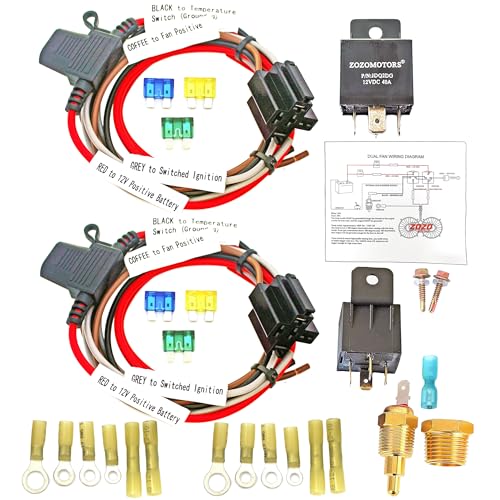
When your build requires two fans — common in high-horsepower V8 swaps, turbocharged engines with intercoolers, or heavy-duty towing applications where single fans struggle at idle — the ZOZOMOTORS dual relay kit consolidates switching for both motors into one harness. It ships with twin 40-amp relays, each dedicated to one fan, so the fans run in parallel rather than sharing a single relay that could saturate under combined load. The kit supports 10-to-16-inch fans, and the included 8 ring terminals plus 4 wire connectors give you extra crimp options for routing.
Temperature actuation uses the same 185°F On / 175°F Off probe as the single version, so both fans trigger at the same set point. This works well for engine bays that need aggressive cooling but can lead to unnecessary battery drain if you only need one fan at cruising speed. The panel-mount relay housing allows you to fasten the relays to a flat fender or radiator support rather than letting them dangle in the wire harness. That physical mounting reduces vibration fatigue on the relay contacts over time.
One nuance: the kit is rated for medium-profile or low-profile fans. ZOZOMOTORS explicitly advises that high-profile fans — which draw over 20 amps per motor — require their separate heavy-duty relay kit or aftermarket 10-gauge wiring upgrades on pins 30 and 87. For the typical dual-16-inch pusher/puller combo used in classic muscle cars and off-road rigs, the included 40-amp relays handle the load comfortably without dipping into temperature derating.
What works
- Dedicated relay per fan prevents load sharing
- Panel-mount design secures relays against vibration
- Includes extra ring terminals and wire connectors
What doesn’t
- Both fans turn on simultaneously, no staging delay
- Not recommended for high-profile fans without wire upgrades
4. Four Seasons 35879 Radiator Fan Switch

The Four Seasons 35879 takes a different approach: rather than a wiring harness with a relay, it is a radiator-mounted push-button temperature switch that inserts directly into the radiator core. This design bypasses the need for a threaded engine block opening entirely, making it ideal for applications where the cylinder head has no free ports or the engine block is aluminum with incompatible NPT threads. The 20-amp current rating limits its use to a single low-profile auxiliary fan.
The push-button actuator is mechanically different from a capillary probe — it expands a wax pellet inside the switch body to physically close the contacts when coolant temperature reaches the calibrated set point. This method is inherently slower to respond than a thermistor-based digital probe, but it eliminates the possibility of electrical sensor drift over years of thermal cycling. Four Seasons has manufactured OE-replacement HVAC and cooling components for decades, so the build quality of the copper contacts inside the switch body is consistent with production-line automotive standards.
Keep in mind that the 35879 is a switch only — it does not include a relay, a wiring harness, or a fuse holder. You must integrate it into a circuit that already has a fused power feed and a relay capable of switching the fan’s full load current. This makes it more of a component for a custom-built harness rather than a plug-and-play kit. The unit’s weight is listed at 0.6 pounds, which reflects the metal body and mounting flange but not the wiring loom you will need to supply yourself.
What works
- Fits directly into the radiator core, no block threading needed
- Mechanical wax-pellet actuator resists electrical drift
- Compact form factor for tight engine bays
What doesn’t
- Only 20 amp rating limits use to small fans
- No relay, harness, or fuse holder included
- Response time is slower than digital sensors
5. JUNRUO Digital Thermatic Fan Switch Kit
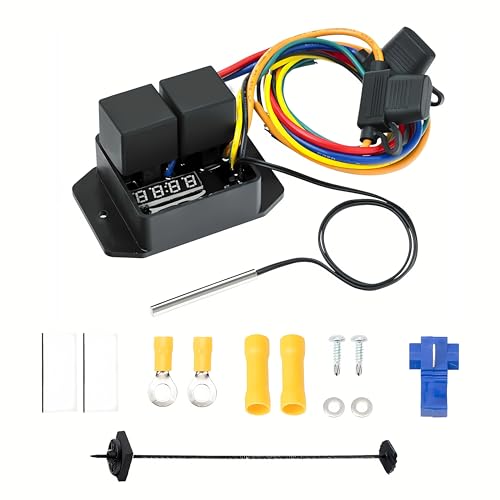
The JUNRUO 0444 digital controller is the most technologically sophisticated option here, offering a fully adjustable temperature range from 104°F up to 230°F with a digital display that reads in either Celsius or Fahrenheit. This programmability lets you set the primary fan to kick on at a lower threshold — say 180°F — and then stage a second fan 10 seconds later if the temperature continues climbing. That progressive staging reduces the electrical load spike at startup and maintains system voltage stability.
Unlike the fixed-probe kits that require a 160°F thermostat to function, the JUNRUO works with any engine thermostat because you dial in the On point yourself. It supports both 12-volt and 24-volt electrical systems, so it crosses over into heavy-duty trucks, boats, and military vehicles running dual-voltage accessories. The included wiring bundle covers battery positive and negative, ignition trigger, A/C clutch input, and dedicated terminals for fan 1 and fan 2. The IP54 protection rating means the main controller is splash-proof but not fully submersible — mount it inside the cab or behind a sealed panel if you expect pressure-washing.
The trade-off for this flexibility is a more involved installation. The thermistor probe must be installed in the coolant flow path, and the controller needs a clean 12-volt switched ignition source to power the digital logic. The kit does not include a pre-wired relay block — you connect the controller’s output to your own 40-amp relays. For the builder who values tuning precision over simplicity, the JUNRUO enables the most exact thermal management possible without a standalone ECU fan output.
What works
- Digital adjustment from 104°F to 230°F, no fixed set points
- Staged dual-fan startup reduces electrical surge
- Operates on both 12V and 24V systems
What doesn’t
- Requires external relays and wiring fabrication
- Thermistor probe needs proper coolant exposure
- IP54 rating not fully waterproof for engine-bay mounting
Hardware & Specs Guide
Relay Contact Rating and Duty Cycle
The relay’s contact current rating (40A vs 60A) defines the maximum continuous current it can switch without arcing or welding the contacts. A 40-amp relay typically handles 15-20 amps of continuous fan draw with safe margin. The contact material — usually copper or silver alloy — affects resistance and heat generation. Silver-alloy contacts resist oxidation better in humid environments.
Temperature Switch Mechanism: Probe vs Wax Pellet
Threaded probe switches use a bimetallic strip or thermistor to sense coolant temperature at the cylinder head or intake manifold. Wax-pellet switches (like the Four Seasons) mount in the radiator core and physically expand to close contacts. Probe switches respond faster and support adjustable thresholds, while wax pellets are more durable against constant vibration but slower to actuate.
FAQ
Why does my fan switch require a 160 degree thermostat when the switch turns on at 185 degrees?
Can I use a single-fan relay kit on a dual-fan setup by daisy-chaining both fans to one relay?
Is it necessary to ground the temperature switch through its threads to the engine block?
Final Thoughts: The Verdict
For most buyers, the automotive fan switch winner is the FASTSTORM 60A Kit because its 60-amp relay headroom and waterproof assembly support both medium and demanding single-fan builds without requiring wiring upgrades. If you need a budget-friendly ZOZOMOTORS Dual Kit entry point with solid component quality, the ZOZOMOTORS single relay kit covers standard installations. And for those who want adjustable staging control over two fans, nothing beats the JUNRUO Digital Kit.

Certification: BSc in Mechanical Engineering
Education: Mechanical engineer
Lives In: 539 W Commerce St, Dallas, TX 75208, USA
Md Amir is an auto mechanic student and writer with over half a decade of experience in the automotive field. He has worked with top automotive brands such as Lexus, Quantum, and also owns two automotive blogs autocarneed.com and taxiwiz.com.