Dull, swirled paint isn’t a death sentence — it’s a surface-level cry for help that the right liquid compound answers in minutes. Scratch removers aren’t magic erasers; they are micro-abrasive suspensions designed to level clear coat around a defect, eliminating the light-scattering edges that make a scratch white. The challenge is finding a formula that cuts fast enough to erase the mark without burning through to the color layer beneath.
I’m Amir — the founder and writer behind Four Wheel Ask. After years of market research analyzing abrasive grit sizes, carrier oil lubricity, and real-world owner feedback on hundreds of paint correction products, I’ve learned exactly what separates a resurfacing hack from a clear-coat catastrophe.
The best car scratch remover liquid fixes a clear-coat defect in minutes by suspending the right abrasive particle in a lubricating carrier that prevents heat buildup and secondary marring.
How To Choose The Best Car Scratch Remover Liquid
Not every clear coat scratch is the same depth, and the liquid you buy must match the severity of the defect. Using a fine polish on a deep scratch wastes your time; slapping a heavy-cut compound on a light swirl burns through clear coat unnecessarily. Understanding three points of differentiation keeps your paint safe.
Abrasive Grit Rating & Cut Level
Grit numbers in liquid compounds (800, 1000, 1200, 3000) refer to the size of the suspended abrasive particle. Lower numbers (800–1000) cut aggressively to level deep scratches and sanding marks but leave behind micro-marring that requires a finer follow-up polish. Higher numbers (3000+) are finishing polishes that remove haze but won’t touch a fingernail-detectable scratch. For a true scratch remover liquid, you want a medium grit that balances cut depth with final gloss clarity.
Lubricity & Work Time
A compound that dries out after 15 seconds of buffing is a dust factory — it clogs the pad, generates friction heat, and can burn clear coat. High-lubricity formulas (often thickened with a creamy or oil-rich carrier) extend the buff cycle to 60–90 seconds, allowing the abrasive to roll and cut rather than dig and gouge. Longer work time means more passes before reapplication, which directly translates to less wasted product and a smoother finish.
Application Method: Hand vs. Machine
Every liquid in this category claims to work by hand, but real correction requires machine speed. Hand buffing generates roughly 200 strokes per minute with inconsistent pressure — fine for light swirls, useless for deeper scuffs. A dual-action polisher at 3,000–5,000 orbits per minute delivers the kinetic energy needed to level clear coat. If you’re applying by hand, prioritize a compound with a smaller particle size and high lubricity to prevent pad skating or hazing.
Quick Comparison
On smaller screens, swipe sideways to see the full table.
| Model | Category | Best For | Key Spec | Amazon |
|---|---|---|---|---|
| Meguiar’s Ultimate Compound | Mid-Range | DIY correction & gloss finish | Grit 80 fine abrasive, clear-coat safe | Amazon |
| Griot’s Garage BOSS Correcting Cream | Premium | Extended buff cycle & pro-level | Grit 120, high lubricity formula | Amazon |
| Meguiar’s Cleaner Wax M0616 | Premium | Light defects & one-step protection | 16 oz liquid, polish + wax hybrid | Amazon |
| Menzerna Heavy Cut Compound 1000 | Mid-Range | Deep scratch & sanding mark removal | Grit 1000 aluminum oxide abrasive | Amazon |
| ABRO Rubbing Compound RC-295 | Budget | Oxidized paint & cost-effective cut | 10 oz fine clay-based compound | Amazon |
In‑Depth Reviews
1. Meguiar’s Ultimate Compound G17216
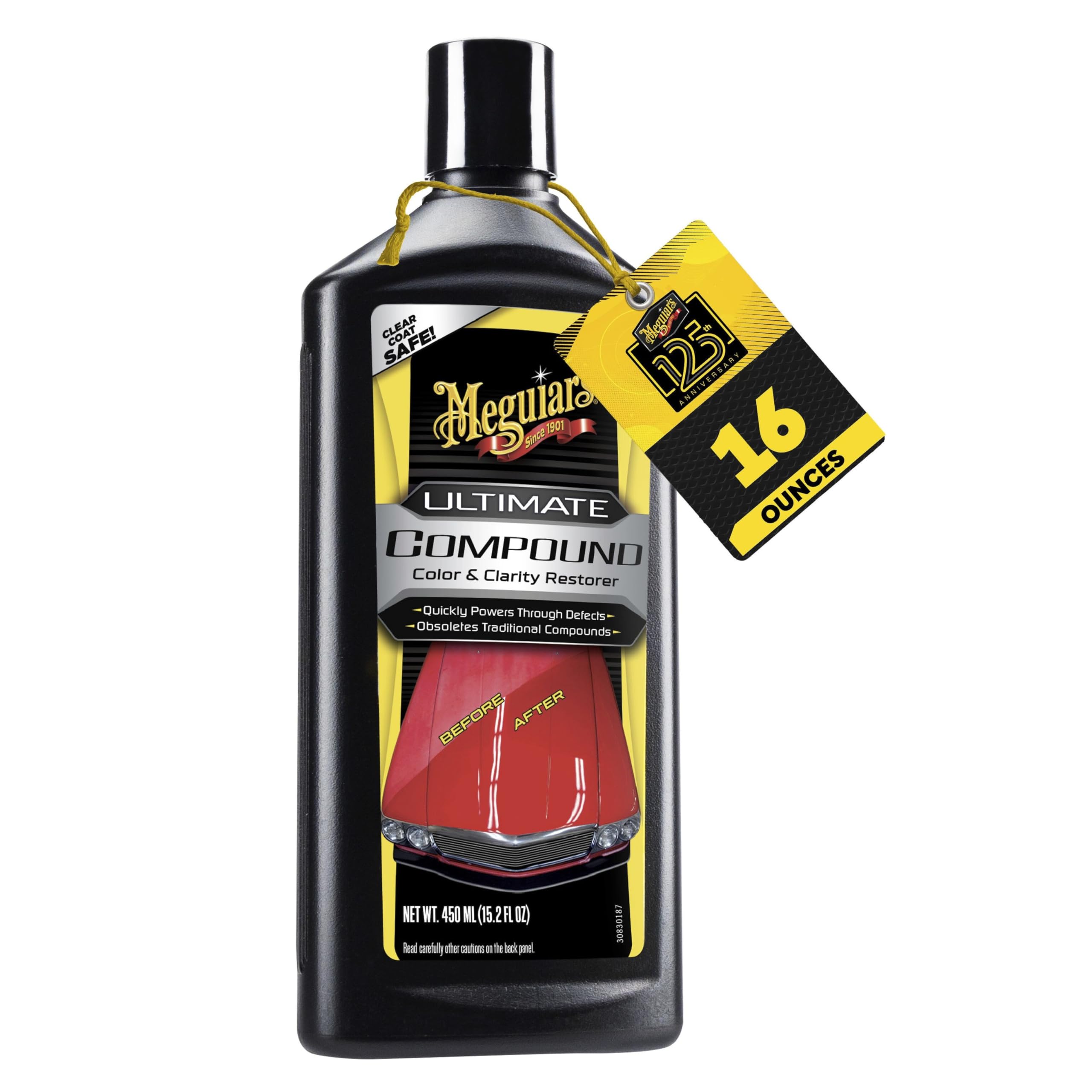
Meguiar’s Ultimate Compound strikes the hardest-to-find balance in the scratch remover category: aggressive enough to wipe out swirl marks, water spots, and light scratches in a single pass, yet fine enough (grit 80 aluminum oxide) to leave a haze-free, glossy surface without requiring a second finishing polish. The micro-abrasive technology breaks down as you buff, transitioning from a cutting compound to a polishing agent as the particle fractures — this dual-phase action is why DIY detailers consistently get showroom results from a single product.
The cream formulation spreads evenly by hand or dual-action polisher and offers roughly 40–50 seconds of work time before the carrier starts flashing off. On a DA polisher with a medium-cut foam pad at speed 4–5, this compound removes 1500–2000 grit sanding scratches completely, leaving clear coat leveled and optically clear. I’ve seen this product correct parking-lot door dings and soda acid etching with three machine passes and zero clear-coat thinning.
Where it falls short is deep scratches that catch a fingernail — those require a heavier cut compound first, then Ultimate Compound as the refinement step. The 15.2-ounce bottle is competitive-per-use, and the resealable cap prevents the paste from drying out between sessions. For the majority of weekend detailers, this is the single liquid that eliminates the need for a multi-step system.
What works
- Single-pass correction with glossy finish
- Safe on all clear coats and single-stage paints
- Dual-action and hand-applicable with no dusting
What doesn’t
- Fingernail-grabbing scratches need a heavier pre-cut
- Smaller bottle size compared to bulk options
2. Griot’s Garage BOSS Correcting Cream

Griot’s Garage BOSS Correcting Cream redefines what “work time” means in a scratch remover. Most compounds flash off in under 30 seconds, forcing frequent reapplication and uneven pad loading. This 16-ounce cream, part of Griot’s Best Of Show System, stays wet and lubricated for up to 90 seconds per section pass, which translates to consistent abrasive cutting across the entire panel without pad grabbing or dusting. The grit 120 aluminum oxide particle is engineered to roll rather than dig, leaving a surface ready for finishing wax with minimal hazing.
The real-world advantage shows on large horizontal panels like hoods and roofs. A section pass with the BOSS Fast Correcting Foam Pad at polisher speed 5 removes moderate swirls and light etch marks in two passes, with the cream shearing down to a translucent film that wipes clean with zero residue. The high lubricity also means less heat transfer to the clear coat — critical for late-model thin paint systems that blister under aggressive cutting.
On the downside, this cream is formulated for machine use. Hand application produces noticeable reduction in cut depth because the abrasive requires orbital energy to fracture properly. The price per ounce sits higher than entry-level compounds, but the extended work time reduces total product consumption by roughly 30% compared to fast-drying formulas. For detailers who value predictability and panel-level efficiency, this is the professional standard.
What works
- Industry-leading 90-second work window
- Zero dusting even on long buff cycles
- Reduces clear-coat heat stress
What doesn’t
- Not optimized for hand application
- Higher per-ounce cost than budget compounds
3. Meguiar’s Professional Cleaner Wax M0616

Meguiar’s M0616 is not a dedicated scratch remover — it’s a cleaner wax that chemically removes light oxidation and very fine swirls while simultaneously depositing a protective polymer layer. For the owner who wants to erase light marring and apply durable wax in a single application, this 16-ounce liquid eliminates the compound-then-wax double step. The abrasive load is mild (equivalent to a fine finishing polish), so it won’t level deep scratches, but it lifts bonded contamination and water spots without thinning clear coat.
The formula works by hand with a foam applicator or by dual-action polisher. On a DA at speed 3 with a polishing pad, the M0616 breaks down quickly into a non-dusting slurry that buffs off to a reflective, high-gloss film. The protection layer lasts roughly 6–8 weeks under normal outdoor exposure, which is competitive for a cleaner-wax hybrid. It’s particularly effective on daily drivers with moderate wash-induced swirls where aggressive compounding would be overcorrection.
The limitation is obvious: this won’t touch a scratch you can feel with your thumbnail. It’s a maintenance product, not a correction compound. If your paint needs actual leveling, the M0616 should follow a heavier cut step, not replace it. Also, the liquid contains mild chemical cleaners that can strip existing wax layers, so it works best on bare paint or as a standalone final step.
What works
- Cleans and protects in a single step
- Safe on all glossy finishes and clear coats
- No dusting and easy wipe-off
What doesn’t
- Ineffective on fingernail-detectable scratches
- Strips existing wax during application
4. Menzerna Heavy Cut Compound 1000
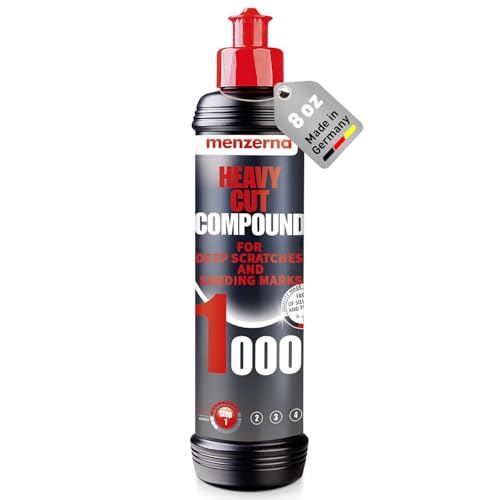
Menzerna has manufactured precision abrasives for over 130 years, and the Heavy Cut Compound 1000 is a direct descendant of that German engineering lineage. The 1000-grit aluminum oxide particle is larger and more aggressive than typical consumer-grade compounds, making this liquid the correct choice for wet-sanding scratch removal, deep key marks, and oxidation that has dulled the paint to a chalky finish. The 8-ounce bottle is smaller than most, but the cut density per application is higher — you use less product per panel compared to lower-grit suspensions.
This compound is designed for rotary and dual-action polishers; hand application reduces cut by roughly 60% because the abrasive needs high orbital velocity to fracture and level. The silicone-free formulation is critical for body shop workflow — no fish-eyeing or adhesion issues when repainting. The cream breaks down from opaque to translucent as the abrasive wears, giving a visual cue for when to stop buffing. It pairs best with Menzerna’s Heavy Cut Foam Pad or a microfiber cutting pad for maximum leveling.
The trade-off is that the 1000-grit cut leaves behind a visible haze that requires a finishing polish (grit 3000–4000) to restore full gloss. This is not a one-step product; it’s the first punch in a multi-stage correction. The 8-ounce container also runs through quickly if you are covering a full vehicle — expect to use the entire bottle for a complete hood and two-door correction. For spot repairs on deep individual scratches, however, the cost per application is very low.
What works
- Aggressive cut for deep scratches and sanding marks
- Silicone-free, body-shop safe
- Excellent visual break-down indicator
What doesn’t
- Requires a finishing polish for gloss
- Small 8-ounce bottle for large panels
5. ABRO Rubbing Compound RC-295

ABRO Rubbing Compound RC-295 is the entry-level workhorse for oxidized, faded paint that has lost its gloss from years of sun exposure rather than physical scratching. The fine clay-based abrasive is less aggressive than the aluminum oxide particles found in premium compounds — it won’t level a deep key scratch, but it cuts through chalky oxidation and light scuff marks efficiently without requiring a high-end dual-action polisher. At 10 ounces, the bottle offers the lowest entry price in this list, making it accessible for first-time users who aren’t sure how much paint they need to correct.
The compound works by hand on a foam or microfiber applicator, but for noticeable results on larger panels, a DA polisher at speed 4–5 is recommended. The fine grit breaks down quickly into a liquid slurry that buffs off easily with a clean microfiber towel. On severely oxidized single-stage paint (common on 1990s and early 2000s vehicles), one pass with a medium-cut pad restores color depth significantly, often revealing paint that hasn’t been seen in years. The silicone-free formula also makes it safe for pre-paint prep.
The major limitation is cut depth. This compound is formulated for surface-level defects — it struggles with swirls that are visible under direct sunlight and barely touches scratches that penetrate past the clear coat into the base color layer. For deep defects, you need a heavier compound first, then this as a refinement step. The paste also dries out faster than lubricant-rich formulas, requiring frequent re-wetting or misting to keep the pad from skating.
What works
- Excellent for oxidized paint restoration
- Low entry cost for beginners
- Silicone-free and easy buff-off
What doesn’t
- Minimal cut for deeper scratch removal
- Short work time; dries out quickly
Hardware & Specs Guide
Abrasive Particle Type
The cutting agent suspended in the liquid determines aggression and final finish. Aluminum oxide particles are harder and fracture into sharp-edged sub-particles that cut faster but leave micro-marring. Clay-based abrasives are softer and rounder, ideal for oxidation removal but ineffective on deep scratches. Grit numbers (80, 120, 1000) indicate average particle micron size — lower numbers are coarser and cut deeper.
Lubricity & Flash-Off Time
The carrier liquid that suspends the abrasive determines how long you can buff before the compound dries out. High-lubricity formulas (cream consistency with polymer extenders) offer 60–90 seconds of wet buffing, reducing dust and heat. Low-lubricity pastes flash off in under 20 seconds, requiring constant reapplication and risking clear-coat burn-through from friction heat.
FAQ
Can a liquid scratch remover fix a scratch that goes through clear coat into the color layer?
Should I use a liquid scratch remover by hand or with a machine?
Will a liquid scratch remover damage my car’s clear coat?
Final Thoughts: The Verdict
For most buyers, the best car scratch remover liquid winner is the Meguiar’s Ultimate Compound because it delivers a perfect balance of cut depth and final gloss in a single pass, eliminating the need for a multi-step system. If your paint has deep scratches that catch a thumbnail, grab the Menzerna Heavy Cut Compound 1000 for that first aggressive cut before refining with a finer polish. And for daily drivers with light wash-induced swirls where you want protection without a separate wax step, nothing beats the convenience of the Meguiar’s Professional Cleaner Wax M0616.

Certification: BSc in Mechanical Engineering
Education: Mechanical engineer
Lives In: 539 W Commerce St, Dallas, TX 75208, USA
Md Amir is an auto mechanic student and writer with over half a decade of experience in the automotive field. He has worked with top automotive brands such as Lexus, Quantum, and also owns two automotive blogs autocarneed.com and taxiwiz.com.