A car’s A/C system losing its chill is a slow, maddening failure. The compressor cycles, the vents push gentle warm air against your skin, and every drive turns into an exercise in patience. The root cause is often just a leak that drops the refrigerant charge below the threshold, starving the system of the pressure it needs to produce cold air. An air conditioner recharge kit is the direct intervention, restoring that pressure without a trip to the shop. But choosing the wrong kit or skipping the diagnostic step can waste money and leave you sweating.
I’m Amir — the founder and writer behind Four Wheel Ask. I’ve spent years analyzing the specifications, build quality, and real-world owner feedback on automotive service tools, from budget recharge cans to pro-grade manifold sets, so you don’t have to guess which hardware actually solves the problem.
This roundup examines seven distinct solutions, stripping away marketing claims to focus on the measurable metrics that matter — gauge accuracy, hose burst pressure, vacuum pump CFM, and refrigerant compatibility — to help you confidently select a air conditioner recharge kit tailored to your exact repair scenario.
How To Choose The Best Air Conditioner Recharge Kit
Picking the right kit hinges on three fixed decisions: the refrigerant your car needs, whether you plan to do a full evacuation with a vacuum pump, and the accuracy threshold of the gauges. Ignoring any of these leads to a partial fix or a wasted product.
Refrigerant Match: R134a vs. R1234yf vs. Retrofit Blends
The single most critical spec is the refrigerant type. Most cars from the mid-1990s through the mid-2010s use R134a. Newer vehicles use R1234yf, which has different service ports and pressures. A kit built for R134a will not physically attach to an R1234yf system without an adapter, and using a non-compatible blend can damage seals. Always check the label on your A/C service port or the under-hood decal before buying any can of refrigerant.
Gauge Accuracy and Manifold Type
The gauge set is the diagnostic brain of any kit. Look for calibrated dials with a stated accuracy of ±1.6%, which is the professional-grade standard. A 3-way manifold handles basic charge and evacuation, while a 4-way manifold adds a dedicated port for vacuum pump isolation, making the workflow cleaner. The hose construction is equally important — reinforced rubber hoses rated for at least 600 PSI working pressure resist swelling and bursting under peak system loads.
Vacuum Pump Capability
A vacuum pump pulls moisture and air out of the system before charging. For a proper repair, a 3.6 CFM single-stage pump is the minimum entry point. A dual-stage pump, like a 5 CFM unit, pulls a deeper vacuum (down to 22.5 microns) and handles larger systems or multi-car use. The pump’s horsepower rating and port size determine how quickly it can pull a stable vacuum. Without a pump, a simple recharge kit only tops off a system that still contains contaminants.
Quick Comparison
On smaller screens, swipe sideways to see the full table.
| Model | Category | Best For | Key Spec | Amazon |
|---|---|---|---|---|
| Orion Motor Tech AC Gauge Set | Budget Gauge Set | DIY Pressure Check | R134a/R410a/R22/R404a, 1.6% accuracy | Amazon |
| ZeroR R134a Refrigerant Replacement | Drop-in Refrigerant | Quick Top-off, Three Cans | R134a compatible hydrocarbon, 6 oz per can | Amazon |
| VEVOR 4-Way Manifold Gauge Set | Mid-Range Manifold | Multi-Refrigerant Service | R134a/R1234yf/R404a/R22, 800 PSI hoses | Amazon |
| Lichamp HVAC Manifold Gauge Set | Complete Gauge Kit | Garage/Shop Diagnostics | R134a/R32/R410a, 4-way manifold, 4 hoses | Amazon |
| BACOENG Vacuum Pump & Gauge Set | Vacuum Pump Kit | Home Mini-Split & Auto R410a | 3.6 CFM vacuum pump, 0.8 Pa ultimate | Amazon |
| PB Motor TECH Vacuum Pump Set | Auto AC Service Kit | Car A/C with Leak Check | 4.5 CFM, 1/3 HP pump, leak detector included | Amazon |
| VIVOHOME Dual-Stage Vacuum Pump Kit | Pro-Grade Dual Stage | Deep Evacuation, Heavy Use | 5 CFM, 2-stage pump, 22.5 microns | Amazon |
In‑Depth Reviews
1. VIVOHOME Dual-Stage Vacuum Pump and Gauge Set

VIVOHOME’s kit is the full arsenal: a 1/2 HP dual-stage vacuum pump that pulls down to 22.5 microns, paired with a 4-way manifold gauge set. The 5 CFM flow rate handles multiple cars in a row without overheating, and the two-stage design compresses gas more efficiently than single-stage alternatives, reducing the time needed to achieve a deep vacuum. The gauge set includes color-coded hoses rated for 800 PSI working pressure, with a handy hook for hands-free hanging during service.
This kit ships with both a self-sealing can tap and a puncture-style tap, giving you flexibility depending on the refrigerant cans you buy. The included leak detector adds another layer of diagnostic capability, helping you confirm the system holds vacuum before charging. At 30.8 pounds, it’s not lightweight, but the carrying case and ergonomic handle make transport manageable from garage to driveway.
The coarse inlet filter on the pump protects internal vanes from debris, and the exhaust filter separates oil mist from the discharge air, keeping the work area cleaner. For anyone who services multiple vehicles or wants a one-time purchase that covers deep evacuation, this kit is the gold standard. The only trade-off is that you need to buy separate R134a quick couplers if your primary focus is automotive R134a — the kit ships with R410a adapters for residential mini-splits.
What works
- Dual-stage pump achieves 22.5 micron vacuum depth
- 4-way manifold with dedicated vacuum port for cleaner workflow
- Includes both self-sealing and puncture can taps plus leak detector
What doesn’t
- Heavy setup at 30 pounds with full kit
- R134a quick couplers not included — requires separate purchase for automotive use
2. PB Motor TECH 4.5CFM Vacuum Pump Set
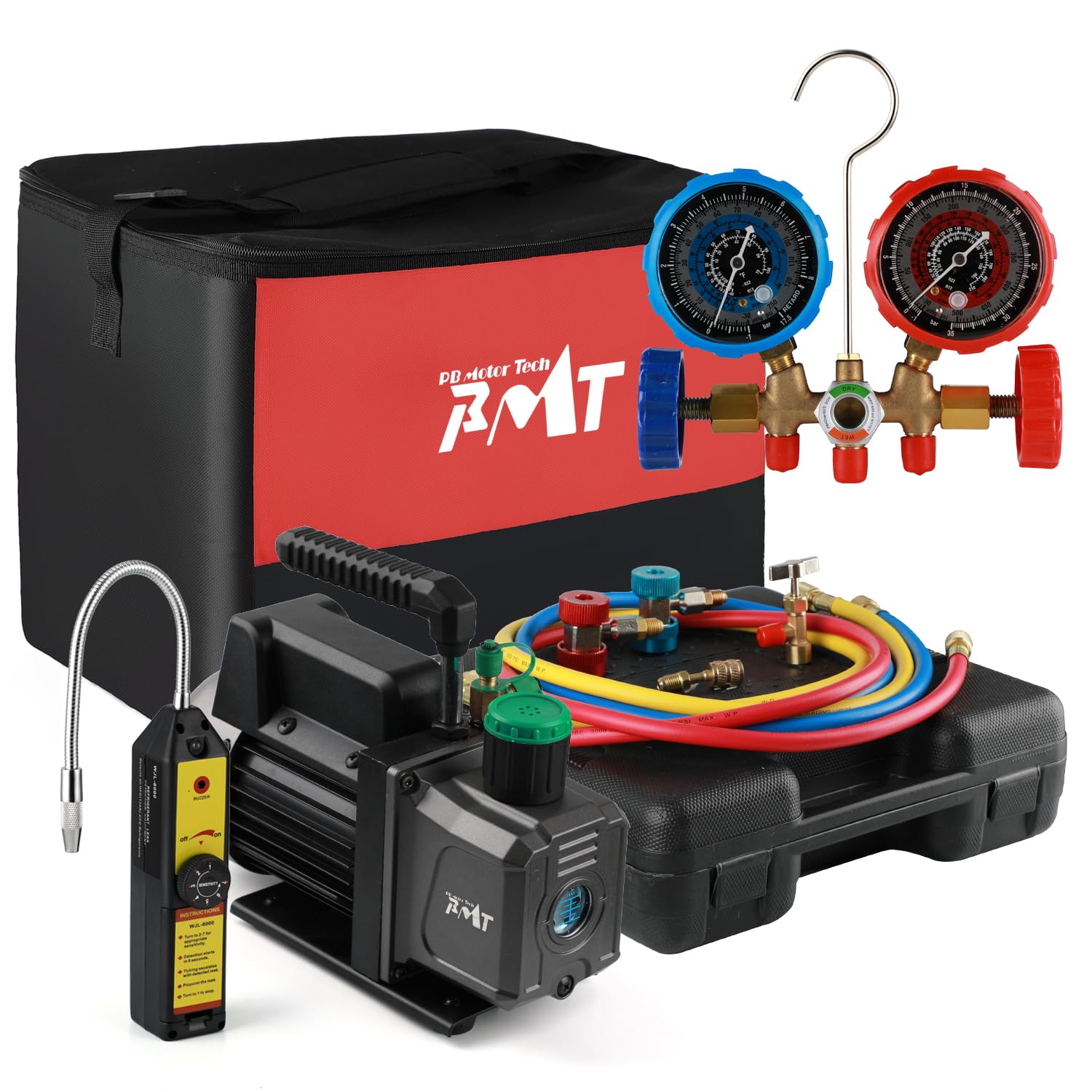
PB Motor TECH delivers a 1/3 HP single-stage pump with a 4.5 CFM flow rate, which is one of the best outputs in the single-stage class. This flow rate pulls a full vacuum on a typical car A/C system in under 15 minutes. The pump features a reinforced aluminum alloy housing that dissipates heat effectively, preventing thermal shutdown during extended runs. The 1/4-inch SAE and 1/2-inch ACME intakes provide dual port compatibility, making it easy to connect to different hose configurations.
The manifold gauge in this kit is a 3-way unit with ±1.6% accuracy and color-coded hoses that handle 600 PSI working pressure with a 3000 PSI burst rating. The included R134a puncture can tap and quick adapters get you charging immediately, and the leak detector lets you check for residual vacuum loss without needing a separate tool. The storage bag and plastic case keep everything organized, though some users note the bag is a snug fit once all hoses are coiled.
This set is compatible with R134a, R12, R22, and R502 refrigerants. The lack of vacuum pump oil in the box is a notable gap — you must purchase it separately before the first use. That aside, the pump’s copper motor construction and corrosion-resistant body suggest durability well beyond the entry-level price point. It’s a strong mid-range choice for the home mechanic who needs a step above a simple can tap.
What works
- 4.5 CFM flow rate pulls vacuum faster than typical 3 CFM pumps
- Leak detector included saves cost on separate diagnostic tools
- Aluminum alloy housing resists corrosion and improves heat dissipation
What doesn’t
- Vacuum pump oil not included
- Storage bag is tight when all hoses are packed
3. BACOENG 3.6CFM Vacuum Pump and Gauge Set

BACOENG’s kit centers around a 3.6 CFM, 1/4 HP vacuum pump with an ultimate vacuum rating of 0.8 Pa. This is a solid entry point for homeowners working on mini-split systems, as the kit ships with a dedicated R410a mini-split adapter. The 3-way manifold features an anodized aluminum block body and an oversized sight glass that makes it easy to see the flow of refrigerant during the charge cycle. The gauge dials are clear and the calibration screw allows for fine adjustments.
The three 5-foot hoses — red for high pressure, blue for low pressure, and yellow for the vacuum pump — comply with SAE-J2196 standards, ensuring compatibility with standard service ports. The set includes two 1/4-inch SAE to 5/16-inch SAE R410a adapters and vacuum oil, so you can start evacuating right out of the box. The compact pump design is noticeably quieter than many competitors in this CFM range, which is a small but real advantage during longer evacuation cycles.
The major limitation is that R134a quick couplers are not included. If you intend to use this kit on a car A/C system running R134a, you must purchase the couplers separately. For its intended audience — mini-split installers and homeowners — this is a complete, ready-to-run kit. For automotive-only use, factor in the extra cost and wait time for the couplers.
What works
- Quiet pump operation with compact footprint
- Includes R410a adapters and vacuum oil for immediate use
- Sight glass on manifold allows direct visual confirmation of refrigerant flow
What doesn’t
- No R134a quick couplers included — extra purchase needed for automotive
- 3-way manifold lacks a dedicated vacuum isolation port
4. Lichamp HVAC Manifold Gauge Set
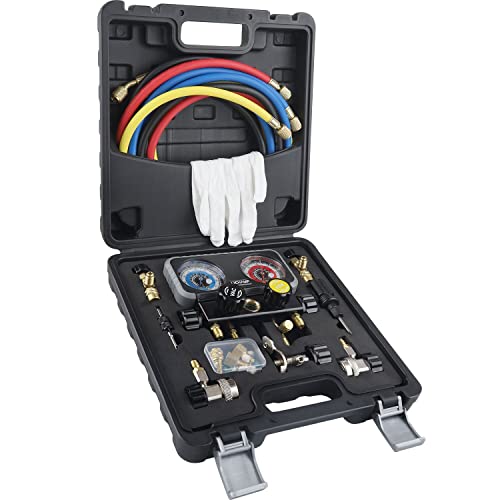
Lichamp offers a 4-way manifold gauge set at a price point that undercuts most 4-way competitors. The manifold works with R134a, R22, R32, and R410a refrigerants, giving it broad compatibility for both automotive and residential applications. The high-pressure side gauge reads up to 800 PSI, while the low-pressure side tops out at 550 PSI. The sight glass built into the manifold head lets you see the refrigerant state — liquid or vapor — during charging, which is a crucial diagnostic cue.
The four included hoses are 5 feet in length, with a 45-degree bend on one end to reach tight service ports. The hose rating is 800 PSI working pressure with a 4000 PSI burst pressure — a large safety margin that exceeds many kits in this mid-range bracket. Accessories include adjustable R134a adapters, R410a liquid safety valves, a calibration screwdriver, and a valve core remover. The set also comes with work gloves and a carrying case.
While the gauge housing uses a mix of steel, copper, aluminum, and brass, the overall build feels robust for the price. The 8.2-pound weight is manageable, and the case keeps everything sorted. The biggest caveat is the small gauge dial size compared to pro-grade units, which can make reading pressure increments more difficult in dim garage lighting. Still, for a home garage or small shop, this kit delivers excellent hardware per dollar.
What works
- 4-way manifold with sight glass for refrigerant flow monitoring
- High safety margin with 4000 PSI burst pressure hoses
- Broad refrigerant compatibility in one kit
What doesn’t
- Gauge dials are smaller than professional-grade models
- No vacuum pump included — requires separate purchase for full evacuation
5. Orion Motor Tech AC Manifold Gauge Set
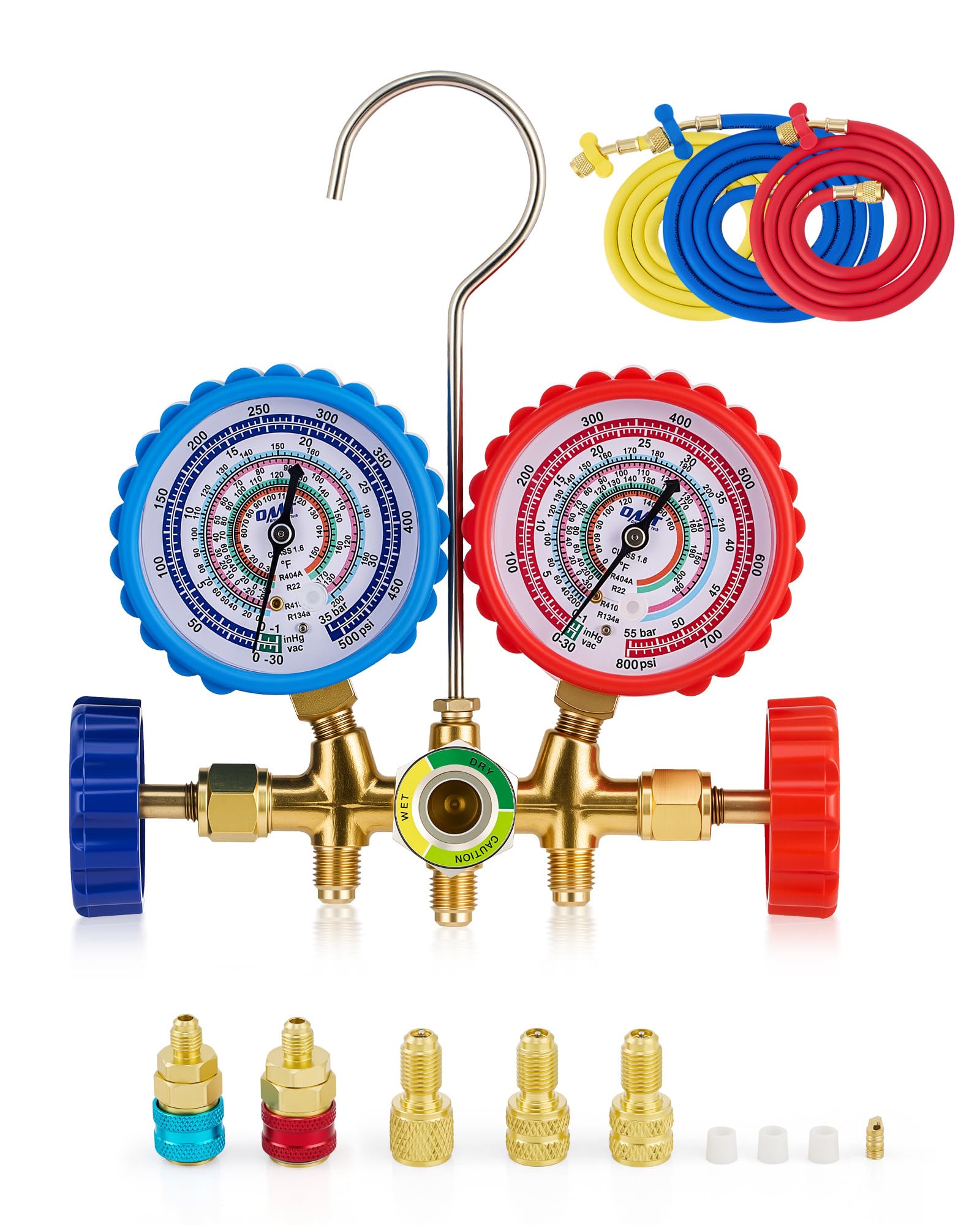
Orion Motor Tech’s 3-way gauge set focuses on core functionality at an entry-friendly price. The manifold works with R134a, R410a, R22, and R404a refrigerants, covering the most common automotive and residential types. The gauge accuracy is rated at ±1.6%, matching the precision of more expensive units. The hybrid antishock design combines an oil-filled core with a dry dial face — the oil dampens vibration in the tool box, while the dry face stays readable in cold weather without fogging.
The three color-coded hoses — low side blue, high side red, and charging yellow — are PVC with four reinforced layers rated to 600 PSI working pressure. The brass fittings resist corrosion, and the included 1/4-inch to 1/2-inch 29-degree adapter helps reach awkward service ports. The set weighs only 3 pounds, making it easy to bring along in a tool bag or glove box. Pure copper fittings on the manifold body add longevity compared to all-plastic designs at the same price.
The biggest shortfall is the absence of quick couplers for R134a that offer adjustable shut-off; the included couplers are non-adjustable, meaning they don’t allow you to incrementally open the Schrader valve. This limits fine control during charging. It’s a capable diagnostic tool for checking pressures and performing basic recharge if you use a separate can tap, but serious DIYers will want to upgrade the couplers.
What works
- Oil-filled gauges with dry dials remain readable in cold weather
- Pure copper fittings resist corrosion over time
- Lightweight and compact for easy transport
What doesn’t
- Non-adjustable quick couplers limit charging control
- PVC hoses have lower working pressure (600 PSI) compared to rubber alternatives
6. ZeroR R134a Refrigerant Replacement (3 Pack)
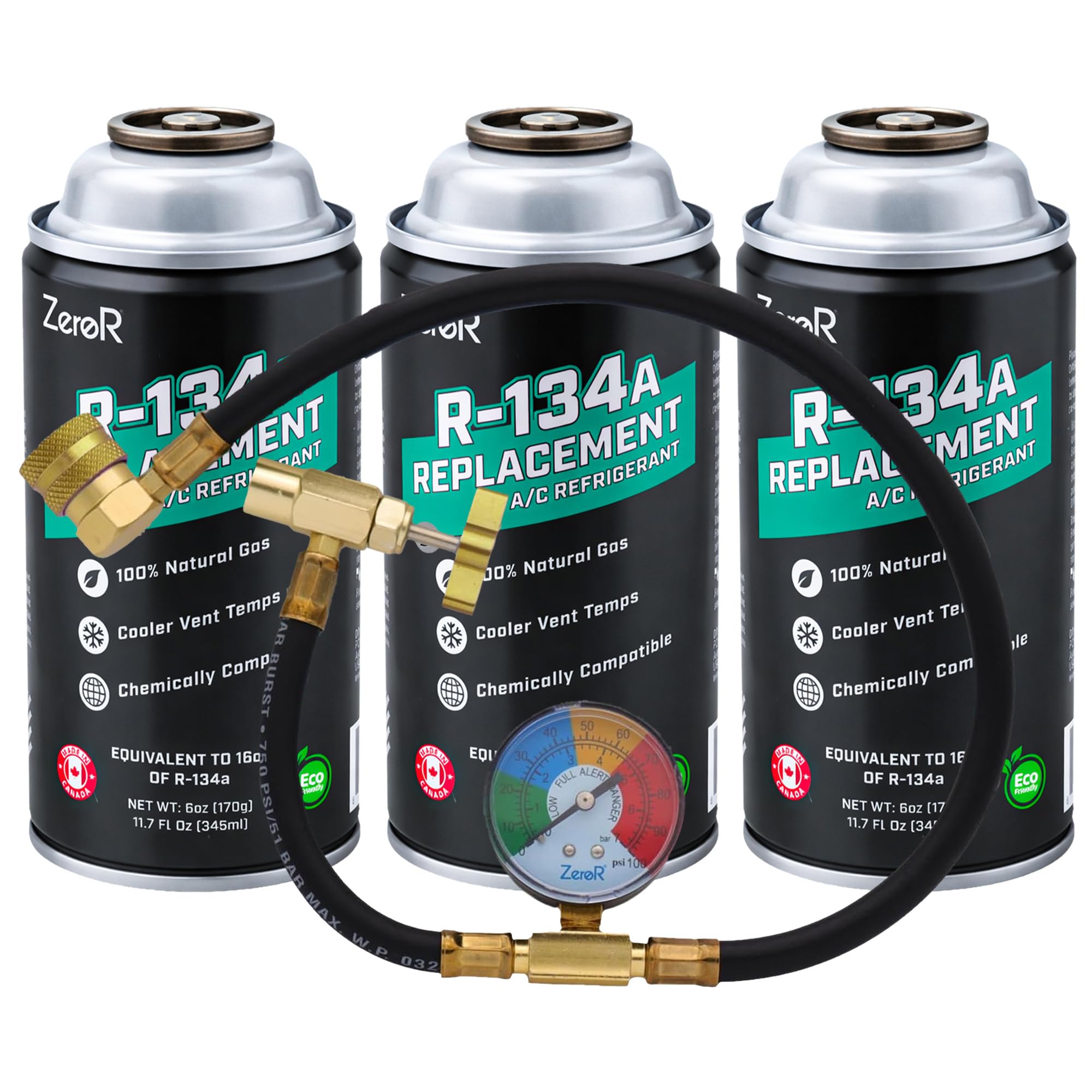
ZeroR’s offering is a drop-in hydrocarbon refrigerant blend designed as a replacement for R134a. The formula is 100% natural, non-ozone-depleting, and has a global warming potential of effectively zero. Each can contains 6 ounces of refrigerant by weight, which translates to roughly 11.7 fluid ounces of volume. The hydrocarbon base is lighter than traditional R134a, so the system requires the same number of cans by weight to achieve the same charge level — the lighter weight per can means slightly more volume per ounce.
The cans use a Self-Sealing Valve (SSV) design, which allows you to store partially used cans without losing pressure. This is a major improvement over disposable piercing-style cans that vent the remaining refrigerant if disconnected. Critically, ZeroR requires an SSV-compatible dispensing tool — the cans will not work with standard piercing taps. This is a limitation if you already own a puncture-style manifold tap. The product is explicitly labeled for Non-MVAC use, so verify local regulations regarding hydrocarbon refrigerants in automotive systems.
The three-can pack provides enough refrigerant for one or two full top-offs depending on your system’s capacity. The biggest trade-off is the need for the SSV tool, which adds an extra purchase if you don’t already own one. For those who value a low-impact refrigerant with a lower environmental footprint, this is a genuine alternative, but compatibility with your specific charging hardware must be confirmed before purchase.
What works
- Natural hydrocarbon blend with very low environmental impact
- Self-sealing cans allow storage of unused refrigerant
- Chemically compatible with R134a system components
What doesn’t
- Requires SSV-compatible tool — not compatible with standard piercing taps
- Flammable hydrocarbon refrigerant requires careful handling
7. VEVOR 4-Way AC Manifold Gauge Set
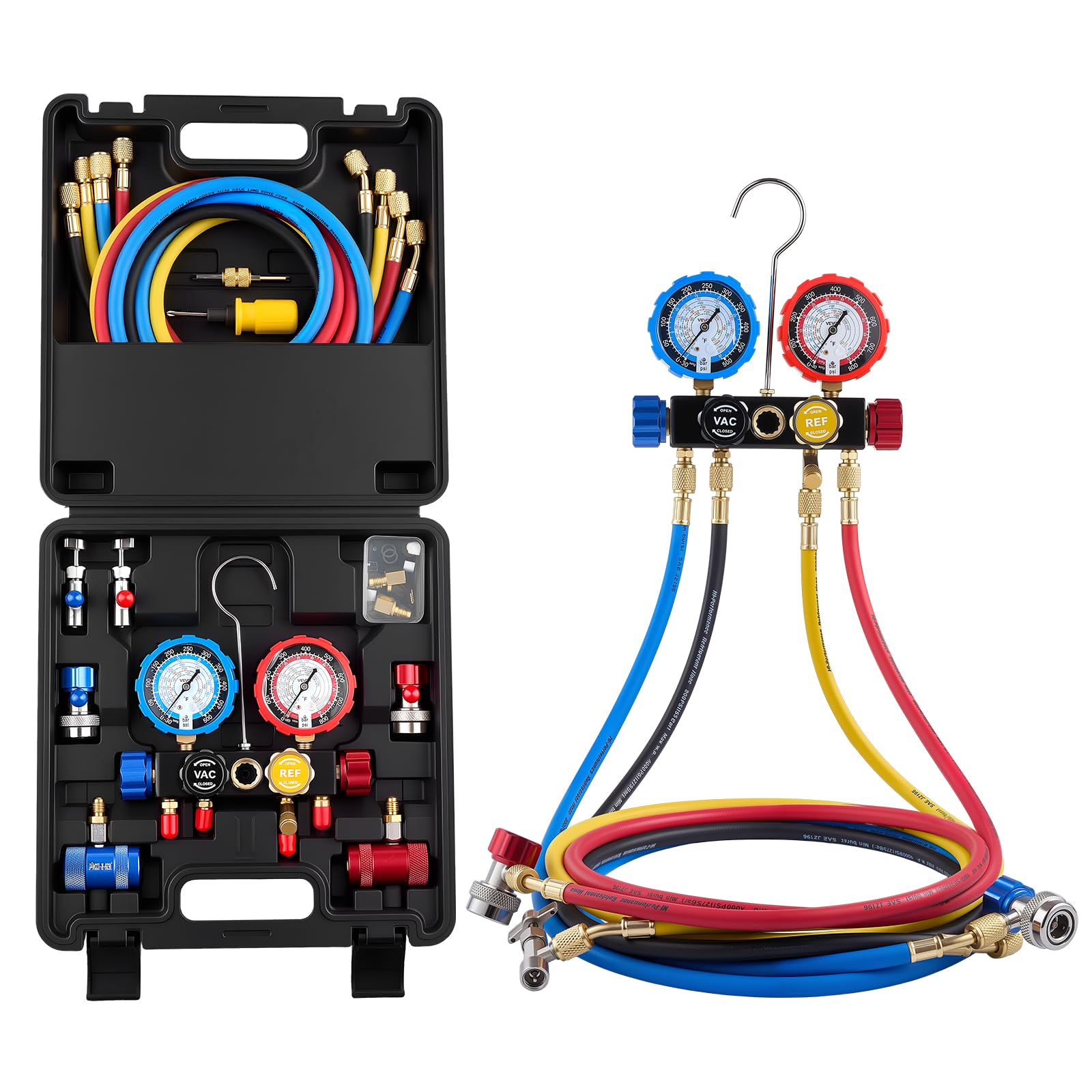
VEVOR’s 4-way manifold gauge set distinguishes itself by supporting R1234yf refrigerant right out of the box, alongside R134a, R404a, and R22. For owners of newer vehicles switching to R1234yf, this makes the VEVOR kit a future-proof choice that avoids the need for adapters. The manifold body is machined from aluminum, keeping the weight manageable while maintaining sealing integrity. The high-pressure side is rated at 800 PSI working pressure, and the low-pressure side is similarly robust.
The set includes four color-coded hoses, each 5 feet long, with gasketed brass connectors to reduce leaks. The hoses are rated for working pressures up to 800 PSI, with a burst pressure of 4000 PSI. The included sealed can taps are designed for both self-sealing and standard cans, giving you flexibility. The kit also packs a valve core wrench, a screwdriver for calibration adjustments, and a sight window on the gauge dial to evaluate charge level during testing.
One area where VEVOR saves money is in the plastic case and the feel of the gauge knobs, which are functional but not as tight as those on premium units. Additionally, the hoses are stiff when brand new, requiring some effort to route into tight engine bays. For someone servicing mixed-refrigerant vehicles — especially a blend of older R134a cars and newer R1234yf ones — this kit represents the best single-manifold solution without buying separate gauge sets.
What works
- Supports R1234yf directly without adapters
- Aluminum valve body resists corrosion and remains lightweight
- Sealed can taps work with both SSV and standard cans
What doesn’t
- Gauge knobs feel less precise than pro-grade units
- Hoses are stiff when new, harder to maneuver in tight spaces
Hardware & Specs Guide
Manifold Gauge Accuracy & Scale
The professional standard for AC gauge accuracy is ±1.6% of full scale. Kits like the Orion Motor Tech and Lichamp meet this spec. A lower-grade gauge can mislead you into believing the system is over- or under-charged, causing compressor damage. Look for dials with a sight glass — this window shows you if the refrigerant is flowing as liquid or vapor, which indicates whether the charge is complete.
Vacuum Pump Stages & CFM Rating
A single-stage pump compresses gas once before expelling it. A dual-stage pump compresses the gas twice, achieving a deeper vacuum — typically below 25 microns for a dual-stage versus 75–100 microns for a single-stage. The CFM (cubic feet per minute) rating tells you how fast the pump pulls down the system. A 3.6 CFM pump evacuates a standard car A/C in about 15–20 minutes, while a 5 CFM pump cuts that time by 30%.
Hose Construction & Pressure Rating
Hoses are the most abused component in any recharge kit. Look for reinforced rubber hoses with a minimum working pressure of 800 PSI and a burst pressure of at least 3000 PSI. PVC hoses, while cheaper, degrade faster under heat cycles and UV exposure in an engine bay. Brass fittings with gasketed seals reduce the chance of leaks at the connection points — a common failure point that wastes refrigerant.
Can Tap Type: Puncture vs. Self-Sealing
Puncture-style taps pierce the top of a refrigerant can and hold it in place until you turn a valve. Once opened, the can cannot be removed without losing the remaining gas. Self-sealing valves (SSV) allow the can to be disconnected mid-use, preserving any unused refrigerant. The ZeroR refrigerant requires an SSV-compatible tap. Kits like the VIVOHOME include both types, giving you flexibility regardless of the can design.
FAQ
Can I use a air conditioner recharge kit on a system that still has pressure?
How much refrigerant does a typical car A/C system need?
Is a hydrocarbon refrigerant safe for my car A/C?
Final Thoughts: The Verdict
For most buyers, the air conditioner recharge kit winner is the VIVOHOME Dual-Stage Vacuum Pump and Gauge Set because it combines a pro-grade 5 CFM two-stage pump with a 4-way manifold and all essential accessories in one carry case. If you want a dedicated R1234yf-compatible manifold without the vacuum pump, grab the VEVOR 4-Way Manifold Gauge Set. And for a quick top-off with lower environmental impact, nothing beats the ZeroR R134a Replacement three-pack — provided you have the right SSV tap.

Certification: BSc in Mechanical Engineering
Education: Mechanical engineer
Lives In: 539 W Commerce St, Dallas, TX 75208, USA
Md Amir is an auto mechanic student and writer with over half a decade of experience in the automotive field. He has worked with top automotive brands such as Lexus, Quantum, and also owns two automotive blogs autocarneed.com and taxiwiz.com.