Corrosion doesn’t sleep. Once oxygen hits bare steel, the reaction chain begins — and in high-salt, humid, or coastal environments, that chain can eat through a quarter-inch of chassis metal in a single season. A quality rust cleaner chemically arrests that degradation on contact, buying your frame, underbody, and wheel wells years of structural integrity instead of months.
I’m Amir — the founder and writer behind Four Wheel Ask. I spend my time analyzing chemical formulations, comparing aerosol delivery systems, and dissecting real owner feedback on how each compound holds up against road salt, winter brine, and tidal moisture so you don’t have to guess.
Whether you’re coating a project car’s box sections, treating a daily driver’s rocker panels, or protecting marine equipment stored near saltwater, the right pick depends on the surface area, the rust stage, and the environment. This guide breaks down the best available treatments so you can choose with confidence. The car rust cleaner you land on must match your specific corrosion threat, not a marketing promise.
How To Choose The Best Car Rust Cleaner
The surface area you’re treating, the stage of rust present, and the environmental exposure dictate which formulation is right. A converter paint that neutralizes deep pitting on a truck frame differs fundamentally from a thin penetrating spray meant for door cavities.
Waxy Fluid vs Converter Paint vs Thin Penetrant
Waxy aerosols, like the Jenolite Waxoil, drive moisture out of box sections and self-seal after scratches — ideal for hollow cavities and seams. Converter paints, such as the Meuvcol Rust Reformer, chemically transform iron oxide into a stable black coating and require a brush-on application, suited for flat, accessible metal panels. Thin penetrants, like the classic CorrosionX, creep into threads and electrical terminals, blocking moisture at the molecular level without leaving a viscous residue.
Aerosol Can Reach and Nozzle Design
For underbody and chassis work, the included straw or flexible nozzle determines whether you can actually reach the backside of a sill, the inside of a rocker panel drain hole, or a buried frame crossmember. Some aerosol cans lack a directional tube entirely, forcing you to overspray adjacent areas. Check for “straw included” or “360° nozzle” in the product description before you start spraying blind.
Dielectric Strength and Galvanic Protection
If you’re treating battery terminals, ground straps, or exposed sensor connectors, a rated dielectric barrier (like CorrosionX’s 39,000+ volt rating) prevents current leakage and stops galvanic corrosion between dissimilar metals — aluminum grounding lugs against steel frames, for instance. Standard wax coatings offer no such electrical insulation; they’re purely mechanical moisture barriers.
Quick Comparison
On smaller screens, swipe sideways to see the full table.
| Model | Category | Best For | Key Spec | Amazon |
|---|---|---|---|---|
| JENOLITE Waxoil | Waxy Aerosol | Box sections and underbody cavities | 16.9 fl oz self-sealing wax aerosol | Amazon |
| Fluid Film 752-515 | Lanolin Spray | Underside coating and tool protection | 11.75 oz lanolin-based aerosol | Amazon |
| CorrosionX 90101 | Penetrant Spray | Electrical terminals and threaded fasteners | 6 oz, 39,000V dielectric barrier | Amazon |
| Meuvcol Rust Reformer | Converter Paint | Frame rails and flat chassis panels | 35 fl oz black matte converter paint | Amazon |
| CorrosionX Heavy Duty | Dripless Gel Spray | Marine gear and harsh outdoor equipment | 12 oz, self-healing barrier, 2 yr outdoor | Amazon |
In‑Depth Reviews
1. Meuvcol 2 in 1 Rust Converter & Metal Primer
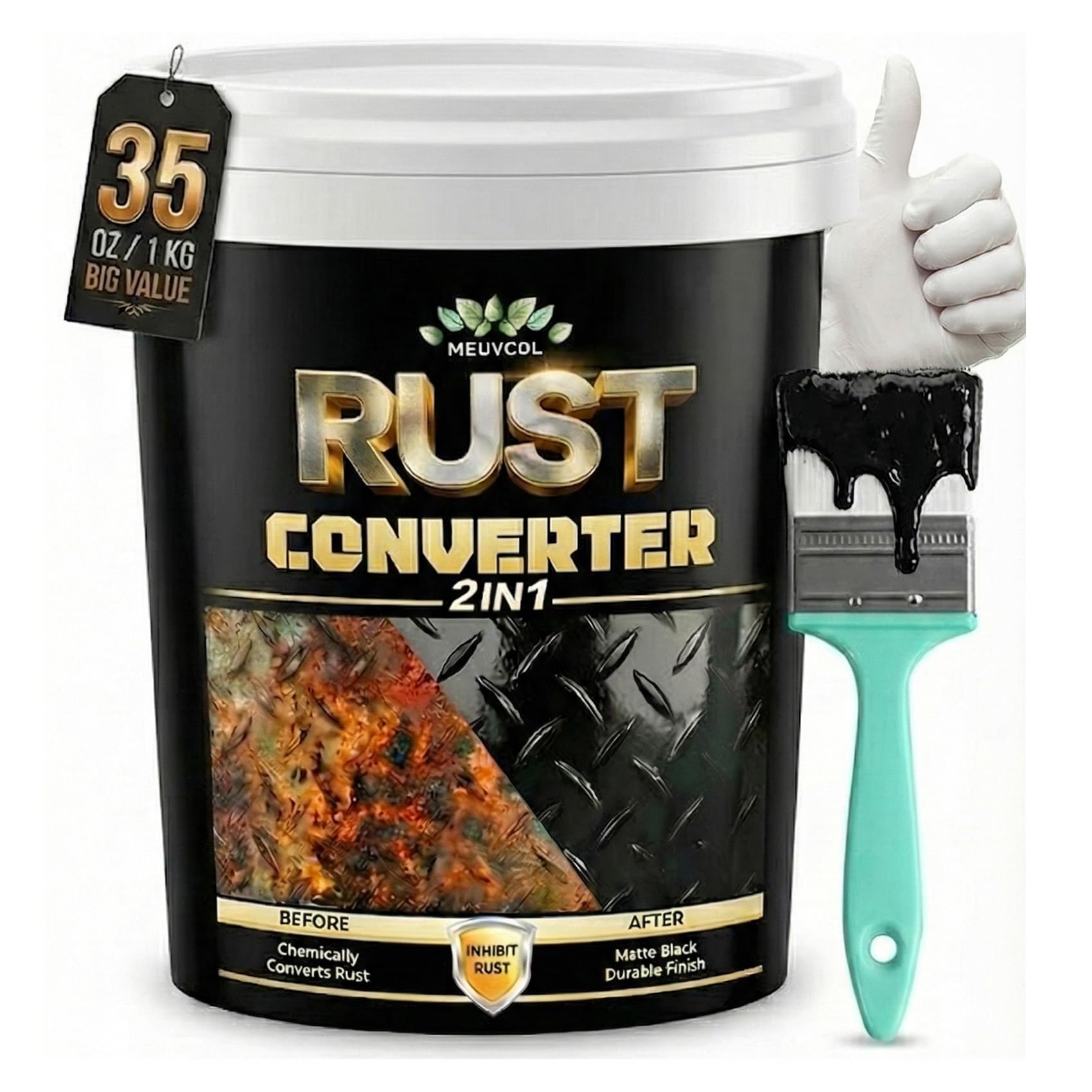
The Meuvcol Rust Reformer delivers the most complete coverage for any buyer dealing with visibly rusted frame sections, trailer rails, or chassis panels. This is not a spray-and-forget aerosol — it’s a brush-on converter paint that chemically neutralizes iron oxide and leaves a durable matte black barrier that locks out both oxygen and moisture. At 35 fluid ounces per can, you get enough material to treat two full truck frames or an entire utility trailer with generous dry-film thickness.
Where this product excels is oxygen isolation. The cured coating creates a true physical seal that blocks water and airborne contaminants from reaching the substrate beneath. It also handles moderate heat, making it suitable for engine bay components and exhaust-adjacent areas as long as direct contact with extreme heat sources is avoided. The included brush and gloves simplify application — just degrease the surface, scuff loose rust, and apply in two thin coats with a 24-hour cure between them.
On the downside, the brush-on method is slower than an aerosol for hard-to-reach cavities like door inners or box-section drain holes. You also need to stir the formula thoroughly after storage, as pigment separation can occur. For solid surface panels and structural steel, this is the most permanent, abrasion-resistant solution in this roundup.
What works
- Chemically neutralizes rust rather than just coating over it
- Thick film bridges pitted surfaces without runs
- Includes hardware (brush/gloves) for immediate application
What doesn’t
- Brush application is slow for large underbody areas
- Requires 24-hour cure between coats for proper bond
- Pigment settles during storage; requires thorough mixing
2. CorrosionX Heavy Duty Anti Rust Spray

CorrosionX Heavy Duty is the dripless gel version of the flagship CorrosionX formula, engineered specifically for applications where a standard aerosol would run or drip off vertical surfaces. The self-healing barrier remains flexible through vibration and temperature swings, making it ideal for boat trailers, farm implements, and industrial equipment that stays outdoors year-round. At 12 ounces per can, the coverage is generous for a gel — a 2-year outdoor performance claim and 5-year indoor rating back up the chemical engineering.
The polar bonding technology is the standout feature here. Rather than simply sitting on top of the metal, the molecular structure attaches to the substrate and reseals itself if scratched or scraped. This makes a tangible difference on equipment like gate hinges, excavator pins, and battery box brackets that experience constant physical contact. The gel also handles pressure washing without washing out, which is a common failure point for cheaper waxy sprays.
The main trade-off is thickness — the gel won’t wick into tight threaded joints or seized bolts the same way a low-viscosity penetrant would. For freeing rusted fasteners, you’ll still want a dedicated penetrating oil. Additionally, the larger 12-ounce can requires a more deliberate spray pattern; for spot-treating tiny electrical terminals, the standard CorrosionX 6-ounce is more precise.
What works
- Self-healing barrier actively reseals after scratches
- Resists washout from rain, salt spray, and pressure washers
- Flexible coating won’t crack under vibration or thermal cycling
What doesn’t
- Too thick for deep fastener thread penetration
- Less precise spray pattern than smaller 6-ounce cans
- Over-application can leave visible film on painted surfaces
3. JENOLITE Waxoil Rust Prevention Aerosol

JENOLITE Waxoil delivers proven cavity protection at a price that makes daily-driver maintenance affordable. The thick, waxy formulation drives moisture out of enclosed spaces and cures into a semi-soft film that won’t flake or crack when the chassis flexes over bumps. At 16.9 fluid ounces per can, you get enough reach to treat two full sets of door sills, wheel arches, and the entire underbody of a compact sedan with a single purchase.
The self-sealing property is the key advantage here — if a stone chip or scuff pierces the coating, the wax creeps back together and reseals the bare metal. This is particularly useful on the underside of fenders and inside rocker panels where physical abrasion from road debris is constant. A simple spray-on application with the included tube lets you reach into box-section drain holes without dismantling trim panels.
One limitation is that the coating remains slightly tacky even after full cure, which can attract road dust over time. On visible underbody components, that film can appear dirty compared to a dry converter paint. Also, the wax layer is not rated for high-temperature engine bay areas — keep it below exhaust routing and heat shields for best results.
What works
- Drives out moisture and self-seals after minor scratches
- Ideal for hollow cavity injection via supplied tube
- Large 16.9-ounce can covers an entire subcompact chassis
What doesn’t
- Remains tacky after cure; picks up road grime
- Not designed for high-heat zones near exhaust
- Thin film on vertical surfaces can run if over-applied
4. CorrosionX Rust Inhibitor 6oz Aerosol
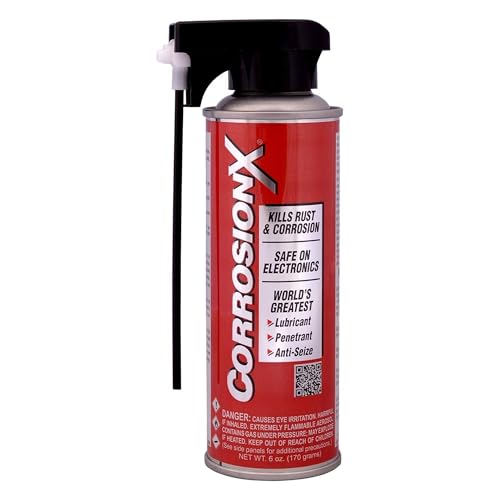
If your rust battlefield involves battery terminals, fuse box connectors, marine wire lugs, or galvanized trailer hitch receivers, this standard CorrosionX 6-ounce aerosol is the correct tool. Its low-viscosity carrier penetrates deep into threaded interfaces and capillary paths, then molecularly bonds to the metal surface. The dielectric barrier is rated above 39,000 volts, meaning you can spray directly onto live battery posts and sensor harnesses without risk of conductive creepage.
The U.S. Navy qualification is not just marketing theater — the Advanced Corrosion Preventive Compound specification (MIL-PRF-81309) demands rigorous salt-fog, humidity, and thermal cycling tests. This formula passes those requirements because the film is self-healing at a molecular level and resists galvanic corrosion between dissimilar metals like aluminum grounding lugs and steel chassis tabs. For marine outboard powerheads, trailer winches, or any electrical connection exposed to tidal moisture, this is the most chemically sophisticated option here.
The smaller 6-ounce can means fewer passes per dollar compared to the larger 12-ounce Heavy Duty version. For a full underbody coating job, you’d need multiple cans, driving the total cost up. This is best positioned as a precision tool for critical electrical connections and seized fasteners rather than a bulk chassis coating.
What works
- Qualified MIL-PRF-81309 for military-grade corrosion prevention
- Safe on live circuits; 39,000V dielectric rating
- Penetrates deep into threads, connectors, and sensor bases
What doesn’t
- 6-ounce can is small for large-area chassis treatment
- Thin film has less mechanical abrasion resistance than heavy-duty gel
- Not intended as a stand-alone underbody coating for daily drivers
5. Fluid Film 752-515 Rust and Corrosion Protection

Fluid Film’s lanolin-based formula is an affordable, no-frills rust protectant for budget-conscious owners who need a clear, low-odor spray for occasional underbody touch-ups and tool storage protection. The 11.75-ounce aerosol applies as a translucent film that clings to vertical surfaces without running excessively. Being lanolin — a natural wool-grease derivative — the coating resists washout from rain and road splash better than petroleum-based light oils.
Where Fluid Film stands out is its compatibility with existing coatings. Because it’s clear and non-hardening, you can spray it over painted panels, rubber bushings, and plastic underbody covers without damaging finishes or causing sticky residue. The film stays flexible indefinitely, making it suitable for hinges, cable ends, and lawn mower decks that need periodic refresh rather than permanent encapsulation.
The trade-off is longevity. Lanolin-based sprays typically require reapplication every 3–6 months, especially in wet winter conditions, because they don’t chemically bond to the substrate the way synthetic polar compounds do. The clear film also provides minimal barrier thickness — it won’t bridge pitted rust the way a converter paint would. For a cheap, non-damaging protectant to throw on during seasonal maintenance, it works fine; for heavy-frame corrosion control, it’s not the primary solution.
What works
- Clear application won’t stain painted surfaces or trim
- Natural lanolin resists washout better than mineral oils
- Safe on rubber, plastics, and electrical connectors
What doesn’t
- Needs reapplication every few months in harsh conditions
- Thin film doesn’t fill or neutralize pitted rust
- Not suitable as a permanent chassis coating
Hardware & Specs Guide
Dielectric Barrier Rating
Measured in volts, this spec indicates how much electrical potential the coating can block before breaking down. The CorrosionX standard formula is rated at over 39,000V, meaning you can safely spray battery terminals, alternator connections, and sensor harnesses without creating a conductive path that could cause parasitic drain or a short circuit. Waxy products like Jenolite Waxoil and Fluid Film offer no published dielectric rating and should be kept away from live electrical contacts.
Self-Healing vs Static Coating
Self-healing coatings (CorrosionX Heavy Duty and Jenolite Waxoil) contain mobile polymers that flow back together when the film is cut or abraded, resealing the exposed bare metal. Static coatings like the Meuvcol converter paint cure hard and do not self-repair; once scratched down to bare steel, you must recoat those spots manually. For chassis components that see stone chips and frequent contact, a self-healing wax or gel reduces maintenance intervals significantly.
FAQ
Can I use a car rust cleaner on painted surfaces?
How long does each type of rust protection last outdoors?
Do I need to remove rust before applying a rust reformer paint?
Can I spray rust protection inside door panels without removing them?
Final Thoughts: The Verdict
For most buyers, the car rust cleaner winner is the Meuvcol Rust Reformer Paint because its chemical conversion and thick barrier film provide the most permanent solution for visible frame and chassis rust. If you need a precision penetrant for battery terminals and marine connectors, grab the CorrosionX 6oz Aerosol. And for long-term heavy-duty outdoor protection on equipment and trailers, nothing beats the CorrosionX Heavy Duty.

Certification: BSc in Mechanical Engineering
Education: Mechanical engineer
Lives In: 539 W Commerce St, Dallas, TX 75208, USA
Md Amir is an auto mechanic student and writer with over half a decade of experience in the automotive field. He has worked with top automotive brands such as Lexus, Quantum, and also owns two automotive blogs autocarneed.com and taxiwiz.com.