Automotive paint correction and bodywork demand a tool that matches the complex, compound curves of modern vehicle panels. Using a rigid, flat block on a contoured fender, door line, or quarter panel will leave high spots and uneven material removal, ruining hours of prep work. The right sanding block flexes with the surface, distributing pressure evenly to achieve a perfectly level substrate for primer and paint.
I’m Amir — the founder and writer behind Four Wheel Ask. I’ve spent years analyzing automotive refinishing tools, from abrasives to sanding profiles, studying manufacturer specs, material science, and real-world owner feedback to separate tools that deliver precision from those that cause more harm than good.
Modern vehicle bodies have virtually no true flat surfaces. Longboard blocks and contoured profile sanders have replaced the rigid wood block for any serious paint prep, which is why identifying the best car body sanding blocks depends on how well each tool handles variable-radius body lines without digging into the panel.
How To Choose The Best Car Body Sanding Blocks
Selecting a sanding block for automotive paint prep isn’t as simple as grabbing the longest one on the shelf. You need to consider the block’s flex characteristics, the surface area of the pad, how it attaches to the sandpaper, and whether the shape matches the body lines you’re working on. A mismatch in any of these areas will leave visible defects under paint.
Flex Profile: Soft versus Stiff Polyurethane
Polyurethane foam blocks range from nearly rigid to highly flexible. Stiffer blocks (higher durometer foam) are better for long, gentle curves and large flat sections like a hood or roof, as they bridge low spots. Softer, more flexible blocks conform to tight compound curves like fender arches and door contours, preventing the block from digging into the high points. Some adjustable blocks let you increase flex by removing tension screws.
Width and Attachment System: Hook-and-Loop versus PSA versus Clip-On
The standard width for automotive longboard sandpaper is 2-3/4 inches, so your block should match this to avoid paper overhang. Hook-and-loop backing offers quick paper swaps between grits without residue. PSA (pressure-sensitive adhesive) provides a more rigid, non-slip bond for precision work. Hybrid blocks that accept both systems give you the most flexibility. Clip-on systems work with dry-back paper but can loosen under heavy use.
Profile Diversity: Flat, Convex, and Concave Blocks
No single block shape works for an entire vehicle. A flat rectangle block handles large panels but fails on curved body lines. Contoured profile blocks with convex and concave shapes are essential for sanding the edges of panels, door creases, and wheel arches. A kit with multiple profiles eliminates the need to improvise by bending a flat block.
Quick Comparison
On smaller screens, swipe sideways to see the full table.
| Model | Category | Best For | Key Spec | Amazon |
|---|---|---|---|---|
| Dura-Gold 12-Piece Contoured Profile Set | Premium Kit | Intricate body contours & moldings | 12 profiles + 40 sandpaper sheets | Amazon |
| VOLSIVE 7-Piece Hand Sanding Block Set | Versatile Set | General bodywork & tight spots | 7 blocks: 5″ to 9″ lengths | Amazon |
| Toromp Adjustable Radius Flex Longboard | Flex Longboard | Curved panels & fairing | 15.75″ length, rotating handle | Amazon |
| Dura-Gold Pro Series Longboard File Block | Rigid Longboard | Flat panels & straight-line blocking | Aluminum body, 3-way attachment | Amazon |
| Dura-Gold Pro Series Rectangle 3-Block Kit | Value Multi-Block | Budget-conscious paint prep | 3 sizes: 5″, 7.75″, 10″ | Amazon |
In‑Depth Reviews
1. Dura-Gold 12-Piece Contoured Profile 4″ Hand Sanding Block Set

This Dura-Gold set is the most complete solution for automotive body contour sanding. It includes 12 different block shapes—convex, concave, and specialty profiles—covering nearly every mold line, door edge, and fender curve you’ll encounter on a car body. The polyurethane foam blocks are medium-density, offering enough flex to follow tight radii while maintaining enough body to bridge low spots. Each block is 4 inches long and ranges from 1-1/2 to 2-1/2 inches wide, fitting into door jambs and behind body lines that a full-size longboard cannot reach.
The kit comes with 40 sheets of hook-and-loop sandpaper spanning eight grits from 60 to 600, letting you work from aggressive coarse cutting to final fine finishing without buying extra paper. These sheets are 4 by 2-3/4 inches, matching the block faces exactly so you don’t waste material. The aluminum oxide construction with zirconia alumina additive provides a noticeably longer cut life than standard budget paper, meaning fewer changes during a full paint-prep cycle.
The two included base handles snap onto any block in the set, giving you extra leverage for heavier material removal without sacrificing the contoured shape. Because each block has an integrated hook-and-loop surface, switching between profiles and grits takes seconds. If you frequently sand complex body lines, crown moldings, or fiberglass repairs, this set eliminates the guesswork of bending flat blocks and gives you the exact shape the panel needs.
What works
- 12 unique contours match real-world panel shapes
- Included 40-sheet grit pack covers coarse to fine sanding
- Removable handles add leverage for aggressive cuts
What doesn’t
- Blocks are shorter than a standard longboard for large flat areas
- Price is higher than individual block purchases
2. VOLSIVE 7-Piece Hand Sanding Block Set
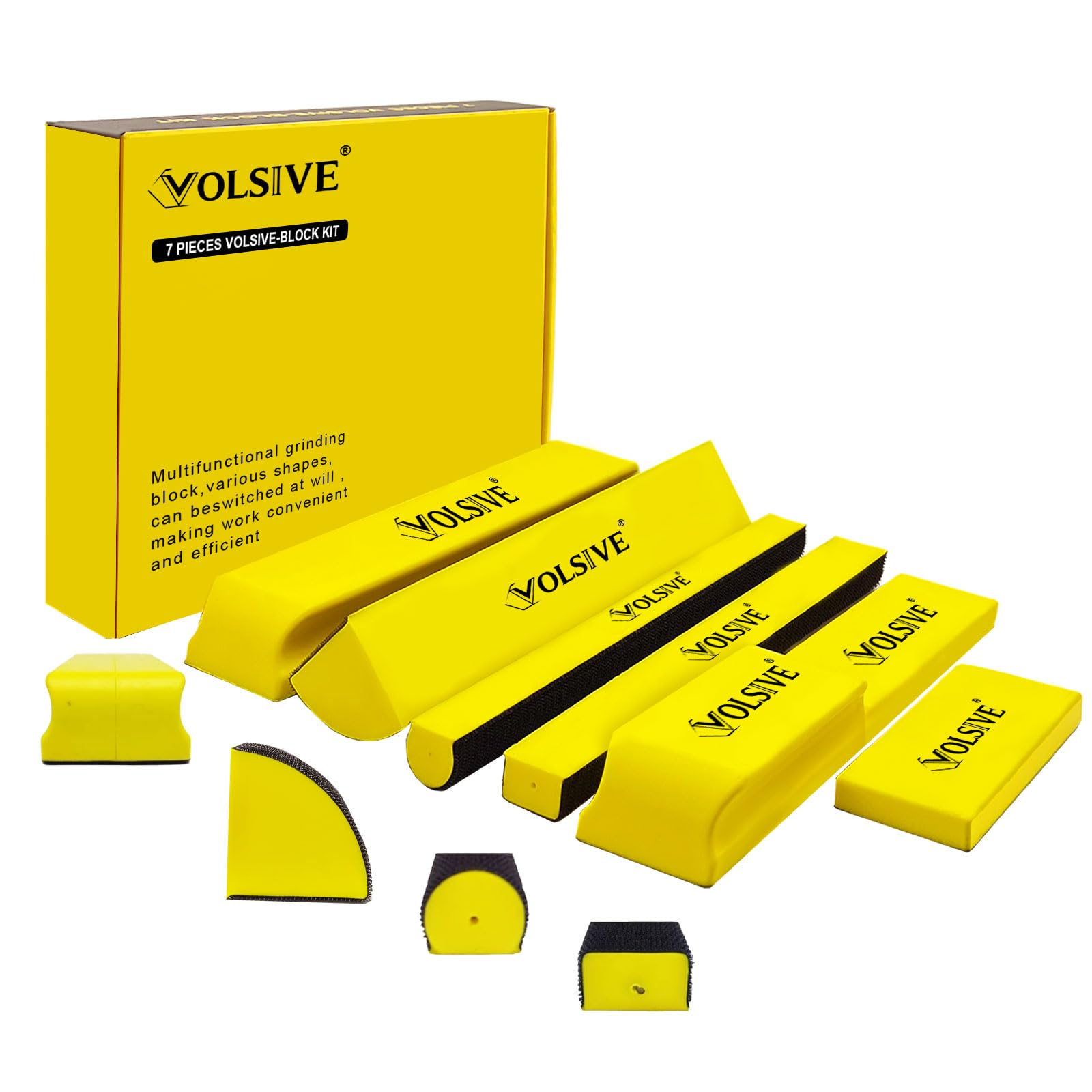
The VOLSIVE set provides seven polyurethane foam blocks in lengths of 5, 5-1/2, and 9 inches, giving you a range of working surfaces for different panel sections. The medium-density foam has a soft feel in the hand and enough flexibility to follow the subtle crown of a hood or the gentle curve of a door skin. Reviewers who used this set to sand a full 1993 Astro van before paint reported a noticeable improvement in hand-sanding consistency compared to previous attempts with hardware-store blocks.
The hook-and-loop backing on every block grabs sandpaper sheets firmly, and users confirm the Velcro holds well even after repeated repositioning. The smaller 5-inch blocks are particularly useful for getting into door pockets, behind mirrors, and around trim lines where a longboard overhangs and catches edges. The polyurethane construction keeps the blocks lightweight, reducing hand fatigue during long sanding sessions.
One advantage of this set is the ability to trim individual blocks down to create custom profiles for unique panel shapes. Several owners reported cutting the 5-1/2-inch block in half to make a tight-radius sanding pad for door creases. If you want a flexible system that covers a lot of surface area while still fitting into tight spaces, this set offers a strong balance of length options and conformation.
What works
- Multiple block lengths for varied panel sizes
- Foam is soft enough to conform to moderate curves
- Can be trimmed to custom shapes
What doesn’t
- Not rigid enough for blocking large flat panels dead flat
- Does not include PSA conversion pads
3. Toromp Adjustable Radius Flex Longboard Hand Sanding File Block

At 15-3/4 inches long and 2-3/4 inches wide, this Toromp longboard covers large sections of bodywork in fewer passes. Its defining feature is the adjustable-radius mechanism: a tension screw in the rear groove lets you increase or decrease the block’s curvature, and the handle can rotate, giving you control over the pressure angle. For fairing a wood boat hull or sanding the sweeping curve of a quarter panel, this block bridges the gap between a rigid straight line and a fully flexible sanding pad.
The hook-and-loop backing works with standard 2-3/4-inch-wide longboard rolls or sheets, and the foam core is lightweight polyurethane that reduces arm fatigue. Multiple users mention removing the turnbuckle nut entirely to get even more flex for tight radius work, which unlocks additional curvature that the stock tension setting doesn’t allow. This adaptability is useful on everything from fiberglass repair to auto body filler blocking.
Keep in mind that the flex mechanism relies on a screw-and-nut system that can loosen during extended use if not periodically tightened. The handle rotation is helpful for varying the attack angle, but the handle itself is plastic and may feel less confidence-inspiring than a fully metal assembly. For the price, it delivers the longest adjustable surface you can get for curved panel work.
What works
- Adjustable radius lets you tune flex for the panel
- Long 15.75″ length covers large areas quickly
- Rotating handle improves ergonomic control
What doesn’t
- Flex mechanism requires periodic tightening
- Plastic handle doesn’t feel as durable as aluminum
4. Dura-Gold Pro Series Longboard Hand Sanding File Sander Block

This Dura-Gold Pro Series longboard is built with a flat, rigid aluminum base that ensures zero flex for the most aggressive flat-panel blocking tasks. It is the tool you reach for when you need to level a large body filler repair across a hood, roof, or deck lid where any deviation from flatness will telegraph through the paint. The standard 2-3/4-inch width matches industry-standard longboard sandpaper, and the 3-way design lets you use hook-and-loop, PSA, or clip-on dry-back paper without needing adapters.
The cushioned base adds a thin layer of foam between the aluminum and the sandpaper, providing just enough compliance to avoid scratching the panel while maintaining a true reference surface. The reinforced plastic handle is comfortable for extended sessions and provides good control when pushing the block across filler. The included PSA conversion pad gives you the option of sticking pressure-sensitive adhesive paper directly onto the vinyl face, which is preferred for precision sanding where paper shifting cannot be tolerated.
Because the block is completely rigid, it is not suitable for curved panels or compound body lines. Using it on a contoured fender will result in edge digging and uneven material removal. It is a specialized tool for straight-line blocking only. If your primary need is leveling filler on large flat areas, this is the most durable, true-flat block in this lineup.
What works
- Aluminum body provides dead-flat reference surface
- 3-way attachment system accepts all sandpaper types
- PSA conversion pad prevents paper shifting
What doesn’t
- Completely rigid—no ability to follow body curves
- Heavier than foam blocks for overhead work
5. Dura-Gold Pro Series Classic Rectangle Hand Sanding Block Kit

This entry-level Dura-Gold kit gives you three rectangle blocks in 5-inch, 7-3/4-inch, and 10-inch lengths, all at a budget-friendly price point that makes it accessible for beginners and occasional users. Each block is made of medium-density polyurethane foam with a hook-and-loop face, and each includes its own PSA conversion pad that sticks onto the hook-and-loop surface to accept pressure-sensitive adhesive sandpaper. This 2-way system allows you to work with either standard hook-and-loop sheets, which are easy to swap, or PSA paper, which gives a rigid, non-slip bond for precision work.
The 2-3/4-inch width is consistent across all three blocks, matching common longboard sandpaper so you don’t have to trim sheets. The foam is firm enough to provide decent flatness on small-to-moderate corections, but it does flex under heavy pressure, which means it is not a substitute for a rigid aluminum block on large flat repairs. For paint prep work on doors, fenders, and small panels, the flexibility is actually an advantage, as it reduces the risk of sanding through the paint edge.
The main limitation is that three rectangular blocks, even in different lengths, cannot replicate the contoured shapes needed for complex body lines like door handles or grill surrounds. The kit is best suited as a general-purpose set for straight panel work and autobody refinishing education. At this price, adding one of the contoured sets above completes a full arsenal without a large investment.
What works
- Three common lengths cover most panel sizes
- Includes PSA conversion pads for rigid paper bonding
- Low entry cost for building a sanding block collection
What doesn’t
- Foam flexes too much for dead-flat filler leveling
- Rectangular shape only—no contoured or curved profiles
Hardware & Specs Guide
Polyurethane Foam Density
The density of the foam (measured in durometer or g/cm³) dictates how the block interacts with the panel. Medium-density foam (typically 0.2–0.4 g/cm³) is standard for auto body sanding because it provides enough firmness to support sandpaper and bridge minor irregularities while still conforming to moderate curves. High-density foam is stiffer and better for long, flat sections, while low-density foam (very soft) can wrap tightly into concave details but may not cut evenly on large areas.
Hook-and-Loop versus PSA Attachment
Hook-and-loop backing uses a fabric loop surface on the block and a hook backing on the sandpaper, allowing fast grit changes without residue. PSA (pressure-sensitive adhesive) requires a smooth vinyl conversion pad that the sandpaper sticks to; it creates a rigid bond that prevents paper from lifting or curling on curved surfaces. The best approach for automotive prep is to have blocks that support both systems so you can use quick-change hook-and-loop for most sanding and PSA for critical final blocking on filler.
FAQ
Can I use a regular wood sanding block on car body filler?
What length of sanding block do I need for automotive work?
How do I clean sanding block hook-and-loop surfaces?
Should I use PSA or hook-and-loop sheets for wet sanding?
Final Thoughts: The Verdict
For most buyers, the best car body sanding blocks winner is the Dura-Gold 12-Piece Contoured Profile Set because it provides the widest range of panel-specific shapes, saving you from improvising with flat blocks on complex curves. If you need a versatile multi-length system for general bodywork and tight spots, grab the VOLSIVE 7-Piece Set. And for dead-flat leveling of large body filler repairs, nothing beats the rigid aluminum Dura-Gold Pro Series Longboard.

Certification: BSc in Mechanical Engineering
Education: Mechanical engineer
Lives In: 539 W Commerce St, Dallas, TX 75208, USA
Md Amir is an auto mechanic student and writer with over half a decade of experience in the automotive field. He has worked with top automotive brands such as Lexus, Quantum, and also owns two automotive blogs autocarneed.com and taxiwiz.com.