Upgrading your Chrysler 300 to a crisp white turn signal isn’t just about style — it eliminates the yellowed, dull glow that makes a clean sedan look dated. Factory amber bulbs cast a warm tint that clashes with modern LED lighting, and switching to a white source restores the clean, monochromatic look the 300’s design deserves while improving nighttime visibility for other drivers.
I’m Amir — the founder and writer behind Four Wheel Ask. I’ve spent years cross-referencing automotive bulb specs, analyzing lumen outputs versus stock halogens, and sorting through thousands of owner-reported fitment results to find what actually holds up in a Chrysler 300’s crowded turn signal housing without throwing dash warnings.
Whether you need pure white backup lighting or a dual-function switchback that goes white-to-amber, this guide breaks down the top chrysler 300 white turn signal upgrades by real-world performance, socket compatibility, and long-term reliability so you can buy with confidence.
How To Choose The Best Chrysler 300 White Turn Signal
Chrysler 300 models from 2005 onward use a mix of 3157, 3057, and 1157-based sockets depending on the model year and whether you’re replacing front turn signals or rear tail/brake/turn combos. Picking the wrong base type leads to loose fitment or no light at all, so confirm your year’s socket before ordering.
Socket type and polarity
Most 300 front turn signals use a 3157 base with CK (clockwise offset) pins, but some aftermarket housings accept standard straight pins. Non-polarity LEDs work in both, eliminating the guesswork. Rear positions often use 3057 or 3157 with different pin shapes, so verify your specific model year diagram.
Brightness and color temperature
White turn signals should hit 6000K to match modern LED DRLs — warmer than 5000K looks yellow, and cooler than 8000K turns blue. Lumen output above 400 per bulb gives a noticeable upgrade over stock halogens, but excessive brightness in a reflector housing can scatter light and glare oncoming traffic.
Hyper flash prevention
LEDs draw roughly one-tenth the power of incandescent bulbs, which tricks the Chrysler 300’s thermal flasher relay into thinking a bulb is burned out — causing rapid blinking called hyper flash. Some bulbs include built-in load resistors, but many require an external 50W 6-ohm resistor or an LED-specific flasher relay to maintain proper flash rate.
Quick Comparison
On smaller screens, swipe sideways to see the full table.
| Model | Category | Best For | Key Spec | Amazon |
|---|---|---|---|---|
| PHINLION Dual Color Switchback | Switchback | Front signal upgrade | 106 SMD chips per bulb | Amazon |
| iBrightstar Switchback LED | Switchback | DRL plus turn signal | 16x 3030 chips with projector | Amazon |
| Vouke 1157 Switchback | Switchback | Standard base front signals | 22x 5730 chips per bulb | Amazon |
| PHINLION 3157 White LED | Pure White | Reverse and tail lights | 2000 lumen per pair | Amazon |
| Antline 3157 White LED (10-pack) | Bulk Value | Multiple positions at once | 54 SMD chips per bulb | Amazon |
In‑Depth Reviews
1. PHINLION Super Bright White Amber Dual Color Switchback 3157

The PHINLION dual-color switchback packs 100 pieces of 3014 chips plus 6 pieces of 2835 chips into each 3157 bulb, delivering a bright 6000K white for parking/DRL mode that switches to a saturated amber for turn signal operation. The projection lens focuses the beam into a clean cutoff pattern that works well inside the Chrysler 300’s factory reflector housing without scattering light into adjacent lanes.
Unlike cheaper switchbacks that flash amber-white-amber-white, this model flashes strictly amber-off-amber-off, making the turn signal more visible in bright daylight and eliminating the confusing white flash some drivers mistake for a hazard. The constant current IC driver keeps brightness stable across 10V to 30V, which helps if your 300’s electrical system fluctuates during cold starts or alternator load changes.
At 4.3 watts per bulb, these draw significantly less than stock 27-watt incandescents, so you will need a 50W 6-ohm load resistor or an aftermarket flasher relay on most Chrysler 300 years to avoid hyper flash. The non-polarity design fits both CK and standard sockets, removing the guesswork for front signal positions.
What works
- Superior chip density for even light distribution
- Amber-off-amber flash pattern is safer and more visible
- Compact aluminum housing fits tighter housings
What doesn’t
- Requires external resistor or relay on most Chrysler 300 models
- Only compatible with dual-function front sockets
2. iBrightstar Switchback LED 3157

The iBrightstar switchback uses 16 high-power 3030 LED chips per bulb with a built-in projector lens that creates a tight, focused beam. This design reduces glare in reflector housings compared to open SMD arrays, making it a strong match for the Chrysler 300’s front turn signal reflector where scattered light can wash out the signal’s appearance.
The white mode outputs a clean 6000K that matches most factory LED DRLs perfectly, and the amber transition is instant with no visible fade or lag. At 30,000-hour rated life, these should outlast your ownership of the car, and the full aluminum housing dissipates heat effectively even in enclosed sockets where airflow is limited.
Like other LED turn signals, this bulb requires a 50W 6-ohm load resistor if your 300’s stock flasher relay is the thermal type. The bulb operates across 9V to 24V, so it tolerates the voltage dips seen during cranking or accessory load without dimming or flickering.
What works
- Projector lens reduces scatter in reflector housings
- Instantaneous color transition with no fade
- Rugged aluminum body handles heat well
What doesn’t
- Lower chip count than some competitors at 16 SMD per bulb
- Hyper flash resistor not included in package
3. Vouke 1157 Switchback White/Yellow LED

The Vouke switchback targets the 1157 standard base socket — important because some Chrysler 300 years and certain aftermarket tail light assemblies use 1157 instead of 3157 up front or in combination rear positions. The 22 high-power 5730 chips per bulb produce a rich 6000K white and a deep golden amber that doesn’t wash out in direct sunlight.
Because it uses a standard base rather than CK pins, verify your socket configuration before purchase. On 300 models with standard 1157 sockets, this bulb fits snugly without wobble and the projector lens shapes the output into a usable pattern for both parking and signal duties without excessive hotspotting.
The unit draws very little current compared to stock, so adding a 50W 6-ohm load resistor is nearly mandatory for proper flash rate on this platform. The 50,000-hour operating life is among the highest in this group, providing years of service before any noticeable degradation in brightness.
What works
- Deep amber color holds visibility in harsh daylight
- High 50,000-hour lifespan reduces replacement frequency
- Projector lens shapes beam cleanly
What doesn’t
- 1157 base only — not compatible with CK sockets
- Requires load resistor for correct flash rate
4. PHINLION 3157 LED White Bulb

The PHINLION 3157 white LED delivers 2000 lumens per pair from 72 pieces of 3014 SMD chips, making it one of the brightest pure-white options for Chrysler 300 reverse lights or rear brake/tail positions where you want maximum illumination without switchback functionality. The 6000K color temperature matches white DRLs and clears up the yellowish output of stock incandescents in the tail lamp assembly.
Non-polarity construction means it works in both CK and standard 3157 sockets, so installation is straightforward — just pull the old bulb and insert the new one. The 6063 aluminum housing sinks heat effectively, which is critical when these bulbs are used in reverse light housings that run continuously while backing up for extended periods.
For rear turn signal use, you will need a load resistor to prevent hyper flash, but for reverse or brake applications the LED’s instant-on response gives a noticeable safety benefit over incandescent bulbs that take milliseconds to reach full brightness. The compact design is slightly shorter than factory bulbs, easing installation in tight housing recesses.
What works
- 2000 lumen output provides excellent reverse visibility
- Non-polarity design fits both CK and standard sockets
- Shorter profile helps in cramped housings
What doesn’t
- Pure white only — not switchback for dual-function fronts
- Resistor still needed for turn signal use
5. Antline 3156 3157 LED Bulbs White (10-Pack)
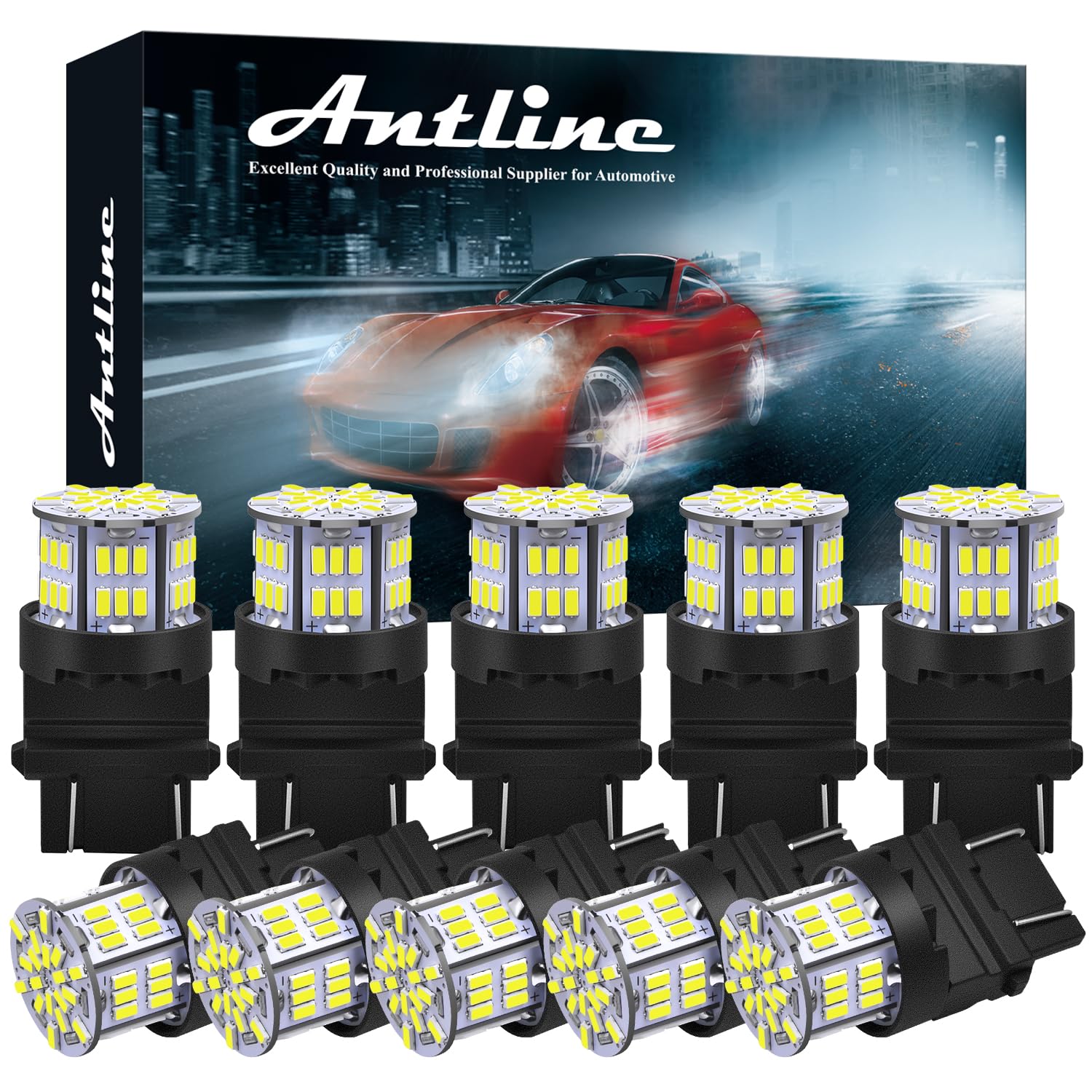
The Antline 10-pack covers the entire exterior lighting suite of your Chrysler 300 at once — front turn signals, rear brake/tail lights, reverse lights, side markers, and even interior cargo or license plate lamps. Each bulb uses 54 pieces of 3014 SMD chips arranged in a 360-degree pattern to maximize side-emitted light in reflector housings, and the xenon white color (approximately 6000K) keeps the look uniform.
At 400 lumens per bulb, these are noticeably brighter than stock halogens but not as intense as the 2000-lumen PHINLION pair, making them a sensible middle ground for all-around replacement. The 12V-24V voltage range covers any fluctuations in the 300’s system, and the slim 1.7-inch length with 0.7-inch diameter fits easily into the tight rear tail light housings that often frustrate bulkier LED replacements.
Because this is a pure white bulb without switchback functionality, it works best in positions that don’t require amber turn indication — rear tail, brake, reverse, and marker lights. For front turn signals, you would still need a switchback or amber bulb unless your state allows white turn signals. The one-year warranty adds peace of mind for a bulk purchase.
What works
- 10-bulb pack covers entire vehicle for uniform color
- 360-degree light pattern maximizes reflector use
- Slim dimensions fit tight housings easily
What doesn’t
- Pure white only — not suitable for front turn signals in most states
- Lower lumen per bulb compared to premium options
Hardware & Specs Guide
Lumen Output and Chip Architecture
Brightness in a turn signal bulb is determined by the number and size of SMD chips, not just the stated lumen number. 3014 chips (0.1W each) are common in value packs and deliver good efficiency, while 3030 chips (1W each) push much higher intensity for focused beams. 5730 chips sit between them in power. For front signals where visibility matters most, bulbs with 16 or more high-power chips per unit produce the best balance of brightness and heat management inside the sealed housing.
Load Resistors and Hyper Flash
Chrysler 300 flasher relays detect bulb failure by measuring current draw. LED bulbs typically draw 0.3-0.5 amps versus 2 amps for a stock incandescent. Adding a 50W 6-ohm load resistor in parallel with each LED bulb restores the load to factory levels, eliminating hyper flash. Some newer 300 models use electronic flasher modules that can accept LED draw without resistors, but this varies by model year — testing without resistors is safe if you’re prepared to install them if rapid flashing occurs.
FAQ
Will a white turn signal bulb pass inspection on my Chrysler 300?
Why do my new LED turn signals blink fast on my Chrysler 300?
How do I know if my Chrysler 300 uses CK or standard pin sockets?
Can I use switchback bulbs in the rear turn signal position on a Chrysler 300?
Final Thoughts: The Verdict
For most buyers, the chrysler 300 white turn signal upgrade that balances brightness, color quality, and legal compliance is the PHINLION Dual Color Switchback because its 106-SMD array gives you crisp white parking mode and a clean amber-off-amber flash pattern that passes inspection. If you need a focused beam that minimizes glare in factory reflector housings, grab the iBrightstar Switchback. And for the budget-conscious owner replacing every exterior bulb at once, nothing beats the Antline 10-pack for uniform white lighting across the entire Chrysler 300.

Certification: BSc in Mechanical Engineering
Education: Mechanical engineer
Lives In: 539 W Commerce St, Dallas, TX 75208, USA
Md Amir is an auto mechanic student and writer with over half a decade of experience in the automotive field. He has worked with top automotive brands such as Lexus, Quantum, and also owns two automotive blogs autocarneed.com and taxiwiz.com.