Hauling multiple bikes to the trailhead should be about the ride ahead, not the anxiety of whether your gear will survive the drive. The real challenge with a receiver hitch bike rack is balancing secure frame contact, swing-away access, and the ability to carry heavy e-bikes without wobble or sway at highway speeds.
I’m Amir — the founder and writer behind Four Wheel Ask. I’ve spent years analyzing hitch rack designs, load capacities, and owner reports to separate the rugged performers from the harmful frame-benders across the entire category.
Many racks claim to fit all bikes, but the real test comes with fat tires, carbon frames, and heavy e-bikes — only a properly chosen best receiver hitch bike rack protects your investment while offering the tilt and fold features your daily driving demands.
How To Choose The Best Receiver Hitch Bike Rack
The market offers two main architectures: hanging racks that suspend bikes by the top tube, and platform racks that cradle bikes by the wheels. Each has distinct implications for frame safety, weight handling, and vehicle access. Understanding these core differences is your first step toward a smart purchase.
Platform vs. Hanging Design
Platform racks hold each bike by its wheels, eliminating frame contact and protecting carbon and painted surfaces. They excel with step-through, full-suspension, and fat tire bikes but add weight due to the tray structure. Hanging racks are lighter and often cheaper, but they rely on top-tube contact and cannot carry step-through or some full-suspension frames without adapters. If you own expensive bikes, the platform style is the safer long-term choice.
Hitch Size and Vehicle Fitment
Two hitch receiver sizes dominate: 1.25-inch (Class I/II) and 2-inch (Class III/IV). Many premium platform racks are 2-inch only and require an adapter for smaller receivers—adding wobble and reducing stability. Always verify that your vehicle’s hitch class matches the rack’s native receiver size. A mismatched setup can lead to dangerous sway at highway speeds.
Load Capacity and E-Bike Readiness
Standard bike racks carry 30–40 pounds per bike, but modern e-bikes often weigh 60–80 pounds each. Overloading a rack rated for lighter bikes stresses the hitch welds and the rack arms, leading to failure on rough roads. Look for a per-tray capacity of at least 60 pounds if you plan to carry electric bicycles, and confirm the total combined capacity as well.
Quick Comparison
On smaller screens, swipe sideways to see the full table.
| Model | Category | Best For | Key Spec | Amazon |
|---|---|---|---|---|
| Thule T2 Pro XT/XTR | Platform | Premium all-round transport | 60 lbs per tray, zero frame contact | Amazon |
| Hollywood RV Rider | Platform | Heavy e-bikes on RVs | 80 lbs per bike, 160 lbs total | Amazon |
| KUAT Transfer V2 | Platform | Lightweight steel durability | 60 lbs per tray, tamper-resistant hitch | Amazon |
| YAKIMA HoldUp | Platform | Side-to-side adjustability | 60 lbs per bike, tilts with bikes loaded | Amazon |
| RockyMounts Monorail | Platform | Fat tire and wide tire bikes | 60 lbs per bike, up to 5.0″ tires | Amazon |
| Hollywood Sport Rider | Platform | Heavy-duty e-bike carrier | 80 lbs per bike, 160 lbs total | Amazon |
| Trimax Road-MAX RMBR4 | Hanging | Compact 4-bike storage | 132 lbs total capacity, folding arms | Amazon |
| YAKIMA DoubleDown 4 | Hanging | 4-bike transport on a budget | 120 lbs total, tilting mechanism | Amazon |
| Allen Sports 552QR | Hanging | Lowest cost 5-bike carrier | 175 lbs total, quick-release hitch | Amazon |
In‑Depth Reviews
1. Thule T2 Pro XT/XTR

The Thule T2 Pro XT/XTR sets the benchmark for platform-style rack performance with its integrated wheels that let you roll the rack like a dolly when it’s off the vehicle. The HitchSwitch lever allows one-handed tilt down for rear cargo access while bikes remain loaded, a feature that transforms daily usability. With 12.5 inches of spacing between trays, even bikes with wide handlebars clear each other without clattering on rough terrain.
The AutoAttach system clicks into 2-inch receivers tool-free and tightens with a single knob, eliminating the guesswork of bolt alignment. The rack comfortably fits 20- to 29-inch wheels and tires up to 5 inches wide without adapters, making it ready for fat tire mountain bikes straight out of the box. The integrated cable locks secure each bike to the rack, and the locking knob locks the rack to the hitch receiver.
At 52 pounds, the Thule is not the lightest option, but that weight translates into a rock-solid feel at highway speeds. The maximum per-tray capacity of 60 pounds limits its use with the heaviest e-bikes, but for standard mountain, road, and fat tire bikes, this rack delivers unmatched stability and convenience. The add-on kit extends capacity to four bikes for larger families.
What works
- Zero frame contact protects carbon bikes
- Integrated wheels ease off-vehicle handling
- Tool-free AutoAttach installation
What doesn’t
- Heavy at 52 pounds
- 60-pound per tray limit excludes some e-bikes
- Premium price places it above budget options
2. Hollywood RV Rider

The Hollywood RV Rider is purpose-built for the heaviest electric bicycles, with a per-bike capacity of 80 pounds and a total of 160 pounds. This rating makes it one of the few racks that can safely transport two premium e-bikes without exceeding structural limits. The heavy-duty receiver tube resists flexing when loaded on long RV trips, and the integrated frame grabbers clamp the bike securely by the top tube without damaging the paint.
Security is addressed through a locking cable and a hitch tightener that eliminates wobble at the receiver joint. The rack folds flat against the vehicle when not in use, reducing wind noise and rear obstruction. The tilt-down feature allows access to the rear of the vehicle even when bikes are loaded, a critical convenience for RV owners who need to reach storage compartments frequently.
Owner reports highlight the rack’s stability over thousands of miles of towing behind a flat-towed vehicle. The assembly requires tools and is more involved than some competitors, but the result is a rack that feels permanently attached. The center crossbar can interfere with pedals on the bike closest to the vehicle, so pedal removal may be necessary depending on your bike’s geometry.
What works
- True 80-pound per bike capacity
- Very stable on rough RV routes
- Folds flat for storage
What doesn’t
- Center bar may contact pedals
- Assembly is more complex than some
- Bolts and lock washers slow quick adjustments
3. KUAT Transfer V2
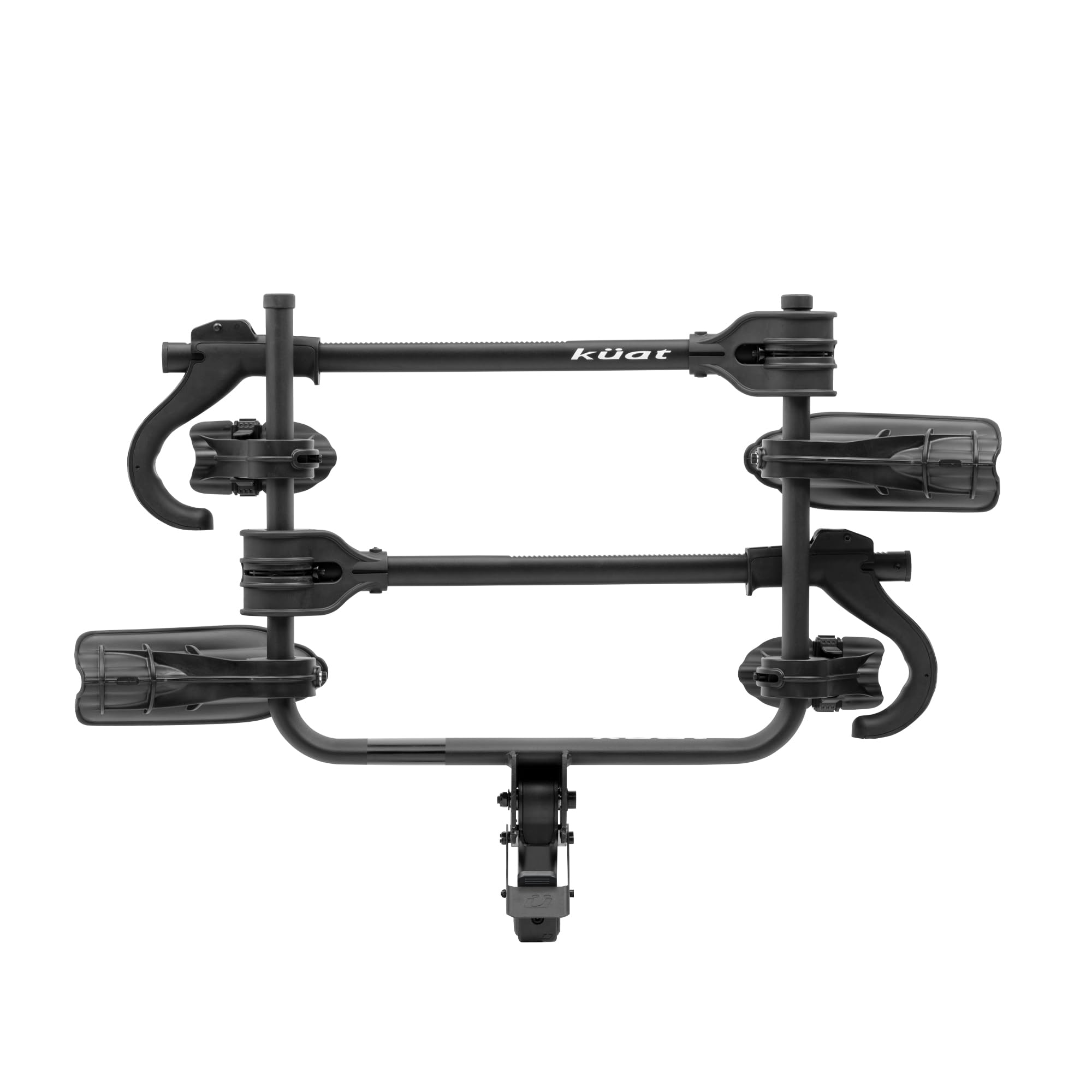
The KUAT Transfer V2 distinguishes itself with a tamper-resistant hitch security system and a semi-integrated bicycle cable lock that simplifies locking your bikes at a trailhead. The FlatLock hitch cam cinches the rack into the receiver without wobble, and the external cable routes through the rack frame for a clean look. The all-steel construction at 52 pounds gives it a planted feel, while the 60-pound per tray capacity handles most standard and electric mountain bikes.
The rack fits wheelbases up to 50 inches and tires from 18 to 29 inches, with an accessory strap available for 5-inch fat tires. The arms grab the tires exclusively, keeping the frame untouched. This design is especially friendly to carbon frames where clamp pressure can cause stress cracks. The 2-inch dedicated version mounts directly to campers and trailers with chassis-mounted receivers.
One practical advantage is the rack’s relatively low weight compared to its steel robustness. At 37 pounds shipping weight, it is one of the lighter platform racks in this class, making installation and removal easier for solo users. The lock system uses a single key for both the hitch and the cable, reducing keychain clutter. The non-foldable design means it stays extended when not carrying bikes, which can be a minor nuisance in tight garages.
What works
- Tamper-resistant hitch cam
- Semi-integrated cable lock
- Light for a steel platform rack
What doesn’t
- Does not fold when empty
- Fat tire accessory sold separately
- 60-pound limit restricts heavy e-bikes
4. YAKIMA HoldUp
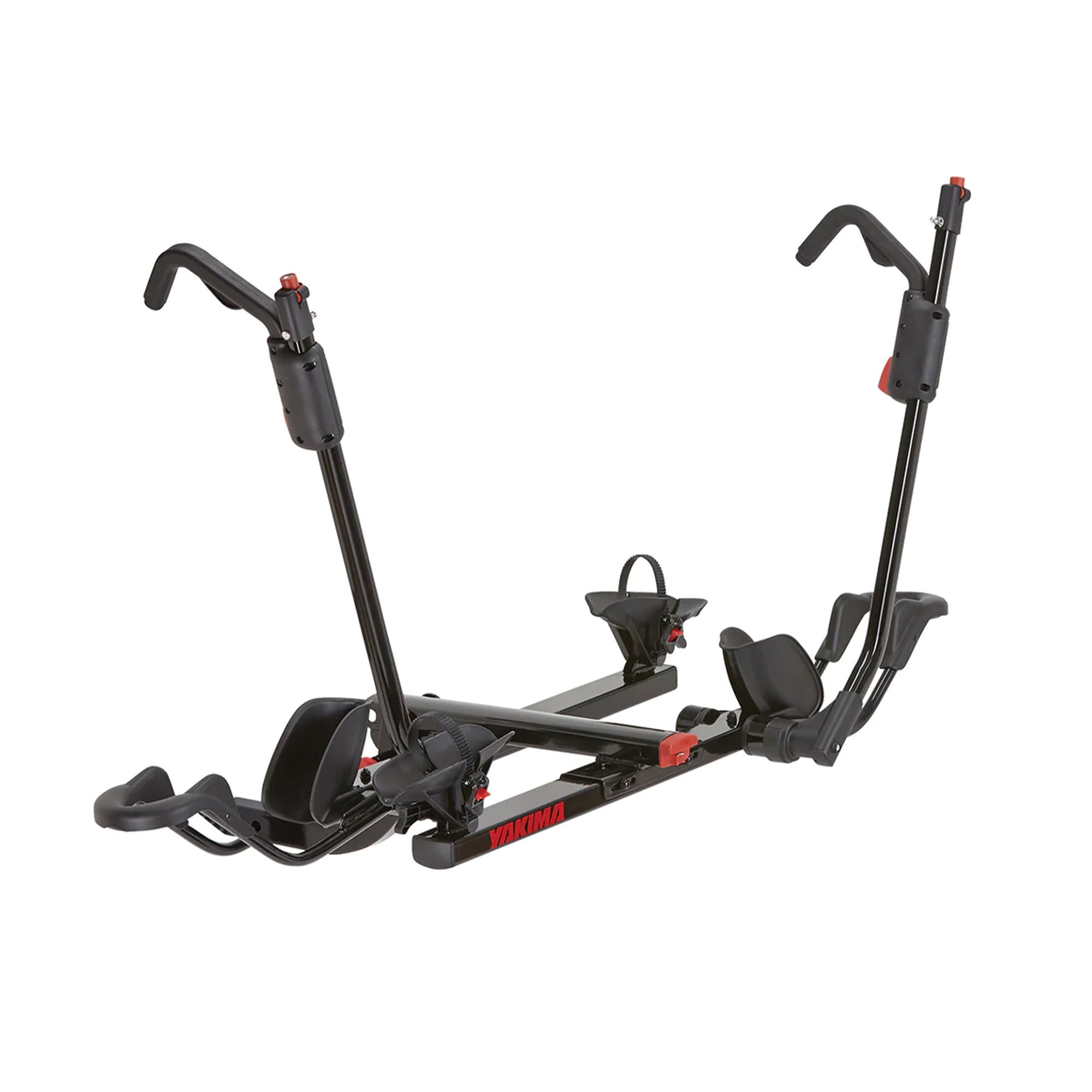
The YAKIMA HoldUp offers a unique side-to-side adjustability feature that lets you shift each tray up to 2 inches laterally, creating extra clearance between bikes with wide handlebars. This adjustability is rare among platform racks and solves the common problem of handlebar interference when carrying two mountain bikes with 780-millimeter bars. The rack tilts down with bikes loaded, providing full rear hatch access without removing any bicycles.
This rack supports 20- to 27.5-inch wheels with tires up to 3 inches wide, and 29-inch wheels with tires up to 2.5 inches wide. The integrated SKS locks secure both the bikes to the rack and the rack to the vehicle using a single key. The folding design allows the rack to collapse flat against the vehicle when not in use, reducing its profile and wind drag. The alloy steel frame carries 60 pounds per bike with a total of 120 pounds.
The HoldUp is not compatible with trailers, campers, or RVs due to the hitch stress induced by the extra moment arm. The 49-pound weight is manageable for one person but requires some effort to lift into a tall SUV receiver. The optional HoldUp +2 add-on expands capacity to four bikes, making this a scalable solution for growing families or group rides.
What works
- Side-to-side tray adjustment reduces bike contact
- Tilts with bikes loaded for trunk access
- Folds flat for storage
What doesn’t
- Not for use with RVs or trailers
- Limited tire width support for 29-inch wheels
- Heavier than some comparable racks
5. RockyMounts Monorail

The RockyMounts Monorail specializes in accommodating extra-wide tires, supporting road tires up to 5.0 inches wide without needing adapters or strap extensions. This makes it a top choice for fat bike enthusiasts who struggle to fit their 4.8-inch tires into standard trays. The monorail design secures the bike by the front wheel only, keeping the frame completely free of contact—ideal for expensive full-suspension and carbon frame bikes.
The tray adjusts 2 inches side-to-side to prevent bike interference, similar to the YAKIMA HoldUp. Wheelbases from 34 to 49 inches are supported, covering most adult mountain and road bikes. The rack tilts down 30 degrees for hatch access and folds flat against the vehicle. The 2-inch variant can be expanded to a 3-bike configuration using the optional Add-On, though the per-bike capacity drops to 45 pounds for the extra positions.
The rack includes an anti-wobble bolt, locking hitch pin, cable lock, and standard lock pods all keyed alike. At 39 pounds, the Monorail is lighter than many steel platform racks, making it easier to handle during installation. One limitation is its incompatibility with fender-equipped bicycles, as the front wheel clamp interferes with mudguards. The 60-pound per bike capacity is adequate for standard e-bikes but will not support the heaviest cargo e-bikes.
What works
- Native 5-inch tire support
- No frame contact design
- Relatively light at 39 pounds
What doesn’t
- Not compatible with fenders
- 60-pound per bike limit
- Front wheel clamp can be tight on plus-sized tires
6. Hollywood Sport Rider

The Hollywood Sport Rider pairs an 80-pound per bike capacity with a wobble-free hitch-tightening system, giving e-bike owners a stable platform for heavy electric bicycles. The rack accommodates tires up to 5 inches wide without adapters, covering fat tire e-bikes like the RadRover or Himiway. The folding design allows the rack to tuck flat against the vehicle when not in use, and the tilting mechanism provides rear vehicle access with bikes still loaded.
Security comes from locking frame clamps that grip the top tube and a locking hitch pin that secures the rack to the receiver. A security cable loops through the bike frames for additional theft deterrence. The platform-style wheel holders use universal straps that fit standard rims and fat tires alike. The rack is designed specifically for 2-inch receivers and should not be used with adapters or hitch extensions longer than 8 inches.
The steel construction adds up to a 56-pound rack, which is substantial but necessary for the 160-pound total capacity. The heavy-duty receiver tube adds strength where platform racks typically fail—at the hitch interface. The rack is not suitable for trailers, fifth wheels, or towed vehicles, as the dynamic forces on a towed rig exceed the rack’s design limits. For standard trucks and SUVs, the Sport Rider is a durable workhorse for daily e-bike commuting.
What works
- High 80-pound per bike capacity
- Wobble-free hitch tightener
- Fits 5-inch fat tires natively
What doesn’t
- Heavy at 56 pounds
- Not for use on trailers or RVs
- Straps can loosen if not cinched tightly
7. Trimax Road-MAX RMBR4
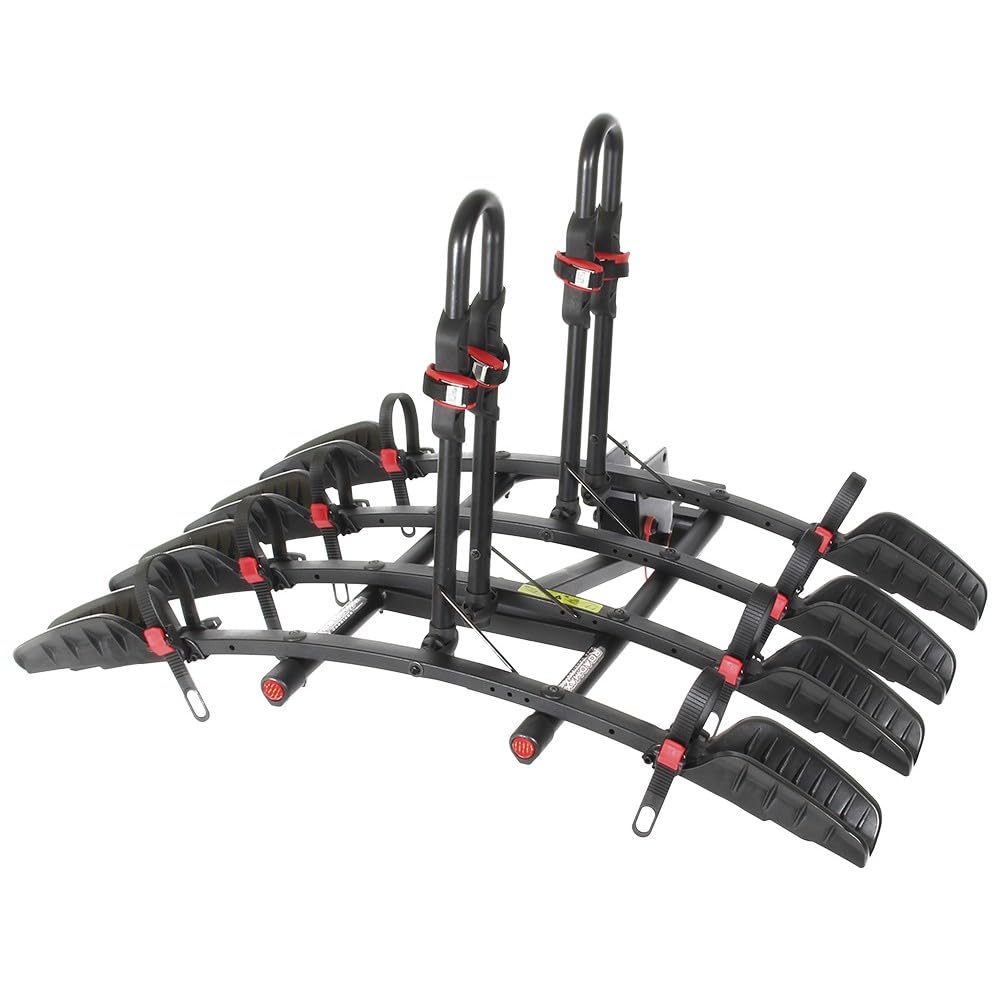
The Trimax Road-MAX RMBR4 is a hanging-style rack that carries up to four bikes using adjustable padded arms that support the bikes vertically. The arms fold flat against the rack when not in use, allowing gate access or trunk opening without obstruction. This is a rare feature among hanging 4-bike racks and makes the RMBR4 practical for daily drivers who need occasional extra capacity. The compact and lightweight design fits inside a car trunk when removed from the hitch.
The rack uses a strong locking attachment system for 2-inch receivers and includes high-resistance wheel straps with zamack buckles and soft pads. The straps fit all rim and tire sizes, though the design relies on the bike’s top tube for support. The 132-pound total capacity means each bike averages 33 pounds, which limits compatibility with heavy e-bikes or downhill sleds. The rack is best suited for standard road and mountain bikes under this weight.
One trade-off with hanging racks is the frame contact required by the padded arms. For carbon frames, the pressure point can lead to damage over rough roads. The arm folding mechanism is convenient but adds a few moving parts that require periodic tightening. Overall, the RMBR4 delivers good value for families with four lightweight bikes who prioritize compact storage and quick installation.
What works
- Folding arms for gate access
- Compact enough to store in trunk
- Locking attachment system
What doesn’t
- Not for carbon or step-through frames without adapter
- 33-pound average per bike is restrictive
- Straps can loosen with vibration
8. YAKIMA DoubleDown 4

The YAKIMA DoubleDown 4 offers hanging-style 4-bike transport with a built-in tilting mechanism that provides rear vehicle access without removing the bikes. The rack fits both 1.25-inch and 2-inch receivers, making it versatile for a wide range of vehicles from compact cars to trucks. The heavy-duty aluminum construction keeps the weight at 31 pounds, making it one of the lighter 4-bike options available. The 120-pound total capacity supports standard road, mountain, and hybrid bikes.
The rack is not compatible with e-bikes due to the frame-hanging design, and the TubeTop adapter is required for step-through, BMX, kid’s bikes, and some full-suspension frames. The tilting mechanism works smoothly, but some users report that the tilt latch requires two hands to operate when the rack is fully loaded. The optional DeadLock system adds locking security for both the bikes and the rack itself.
Customer feedback consistently praises the rack’s ease of installation and intuitive design. The rack holds bikes securely with minimal sway on paved roads. The limited lifetime warranty from YAKIMA adds confidence, though the rack has been discontinued by the manufacturer, which may complicate future part replacements. For buyers seeking a budget-friendly entry into hitch racks for a family of riders, the DoubleDown 4 delivers solid value.
What works
- Lightweight aluminum construction
- Fits both 1.25 and 2-inch receivers
- Tilts for rear access
What doesn’t
- Not compatible with e-bikes
- Requires TubeTop adapter for step-through frames
- Discontinued model, parts may be scarce
9. Allen Sports 552QR

The Allen Sports 552QR is a top-tube hanging rack that carries up to five bikes with a total capacity of 175 pounds, making it the highest-quantity rack in this lineup. The quick-release hitch mechanism allows installation without tools, and the foldable design collapses the rack when not in use. The universal fit works with any 2-inch receiver equipped vehicle. This is a classic low-cost solution for moving a fleet of bikes to a group ride or family outing.
The rack uses individual tiedown straps for each bike, plus a security strap that connects the top tube to the rack. The mainframe is welded steel with a powder-coated black finish. The individual tie-downs prevent bikes from contacting each other during transport, a common issue with lower-end hanging racks. The 10.6-kilogram weight is moderate, and the rack folds into a relatively compact shape for storage in a garage or shed.
The 552QR is a basic design with no tilting mechanism, so rear vehicle access requires removing all bikes first. The top-tube contact can rub paint on frames over long distances, and the rack lacks integrated locks. For buyers on a tight budget who need to carry many bikes occasionally, this rack fills the role without emptying the wallet. The lifetime warranty from Allen Sports covers defects but not normal wear from daily use.
What works
- Carries 5 bikes at a low cost
- Quick-release hitch installs tool-free
- Foldable for storage
What doesn’t
- No tilt access to vehicle
- Top tube contact can damage paint
- No integrated lock system
Hardware & Specs Guide
Hitch Receiver Class
The receiver class determines maximum tongue weight and rack compatibility. Class I (1.25-inch) supports up to 200 pounds tongue weight, while Class III/IV (2-inch) supports 500–600 pounds. Heavy platform racks with 4-bike capacity and e-bike weights require Class III or higher. Adapters allow 1.25-inch racks in 2-inch receivers, but the reverse is dangerous and voids warranties. Always match the rack’s native receiver size to your vehicle’s hitch class for maximum safety.
Per-Tray Capacity
Each tray or arm on a rack has an individual weight limit, not just a total. For hanging racks, the total is distributed evenly across the arms. For platform racks, each tray typically holds 30–80 pounds. Exceeding per-tray capacity can cause the tray to bend or detach. E-bikes with heavy batteries often require 60+ pound per-tray ratings. Check both the per-tray and total capacity to ensure your heaviest bike is within spec.
Tilt and Fold Mechanisms
Tilt mechanisms allow the rack to pivot downward, giving access to the rear hatch or tailgate while the bikes remain loaded. Fold mechanisms collapse the rack flat against the vehicle when empty, reducing the rack’s rear protrusion. These features are ergonomic necessities for daily drivers. Racks without tilt require removing bikes for any trunk access, which becomes tedious on long trips with frequent stops.
Locking Systems
Integrated locks secure both the bikes to the rack and the rack to the receiver. The most common system uses a single key for both functions. Cable locks integrated into the rack frame are more convenient than separate chain locks. Hitch pin locks with anti-wobble bolts prevent the rack from being stolen and reduce movement. For expensive bikes, consider a rack with locking frame clamps rather than just wheel straps.
FAQ
Can I use a 2-inch rack with a 1.25-inch receiver using an adapter?
What is the maximum tire width a receiver hitch bike rack can accommodate?
Why do some racks not work with full-suspension or step-through bike frames?
Final Thoughts: The Verdict
For most buyers, the best receiver hitch bike rack winner is the Thule T2 Pro XT/XTR because its zero frame contact, integrated wheels, and tool-free installation set the standard for safe, convenient transport. If you need high capacity for heavy e-bikes, grab the Hollywood RV Rider with its 80-pound per tray rating. And for the best combination of side-to-side adjustability and tilt access, nothing beats the YAKIMA HoldUp.

Certification: BSc in Mechanical Engineering
Education: Mechanical engineer
Lives In: 539 W Commerce St, Dallas, TX 75208, USA
Md Amir is an auto mechanic student and writer with over half a decade of experience in the automotive field. He has worked with top automotive brands such as Lexus, Quantum, and also owns two automotive blogs autocarneed.com and taxiwiz.com.