Standing in a freezing garage with numb fingers while your tools feel like ice cubes is a problem that demands a real solution — not a space heater that trips the breaker every fifteen minutes. A natural gas garage heater delivers relentless, dry heat directly to your workspace without relying on your home’s electrical panel, making it the go-to choice for anyone who needs consistent warmth during long winter projects. The decision, however, comes down to matching the heater’s BTU output to your garage’s insulation level, square footage, and ceiling height.
I’m Amir — the founder and writer behind Four Wheel Ask. I’ve spent years analyzing the interplay between British Thermal Units, room volume, and thermal efficiency to help garage owners select heaters that actually perform in real-world conditions without wasting gas.
Whether you need a ventless unit for a small workshop or a forced-air behemoth for a three-car garage, the best natural gas garage heaters balance safety certifications, installation requirements, and raw heating capacity to match your specific space.
How To Choose The Best Natural Gas Garage Heaters
Picking the right heater involves more than grabbing the highest BTU number you can find. Your garage’s insulation quality, ceiling height, and the climate zone you live in all determine whether a 30,000 BTU unit will roast you out or barely take the chill off. Below are the three factors that separate a smart buy from a costly mistake.
Match BTU Output to Garage Volume
BTU stands for British Thermal Unit, and one BTU is roughly the energy needed to raise one pound of water by one degree Fahrenheit. For a garage, a common rule of thumb is 25 to 30 BTU per square foot for a standard 8-foot ceiling with average insulation. If your garage has 10-foot ceilings, add 20 percent more BTU. If the walls are uninsulated concrete, double the estimate. A 20,000 BTU unit covers roughly 500 to 700 square feet under decent conditions, while a 45,000 BTU forced-air unit handles up to 1,500 square feet with overhead clearance.
Ventless vs Vented: Know the Trade-Off
Ventless natural gas heaters (also called vent-free) burn gas with near-100 percent efficiency and release all heat into the room, but they also release water vapor and trace combustion byproducts. This means they can raise humidity levels and require a functional oxygen depletion sensor (ODS) as a mandatory safety device. Vented or direct-vent heaters use a sealed combustion system that draws air from outside and exhausts flue gases outdoors. They are safer for tightly sealed garages and are approved for bedrooms, but they lose some heat through the exhaust pipe and cost more to install. Your choice should hinge on how much moisture your garage can tolerate and whether local codes allow vent-free units.
Ignition Type and Thermostat Control
Most ventless heaters use a piezo or push-button ignition that requires no electricity — perfect for power outages. Larger forced-air units typically need an electrical connection for the blower fan and electronic ignition. A built-in thermostat, whether manual or programmable, prevents the garage from cycling between too cold and too hot. Units with a high/medium/low thermostat control give you finer adjustment rather than just on/off operation. If you plan to leave the heater running for extended periods, a unit with a programmable digital thermostat offers better fuel economy and steadier comfort.
Quick Comparison
On smaller screens, swipe sideways to see the full table.
| Model | Category | Best For | Key Spec | Amazon |
|---|---|---|---|---|
| Modine HD45AS0111 | Forced Air | Large shops & extreme cold | 45,000 BTU / 80% efficiency | Amazon |
| Rinnai FC824N | Ventless Fan | Precise temp & quiet operation | 24,000 BTU / programmable thermostat | Amazon |
| Modine Hot Dawg HD45AS01-21 | Direct Vent | Certified commercial/industrial use | 45,000 BTU / forced air | Amazon |
| Comfort Glow 17,000 BTU | Direct Vent | Bedroom-safe & no electricity | 17,000 BTU / sealed burn system | Amazon |
| JEWUNO 30,000 BTU | Dual Fuel | Switching between NG and propane | 30,000 BTU / 99.9% efficiency | Amazon |
| Mr. Heater 20,000 BTU | Ventless Blue Flame | Medium garages & power outages | 20,000 BTU / electronic ignition | Amazon |
| ProCom MN180TPA-B | Ventless Infrared | Radiant warmth over large areas | 18,000 BTU / heats 950 sq ft | Amazon |
| Mr. Heater F299711 | Ventless Blue Flame | Small workshops & offices | 10,000 BTU / 300 sq ft coverage | Amazon |
| ProCom MN100TBA-B | Ventless Blue Flame | Compact spaces & budget entry | 10,000 BTU / 500 sq ft coverage | Amazon |
In‑Depth Reviews
1. Modine HD45AS0111 Natural Gas Hot Dawg Garage Heater 45,000 BTU

The Modine Hot Dawg HD45AS0111 is the benchmark for serious garage heating. With 45,000 BTU and an 80 percent thermal efficiency rating, this forced-air unit is designed to handle uninsulated two-car garages and small automotive workshops where extended run time is the norm. The low-profile grey cabinet mounts flush against the ceiling, saving valuable floor and wall space, while the standard power exhaust system lets you vent through a side wall or roof with minimal duct diameter.
Field wiring connections and pre-cut knockouts simplify installation for anyone comfortable with basic gas and electrical hookups. The forced-air blower circulates heat quickly across the entire space, eliminating cold spots near the garage door. Owners consistently report that this unit operates quietly compared to propane alternatives of the same size, and the 80 percent efficiency means lower gas consumption than older atmospheric burner designs.
Certified for residential, commercial, and industrial use, the Hot Dawg is built to withstand years of seasonal freeze-thaw cycles. The 60-pound weight reflects the heavy-gauge steel construction, and the neutral grey finish blends into most ceiling environments. This is not a weekend project heater — it’s a primary heat source for anyone who spends serious time in a cold garage.
What works
- Handles up to 1,500 sq ft with strong air circulation
- Quiet forced-air operation compared to equivalent BTU units
- Certified for residential, commercial, and industrial spaces
What doesn’t
- Requires dedicated electrical connection for the blower fan
- Installation is involved and may need a professional gas fitter
- 80% efficiency is solid but not as high as ventless models
2. Rinnai FC824N Ventless Natural Gas Heater

The Rinnai FC824N brings residential-grade sophistication to the garage heater category. Its 24,000 BTU output feeds a fan convector that pushes warm air through upper louvers and bottom front vents, creating a gentle convection loop rather than a harsh blast. The programmable thermostat with digital adaptive control lets you set precise temperature targets and run schedules, which translates to lower gas usage when the garage is unoccupied.
Safety is layered here: a flame failure device, overheat switch, oxygen depletion sensor, and tilt switch all automatically disable gas or power if conditions go out of spec. The cabinet stays cool to the touch, and a child-safety lock adds peace of mind if the heater is installed in a shared utility room. Rinnai strongly recommends professional installation, and the unit requires no venting, which simplifies placement on an interior wall.
Coverage claims up to 8,000 square feet on the listing are misleading for garage use — real-world experience pegs it closer to 600 to 800 square feet in a standard insulated garage. The fan adds a low hum that is quieter than forced-air units but more noticeable than a passive blue flame heater. For buyers who prioritize precise temperature control and a polished interface, the FC824N is the refined choice.
What works
- Programmable digital thermostat for scheduled heating
- Multiple safety features including flame failure and ODS
- Cool-touch cabinet with child safety lock
What doesn’t
- Fan noise is present during operation
- Heating coverage is overstated in the official spec
- Professional installation is strongly recommended
3. Modine Hot Dawg HD45AS01-21 Direct Vent Garage Heater
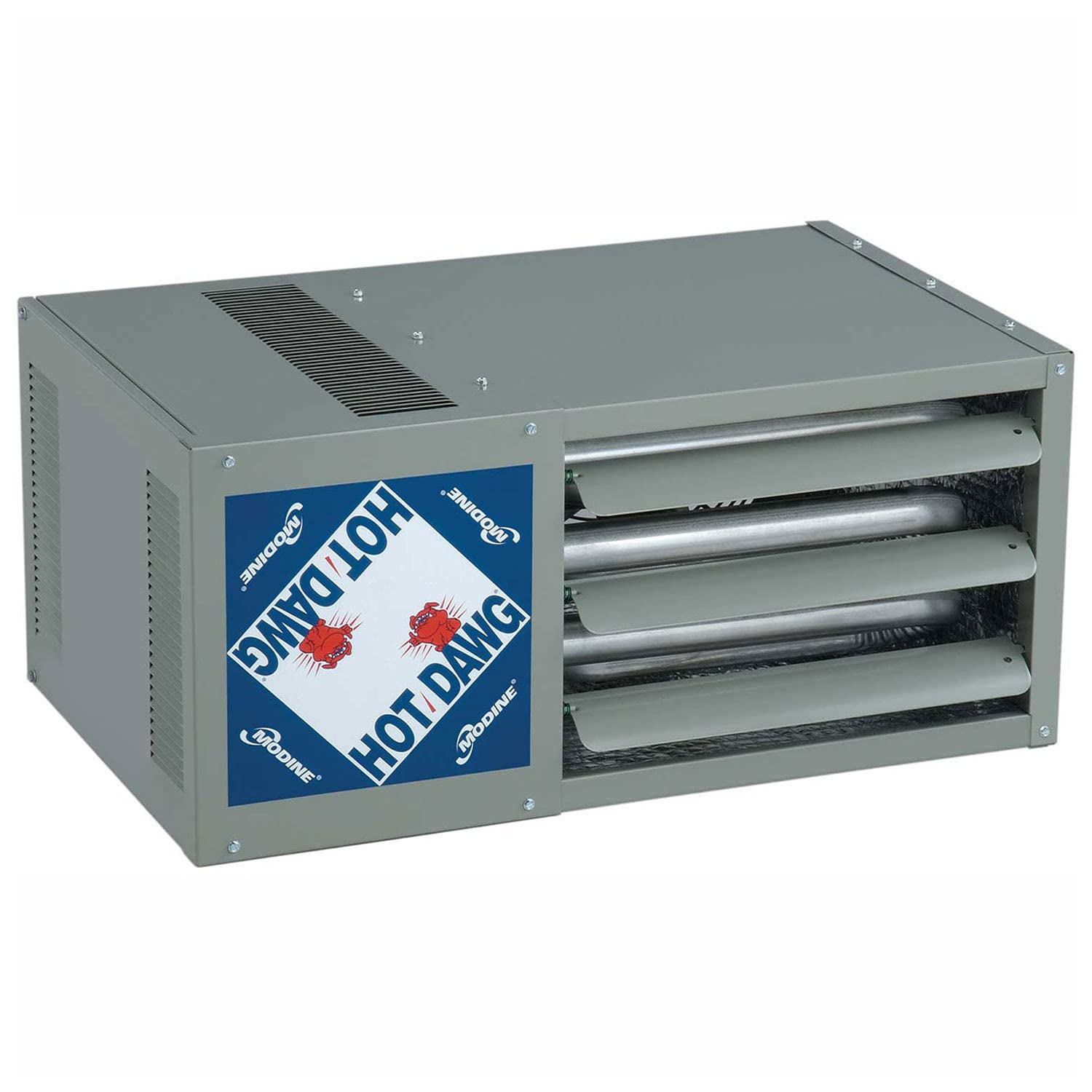
The HD45AS01-21 is the direct-vent sibling of the HD45AS0111, designed for installations where the gas line hookup is more convenient with propane but still rated for high-volume heating. Although the primary fuel listed is propane, the unit is convertible to natural gas with a field conversion kit, making it a flexible option for garages with existing NG piping. The direct-vent sealed combustion system draws intake air from outside and exhausts through a small-diameter pipe, which keeps indoor air quality pristine.
This unit outputs 45,000 BTU and covers up to 1,500 square feet with the same forced-air blower and low-profile cabinet as its natural-gas-only counterpart. The 60-pound build and 26.8-inch width require sturdy mounting on a ceiling joist or wall bracket. The certified rating for commercial and industrial use means the heat exchanger and motor are built for continuous duty, not intermittent home-use cycles.
Installation is more complex than a ventless heater because the vent termination must penetrate an exterior wall and clear snow lines. Once installed, however, the reliability is exceptional. Owners of detached garages in northern climates report that this heater maintains a steady 50-degree floor temperature even during subzero nights, making morning shop time tolerable without a long preheat period.
What works
- Sealed combustion keeps garage air clean
- Rugged build suitable for continuous commercial use
- Convertible between propane and natural gas
What doesn’t
- Requires professional installation and exterior venting
- Heavy unit at 60 pounds needs secure mounting
- Higher upfront cost than ventless alternatives
4. Comfort Glow 17,000 BTU Direct Vent Natural Gas Wall Heater
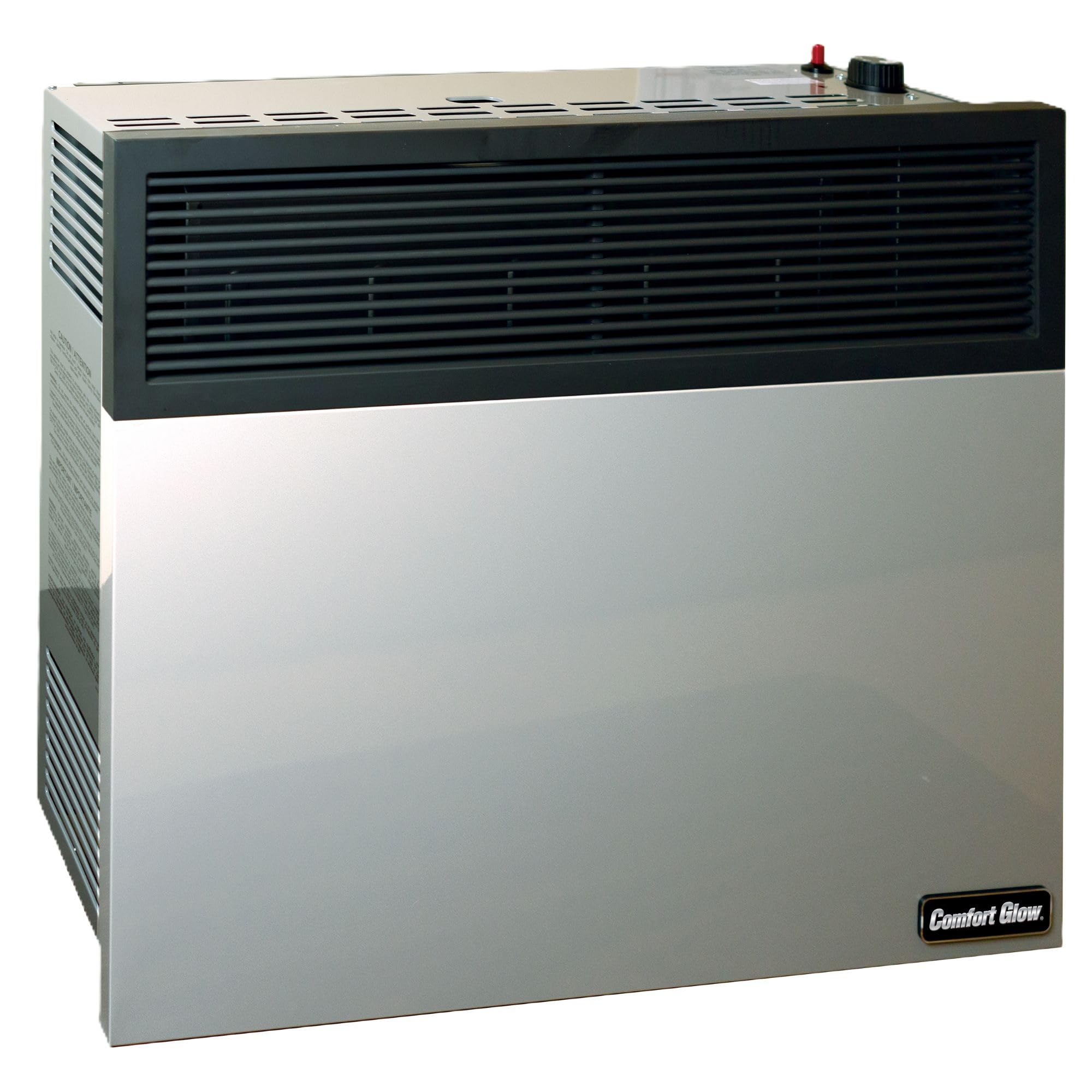
The Comfort Glow 17,000 BTU heater is a rare find in the direct-vent category because it operates without any electricity. The matchless piezo ignition lights the pilot manually, and the sealed burner uses natural convection rather than a fan to circulate heat. This makes it an ideal backup heat source for garages that lose power during winter storms, as it will keep running as long as the gas supply holds.
With a 570-square-foot coverage rating and dimensions of just 20 by 27 inches, this unit tucks neatly between studs on an exterior wall. The direct-vent kit included in the box routes combustion air and exhaust through a single wall penetration, eliminating the need for a chimney or vertical flue. The gray and black finish resists scuffs, and the cabinet is rated for bedroom and bathroom installation, which speaks to the cleanliness of the sealed burn system.
The trade-off is heat output. At 17,000 BTU, this heater is best suited for insulated one-car garages or small workshops. Trying to heat a drafty two-car space with high ceilings will leave the far corners cool. The built-in pressure regulator and safety pilot add reliability, but the convection-only heat distribution is slower than forced air and creates a noticeable temperature gradient from floor to ceiling.
What works
- Zero electricity required for operation
- Sealed burn system approved for bedrooms
- Included vent kit simplifies installation
What doesn’t
- 17,000 BTU is limited for larger garages
- Convection-only heating is slower than forced air
- Installation still requires a wall penetration
5. JEWUNO 30,000 BTU Natural Gas/Propane Wall Heater

The JEWUNO 30,000 BTU heater stands out for its dual-fuel capability, letting you run either natural gas or propane without buying a separate conversion kit. The infrared heating element produces radiant heat that warms objects and people directly rather than just the air, which feels more comfortable in a drafty garage where air movement carries warmth away. The thermostatic control with electronic spark ignition maintains the set temperature without constant cycling.
The 99.9 percent efficiency rating is near the theoretical maximum for a ventless heater, meaning almost every cubic foot of gas translates into usable heat. The oxygen depletion sensor and auto shut-off are CSA certified, and the unit requires no electricity, so it remains functional during power outages. The dimensions are generous at 28.5 inches wide, so check your wall space before mounting.
Weight comes in at 30.88 pounds, which is manageable for a single-person wall mount if you use the included bracket. The infrared technology provides a more even heat feel than blue flame designs, though it still releases moisture into the air — a consideration if your garage stores metal tools or woodworking equipment that could rust or warp. Owners in temperate climates with moderate humidity report excellent results in garages up to 1,000 square feet.
What works
- Dual-fuel operation without conversion kit needed
- Infrared heat warms objects directly for comfortable feel
- 99.9% efficiency with no electricity required
What doesn’t
- Adds moisture to the garage air
- Wide unit may limit mounting locations
- Not sold to California, Alaska, or Hawaii
6. Mr. Heater 20,000 BTU Vent Free Blue Flame Natural Gas Heater
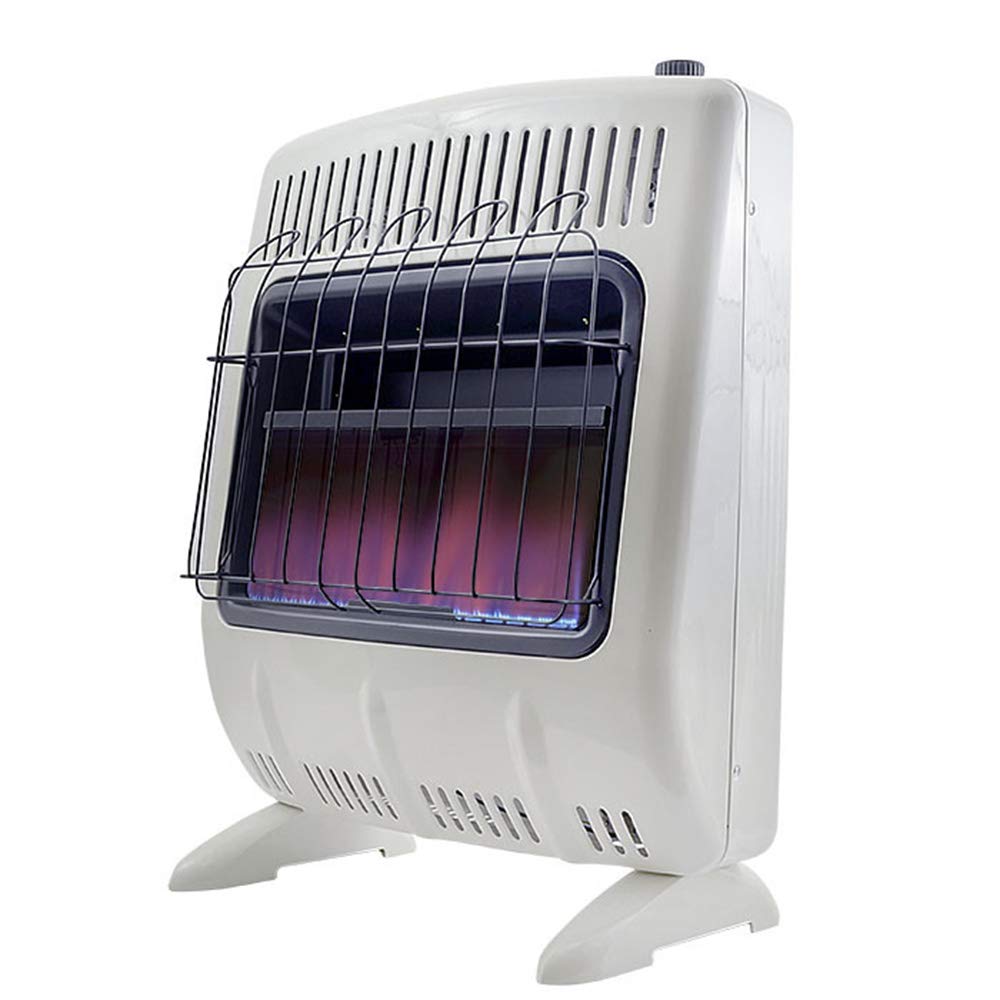
The Mr. Heater 20,000 BTU vent-free blue flame heater is a straightforward solution for medium-sized garages. The blue flame burner produces convection heat that rises and circulates naturally, warming the air gradually rather than blasting a directional beam. The built-in adjustable thermostat with battery-operated electronic ignition — powered by a single AA battery included in the box — means you can set it and forget it without running a power cord.
With a rated coverage of 700 square feet, this unit fits snugly in a standard two-car garage with average insulation. The cabinet dimensions are 23.75 inches deep by 25.25 inches high, and the included wall-mounting hardware makes installation straightforward. The ODS safety system automatically cuts gas flow if oxygen levels drop, which is the minimum safety standard for vent-free heaters.
One notable feature is the optional blower fan kit sold separately (Mr. Heater F299201) that can be added to improve air circulation. Without the fan, the blue flame relies on natural convection, which leaves cooler air near the floor — especially in garages with high ceilings. For buyers who want a reliable mid-range heater with room to upgrade later, this is a balanced pick that won’t overwhelm a residential gas line.
What works
- Battery-operated ignition works during power outages
- Adjustable thermostat maintains steady temperature
- Optional blower fan kit available for better circulation
What doesn’t
- Natural convection leaves cooler air near the floor
- Blower fan is not included in the box
- Heating coverage drops in uninsulated garages
7. ProCom MN180TPA-B Natural Gas Ventless Infrared Plaque Heater

The ProCom MN180TPA-B uses infrared plaque technology to generate 18,000 BTU and cover up to 950 square feet — an impressive reach for a ventless heater in this power class. Infrared plaques operate at a higher surface temperature than blue flame burners, producing radiant energy that travels directly to objects rather than warming the air first. The result is immediate warmth on your skin, tools, and workbench, which feels more effective in a space with high air leakage.
The thermostat offers high, medium, and low settings, and the push-button ignition with built-in ODS ensures safe operation without electricity. The unit ships with both wall-mounting hardware and base feet, so you can install it permanently or move it around as needed. At 26 pounds, it’s light enough for a single wall bracket but solid enough to stay stable on the floor.
Coverage of 950 square feet is optimistic for an uninsulated garage — expect more like 600 square feet in real-world conditions with a concrete slab and single-pane windows. The slim profile (8 inches deep) allows installation in tight spaces, and the white finish blends into most walls. For a mid-range infrared option that doesn’t require a gas line conversion, this ProCom model delivers strong radiant performance at a reasonable investment.
What works
- Infrared plaques provide direct radiant warmth
- Flexible installation with wall mount or base feet
- 18,000 BTU covers a large area for its class
What doesn’t
- Real-world coverage is less than the listed 950 sq ft
- Ventless design releases moisture into the garage
- Three-position thermostat is not fully proportional
8. Mr. Heater F299711 Vent-Free 10,000 BTU Blue Flame Natural Gas Heater
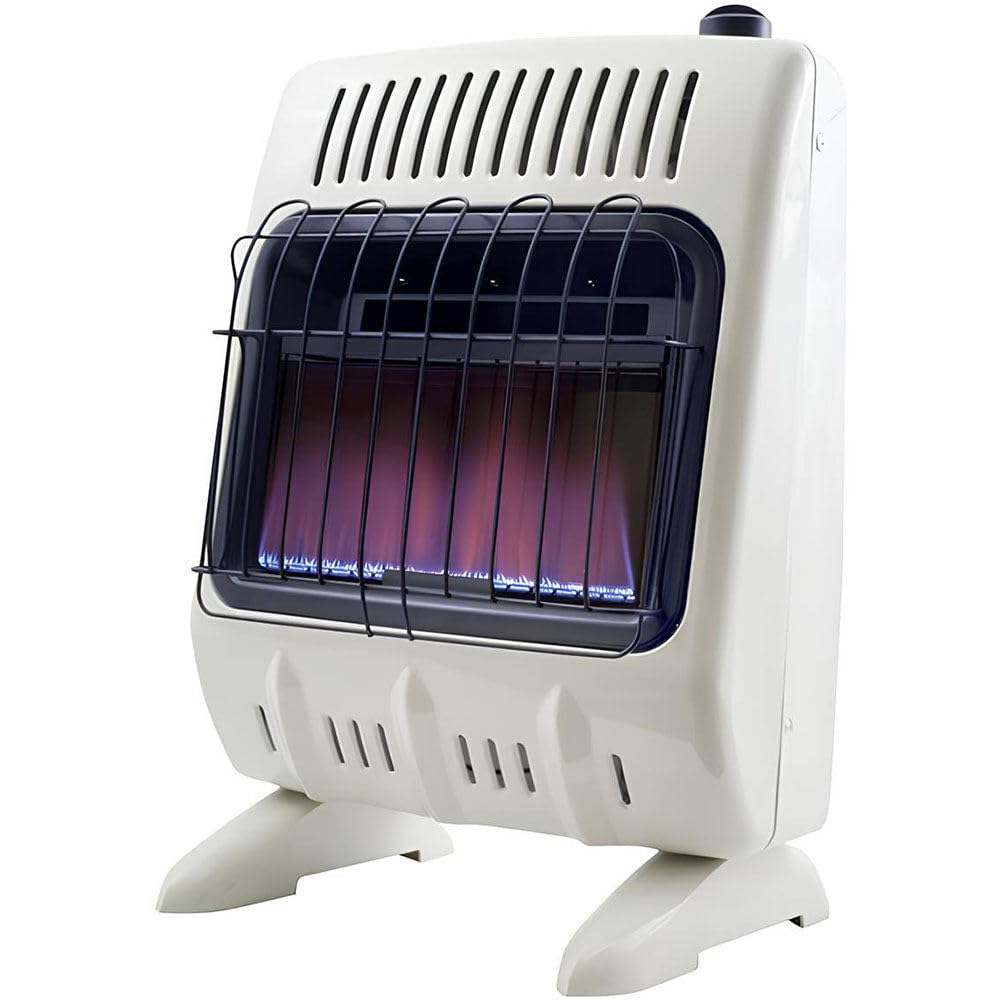
The Mr. Heater F299711 is the entry point in Mr. Heater’s vent-free line, producing 10,000 BTU for spaces up to 300 square feet. The blue flame burner generates convection heat that warms the air gradually, making it a natural fit for small offices, insulated tool sheds, or a single-car garage where you only need to take the edge off the cold. The cabinet form factor with included legs and wall-mounting hardware gives you placement flexibility.
The automatic low oxygen shut-off system (ODS) is the primary safety mechanism, and the unit operates without any electricity — just turn the gas valve, push the piezo igniter, and you have heat. At 15 pounds, it’s light enough to move between locations if needed, and the 19.75-inch depth means it protrudes less than many larger cabinets. The white finish is utilitarian but unobtrusive.
The coverage limitation at high altitude is an important catch — the heater’s ODS system may shut down the pilot at elevations above 4,500 feet, so mountain-state buyers should look at models rated for high altitude. Within its intended size range, this unit performs reliably and quietly, but attempting to heat a full two-car garage with it will leave you disappointed. It’s a specialist for small, enclosed spaces.
What works
- Compact size fits small garages and offices
- No electricity required for operation
- Lightweight and portable between rooms
What doesn’t
- Limited to 300 sq ft coverage
- ODS may shut down above 4,500 ft elevation
- Convection heat leaves floor cool in tall spaces
9. ProCom MN100TBA-B Ventless Natural Gas Blue Flame Space Heater

The ProCom MN100TBA-B offers the most accessible entry point in this lineup, delivering 10,000 BTU for up to 500 square feet of coverage. The blue flame design produces convection heat that rises and circulates naturally, and the slim modern profile makes it one of the more visually appealing ventless heaters on the market. The push-button ignition with built-in pilot ODS provides the same core safety system found on units costing twice as much.
No electricity is required, making this a solid choice for emergency heat during power outages. The thermostat offers high, medium, and low settings, giving you more control than a simple on/off valve. At just over 15 pounds and with both wall-mount and base-feet options, installation is flexible and straightforward. The 17-inch width fits easily between standard wall studs.
The practical limitation is heat output. 10,000 BTU is sufficient for a small, well-insulated room or a compact single-car garage, but it will struggle to keep a drafty or large garage comfortable in freezing weather. The ventless design adds humidity, and the blue flame heat signature is visible, which some users find comforting and others find distracting. For a secondary heat source or a small workspace, this is a capable and affordable starter unit.
What works
- Very affordable entry point for natural gas heat
- Slim profile fits between standard wall studs
- No electricity needed for ignition or operation
What doesn’t
- Low BTU output limits use to small spaces
- Blue flame glow may be distracting in dark garages
- Adds noticeable humidity to the room
Hardware & Specs Guide
BTU Output and Garage Volume
BTU (British Thermal Unit) measures the heat output of a gas burner. A general target is 25 to 30 BTU per square foot for an 8-foot ceiling with standard insulation. For a 600-square-foot garage, you need roughly 18,000 to 20,000 BTU. Uninsulated garages with concrete walls often require doubling that estimate. Always measure your garage’s cubic footage (length × width × height) and use that volume for a more accurate BTU calculation.
Ventless vs Vented Heaters
Ventless (vent-free) heaters burn gas with near-100 percent efficiency but release water vapor and trace combustion byproducts into the room. They require an oxygen depletion sensor (ODS) and are best suited for garages with reasonable air leakage. Vented or direct-vent heaters use a sealed combustion system that exhausts all flue gases outdoors, making them safer for tightly sealed spaces but less efficient because some heat escapes through the vent pipe.
Ignition Systems
Piezo and push-button ignitions use a mechanical spark to light the pilot and require no external power — ideal for garages without nearby outlets or during blackouts. Battery-operated electronic ignitions, common on Mr. Heater models, use a single AA cell and offer the convenience of a thermostat without a wall plug. Larger forced-air units (like the Modine Hot Dawg) need a 120V electrical connection for the blower motor and control board.
Oxygen Depletion Sensor (ODS)
ODS is a mandatory safety feature on all ventless gas heaters sold in the U.S. It monitors the oxygen level in the room and automatically shuts off the gas supply if oxygen drops below 18 percent, preventing carbon monoxide buildup. Never operate a ventless heater that lacks a functioning ODS, and test the system periodically by partially blocking the air intake to confirm the pilot extinguishes.
FAQ
Can I install a natural gas garage heater myself or do I need a professional?
How many BTU do I need to heat a two-car garage in a cold climate?
Is it safe to run a ventless natural gas heater overnight in an attached garage?
Will a natural gas heater work during a power outage?
Does a ventless heater add moisture that can damage my tools?
Final Thoughts: The Verdict
For most buyers, the best natural gas garage heaters winner is the Modine HD45AS0111 Hot Dawg because its 45,000 BTU forced-air output handles large, uninsulated garages with quiet, efficient circulation and commercial-grade reliability. If you want precise temperature control and a polished interface, grab the Rinnai FC824N. And for a zero-electricity backup heat source in a small workshop, nothing beats the Comfort Glow 17,000 BTU direct vent.

Certification: BSc in Mechanical Engineering
Education: Mechanical engineer
Lives In: 539 W Commerce St, Dallas, TX 75208, USA
Md Amir is an auto mechanic student and writer with over half a decade of experience in the automotive field. He has worked with top automotive brands such as Lexus, Quantum, and also owns two automotive blogs autocarneed.com and taxiwiz.com.