A coolant hose that looks flawless to the eye can hide a micro-crack that only reveals itself through a temperature delta of a few degrees. That is the precise gap an auto infrared camera is built to close — turning invisible thermal signatures into visual evidence you can trace, measure, and document in seconds.
I’m Amir — the founder and writer behind Four Wheel Ask. I’ve spent the last fifteen years analyzing thermal imaging sensor specifications, optical system designs, and real-world inspection workflows across automotive, HVAC, and electrical diagnostics to separate marketing claims from measurable performance.
This guide breaks down the nine most serious contenders on the market today, from phone-connected pocket imagers to standalone field units, so you can confidently choose the best auto infrared camera for your specific diagnostic needs.
How To Choose The Best Auto Infrared Camera
An auto infrared camera is not a general-purpose thermal tool — the demands of automotive diagnostics (moving parts, reflective surfaces, rapidly changing temperatures, and tight engine bays) require specific sensor and form-factor trade-offs. Understanding these specs before you buy will save you time and misdiagnoses.
IR Sensor Resolution and Frame Rate
The raw pixel count of the microbolometer dictates how much thermal detail you can resolve. A 160×120 sensor can show a hot brake caliper, but a 256×192 or 320×240 sensor will reveal whether the heat is uniform across the rotor face or concentrated on one side — a classic sign of a sticking piston. Frame rate matters equally: 25 Hz gives a fluid real-time view that lets you follow a cooling system as the thermostat opens. Lower frame rates produce laggy, stuttering images that make dynamic testing frustrating.
Temperature Range and Accuracy for Automotive Use
Automotive diagnostics demand a floor around -4°F (cold A/C lines) and a ceiling of at least 752°F (exhaust manifolds, catalytic converters). A spec of ±2°C or ±2% is the standard for reliable work. Some units auto-highlight the hottest and coldest pixel, which is invaluable when scanning a fuse box or checking each cylinder’s exhaust port temperature.
Handheld Standalone vs. Phone-Attached Form Factor
A dedicated handheld camera with a built-in screen lets you work in bright sunlight and keeps your phone free for service data or wiring diagrams. Phone-attached cameras (USB-C) are far more portable and often cheaper, but they drain your phone battery and require the manufacturer’s app for every function. If you inspect multiple cars per day, a standalone unit with physical buttons and a bright display is the more efficient choice.
Quick Comparison
On smaller screens, swipe sideways to see the full table.
| Model | Category | Best For | Key Spec | Amazon |
|---|---|---|---|---|
| TOPDON TC004 | Handheld | Standalone all-day shop use | 256×192 IR / 512×384 TISR | Amazon |
| FOXWELL RT280 PRO | Handheld | Dual-camera precision | 512×384 TISR / 2MP Visible | Amazon |
| VEVOR AI SC256M | Handheld | AI-driven analysis | 256×192 IR / 3.5” Touch | Amazon |
| Klein TI290 | Handheld | Lightweight pro carry | 76,800 Pixels / Wi-Fi | Amazon |
| FLIR TG275 | Handheld | Automotive-specific MSX | 19,200 Pixels / MSX | Amazon |
| Seek Nano 300 | Phone | Apple iPhone integration | 320×240 IR / 25 Hz | Amazon |
| Klein TI250 | Handheld | Entry-level budget pick | 19,200 Pixels / Rechargeable | Amazon |
| HSFTOOLS HF96V | Handheld | Long battery inspections | 240×240 Super Res / 11hr | Amazon |
| TOPDON TC002C Duo | Phone | USB-C universal compatibility | 512×384 TISR / 256×192 | Amazon |
In‑Depth Reviews
1. TOPDON TC004

The TOPDON TC004 brings a 256×192 native infrared sensor boosted by TISR (TOPDON Image Super Resolution) up to 512×384, meaning you can distinguish a hot ignition coil from an adjacent cylinder’s exhaust port without the smear that plagues lower-resolution units. The 3.5-inch display is large enough to view in the cramped space between an open hood and a fender, and the 12-hour battery life easily covers a full workday of scanning, capturing, and rechecking repairs.
Built-in 64GB storage eliminates the hunt for a microSD card, and the IP54 rating with 2-meter drop resistance gives you confidence when working around greasy concrete shop floors. The red laser pointer is crisp even under direct sunlight, helping you map a thermal anomaly back to a physical component before you even reach for a wrench.
Wireless file transfer via the TopInfrared app makes report generation fast, and the ability to set custom high/low alarms means you can hands-free monitor a cooling system as it warms up. If you need one camera for electrical diagnostics, HVAC line checks, and engine bay scans, the TC004 delivers the most complete package at a mid-range investment.
What works
- Excellent TISR-enhanced clarity for engine bay detail
- Long battery life supports full-day mobile diagnostics
- Large 3.5-inch screen with crisp readability
What doesn’t
- Wired-only connectivity; no built-in Wi-Fi
- Heavier than pocket-sized phone cameras
2. FOXWELL RT280 PRO
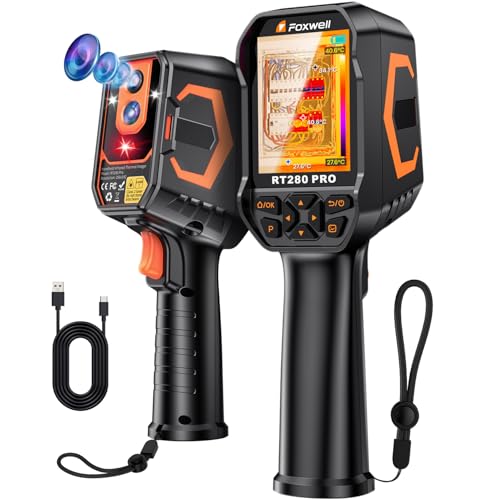
The FOXWELL RT280 PRO differentiates itself with a dedicated 2MP visible-light camera that enables five image overlay modes — including Picture-in-Picture and full fusion overlay — so you can see exactly which wire in a bundle is running hot without guessing from a standalone thermal shot. The TISR-enhanced resolution climbs to 512×384, and the 25Hz frame rate keeps the image smooth when you sweep across a running engine.
Nine color palettes give you flexibility for different environments: ironbow for high-contrast electrical panels, rainbow for subtle plumbing deltas, and grayscale for direct-sun outdoor work. The 32GB eMMC onboard storage holds over 80,000 images, and the included PC software supports 2D and 3D thermal analysis with automated report templates — a serious advantage if you document every job.
Built to withstand a 6.6-foot drop and rated IP54, this camera feels solid in the hand. The ±2% measurement accuracy and automatic hot/cold spot detection make it a reliable partner for diagnosing intermittent misfires or verifying that a newly installed radiator is flowing evenly across its core.
What works
- Fusion overlay modes simplify component-to-heat mapping
- PC software offers 2D/3D analysis and reporting
- Rugged build suited for daily shop use
What doesn’t
- No Mac software support
- Touchscreen would improve menu navigation
3. VEVOR AI SC256M
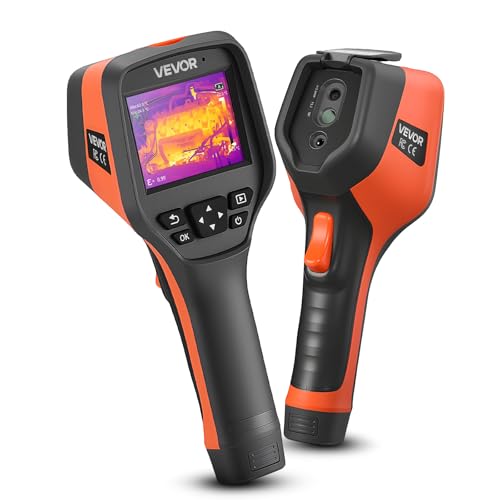
The VEVOR AI SC256M integrates an AI chip that assists with scene recognition and voice annotations directly on the 3.5-inch touchscreen — a feature that saves time when you need to log fifty inspection points in a row without typing notes. The 256×192 IR sensor paired with a 2MP visible camera delivers 56°×42° field of view, and the 25Hz refresh rate ensures you don’t miss transient thermal events like a failing relay.
Dual 4500mAh batteries (hot-swappable) provide extended runtime that can outlast even the longest diagnostic sessions, and the 32GB internal storage holds over 120,000 images. High/low temperature alarms are configurable and produce both visual and audible alerts, which is invaluable when you’re focused on the road ahead during a test drive and need to know if a brake rotor is overheating.
The IP54 sealing and 2-meter drop rating match the best in this class, and the Wi-Fi transfer capability lets you offload images to a tablet or cloud storage without hunting for a cable. If you want AI-enhanced workflow efficiency in a rugged handheld, this is a forward-looking option.
What works
- AI scene detection and voice annotation speed up documentation
- Hot-swappable dual batteries for non-stop field work
- Touchscreen interface is intuitive for menu navigation
What doesn’t
- Touchscreen can be less responsive with greasy gloves
- Relatively new model with limited long-term user data
4. Klein Tools TI290
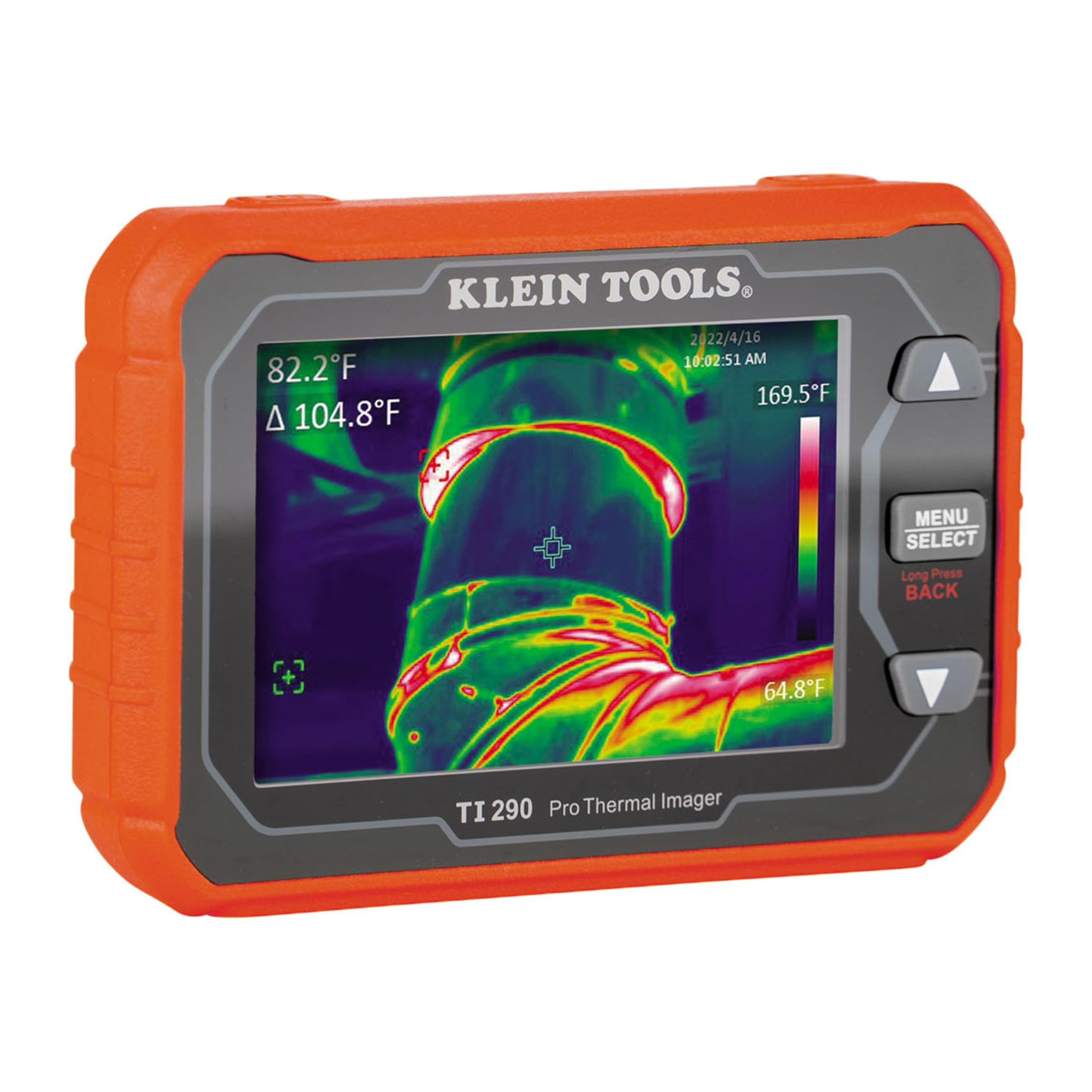
The Klein TI290 packs over 76,800 pixels into a body that weighs only 7.5 ounces — light enough to hang from a carabiner on your tool belt without noticing it. Despite the compact form, it delivers Wi-Fi data transfer to the Klein Tools app, enabling instant image sharing with a service manager or remote diagnostic specialist.
Three color palettes (ironbow, rainbow, grayscale) cover the essential visualization modes, and the emissivity adjustment range from 0.01 to 0.99 ensures accurate readings on everything from polished aluminum intake tubes to matte rubber hoses. The high/low temperature alarm range extends from -40°F to 752°F, which covers the full spectrum from a frozen A/C accumulator to a hot exhaust manifold.
The micro-USB charging is a minor concession to an older standard, but the molded storage pouch with carabiner clip compensates with exceptional carry convenience. For a technician who wants a lightweight, pocketable imager that still delivers Wi-Fi connectivity and professional-grade accuracy, the TI290 is a standout.
What works
- Extremely lightweight and easy to carry all day
- Wi-Fi transfer for quick report sharing
- Wide emissivity range covers diverse auto materials
What doesn’t
- Micro-USB charging instead of USB-C
- Only three color palettes limit analysis flexibility
5. FLIR TG275

The FLIR TG275 is purpose-built for automotive diagnostics, and its patented MSX (Multi-Spectral Dynamic Imaging) technology embeds visible-light edge details directly into the thermal image — meaning the silhouette of a brake line or the outline of a fuel injector stays sharp against the heat map. This makes it dramatically easier to interpret, especially for technicians who are new to thermal imaging.
The Bullseye laser system projects a circle-dot pattern that indicates the exact measurement area, so you know the temperature reading corresponds to the specific component you’re aiming at, not the surrounding heat sink. Temperature range spans -13°F to 1022°F, covering everything from a cold intake charge to a glowing turbo housing.
FLIR backs the TG275 with a 2-year parts-and-labor warranty plus a 10-year detector warranty, reflecting confidence in the sensor’s long-term stability. The IP54 enclosure and drop-tested design match shop-floor realities, and the included carry pouch keeps the unit protected between jobs. For a dedicated auto tech who values image interpretability above raw pixel count, the TG275 is a refined tool.
What works
- MSX technology produces exceptionally clear, easy-to-read images
- Bullseye laser pinpoints exact measurement zone
- Industry-leading 10-year detector warranty
What doesn’t
- Lower pixel count compared to similarly priced competitors
- No Wi-Fi; relies on USB cable for image transfer
6. Seek Thermal Nano 300

The Seek Thermal Nano 300 delivers a class-leading 320×240 infrared resolution in a form factor that plugs directly into any iPhone with a USB-C port — turning your phone into a thermal imager without the bulk of a standalone housing. The 25Hz refresh rate is smooth enough for live scanning of a running engine, and the <35mK thermal sensitivity captures subtle temperature differences that cheaper sensors would smear into noise.
The free Seek Nano app handles image and video capture directly to your phone’s storage, and the ability to view the phone camera feed alongside the thermal image helps you match heat signatures to physical components in real time. Temperature range covers -4°F to 626°F, which is adequate for most automotive work except extreme exhaust gas readings.
Seek Thermal designs and assembles the Nano 300 in the USA, and they provide lifetime online support. The main trade-off is that the measurement accuracy (±5%) is less tight than the ±2% offered by handheld units, and the device relies entirely on your phone battery. If you want maximum portability and already carry an iPhone, this is the highest-resolution phone-attached option available.
What works
- Best-in-class 320×240 resolution for a phone imager
- Ultra-portable, weighs just over 1 ounce
- Designed and assembled in the USA
What doesn’t
- ±5% accuracy is looser than handheld standards
- Drains phone battery during extended use
7. Klein Tools TI250

The Klein TI250 serves as a practical entry point for home mechanics and small shop owners who want thermal imaging capability without the premium investment. Its 19,200-pixel sensor, while modest, is sufficient for identifying major temperature deltas — a misfiring cylinder, a dragging brake caliper, or a blocked radiator core — and the three adjustable color palettes help differentiate hot spots from normal operating temperatures.
Emissivity adjustment from 0.01 to 0.99 is present, ensuring you can get accurate readings across different surface finishes, and the user-selectable high/low alarms help you monitor critical thresholds without staring at the screen. The rechargeable lithium-ion battery eliminates the need for disposable cells, and the USB-C charging interface aligns with modern device standards.
Image storage and sharing happen via USB-C, so you can pull images onto a laptop for documentation. The resolution is low enough that small faults like a single hot wire in a bundle may blend into the background, but for visual confirmation of obvious thermal anomalies, the TI250 is a reliable, low-cost tool that won’t collect dust in your toolbox.
What works
- Affordable entry point for basic automotive thermal scanning
- Adjustable emissivity for accurate multi-surface readings
- Compact and rechargeable with USB-C
What doesn’t
- Low pixel count struggles with small or subtle temperature differences
- No Wi-Fi or Bluetooth; wired transfer only
8. HSFTOOLS HF96V
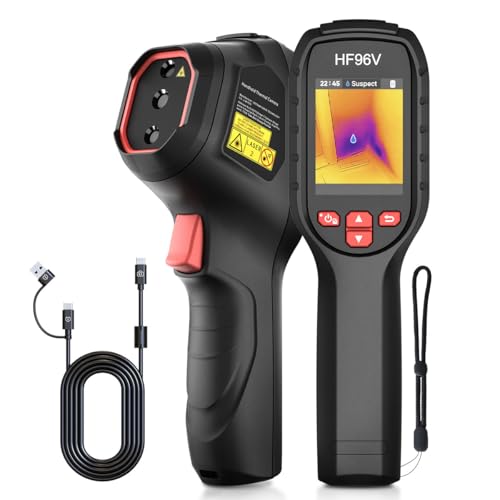
The HSFTOOLS HF96V takes a 96×96 native IR sensor and applies Live Super Resolution to produce a 240×240 effective image — a smart software approach that extracts more detail than the base hardware would suggest. The 11-hour battery life is the longest in this lineup, making it the ideal choice for extended fleet inspections or multi-vehicle diagnostic sessions where recharging mid-day is not practical.
The IntellFault scene detection system uses deep learning to automatically identify water leaks and insulation gaps, which is useful when you branch out from automotive work into building diagnostics. The 50° field of view gives wide coverage for scanning large radiators or entire fuse panels in a single pass, and the integrated 4GB storage holds over 30,000 images.
Built-in laser pointer and a standard tripod mount add versatility, and the IP54 protection with 6.6-foot drop rating matches the durability of more expensive units. The 96×96 base resolution means fine thermal details can appear blocky before the super-resolution algorithm applies, but for prolonged shift-long diagnostics, the HF96V provides unmatched runtime.
What works
- Exceptional 11-hour battery life for full-day inspections
- Live Super Resolution improves effective clarity
- IntellFault scene detection assists with leak identification
What doesn’t
- 96×96 base sensor is low for fine detail work
- Relies on algorithm rather than native hardware resolution
9. TOPDON TC002C Duo

The TOPDON TC002C Duo is the most affordable entry into TISR-enhanced thermal imaging, taking a 256×192 native sensor and boosting it to 512×384 for a level of detail that typically costs significantly more. It connects via USB-C to any compatible smartphone, tablet, or Windows device — the package even includes both USB-C and Lightning cables — making it the most platform-flexible thermal camera here.
Temperature range spans -4°F to 1022°F with ±2°C accuracy, matching the precision of handheld units that cost twice as much. The 25Hz refresh rate and 40mK thermal sensitivity deliver smooth, responsive imaging for dynamic diagnostics. The compact body measures just 2.8 inches long and weighs 1.1 ounces, so it disappears into a pocket or diagnostic case.
The TopInfrared app supports customizable temperature limits, waveform display, and photo/video recording directly to your phone. Real-world user feedback highlights accurate readings within 1°F of reference thermometers and seamless plug-and-play setup. If you want the thermal performance of a pro-grade sensor without the bulk and cost of a standalone unit, the TC002C Duo delivers outstanding value.
What works
- Exceptional TISR-enhanced image quality for the price point
- Universal USB-C compatibility with iOS and Android
- Highly accurate ±2°C temperature measurement
What doesn’t
- Drains host device battery during operation
- Not compatible with Mac or Android 16 temporarily
Hardware & Specs Guide
IR Sensor Resolution
The microbolometer’s native pixel count (e.g., 96×96, 256×192, 320×240) determines the raw thermal detail. Higher native resolution captures more distinct temperature points per square inch, which directly translates to the ability to spot a single hot cylinder among six cool ones. Software enhancement like TISR or Live Super Resolution can interpolate extra pixels, but native resolution remains the primary quality anchor.
Temperature Range and Accuracy
Automotive diagnostics require a range from roughly -4°F (A/C evaporator) to at least 752°F (exhaust manifold). Accuracy is typically stated as ±2°C or ±2% of reading — the lower figure wins for precision work like checking bearing temperatures. The distance-to-spot ratio also matters: a 50:1 ratio means a 1-inch hot spot can be measured from 50 inches away, critical for live exhaust scans.
FAQ
What IR resolution do I need for automotive engine diagnostics?
Can a phone-attached thermal camera replace a handheld unit for professional shop use?
How does emissivity adjustment affect my diagnosis of engine components?
Final Thoughts: The Verdict
For most buyers, the best auto infrared camera winner is the TOPDON TC004 because it balances pro-grade TISR-enhanced resolution, a large 3.5-inch display, and 12-hour battery life into a single rugged package that handles everything from brake diagnostics to HVAC line scans. If you want the highest thermal clarity in a phone-connected form factor at a lower entry cost, grab the TOPDON TC002C Duo. And for dedicated automotive technicians who value instant image interpretability through MSX overlays, nothing beats the FLIR TG275.

Certification: BSc in Mechanical Engineering
Education: Mechanical engineer
Lives In: 539 W Commerce St, Dallas, TX 75208, USA
Md Amir is an auto mechanic student and writer with over half a decade of experience in the automotive field. He has worked with top automotive brands such as Lexus, Quantum, and also owns two automotive blogs autocarneed.com and taxiwiz.com.