A freezing shop floor sucks the motivation right out of a work session. Your hands stiffen, grease thickens, and every job takes twice as long because you are spending energy fighting the cold instead of turning wrenches. A properly matched heater changes that reality by delivering focused warmth directly to your workspace, not the empty rafters.
I’m Amir — the founder and writer behind Four Wheel Ask. I’ve spent years analyzing shop heating systems across electric, propane, and diesel platforms — studying BTU outputs, conduction methods, and real-world feedback from mechanics, woodworkers, and garage builders to separate effective heat solutions from underpowered space wasters.
Whether you run a fabrication shop, a home garage, or a warehouse workspace, finding the right heater for shop depends on matching fuel type, mounting style, and heat output to the square footage and ventilation realities of your specific space.
How To Choose The Best Heater For Shop
Selecting the right shop heater is not about grabbing the highest wattage on the shelf — it is about matching heat delivery to your shop’s volume, insulation, and ventilation. An oversized unit in a leaky space wastes fuel, while an undersized unit runs constantly without ever taking the edge off.
Match BTU Output to Your Shop Volume
BTU (British Thermal Unit) is the true measure of heating capacity. A general rule is 30 to 40 BTUs per square foot for an average insulated garage. A 500-square-foot shop with 10-foot ceilings needs roughly 15,000 to 20,000 BTUs. An uninsulated metal building can need double that because heat escapes through the walls and roof faster than it builds up.
Choose the Right Fuel Type for Your Workflow
Electric heaters shine in smaller, well-insulated shops where you need quiet, zero-fume operation and can handle the higher per-BTU electricity cost. Propane forced-air units deliver massive heat output for large spaces but require ventilation to handle combustion byproducts. Diesel heaters offer excellent fuel efficiency and low operating costs for medium-sized shops, but they need proper exhaust routing if used indoors.
Consider Mounting and Space Efficiency
Floor space in a shop is precious — every square foot occupied by a heater is a square foot you cannot park a tool box, workbench, or vehicle under. Ceiling-mounted or wall-mounted units keep the floor clear and distribute heat more evenly since warm air naturally rises. Portable units offer flexibility to move heat where you need it but take up valuable real estate and introduce trip hazards with cords and hoses.
Quick Comparison
On smaller screens, swipe sideways to see the full table.
| Model | Category | Best For | Key Spec | Amazon |
|---|---|---|---|---|
| Comfort Zone Ceiling Mount | Electric Hardwired | Permanent shop install | 17,065 BTU / 240V | Amazon |
| DEWALT 68000 BTU | Propane Forced Air | Large uninsulated shops | 68,000 BTU | Amazon |
| Ballu Mica Infrared | Electric Panel | Small insulated garages | 1500W / 250 sq ft coverage | Amazon |
| Remington LP 60K | Propane Forced Air | Job site portability | 60,000 BTU | Amazon |
| Flame King 60K | Propane Forced Air | Covered outdoor areas | 60,000 BTU | Amazon |
| LF Bros 5KW Diesel | Diesel Forced Air | Medium shops with fuel access | 17,000 BTU / 5KW | Amazon |
| Cadet Com-Pak Wall | Electric Hardwired | Small room supplement | 5,120 BTU / 120V | Amazon |
| Dr. Infrared Heater Wall | Electric Hybrid | Small shop zone heating | 5,200 BTU / 1500W | Amazon |
| BEYOND HEAT Milkhouse | Electric Compact | Budget multi-zone heating | 1500W / 2-pack | Amazon |
In‑Depth Reviews
1. Comfort Zone Ceiling Mount Garage Heater
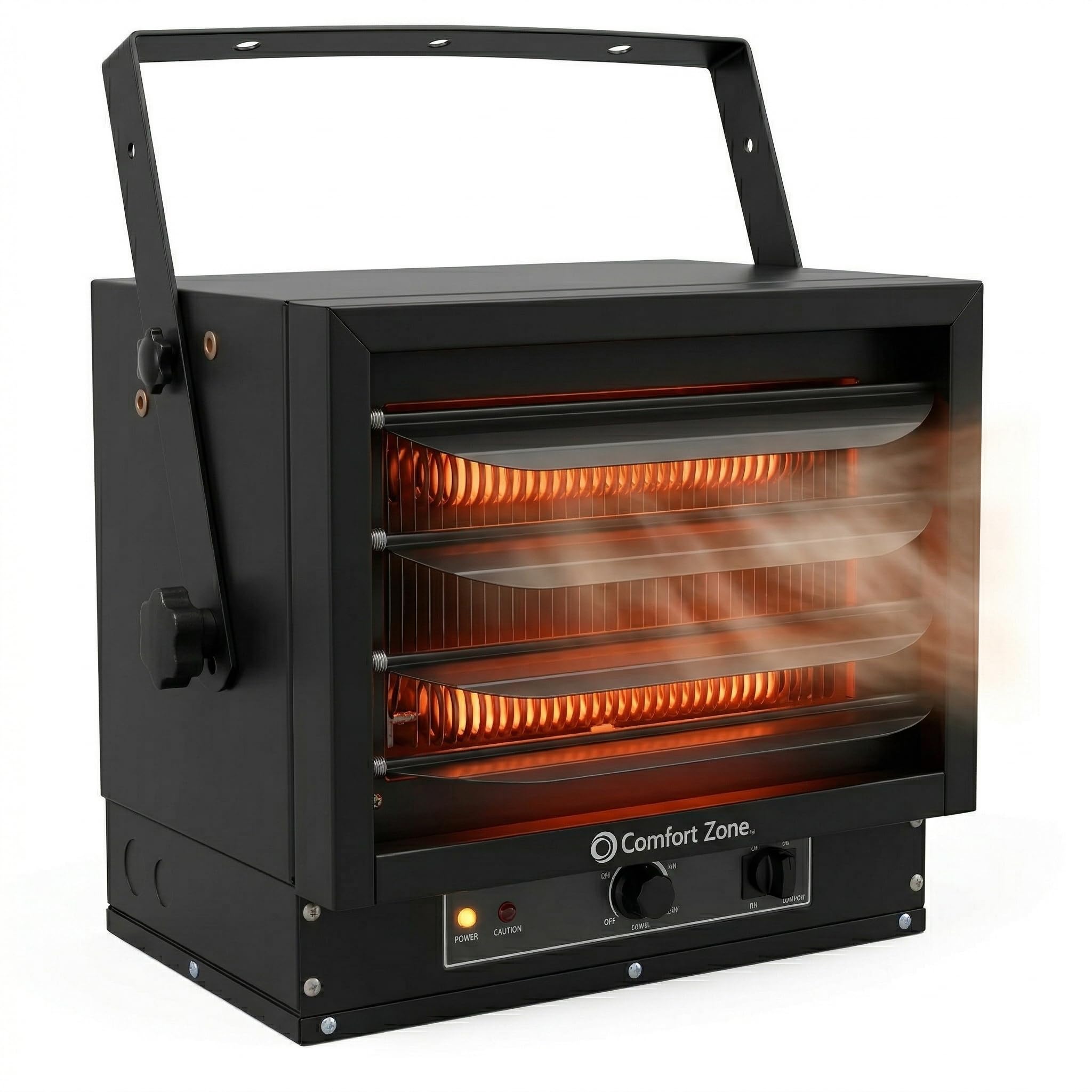
The Comfort Zone CZ220BK dominates the shop heater category by delivering 17,065 BTUs from a ceiling-mounted position that keeps the floor completely clear. Installation requires a dedicated 240V circuit and hardwiring, but the payoff is permanent heat distribution that covers up to 1,000 square feet without occupying a single inch of workbench or parking space.
The robust steel construction and adjustable louvers let you aim warm air exactly where you need it — critical when you have a car lift on one side and a workbench on the other. The dual-knob thermostat gives you precise temperature control rather than just high/low/off, and the built-in overheat sensor with automatic shutoff provides reliable protection in a shop environment full of combustible materials.
At this BTU output and mounting configuration, this unit becomes the backbone of a serious workshop heating plan. It runs quietly for a forced-air unit, and the power indicator light lets you know at a glance it is operating. The trade-off is the installation complexity — you will need an electrician unless you are comfortable running 240V lines yourself.
What works
- Ceiling mount frees all floor space
- 17,065 BTU covers substantial shop areas
- Adjustable louvers direct heat precisely
- Steel body handles temperature swings
What doesn’t
- Hardwired installation requires 240V circuit
- Not portable once mounted
2. DEWALT 68000 BTU Forced Air Propane Heater

DEWALT’s 68,000 BTU forced-air propane heater is the go-to choice for large, uninsulated shops, barns, and construction sites where quick heat recovery matters more than quiet operation. This freestanding unit cranks enough heat to cover 1,700 square feet, making it one of the highest-output portable options in this lineup.
The 13.2-pound weight and built-in handle make it genuinely portable — you can move it from the main shop to an equipment bay without breaking a sweat. It runs on standard 20-pound propane tanks and includes the hose and regulator assembly right out of the box. The electronic ignition provides reliable starting even in cold conditions where piezo igniters sometimes struggle.
You need to understand that this is a forced-air torch, not a silent radiant heater. It produces a noticeable jet-engine roar at full output, and it requires adequate ventilation because propane combustion consumes oxygen and produces carbon monoxide. It is ideal for brief, intense heating sessions in open spaces but not for enclosed, occupied workshops where you spend hours stationary.
What works
- Massive 68,000 BTU output for large spaces
- Lightweight and portable at 13.2 lbs
- Electronic ignition for reliable cold starts
What doesn’t
- Very loud during operation
- Requires ventilation for safe indoor use
3. Ballu Mica Infrared Space Heater

The Ballu Mica Infrared Heater represents the premium end of electric shop heating, using far-infrared mica panels to warm objects and people directly rather than circulating hot air. This means the toolboxes, workbench, and concrete floor absorb and retain heat, creating a more comfortable working environment than forced-air units that just warm the air until you open a bay door.
The 180-degree wide coverage panel heats up in about 10 seconds, and the 1,500-watt output covers primary zones up to 250 square feet with secondary coverage reaching beyond 500 feet. The all-metal construction and 2-year warranty back a unit designed to last through many seasons. Smart features including WiFi app control and Alexa compatibility let you pre-heat the shop from inside the house — a genuine convenience for cold morning starts.
This is not a solution for large open shops or drafty metal buildings. It works brilliantly in a well-insulated two-car garage or a smaller workshop where you want consistent, even heat without noise. The wall-mount capability and included casters give you flexibility in placement, and the whisper-quiet operation means you can run it while on phone calls or listening to diagnostic audio.
What works
- Silent far-infrared heat warms objects not air
- Smart app control for pre-heating on schedule
- Dual mount — stand or wall with casters
What doesn’t
- Limited to smaller insulated spaces
- Not effective in drafty or open bay shops
4. Remington LP Forced Air Heater 60,000 BTU
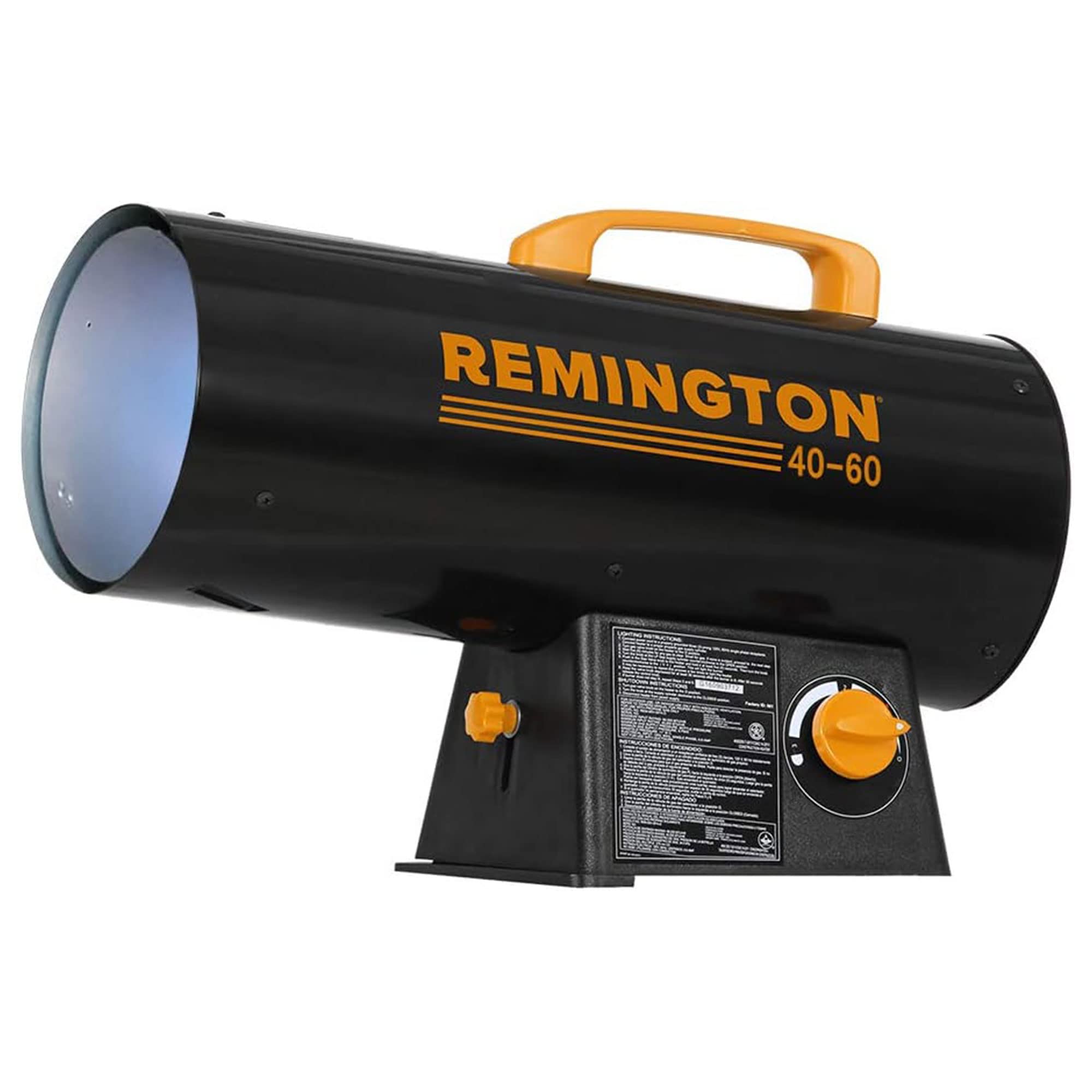
The Remington LP heater packs 60,000 BTUs into a compact steel frame weighing just 11 pounds, making it the most portable serious-output heater in this review. It heats spaces up to 1,500 square feet, and the variable heat settings let you dial back output when you are in a smaller bay or just need a maintenance temperature.
Safety hardware includes a thermocouple, high-temperature limit shut-off, and a flame-out fuel cut-off — three layers of protection for unattended operation in a workshop. The 10-foot hose and regulator are included, and the adjustable height lets you position the heat stream higher or lower depending on your specific work area. Build quality feels substantial, with heavy-duty steel that survives job site transport and rough handling.
The forced-air design moves a tremendous volume of warm air quickly, but the trade-off is significant noise output and the same ventilation requirement as any propane heater. This unit is best used in semi-open shops, construction sites, or barns where you can crack a door or roll-up to maintain fresh air exchange.
What works
- Lightweight 11 lb design for easy transport
- Variable heat output for different spaces
- Triple safety shutoff systems
What doesn’t
- Requires ventilation for safe indoor use
- Loud forced-air fan operation
5. Flame King 60,000 BTU Portable Propane Heater

The Flame King 60K delivers the same class-leading 60,000 BTU output as the Remington and DEWALT units but with a stainless steel body that resists corrosion better in damp or unconditioned shop environments. It heats up to 1,500 square feet and runs for up to 8 hours on a single 20-pound propane tank at full output, giving you a full workday on one tank load.
Safety features include a built-in fire detection system, tilt shutoff, and fuel shutoff — all CSA certified for peace of mind. The auto piezo ignition and gas control button simplify operation, and the included LP hose with regulator gets you set up without extra trips to the hardware store. The one-year warranty covers manufacturer defects, which is standard for this category.
The Flame King is marketed as an outdoor unit, and you must respect that — it should only be used in well-ventilated areas like a garage with open doors or partially enclosed workspaces. It is a straightforward, no-frills heat cannon that does exactly what it promises: warm large spaces fast. The stainless steel construction is a genuine durability advantage over painted steel units in humid climates.
What works
- Stainless steel body resists corrosion
- 8-hour runtime on a 20 lb tank
- CSA certified safety systems
What doesn’t
- Outdoor-rated — ventilation mandatory
- Not suitable for enclosed occupied shops
6. LF Bros 5KW All-in-One Diesel Heater
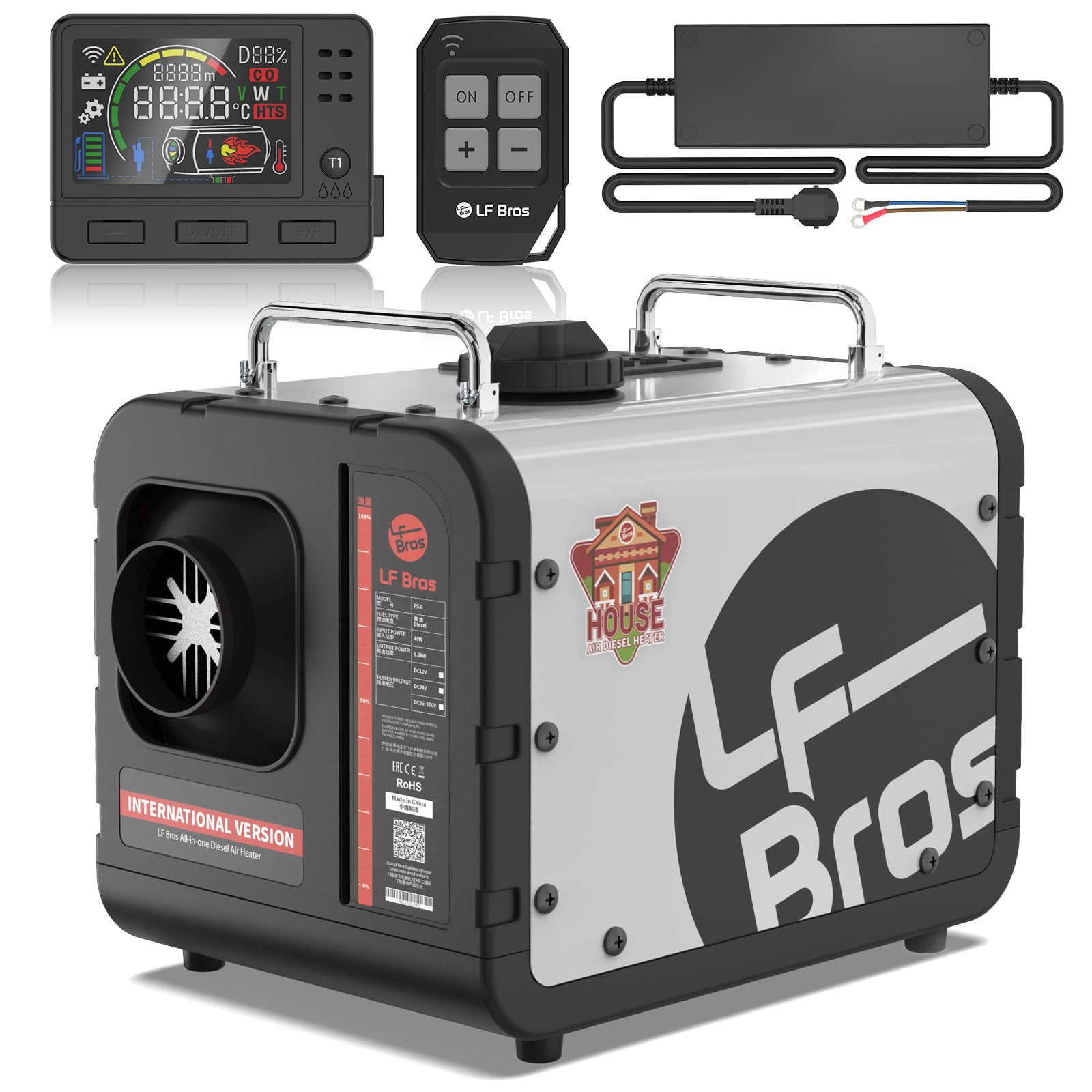
LF Bros brings a different fuel strategy to the shop with this 5KW diesel heater that runs on standard diesel fuel rather than propane. Output ranges from 4,700 to 17,000 BTUs with fuel consumption between 0.18 and 0.53 liters per hour, making it extremely economical for long-duration heating compared to propane units that burn through tank after tank.
The all-in-one design includes a 110V transformer so you can plug it directly into a standard wall outlet — no 12V or 24V wiring needed. The LCD screen displays operating status, the remote control works up to 100 feet away, and the oil-leak-proof fuel tank cap prevents spills if the unit gets bumped in a busy shop. Working temperature range goes down to -40°F, so it starts reliably even in deep cold.
Diesel heaters produce a mild exhaust smell and require a combustion intake from outside the heated space for safe indoor operation. The included installation kit needs some setup work to route the exhaust properly, but once installed, the fuel cost savings over propane are substantial. The 215-269 square foot coverage rating makes it ideal for a single work bay focused heating.
What works
- Very low fuel consumption per hour
- 110V plug-in capability with included transformer
- Remote control with 100 ft range
- Operates down to -40°F
What doesn’t
- Requires exhaust routing for safe indoor use
- Smaller coverage area than propane alternatives
7. Cadet Com-Pak Electric Wall Heater

Cadet’s Com-Pak wall heater is the industry standard for in-wall electric heating in small shops, tool rooms, and office spaces attached to a garage. The 5,120 BTU output on a 120V circuit fills a 200-square-foot room without requiring a dedicated 240V line, and the built-in thermostat gives you hands-off temperature maintenance.
The cabinet form factor fits between standard 16-inch on-center wall studs with a 4-inch depth that keeps the heater flush with the wall surface. Installation is straightforward for anyone comfortable with basic electrical work, and the forced-air design moves heat effectively through the small space. The white finish blends into most wall surfaces without looking industrial.
This is not a primary heater for a large shop. It is a zone-heating solution for a small office, a heated storage room, or a workshop annex where you want to maintain temperature without running a large central unit. The 120V requirement makes it accessible in garages that lack 240V capacity, and the 12.5-amp draw is compatible with most 15-amp circuits.
What works
- Fits between standard wall studs cleanly
- Runs on standard 120V circuit
- Built-in thermostat for automatic control
What doesn’t
- Only 5,120 BTU — small space only
- Hardwired installation required
8. Dr. Infrared Heater Ecoheat Wall Mount
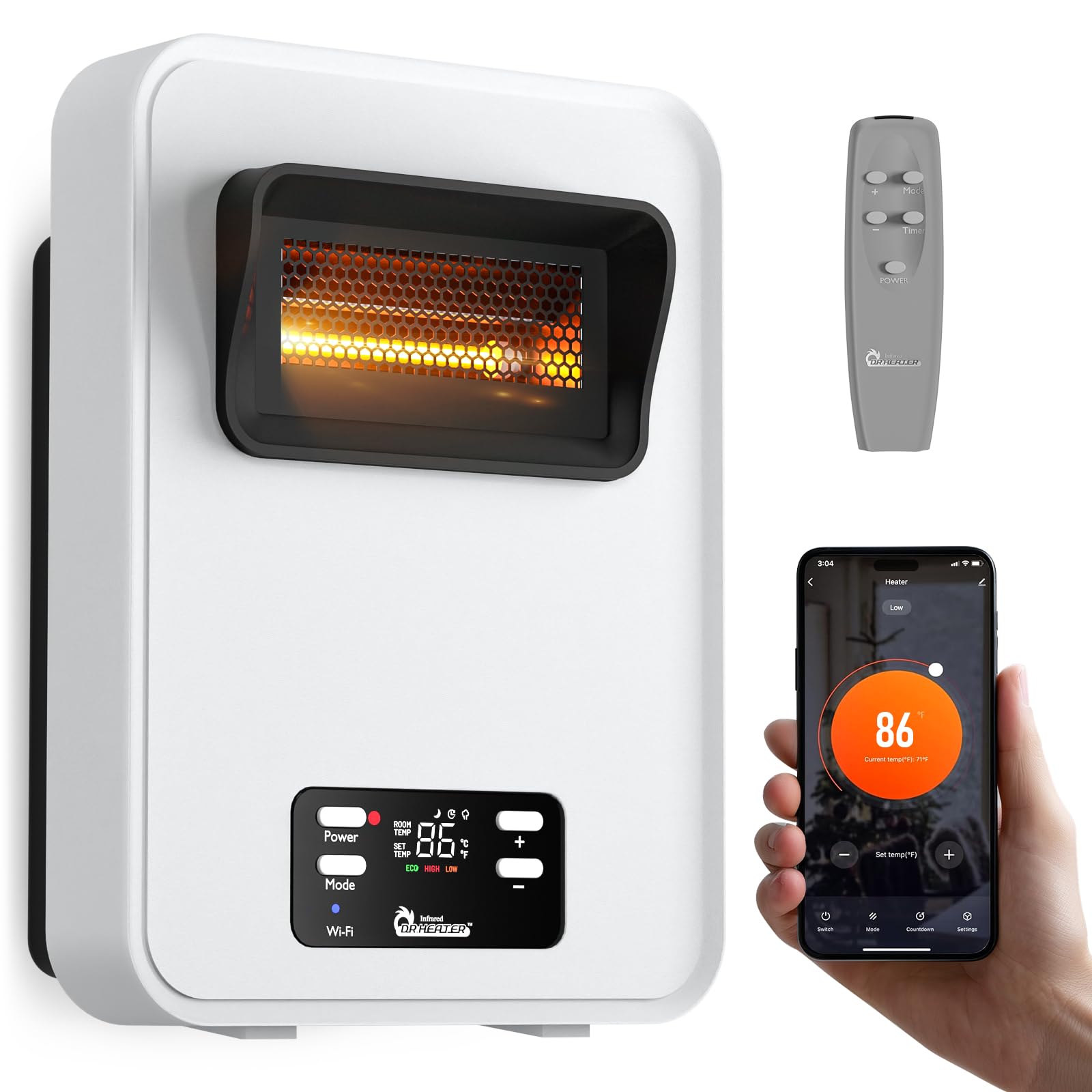
The Dr. Infrared Heater Ecoheat uses a unique dual heating system that combines a quartz infrared element for instant radiant warmth with a blower for even air distribution. This hybrid approach gives you the feel of infrared heat on your body and tools while the fan circulates warmth through a 150-200 square foot space, reducing cold spots.
The wall-mount design with the easy-hang system installs without the bulky brackets and professional labor that traditional baseboard heaters require. If you change your workspace layout, the unit converts to a freestanding portable heater without any tools — a genuine flexibility advantage over permanent hardwired installations. The remote control and three heat settings (ECO, HIGH, LOW) give you granular control.
At 1,500 watts and 5,200 BTUs, this is a supplemental heater for a small shop or a zone heater for a specific work area rather than a whole-shop solution. The WiFi connectivity is not present despite the form factor note — the included remote handles all control. The 8.5-pound weight makes wall mounting simple, and the white finish looks clean in finished shop interiors.
What works
- Dual infrared and blower heat distribution
- Converts from wall mount to freestanding
- Remote control included
What doesn’t
- Covers only 150-200 square feet
- WiFi feature listed but not functional
9. BEYOND HEAT Milkhouse Space Heater 2-Pack

The BEYOND HEAT Milkhouse heater 2-pack offers the most accessible entry point for adding heat to multiple zones in a shop. Each unit delivers up to 1,500 watts with three adjustable settings including fan-only mode, 1,300W, and 1,500W, giving you flexibility to use them as ventilation fans in summer and heat sources in winter.
The anti-freeze setting is a standout feature for shop owners who need to keep a space above freezing without running the heater at full power continuously. When the ambient temperature drops below 40°F, the heater automatically fires up, keeping pipes and stored materials from freezing while minimizing energy consumption. The tip-over switch and overheat protection provide essential safety for unattended operation in a garage environment.
ETL certification confirms the units meet safety standards, and the heavy-duty material construction feels durable despite the budget-friendly positioning. The solid carry handle makes each unit easy to reposition, and at this price for a two-pack, you can place one near your workbench and another near the entrance to create a more comfortable temperature gradient across the shop.
What works
- Two heaters included for multi-zone coverage
- Anti-freeze mode activates below 40°F
- ETL certified for safety
What doesn’t
- Limited to small spaces individually
- Fan noise noticeable at high setting
Hardware & Specs Guide
BTU Output and Square Footage Matching
BTU (British Thermal Unit) measures the heat output capacity. A shop with standard insulation in a temperate climate needs roughly 30 to 40 BTUs per square foot. An uninsulated metal building or a shop with high ceilings can require 50 to 60 BTUs per square foot because heat escapes through the metal skin faster than it accumulates. Always calculate based on total cubic volume, not just floor area — a 1,000-square-foot shop with 14-foot ceilings contains 40 percent more air to heat than the same floor area with 10-foot ceilings.
Fuel Type Selection: Electric vs Propane vs Diesel
Electric heaters are the simplest to install and run silently with zero combustion byproducts, making them ideal for enclosed, insulated shops where you work for hours. Propane forced-air units deliver the highest BTU per dollar of equipment cost but consume oxygen and produce carbon monoxide — they require ventilation and are better suited for brief heating sessions in semi-open spaces. Diesel heaters offer the lowest per-hour fuel cost and can run unattended for long periods, but they need exhaust routing to the outside and produce a mild diesel odor during operation that some shop users find unpleasant.
Mounting and Safety Certifications
Ceiling and wall-mounted heaters save critical floor space and distribute heat more evenly by placing the heat source above the work area. Portable units offer flexibility but introduce trip hazards from cords and hoses. Essential safety certifications include ETL or UL listing for electric units, CSA certification for gas units, and specific features like tip-over shutoff, overheat protection, and flame-out fuel cutoff. In a shop environment where flammables may be present, these certifications are non-negotiable for fire safety.
FAQ
Can I use a propane heater inside a closed garage workshop?
What size heater do I need for a two-car garage shop?
Is it cheaper to run a diesel heater or a propane heater in a shop?
Final Thoughts: The Verdict
For most buyers, the heater for shop winner is the Comfort Zone Ceiling Mount 17,065 BTU unit because it delivers serious output without sacrificing any floor space, and the hardwired electric design eliminates ventilation concerns. If you need massive BTU output for a large uninsulated space, grab the DEWALT 68,000 BTU forced-air propane heater. And for quiet, even warmth in a smaller insulated shop where noise matters, nothing beats the Ballu Mica Infrared Heater with its smart controls and far-infrared heating technology.

Certification: BSc in Mechanical Engineering
Education: Mechanical engineer
Lives In: 539 W Commerce St, Dallas, TX 75208, USA
Md Amir is an auto mechanic student and writer with over half a decade of experience in the automotive field. He has worked with top automotive brands such as Lexus, Quantum, and also owns two automotive blogs autocarneed.com and taxiwiz.com.