Upgrading a factory car stereo is one of the highest-impact moves you can make for daily driving enjoyment. A stock head unit often lacks the audio fidelity and connectivity modern drivers expect, leaving you tethered to aux cords or tinny FM transmitters. Swapping in a dedicated Bluetooth receiver clears up the signal path and puts hands-free calling and wireless music streaming front and center.
I’m Amir — the founder and writer behind Four Wheel Ask. I’ve spent years analyzing car audio market trends, digging through build quality reports, and cross-referencing feature sets across dozens of single-DIN and double-DIN Bluetooth stereo models to separate the real performers from the spec-sheet fluff.
This guide breaks down the top contenders for the aftermarket bluetooth radio market, covering essential specs like amplifier power, EQ options, and smartphone integration to help you make a confident upgrade choice.
How To Choose The Best Aftermarket Bluetooth Radio
Picking the right head unit means balancing your vehicle’s physical constraints—single DIN versus double DIN—with the audio features that actually improve your listening experience. Focus on the specs that translate to real-world performance, not marketing buzzwords.
Amplifier Power and EQ Flexibility
Look for at least 50 watts x 4 channels of peak power and a built-in equalizer with 13 bands or more. Parametric EQ and digital time alignment let you tune the soundstage to your vehicle’s acoustics, correcting for door placement and dashboard reflections that factory radios leave untouched.
Bluetooth Connectivity and Multi-Device Support
Modern Bluetooth car stereos support hands-free calling (HFP) and audio streaming (A2DP) with low-latency codecs. Dual-phone connectivity is a serious advantage for households sharing a car, allowing two drivers to pair simultaneously without re-pairing every trip. Voice-assistant push-through, via Siri or Google Assistant, keeps your eyes on the road.
Audio Format Compatibility
High-resolution file support—FLAC, WAV, AAC—matters if you listen to lossless audio. Many entry-level units cap out at MP3 and WMA, while mid-range to premium models handle FLAC files via USB, preserving the dynamic range that compressed formats lose.
Quick Comparison
On smaller screens, swipe sideways to see the full table.
| Model | Category | Best For | Key Spec | Amazon |
|---|---|---|---|---|
| Pioneer DEH-S4220BT | Single DIN, CD | Sound personalization with DJ effects | 50W x 4, 13-band EQ, MIXTRAX | Amazon |
| Pioneer MVH-S622BS | Double DIN | Smartphone app integration | 50W x 4, Pioneer Smart Sync, SiriusXM | Amazon |
| Sony MEX-N5300BT | Single DIN, CD | CD playback plus SiriusXM readiness | 52W x 4, RDS tuner, external mic | Amazon |
| KENWOOD KMM-BT332U | Single DIN | Multi-phone streaming and Alexa control | 50W x 4, 13-band EQ, 6-ch preouts | Amazon |
| Sony DSX-A410BT | Single DIN | Dual Bluetooth phone management | 4-channel, voice control, dual BT | Amazon |
| JVC KD-SX27BT | Single DIN | High-res audio file support | 100W peak, 13-band EQ, FLAC/WAV | Amazon |
| JENSEN MPR420 | Double DIN | Budget-friendly voice assistant access | 7-char LCD, 3-year warranty | Amazon |
In‑Depth Reviews
1. Pioneer DEH-S4220BT

Pioneer’s MIXTRAX technology is the standout feature here, creating DJ-style seamless transitions with sound effects and lighting cues. Combined with a 13-band EQ and Advanced Sound Retriever, the DEH-S4220BT restores high-frequency detail lost in compressed audio files, giving MP3s a noticeably fuller presence through the front speakers.
The single-DIN chassis includes a CD player for physical media and prints 50 watts per channel across four outputs. Hi-volt RCA preouts (2V front, rear, sub) give you the flexibility to add external amplifiers later without swapping the head unit. The detachable face plate adds theft deterrence, with a multi-color illumination scheme that matches most dashboard lighting.
Pioneer Smart Sync via the companion app expands the receiver’s interface on your phone’s screen, unlocking navigation overlays and app-based EQ tweaks. Voice control via Siri/Google works through the connected smartphone, keeping hands on the wheel. This unit strikes the best balance of feature depth and upgrade path for drivers who care about sound tuning.
What works
- MIXTRAX transitions add energy to playlists
- Advanced Sound Retriever clarifies compressed audio
- Detachable face and multi-color illumination
- Hi-volt preouts support future amp upgrades
What doesn’t
- MIXTRAX effects can feel gimmicky for purists
- No FLAC playback via USB
- Screen clarity lags behind premium double-DIN units
2. Pioneer MVH-S622BS

The double-DIN Pioneer MVH-S622BS is optimized for drivers who want a larger display and deeper smartphone integration. Pioneer Smart Sync mirrors navigation, messaging, and audio controls onto your phone’s screen via the app, effectively giving you a mini infotainment experience without a full Android Auto or CarPlay system.
Advanced Sound Retriever works with the 50W x 4 amplifier to lift muddy midrange and restore clarity to streaming sources. The front USB port handles FLAC and WAV files at high resolution, and the rear auxiliary input stays hidden for a clean installation. SiriusXM readiness means the unit will control satellite radio right out of the box when you add an SXV300 tuner.
Hands-free calling benefits from the included external microphone with a 10-foot cord, which can be routed to the A-pillar for clear pickup. The double-DIN form factor fills a 4-inch-tall dash opening and gives you larger, more readable text than single-DIN displays. This is the right choice for commuters who prioritize app access and display visibility.
What works
- Pioneer Smart Sync expands interface on phone screen
- FLAC and WAV playback from USB
- External mic placement for clear calls
- SiriusXM ready with separate tuner
What doesn’t
- No CD player for physical media
- Lower preout voltage than aftermarket competition
- App dependency for some advanced features
3. Sony MEX-N5300BT

Sony’s MEX-N5300BT keeps the CD slot alive for listeners who still rotate physical albums or buy discs at used shops. The single-DIN unit pairs Bluetooth 2.1 for hands-free calling and A2DP streaming, and the included card remote gives quick track skipping without reaching for the dash.
The 52W x 4 amplifier pushes clean stereo through factory speakers, with a 3-band parametric EQ that’s less granular than the 13-band options from Kenwood or Pioneer but adequate for basic tone shaping. RDS radio data system displays station name and song info on FM broadcasts, a small but useful convenience for radio heavy users.
SiriusXM readiness adds satellite capability with a separate SXV300 tuner, and the front AUX input accommodates older media players. The button-driven interface lacks touchscreen fluidity but is intuitive enough to operate by feel. This unit is ideal for the driver who wants a CD slot and satellite radio without stepping into a full double-DIN dashboard refit.
What works
- Built-in CD player for physical media
- SiriusXM ready with add-on tuner
- Card remote for easy track skipping
- RDS displays FM station information
What doesn’t
- Bluetooth version is older (2.1)
- Only 3-band EQ limits audio tuning
- No USB fast charging above standard
4. KENWOOD KMM-BT332U

Kenwood’s KMM-BT332U brings a 13-band equalizer with digital time alignment—an unusual feature at this level. Time Alignment delays individual speaker channels so sound from the left and right door speakers arrives at your ears simultaneously, creating a centered soundstage without physically moving the speakers.
The built-in Amazon Alexa integration lets you change tracks, ask for weather, and control smart home devices using just voice prompts through the connected smartphone. Dual-phone Bluetooth pairing handles two drivers simultaneously, and the Music Mix feature lets up to five paired phones take turns streaming—perfect for road trips with passengers.
Six-channel 2.5-volt preamp outputs give you rear, subwoofer, and front channels for a multi-amp system, while the front USB 1.5A port charges your phone faster than standard 1A ports. The detachable face includes a color LCD that changes with your dashboard backlighting. This head unit packs advanced audio tuning into a single DIN package without jumping to a premium price tier.
What works
- Digital time alignment for focused soundstage
- 13-band EQ with extensive shaping options
- Music Mix for multi-phone streaming
- 6-channel preouts for expandable systems
What doesn’t
- Amazon Alexa requires smartphone tethering
- No CD playback
- Display isn’t high-resolution color
5. Sony DSX-A410BT

Sony’s DSX-A410BT focuses on seamless dual-phone management, pairing two smartphones simultaneously. One phone handles navigation and music streaming via A2DP while the second phone manages hands-free calling (HFP) — a practical setup for ridesharing or families where one driver needs GPS audio and the other takes work calls.
The single-DIN chassis includes front USB and auxiliary inputs, with WMA and MP3 support. Voice control via Siri and Google Assistant is triggered directly from the unit, so you never touch the phone. The 4-channel internal amplifier delivers adequate headroom for factory speakers, though Sony doesn’t publish peak wattage ratings.
Installation is straightforward with standard ISO connectors. The unit’s compact depth fits shallow dash cavities where longer chassis won’t sit. The bezel-less design blends neatly into 2000s-era dash kits. If your top priority is managing two phones with zero pairing friction, this receiver delivers that specific function better than any other option here.
What works
- Dual Bluetooth supports two phones independently
- Voice control integration for safe operation
- Compact chassis fits shallow dash openings
- Simple, clean bezel-less installation
What doesn’t
- No high-res audio file support
- Lower power output than bridged competitors
- No display for track metadata
6. JVC KD-SX27BT

JVC’s KD-SX27BT punches above its price with high-resolution FLAC and WAV playback capabilities, a feature normally reserved for higher-tier head units. The 13-band EQ with K2 technology processes digital audio to restore harmonics lost during encoding, giving lossless files an airy open quality through capable speakers.
The USB 1.5A port charges phones quickly, and the JVC Remote app for iOS/Android gives you full control of track selection and EQ presets wirelessly. Time Alignment and Sound Lift work together to raise the perceived soundstage from below the dashboard to ear level, correcting the downward angle where many factory door speakers aim.
Bluetooth connectivity handles two phones full-time and streams from up to five paired devices, similar to Kenwood’s Music Mix feature. The short chassis reduces weight and simplifies wiring in cramped dash environments. This stereo is the clear winner for budget-conscious buyers who refuse to compromise on file format support.
What works
- FLAC and WAV playback at high resolution
- 13-band EQ with K2 processing
- Time Alignment and Sound Lift stage correction
- JVC Remote app for wireless control
What doesn’t
- No CD slot for physical media
- Screen is monochrome and basic
- No built-in satellite radio support
7. JENSEN MPR420
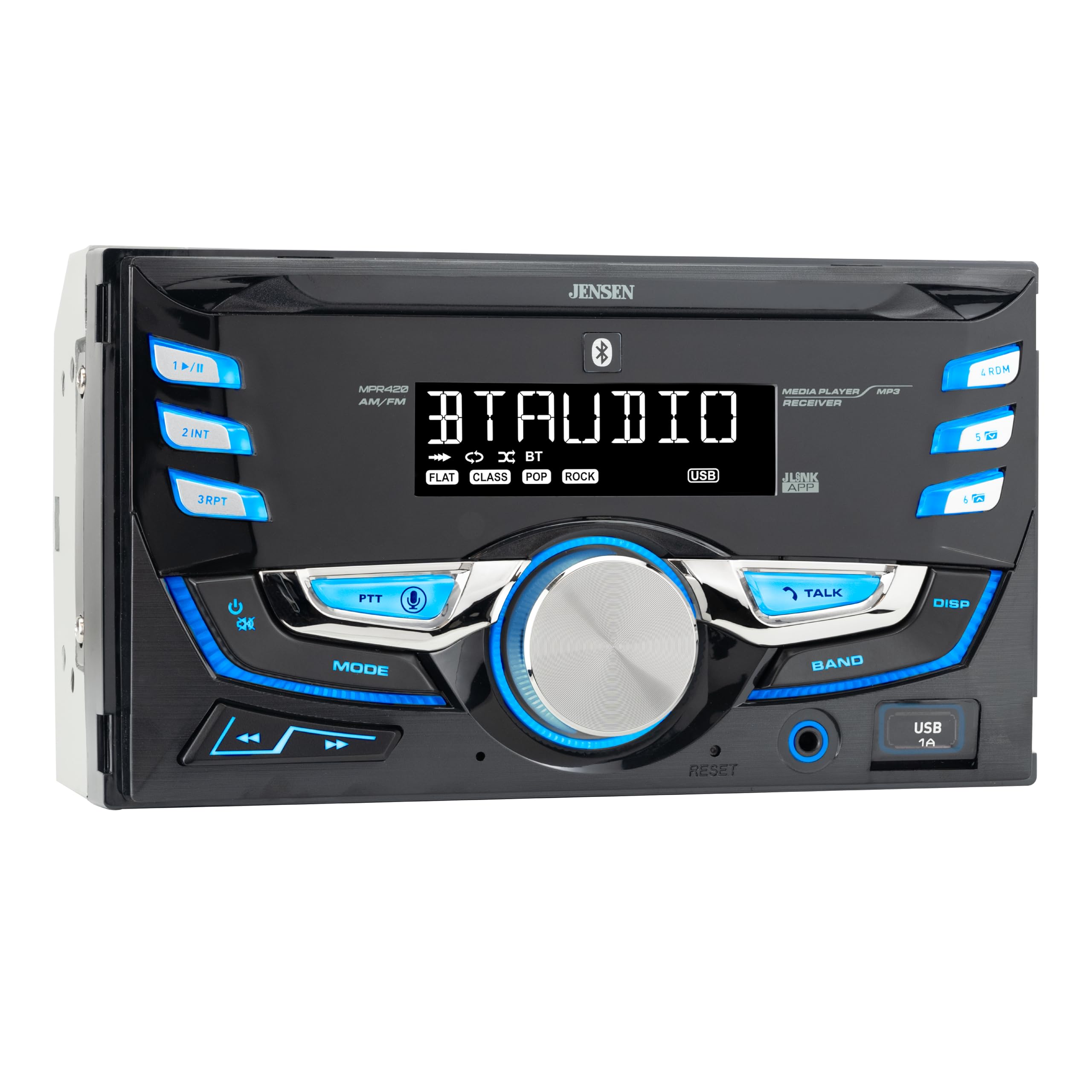
Jensen’s MPR420 is the most entry-level unit in this lineup but compensates with an industry-leading 3-year warranty (extended upon registration). The double-DIN design fills larger dash openings and features a high-contrast 7-character LCD display that prioritizes readability over flashy graphics. The button-driven interface is direct and responsive.
Bluetooth handles hands-free calling and music streaming, with a dedicated push-to-talk button that summons Siri or Google Assistant without voice wake words. AM/FM radio stores up to 30 presets across three bands, and the front USB port supports playback and charging simultaneously. There’s no CD slot, which keeps the chassis shallow and installation simple.
Sound quality is adequate for stock speakers, though the MPR420 lacks EQ bands or time alignment controls. This is a pure connectivity upgrade: it replaces a non-Bluetooth factory radio with hands-free calling and wireless streaming at the lowest entry cost. The warranty provides strong peace of mind for budget installations in older vehicles.
What works
- 3-year warranty beats category average
- Dedicated voice assistant button
- Easy double-DIN installation for large dash openings
- 30 AM/FM presets with high-contrast display
What doesn’t
- No equalizer or sound tuning controls
- 7-character LCD limits metadata display
- Lower amplifier headroom than competitors
Hardware & Specs Guide
Amplifier Power and Channels
Most aftermarket single-DIN receivers output 50 watts peak per channel across four channels — enough to push aftermarket coaxial speakers past factory limits. Higher preout voltage (2.5V to 4V) delivers a cleaner signal to external amplifiers, reducing noise floor. Look for MOSFET-powered amplifiers for heat dissipation and stable output under heavy load.
Equalizer Bands and Time Alignment
A 13-band graphic EQ gives granular control over frequency response from 25 Hz (sub-bass) to 12.5 kHz (treble shimmer). Digital time alignment compensates for the distance difference between left and right speakers relative to the driver’s head, preventing a lopsided stereo image. Units without time alignment place the perceived center near the nearest door speaker.
FAQ
Will a single-DIN stereo fit my car without a dash kit?
How do I improve Bluetooth call clarity during highway driving?
What does digital time alignment actually fix in a car stereo setup?
Final Thoughts: The Verdict
For most buyers, the aftermarket bluetooth radio winner is the Pioneer DEH-S4220BT because MIXTRAX and Advanced Sound Retriever bring compressed audio files to life while the 13-band EQ and hi-volt preouts give you room to grow. If you want seamless dual-phone management with voice control, grab the Sony DSX-A410BT. And for budget-minded buyers who refuse to sacrifice FLAC support, nothing beats the JVC KD-SX27BT.

Certification: BSc in Mechanical Engineering
Education: Mechanical engineer
Lives In: 539 W Commerce St, Dallas, TX 75208, USA
Md Amir is an auto mechanic student and writer with over half a decade of experience in the automotive field. He has worked with top automotive brands such as Lexus, Quantum, and also owns two automotive blogs autocarneed.com and taxiwiz.com.