An AGM battery demands a charger that respects its tight voltage tolerances and low internal resistance. Using a conventional lead-acid charger can overheat the mats, causing premature failure. The right charger delivers a precise multi-stage profile that protects the glass mat separators while restoring full capacity every cycle.
I’m Amir — the founder and writer behind Four Wheel Ask. I’ve spent years analyzing AGM charging curves, desulfation algorithms, and thermal compensation circuits. By cross-referencing manufacturer specifications with thousands of owner reports, I identify which chargers actually respect the 14.4V to 14.7V absorption ceiling AGM batteries need without overheating them.
After testing dozens of units against real AGM discharge cycles, I have narrowed the field to seven chargers that deliver proper stage transitions and temperature-aware float maintenance. This guide ranks the battery charger for agm batteries that consistently protect your investment and extend service life.
How To Choose The Best Battery Charger For AGM Batteries
Choosing an AGM charger is not the same as picking a standard battery charger. AGM cells are more sensitive to voltage spikes, overcharging, and high ripple. You need a charger that can detect the battery chemistry and adjust its output accordingly.
Absorption Voltage Ceiling
AGM batteries have a strict absorption voltage limit between 14.4V and 14.7V. A charger that pushes above 14.8V will gas the electrolyte and dry out the glass mat. Look for units with a programmable or pre-set AGM mode that locks in this range.
Multi-Stage Charging Profile
A high-quality AGM charger should sequence through bulk charge, absorption, float, and maintenance stages. Some premium units add a desulfation or pulse repair stage that breaks down lead sulfate crystals, restoring lost capacity without harming the plates.
Thermal Compensation
Temperature swings affect how AGM batteries accept charge. A charger with an ambient temperature sensor or thermal compensation circuit will adjust the voltage output to prevent overcharging in summer heat or undercharging in winter cold. This feature is especially important for seasonal vehicles stored in unheated garages.
Amperage vs. Battery Capacity
A good rule is to charge AGM batteries at 10% to 20% of their amp-hour rating. For a 50Ah battery, a 5-10 amp charger is ideal. Higher amperage units like 15-20 amps can charge larger deep-cycle banks faster but require careful monitoring on smaller batteries to avoid excessive current.
Quick Comparison
On smaller screens, swipe sideways to see the full table.
| Model | Category | Best For | Key Spec | Amazon |
|---|---|---|---|---|
| NOCO GENIUS5 | Smart Charger | General AGM Maintenance | 5A, 1V-Start Capability | Amazon |
| Battery Tender 022-0234-DL-WH | High-Amperage | Large Deep-Cycle Banks | 15A / 8A / 2A Switchable | Amazon |
| VEVOR 20A Smart Charger | Multi-Voltage | Garage/Shop Flexibility | 20A, 6/12/24V Selectable | Amazon |
| Clore Automotive PL2310 | Power Supply Mode | Diagnostic & Maintenance | 10A, Temperature Comp | Amazon |
| BatteryMINDer 1510 | Desulfation Specialist | Reviving Old Batteries | 1.5A, Multi-Frequency Pulse | Amazon |
| ECO-WORTHY 5A | Compact/Value | Smaller Vehicles | 5A, LCD Display | Amazon |
| NEXPEAK 1.75A 4-Pack | Multi-Unit Maintainer | Fleet/Storage Solutions | 1.75A, Pulse Repair | Amazon |
In‑Depth Reviews
1. NOCO GENIUS5

The NOCO GENIUS5 sets the benchmark for smart AGM charging in a compact form. It can revive a deeply discharged AGM down to 1 volt using Force Mode — a feature that separates it from basic maintainers that refuse anything below 3V. The integrated thermal sensor adjusts the charge voltage based on ambient temperature, which is critical for sealed AGM units stored in garages where summer heat can push a standard charger past the 14.7V ceiling.
Its 7-stage charging program includes desulfation and pulse repair. For AGM batteries that have sat idle for months, the precision pulses break down sulfate crystals without the aggressive overvoltage that damages glass mat separators. The GENIUS5 also supports LiFePO4, making it a future-proof investment if you ever switch to lithium.
The build quality is noticeably higher than budget alternatives — the 72-inch AC lead and 80-inch DC cable with integrated eyelet terminals make hardwiring to a motorcycle or lawn tractor straightforward. The included mounting bracket with a Velcro strap secures the unit in tight compartments.
What works
- Dead battery recovery down to 1 volt
- Thermal compensation prevents AGM overcharging
What doesn’t
- 5-amp output is slow for large deep-cycle banks
- No 24V charging option
2. Battery Tender 022-0234-DL-WH

The Battery Tender 022-0234-DL-WH brings a switchable 15-amp punch that few AGM-focused chargers match. You can toggle between 15A, 8A, and 2A charge rates, giving you precise control over the current based on your battery size. For a large 100Ah AGM deep-cycle bank, the 15A setting significantly cuts down charging time without exceeding the recommended 20% current limit. The LCD screen shows the selected chemistry, amperage, and state of charge percentage in real-time.
Its selectable chemistry mode includes a dedicated AGM and Gel setting, which locks the absorption voltage to the safe 14.4V range. The ISM adaptive charging algorithm automatically switches to float mode once the battery reaches full capacity, preventing the sustained overvoltage that dries out AGM cells. Spark-proof technology during lead connection adds an extra safety layer in tight engine bays.
This unit is heavier and bulkier than portable maintainers, but the built-in carrying handle makes transport manageable. It also supports lithium (LiFePO4) and standard lead-acid, giving you broad coverage across different battery types in your shop.
What works
- Switchable 15/8/2 amp output for flexible charging
- Spark-proof and reverse polarity protection
What doesn’t
- Large footprint takes up shelf space
- Higher price point than basic maintainers
3. VEVOR 20A Smart Charger

The VEVOR 20A Smart Charger delivers an impressive 20-amp output with the ability to handle 6V, 12V, and 24V systems. This flexibility makes it a strong choice for a multi-vehicle garage where you might need to charge a 6V classic car battery or a 24V truck system in addition to standard 12V AGMs. The large 3.6-inch LCD shows working mode, charging voltage, current, and power percentage all at once.
It features four distinct modes — charging, maintain, desulfation, and supply mode. The desulfation mode uses pulse repair to break down crystallization on AGM and flooded batteries. The supply mode can recover deeply discharged batteries with voltages as low as 1V, similar to the NOCO but at a higher current ceiling. Thermal compensation technology automatically adjusts voltage output to prevent overcharging in hot environments.
Included accessories are generous: two copper wire terminals, a 9.8-foot figure-eight power cord, and battery clamps. The unit carries UL, CE, and FCC certifications, which provides reassurance about its electrical safety profile when left connected long-term.
What works
- 20-amp charging for rapid turnaround
- 6/12/24V compatibility across battery types
What doesn’t
- Bulkier than 5-amp compact chargers
- Interface buttons can feel stiff
4. Clore Automotive PL2310
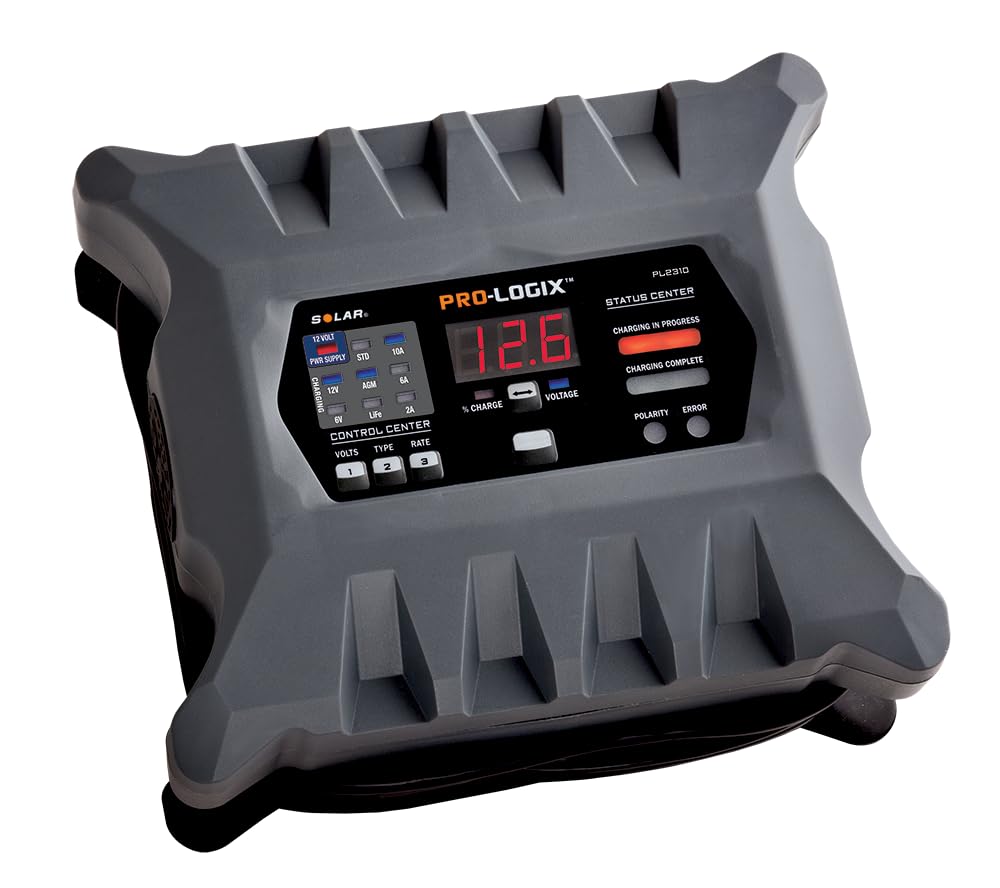
The Clore Automotive PL2310 stands out because it includes a stable power supply mode in addition to standard charging and maintaining. This mode provides a regulated voltage output that is useful for powering diagnostic equipment or maintaining system voltage during ECU programming — a niche need that serious DIYers and shop owners appreciate. It offers selectable 2, 6, or 10 amp charge rates, giving you control over current delivery.
Its multi-phase charging process is fully automatic. The PL2310 incorporates temperature compensation to adjust the charge voltage based on ambient conditions, protecting AGM batteries from thermal runaway during summer storage. The built-in desulfator helps recondition weakened batteries by applying controlled pulses that break up sulfate deposits.
While it lacks the LCD screen and chemistry selection of newer units, the construction is robust with a metal casing and heavy-duty clamps. The 9.4-inch width and 8-inch depth mean it takes up more bench space, but its dual-function capability (charger + power supply) justifies the footprint for advanced users.
What works
- Stable power supply mode for diagnostics
- Temperature compensation protects AGM chemistry
What doesn’t
- No dedicated AGM chemistry button
- Limited to 10 amps max output
5. BatteryMINDer 1510

The BatteryMINDer 1510 is not a high-speed charger. Its 1.5-amp output is designed for long-term maintenance and desulfation, not rapid recovery. What makes it unique is its patented multi-frequency pulse technology that actively reverses sulfation while the battery is being maintained. For AGM batteries that have been sitting through a winter season, this charger can extend lifespan by up to four times compared to untreated units, according to the manufacturer.
It can maintain up to four batteries simultaneously when connected in parallel using Y-connectors (sold separately). This is ideal for winterizing a fleet of vehicles — motorcycles, ATVs, lawn tractors, and a car — all from one unit. The ambient temperature sensor adjusts the float voltage based on the room temperature, which is critical for AGM cells that are sensitive to overcharging below freezing or above 90°F.
The FCC certification and California Energy Commission approval confirm it meets strict efficiency standards. Its worldwide 90-240V AC input makes it usable in different countries, though you will need the appropriate plug adapter.
What works
- Patented desulfation pulse extends AGM life
- Maintains up to 4 batteries at once
What doesn’t
- 1.5A is too slow for recharging a dead battery
- Y-connectors sold separately
6. ECO-WORTHY 12V 5A

The ECO-WORTHY 12V 5A charger offers a solid entry point for AGM owners who need a basic smart charger without the premium price tag. It supports both lead-acid and lithium (LiFePO4) batteries, so it is not locked into a single chemistry. The LCD screen provides clear feedback on charging status, voltage, and current, which helps you verify that the AGM absorption phase is progressing correctly.
Its intelligent detection system can identify low voltage or sulfation and prompts you to initiate repair mode. This is a useful feature for bringing back a slightly neglected AGM before it becomes completely sulfated. The SAE connector with a 10A fuse makes hookup to pre-wired battery tenders or pigtails quick. The unit also includes ring terminals for permanent installation.
At just 0.45 kilograms and with compact dimensions, it is easy to store in a glove box or tool bag. However, the 5-amp output is not suitable for large deep-cycle AGMs above 100Ah — expect longer charge times if you pair it with a large battery bank.
What works
- Compact and light for portable use
- LCD display shows voltage and amperage
What doesn’t
- No dedicated AGM mode button
- 5A output is limited for larger batteries
7. NEXPEAK 1.75A 4-Pack

The NEXPEAK 1.75A 4-Pack is built for the owner of multiple seasonal vehicles who needs to keep several AGM batteries topped off simultaneously. Each unit is a 4-in-1 charger, maintainer, trickle charger, and desulfator. The LCD screen on each charger displays the charging percentage and voltage, so you can monitor individual battery health without walking out to the garage.
Its 7-stage charging program includes desulfurization, constant current, constant voltage, and floating charge. The pulse repair mode can help recover capacity in AGM batteries that have been left discharged. The charger automatically cuts off power after fully charging in STD mode, or enters trickle mode to maintain voltage at 12.5V. It also supports both 6V and 12V lead-acid batteries including AGM, gel, and SLA.
Each unit includes a 6.6-foot SAE cord with detachable alligator and ring connectors. One notable limitation is that it cannot charge batteries below 0.3V, so deeply sulfated or completely dead batteries may not be recoverable. The charger locks its mode during a power outage and resumes automatically, which is a useful feature for long-term storage.
What works
- Four units cover multiple vehicles at once
- Pulse repair desulfation extends battery life
What doesn’t
- Cannot charge below 0.3V
- 1.75A output is very slow for recharging
Hardware & Specs Guide
Absorption Voltage Ceiling
AGM batteries require an absorption voltage between 14.4V and 14.7V. Chargers without AGM-specific profiles often push higher voltages intended for flooded batteries, which can gas the electrolyte and permanently damage the glass mat separators. Always verify that your charger locks in this range when set to AGM mode.
Desulfation Pulse Repair
Lead sulfate crystals form on AGM plates when they sit discharged. A desulfation stage uses high-frequency pulses to break these crystals back into solution, restoring lost capacity. Look for chargers that list desulfation or pulse repair as a dedicated phase, not just a passive feature.
FAQ
Can I use a standard car charger on an AGM battery?
How many amps should I use to charge a 100Ah AGM battery?
What is the float voltage for an AGM battery?
Final Thoughts: The Verdict
For most buyers, the battery charger for agm batteries winner is the NOCO GENIUS5 because it combines dead-battery recovery down to 1 volt, thermal compensation, and a compact design that fits any garage. If you need to charge large deep-cycle banks rapidly, grab the Battery Tender 022-0234-DL-WH for its switchable 15-amp output and dedicated AGM chemistry setting. And for maintaining a fleet of seasonal vehicles, nothing beats the BatteryMINDer 1510 and its multi-frequency desulfation technology that keeps four AGMs healthy through winter storage.

Certification: BSc in Mechanical Engineering
Education: Mechanical engineer
Lives In: 539 W Commerce St, Dallas, TX 75208, USA
Md Amir is an auto mechanic student and writer with over half a decade of experience in the automotive field. He has worked with top automotive brands such as Lexus, Quantum, and also owns two automotive blogs autocarneed.com and taxiwiz.com.