A diesel engine’s cooling system operates under far higher thermal loads than a gas burner — the cylinder pressures are extreme, the EGR and SCR systems dump heat back into the coolant loop, and the water pump seal has to survive years of cavitation and abrasive particles. Choosing the wrong medium means cavitation damage to cylinder liners, silicate dropout that clogs heater cores, or a pH crash that eats aluminum radiators from the inside out. The coolant you pour into the reservoir directly determines whether the engine sees 500,000 miles or a premature head gasket failure.
I’m Amir — the founder and writer behind Four Wheel Ask. I’ve spent years poring over heavy-duty coolant specifications, comparing ASTM D3306, D6210, and TMC RP 329 test data across dozens of brands to understand what actually protects a diesel block when the EGTs climb and the stop-and-go traffic hits.
This guide breaks down the five best formulations for modern common-rail, HEUI, and mechanical injection diesels — whether you’re running a 7.3L Power Stroke, a 6.7L Cummins, or a fleet of Freightliners — by analyzing freeze protection, cavitation erosion resistance, and prolonged service life. With this information, you can confidently choose the best diesel engine coolant for your vehicle.
How To Choose The Best Diesel Engine Coolant
A diesel coolant isn’t just colored water with antifreeze. The additive package — the nitrites, molybdates, silicates, or organic acids — determines whether your cooling system survives high-temperature operation, constant vibration, and the electrolysis that kills heater cores. Here’s what matters most when selecting a formulation for a diesel platform.
Coolant Chemistry: OAT vs. HOAT vs. IAT
Organic Acid Technology (OAT) formulations use carboxylate salts that bond to metal surfaces only where corrosion begins, offering extended service intervals — typically 150,000 miles or 5 years. Hybrid Organic Acid Technology (HOAT) adds a small amount of silicate for immediate protection of aluminum and solder joints, which makes them popular in European and some North American heavy-duty diesels. Inorganic Additive Technology (IAT) is the old-school green stuff that relies on silicates and phosphates; it protects well but requires changing every 30,000 miles. Modern common-rail diesels with EGR coolers and aluminum radiators generally perform best with a full OAT or HOAT — IAT can drop out silicates at high temperature, clogging the cooler passages.
Freeze Point and Boil-Over Protection
A 50/50 mix of concentrate and distilled water typically protects down to -34°F and raises the boiling point to 265°F under a 15-psi cap. If you operate in extreme cold (-40°F or lower), a 60/40 mix (60% coolant) pushes the freeze point to -62°F but reduces heat transfer slightly. Concentrate gives you the flexibility to dial the ratio, while pre-diluted 50/50 bottles are ready to pour directly into the reservoir — no guesswork, no mineral contamination. For diesel engines that see sustained high-load towing or EGTs above 1,200°F, a higher boiling point margin reduces the risk of cavitation at the water pump impeller.
Cavitation and Liner Protection
Wet-sleeve diesel engines — like the 6.5L Detroit Diesel, the 5.9L 12-valve Cummins, and the 7.3L IDI — are prone to cylinder liner pitting from cavitation bubbles that collapse against the sleeve. A coolant with a robust nitrate and molybdate additive package suppresses this bubble formation. Look for formulations labeled “heavy-duty” or “HD” that specifically reference TMC RP 329 or ASTM D6210, the standards for cavitation-corrosion protection in diesel engines. Passenger-car coolants usually lack this protection entirely.
Compatibility with Existing Coolant
Mixing a green IAT with an orange OAT can cause gelation — a thick, sludge-like substance that plugs radiator tubes and heater cores. If the system has residual coolant of unknown chemistry, flush thoroughly with distilled water before switching types. Many modern HD coolants (like the PEAK Final Charge series) are formulated to be compatible with other extended-life coolants up to 25% dilution, but 100% replacement of the charge is always the safer route. The Ford and ACDelco factory coolants are designed to be top-off only with their own chemistry — mixing them with generic store-brand coolant is not advised.
Quick Comparison
On smaller screens, swipe sideways to see the full table.
| Model | Category | Best For | Key Spec | Amazon |
|---|---|---|---|---|
| PEAK Final Charge | HD OAT | Heavy-duty over-the-road fleets | 1M mile / 15,000 hour service life | Amazon |
| Ford VC-7DIL-B | HOAT | Ford/Lincoln/Mercury diesels | WSS-M97B51-A1 spec | Amazon |
| ACDelco 10-101 | DEX-COOL OAT | GM Duramax and LS diesels | GM 6277M spec / 150k miles | Amazon |
| PEAK OET Orange | OAT | NA vehicles requiring orange OAT | 150k miles / 5 year protection | Amazon |
| Valvoline Multi-Vehicle | HOAT | Light-duty diesel truck top-offs | Alugard Plus / -34°F freeze pt | Amazon |
In‑Depth Reviews
1. PEAK Final Charge Concentrate Antifreeze/Coolant

The PEAK Final Charge is formulated specifically for all heavy-duty diesel, gasoline, and natural gas engines — covering everything from a Cummins ISX to a Caterpillar C15 to a 7.3L Power Stroke. It uses a Global Extended Life OAT chemistry that meets or exceeds TMC RP 329, ASTM D6210, and ASTM D3306, and it projects a service life of one million miles or 15,000 hours of on-road operation when properly maintained. That’s not a marketing gimmick — the carboxylate additive package stays suspended in solution without silicate dropout, so the heat exchangers stay clear and the water pump seal sees less abrasive wear.
This is a concentrate, so you need to mix it with distilled water at the correct ratio (typically 50/50 for -34°F protection). The upside is that you can custom-tune the freeze point for extreme climates, and you’re not paying for the water weight in shipping. The formulation is non-abrasive and includes Denatonium Benzoate as a bittering agent to discourage accidental ingestion — a standard safety feature. The heat transfer performance is excellent for high-temperature EGR and SCR systems that push coolant temperatures well above 220°F under sustained load.
Where the Final Charge really separates itself is compatibility: PEAK states it can be mixed with other extended-life coolants as long as the contamination level stays below 25% and the corrosion protection remains intact. That makes it a smart choice for fleet operations that have a mix of equipment and can’t always perform a 100% flush. For a single-owner diesel truck that you plan to keep for half a million miles, this is the coolant to trust for the long haul.
What works
- One-million-mile service life for heavy-duty diesel engines
- Excellent heat transfer for EGR and SCR system cooling
- Non-abrasive formula extends water pump seal life
- Compatible with other OAT coolants up to 25% contamination
What doesn’t
- Concentrate form requires measuring and distilled water mixing
- Not pre-diluted — not ready to pour straight from jug
2. Ford Genuine VC-7DIL-B Gold Pre-Diluted Antifreeze/Coolant

This is the factory-fill coolant for Ford, Lincoln, and Mercury vehicles — the exact gold-colored HOAT formula that meets Ford specification WSS-M97B51-A1. It covers an enormous range of Ford diesel platforms: the 7.3L Power Stroke in the F-250 through F-550 Super Duty, the 6.0L, 6.4L, and 6.7L Power Stroke variants, plus the 6.7L Cummins in the Ford-sourced medium-duty chassis. The pre-diluted 50/50 mix means you open the jug and pour it directly into the degas bottle — no measuring, no risk of using hard tap water that introduces chlorides and scale.
The chemistry is a hybrid OAT with a small amount of silicate for immediate solder and aluminum protection, which is particularly important for the aluminum radiators and heater cores found in early-2000s Super Duties. The yellow color lets you visually distinguish it from the green IAT or the pink OAT formulations. It also meets Chrysler MS-9769, Cummins 14603, and ASTM D6210, so it can be used in Dodge RAM trucks with Cummins engines and in some heavy-duty off-road applications — though it’s primarily engineered for Ford’s cooling system metallurgy.
If your truck is still under the original Ford cooling system, or you want to maintain factory compatibility for resale value, sticking with the genuine VC-7DIL-B is the safest bet. The downside is that this coolant is not meant to be mixed with generic OAT or IAT coolants — Ford specifies that the system must be flushed before switching to this formula. It also carries a premium price per gallon compared to aftermarket alternatives.
What works
- Genuine Ford factory-fill chemistry for exact OEM compatibility
- Pre-diluted 50/50 — ready to pour with no mixing required
- Meets WSS-M97B51-A1, Cummins 14603, and ASTM D6210
What doesn’t
- Not intended for mixing with non-Ford or OAT coolants
- Premium cost compared to universal aftermarket options
3. PEAK OET Orange Extended Life Antifreeze/Coolant

The PEAK OET (Orange Extended Technology) is a full OAT formulation designed for North American vehicles that call for an orange coolant — specifically Ford, Chrysler, and GM models that use an Organic Acid Technology formula. It delivers 150,000 miles or five years of protection when installed as part of a complete flush and fill, and it is fully compatible with other extended-life orange coolants, so you can safely top off a system that already contains DEX-COOL or another OAT product without fear of gelation. It’s a concentrated formula, which gives you the flexibility to mix your own ratio while saving on shipping weight compared to pre-diluted jugs.
The phosphates and silicates are absent in this formula, which means there is no risk of silicate dropout that can clog heater cores and radiator tubes under the high sustained temperatures of a diesel engine. The additive package is built around sebacate and benzoate corrosion inhibitors that protect aluminum radiator fins, the water pump housing, and the cylinder head passages. For a light-duty diesel pickup like a RAM 2500 with the 6.7L Cummins or a Chevrolet Silverado with the Duramax, this is a solid drop-in replacement for the factory OAT coolant at a more accessible price point.
One limitation: PEAK does not certify this coolant for TMC RP 329 or ASTM D6210, which means it was not designed for the extreme cavitation protection needed by wet-sleeve semi-truck engines. If your application is a Class 8 over-the-road truck, step up to the Final Charge line. For a daily-driven diesel pickup or a medium-duty box truck, the OET Orange provides excellent corrosion protection with a generous service interval.
What works
- 150,000-mile protection for North American OAT applications
- Compatible with other orange OAT coolants — safe to top off
- No silicate dropout issues under high diesel heat loads
What doesn’t
- Not certified for TMC RP 329 heavy-duty cavitation protection
- Concentrate must be measured and mixed with distilled water
4. ACDelco 10-101 DEX-COOL Extended Life Coolant

ACDelco’s 10-101 is the genuine DEX-COOL formula used as factory fill in virtually every GM diesel and gasoline engine since the mid-1990s — including the Duramax 6.6L LB7, LLY, LBZ, LMM, and L5P, plus the 6.2L and 6.5L indirect-injection diesels. The orange OAT chemistry uses a patented carboxylate inhibitor package that bonds directly to metal surfaces, providing long-term protection against corrosion, pitting, and scale formation. It meets GM spec 6277M and is the only coolant GM endorses for their diesel platforms.
DEX-COOL has a reputation for extending service intervals up to 150,000 miles or five years — substantially longer than the 30,000-mile interval of conventional green coolant. The OAT chemistry also eliminates silicate dropout, which was a known problem with IAT coolants in high-heat diesel applications, where silicates would precipitate and clog the heater core. ACDelco also includes Denatonium Benzoate as a bittering agent to reduce the risk of accidental ingestion. This is a concentrate, so it requires mixing with distilled water at a 50/50 ratio.
The main consideration with DEX-COOL is that it is not intended to be mixed with green IAT or yellow HOAT coolants — doing so can cause gelation and system damage. If your GM diesel has been partially topped off with universal coolant, a full system flush is recommended before switching to this product. For owners of Duramax-powered trucks or GM medium-duty diesels who want to maintain the original factory chemistry, the ACDelco 10-101 is the correct, no-compromise choice.
What works
- Genuine DEX-COOL formula for GM Duramax and LS diesel engines
- 150,000-mile service interval — less frequent changes
- Excellent aluminum and solder protection in high-heat loops
What doesn’t
- Not compatible with green IAT or yellow HOAT coolants
- Concentrate requires measuring and distilled water mixing
5. Valvoline Multi-Vehicle Concentrate Antifreeze Coolant
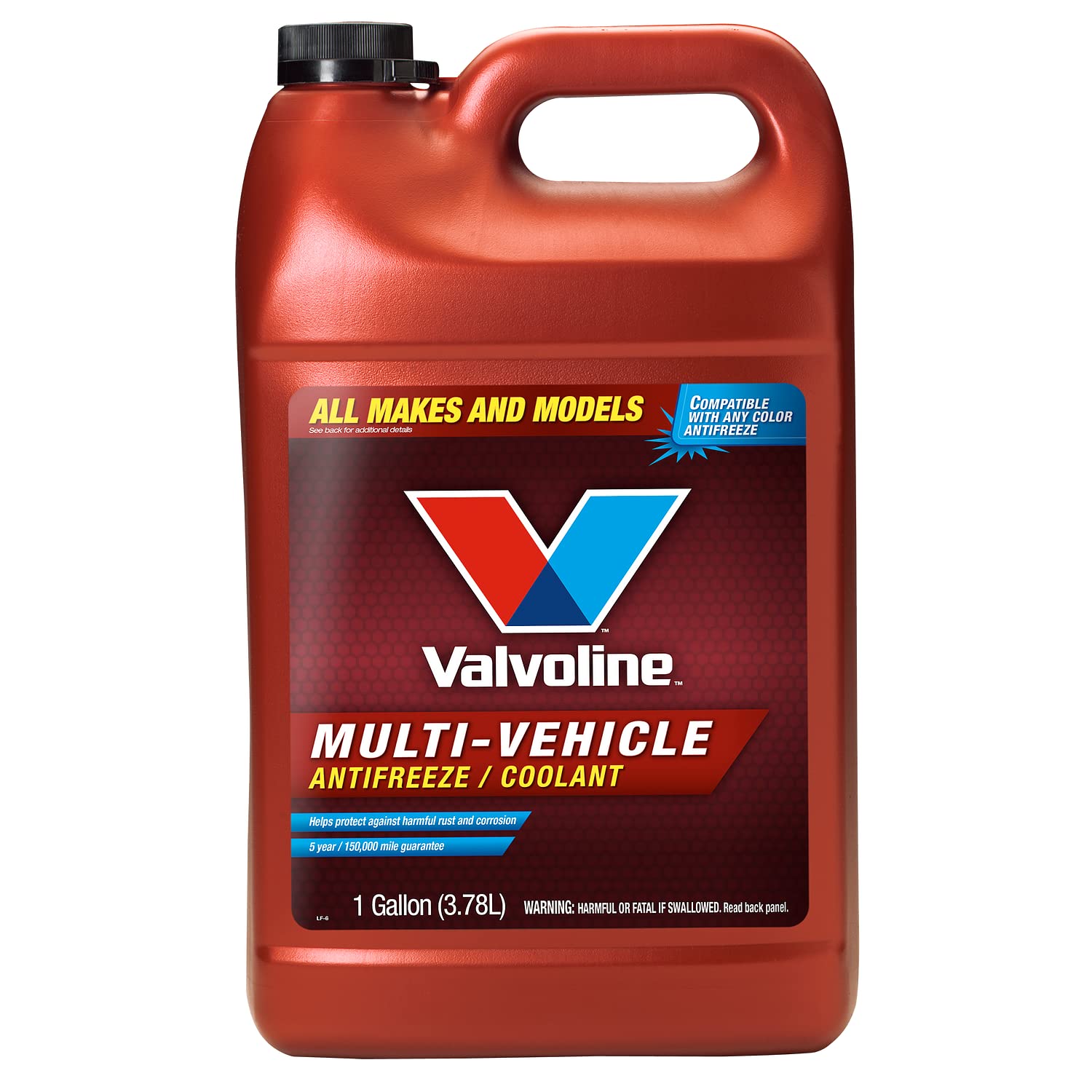
Valvoline’s Multi-Vehicle concentrate is a HOAT formulation that includes Alugard Plus — a proprietary additive package designed to protect aluminum cooling system components from corrosion and pitting. It is marketed for automobiles and light-duty trucks rather than heavy-duty diesel fleets, making it a good budget-friendly option for daily-driver diesel pickups like a 6.7L Power Stroke or a Duramax 6.6L that primarily sees highway cruising and light towing. The yellow concentrate can be mixed to different ratios — 50/50 for -34°F to 265°F protection, 60/40 for -62°F extreme cold, or 70/30 for -84°F arctic conditions.
The formula fights rust, scaling, and corrosion across all cooling system metals, including aluminum, copper, brass, solder, steel, and cast iron — which covers the mixed-metal construction of most modern diesel engines. The additive package also includes a bittering agent and is designed to not harm gaskets, hoses, or plastic radiator tanks, so there is little risk of swelling or embrittlement of the cooling system rubber. Valvoline claims it is compatible with all colors (green, orange, yellow, pink, blue) for top-off purposes, which adds a layer of convenience if you are maintaining a mixed fleet of gas and diesel vehicles.
The trade-off is that Valvoline does not specifically certify this coolant for TMC RP 329 or ASTM D6210 heavy-duty standards, and it is not marketed for wet-sleeve cavitation protection. For a light-duty diesel truck that isn’t pulling heavy loads every day, this is an affordable option that delivers solid all-around protection. For a commercial fleet or a heavy-duty tractor engine, the nitrite and molybdate levels in a HD OAT like the PEAK Final Charge would be more appropriate.
What works
- Alugard Plus provides strong aluminum corrosion protection
- Compatible with all coolant colors for top-off convenience
- Flexible mixing ratio for extreme cold climate tuning
What doesn’t
- Not certified for heavy-duty cavitation (TMC RP 329)
- Best suited for light-duty trucks, not Class 8 over-the-road
Hardware & Specs Guide
Freeze / Boil Protection Ratio
A 50/50 concentrate-to-distilled-water mix is the industry standard, providing freeze protection down to -34°F and a boiling point of 265°F under a 15-psi radiator cap. For severe cold climates (northern Canada, Alaska, Siberia), a 60/40 or 70/30 mixture extends freeze protection to -62°F and -84°F respectively, though the higher coolant ratio slightly reduces specific heat capacity — meaning the coolant absorbs less heat per volume. Diesel engines with EGR coolers and turbocharger cooling circuits tend to run hotter than gas engines, so maintaining at least 50% coolant concentration is critical to prevent localized boiling in the cylinder head.
Reserve Alkalinity and pH Buffering
Reserve alkalinity measures the coolant’s ability to neutralize acidic combustion byproducts that blow past the head gasket and dissolve into the coolant. Diesel engines produce more sulfur and nitrogen oxides than gas engines, which form sulfuric and nitric acids in the coolant. A good HD OAT coolant should have a reserve alkalinity of at least 5.0 (mL of 0.1N HCl) and maintain a pH between 8.5 and 10.5 throughout the service interval. The ACDelco DEX-COOL and PEAK Final Charge both test above this threshold. When the pH drops below 7.0, the coolant becomes acidic and begins etching aluminum and copper components — the first sign is tell-tale deposits on the radiator cap and a sweet syrup smell in the degas bottle.
Nitrite and Molybdate Cavitation Inhibitors
For wet-sleeve diesel engines (5.9L Cummins, 6.5L Detroit, 7.3L IDI, 6.0L Power Stroke), the coolant must contain nitrite and molybdate additives at specific concentrations. Nitrite levels should be maintained between 800 and 2,400 ppm, and molybdate between 400 and 1,200 ppm, to prevent the implosion of vapor bubbles against the cylinder liner surface — a phenomenon that can erode through the liner wall in 50,000 miles if untreated. The PEAK Final Charge is the only coolant in this guide that carries the TMC RP 329 certification, which validates that it meets these nitrite/molybdate targets for heavy-duty wet-sleeve engines. The Valvoline and PEAK OET formulations do not guarantee these levels.
Concentrate vs. Pre-Diluted Volume
A one-gallon jug of concentrate yields two gallons of ready-to-use coolant when mixed with an equal volume of distilled water. This makes concentrate more economical per unit of finished coolant, especially when flushing a system that holds 4–6 gallons. Pre-diluted 50/50 products (like the Ford VC-7DIL-B) are ready to pour straight from the jug, eliminating the risk of using mineral-laden tap water, but you pay for the water weight — a one-gallon jug yields only one gallon of ready-to-use coolant. For a full system flush, you’ll need two gallons of pre-diluted versus one gallon of concentrate to achieve two gallons of coolant.
FAQ
Can I mix diesel engine coolant with regular green coolant?
How often should diesel engine coolant be changed?
What does the orange color of diesel coolant mean?
Is pre-diluted or concentrate coolant better for a diesel engine?
Why does my diesel engine coolant smell sweet after a head gasket failure?
Final Thoughts: The Verdict
For most buyers — whether you’re maintaining a fleet of Freightliners or a single Cummins-powered pickup — the best diesel engine coolant winner is the PEAK Final Charge because it delivers certified one-million-mile cavitation protection, works across all heavy-duty engine types, and is compatible with other OAT coolants for hassle-free top-offs. If you want absolute OEM spec matching for a Ford Super Duty or a Lincoln SUV, grab the Ford VC-7DIL-B — it’s the only coolant that meets WSS-M97B51-A1 and comes pre-diluted, ready to pour. And for a budget-friendly daily-driver diesel truck that doesn’t need wet-sleeve cavitation protection, nothing beats the Valvoline Multi-Vehicle — it provides solid aluminum protection with Alugard Plus at a fraction of the cost of OEM formulas.

Certification: BSc in Mechanical Engineering
Education: Mechanical engineer
Lives In: 539 W Commerce St, Dallas, TX 75208, USA
Md Amir is an auto mechanic student and writer with over half a decade of experience in the automotive field. He has worked with top automotive brands such as Lexus, Quantum, and also owns two automotive blogs autocarneed.com and taxiwiz.com.