Staring at a half-empty battery before your morning commute is the single most frustrating part of owning an electric vehicle. A wall outlet trickles power so slowly that even a full overnight session leaves you scrambling. Level 2 charging changes everything—turning your garage into a true refueling station that delivers usable range every hour you sleep. But between amperage ratings, connector types, smart features, and hardwired versus plug-in configurations, the wrong choice can leave you locked into a charger that doesn’t fit your car, your panel capacity, or your long-term needs.
I’m Amir — the founder and writer behind Four Wheel Ask. Over the last 15 years I’ve analyzed thousands of automotive products, cross-referencing technical specifications against real-world owner reports to separate marketing claims from actual performance metrics in the EV charging space.
The goal here is straightforward: cut through the confusion and deliver a refined, data-backed guide to the best residential ev charger for your specific garage setup, driving habits, and budget tier.
How To Choose The Best Residential EV Charger
Selecting the right home EV charging station requires matching your vehicle’s onboard charger capacity, your home’s electrical panel capabilities, and your daily mileage needs. A mismatch in any of these three areas leaves you paying for speed you cannot use or stuck with charging that is slower than necessary.
Amperage: The engine of your charge speed
The amperage rating (32A, 40A, or 48A) determines how much current the charger can push to the vehicle. A 48A charger on a 60A circuit delivers 11.5 kW, which adds roughly 45 miles of range per hour. Dropping to 32A cuts that to about 7.6 kW and roughly 30 miles per hour. The catch is that your car’s onboard charger must be able to accept the full amperage—plugging a 48A charger into a vehicle that maxes out at 32A wastes the potential. Always check your EV’s peak AC charge rate before buying.
Connector type: J1772 vs NACS
The J1772 connector is the standard for all non-Tesla EVs sold in North America. Tesla vehicles use the NACS port natively, though they include a J1772 adapter. A growing number of stations now ship with a NACS connector plus a J1772 adapter, or offer a dual-port design like the Tesla Universal Wall Connector. If you own a single Tesla, a native NACS charger simplifies your life. If you have multiple EVs of different brands, a unit that supports both standards natively or via adapter saves you from juggling cables.
Hardwired vs plug-in installation
Hardwiring removes the NEMA 14-50 outlet from the circuit, eliminating a potential point of failure and allowing the charger to draw 48A continuously without the NEC-mandated 80% derating that applies to receptacles. Plug-in units top out at 40A on a 50A circuit. Hardwired installation requires hiring a licensed electrician, but it unlocks the fastest possible charge rate and provides a cleaner, more weather-resistant install for outdoor mounting.
Smart features and app control
WiFi-enabled chargers allow scheduled charging during off-peak hours, which reduces electricity costs if your utility has time-of-use rates. Real-time energy tracking helps you monitor consumption, and OTA firmware updates keep the unit current. RFID card security prevents unauthorized use, which matters for shared or outdoor installations. The most useful app features are scheduling and cost-per-kWH tracking—voice control and guest access are secondary conveniences rather than deal-breakers.
Quick Comparison
On smaller screens, swipe sideways to see the full table.
| Model | Category | Best For | Key Spec | Amazon |
|---|---|---|---|---|
| Emporia Level 2 EV Charger | Smart Hardwired | Energy monitoring & off-peak savings | 48A / 11.5 kW | Amazon |
| WOLFBOX Level 2 EV Charger | Smart Display Hardwired | Real-time LCD & RFID security | 48A / 11.5 kW | Amazon |
| Autel Level 2 40A EV Charger | Plug-in Smart | Quick 5-min plug-in installation | 40A / 9.6 kW | Amazon |
| TELGEOOT Level 2 EV Charger | Plug-in Smart | Adjustable 1-48A current range | 48A / 11 kW | Amazon |
| Romaa Level 2 EV Charger | Smart Hardwired | Budget-friendly 48A with LCD | 48A / 11.5 kW | Amazon |
| EVIQO NACS Charger for Tesla | Smart Hardwired NACS | Native Tesla (NACS) hardwired install | 48A / 11.5 kW | Amazon |
| Grizzl-E Ultimate 48A | Premium Hardwired | Heavy-duty aluminum enclosure & OCPP | 48A / 11.5 kW | Amazon |
| ChargePoint HomeFlex | Premium Smart NACS | Network access & app ecosystem | 50A / 12 kW | Amazon |
| Autel MaxiCharger AC Elite 50A | Premium Smart Hardwired | Fast 50A charging & cold-weather cable | 50A / 12 kW | Amazon |
| Tesla Universal Wall Connector | Premium Dual-Connector | Native NACS + J1772 universal household | 48A / 11.5 kW | Amazon |
| Enphase HCS-40 | Commercial-Grade Hardwired | Max durability & 5-year warranty | 32A / 7.6 kW | Amazon |
In‑Depth Reviews
1. EMPORIA Level 2 EV Charger (48 Amp)
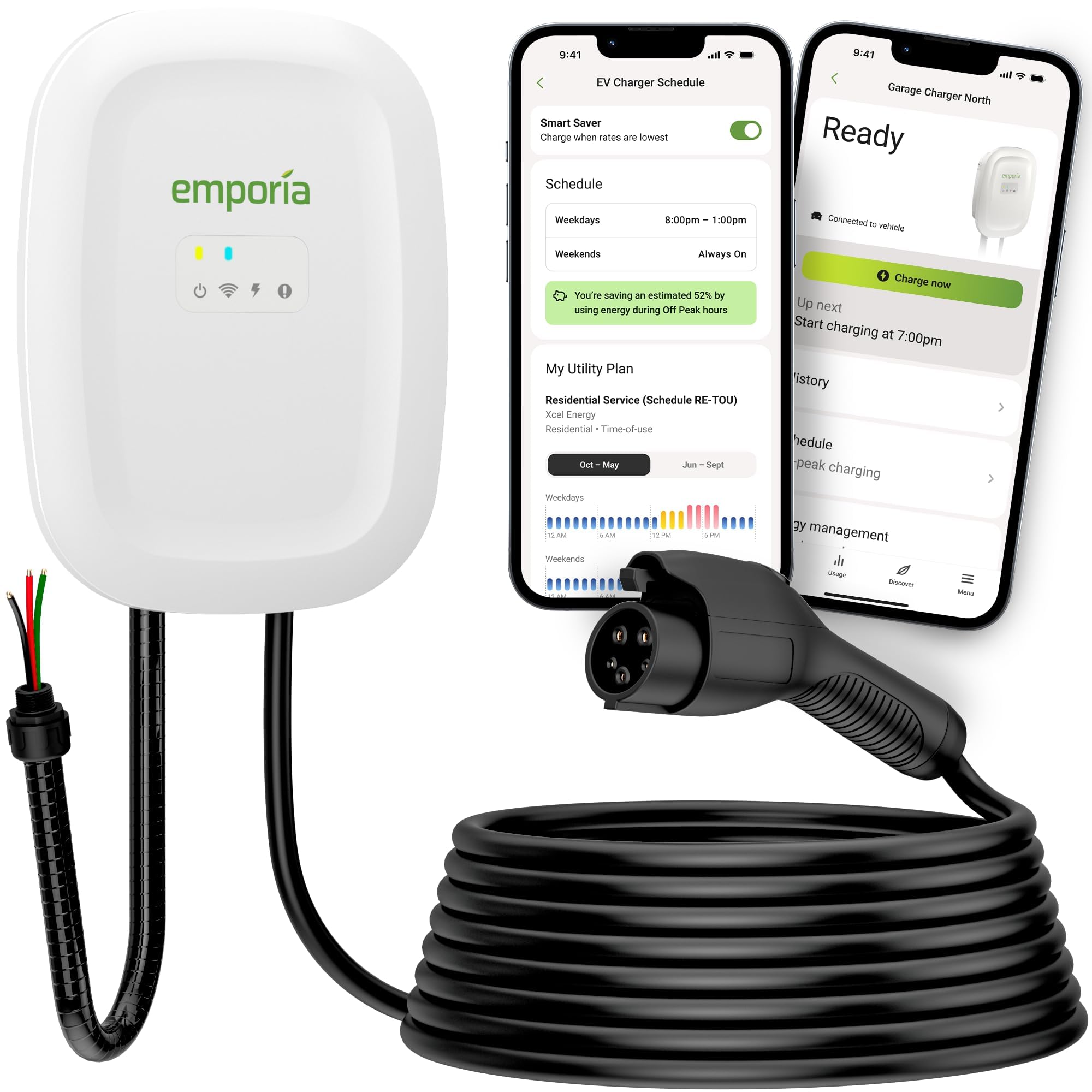
The Emporia Level 2 charger delivers 48A continuous output via hardwired connection, hitting 11.5 kW for a 46-mile-per-hour charge rate that comfortably recharges a typical 65 kWh EV from empty to full in about 5.5 hours. Its UL listing and ENERGY STAR certification cover multiple safety standards including UL 2594 and SAE J1772, giving you a certified path to local rebates and tax credits.
The companion app connects over 2.4 GHz WiFi and provides real-time energy tracking, scheduled charging to capture off-peak utility rates, and detailed consumption history. The included whip and hardwire kit simplify professional installation, and the 25-foot J1772 cable offers generous reach across a two-car garage. Tesla owners need an adapter, but the J1772 connector works natively with Chevrolet Bolt, Ford Mustang Mach-E, Hyundai Ioniq 5 and 6, Volkswagen ID.4, Nissan Leaf, and most other non-North American Charging Standard vehicles.
What pushes the Emporia to the top of the list is the balance of full 48A performance, robust certification, and a feature-rich app at a mid-range price point. The charger lacks a built-in display, but the app compensates with more detailed data than typical on-unit screens provide.
What works
- True 48A continuous output at 11.5 kW
- UL listed with multiple safety certifications
- Excellent energy monitoring and scheduling app
What doesn’t
- No built-in LCD display
- Requires Tesla adapter for NACS vehicles
2. WOLFBOX Level 2 EV Charger (48 Amp)

The WOLFBOX electric vehicle charger integrates a 4.3-inch LCD screen that displays charging rate, elapsed time, voltage, and total energy delivered—info you can read at a glance without launching an app. The unit is CSA certified and built to NEMA Type 4X standards, meaning it withstands rain, snow, and direct hose spray in outdoor installations without degradation.
WiFi connectivity enables app-based scheduling, current adjustment from 6A to 48A, and integration with Alexa and Google Assistant for voice control. The RFID card reader adds a layer of physical security that prevents unauthorized charging, a useful feature for driveway-mounted units accessible to neighbors or passersby. The 25-foot cable and included mounting bracket make installation straightforward for a licensed electrician.
The trade-off is that the smart app ecosystem is newer compared to established players like ChargePoint, and the RFID system adds a minor daily step of tapping the card before plugging in. For buyers who prefer on-unit data and voice control, this is a compelling mid-range option.
What works
- Built-in LCD shows real-time charge data
- RFID card prevents unauthorized use
- Alexa and Google Assistant compatible
What doesn’t
- App ecosystem still maturing
- RFID card required for each charge session
3. Autel Level 2 EV Charger (40 Amp)
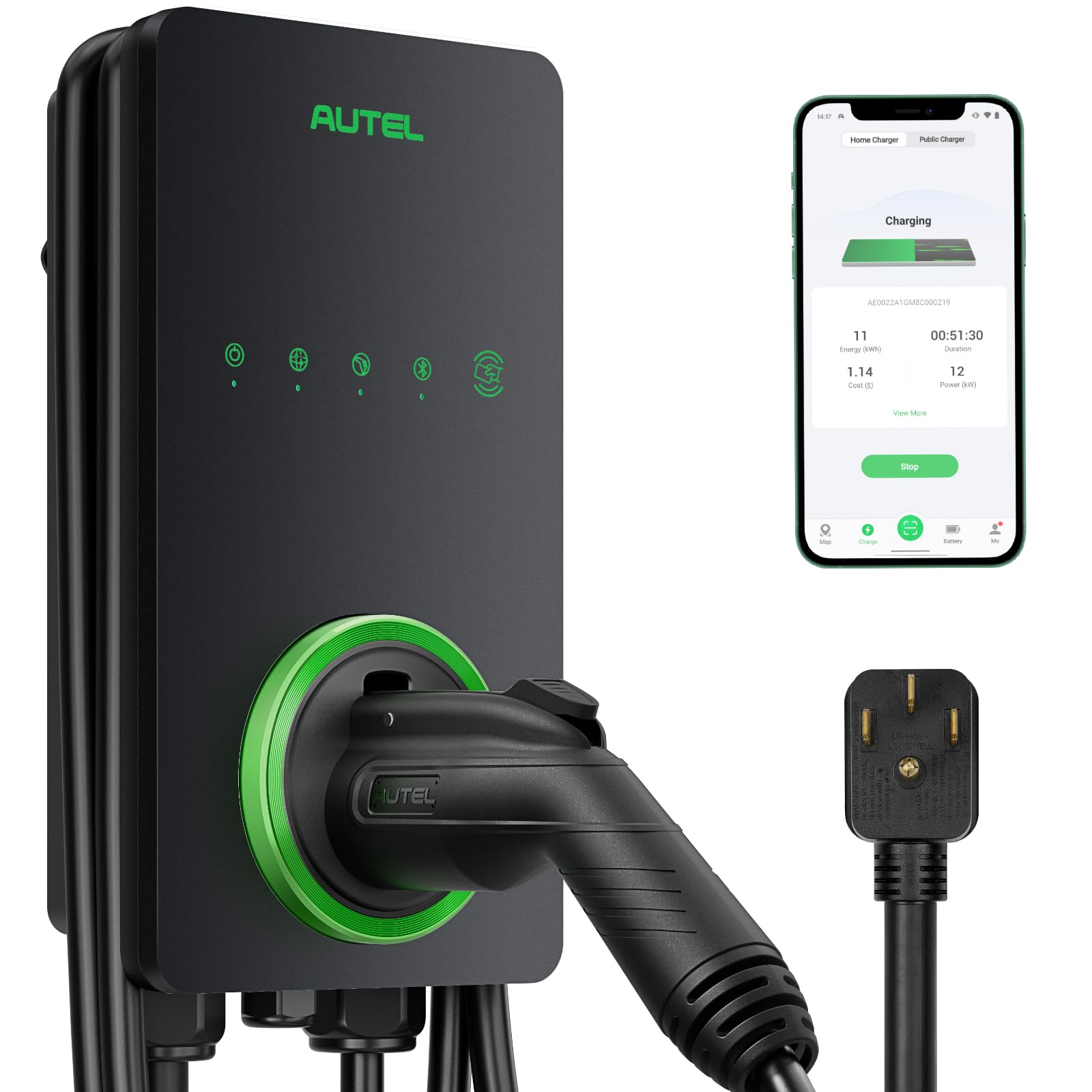
The Autel MaxiCharger AC Home runs at 40A and 9.6 kW via a NEMA 14-50 plug, making it a true 5-minute installation for anyone with an existing RV or dryer outlet. The NEMA 4X enclosure is dust-tight and water-tight, suitable for indoor or outdoor mounting. The adjustable current range from 16A to 40A lets you dial down the draw if your electrical panel is shared with other high-load appliances.
The Autel Charge app manages scheduled charging, tracks energy consumption, and includes RFID start/stop access for security. Autel has been in the automotive diagnostic space for two decades, and the build quality reflects that experience—the cable jacket remains flexible in cold weather, and the connector latch feels solid. The 3-year warranty with OTA firmware updates ensures the unit stays current.
The limitation is the 40A ceiling: if your vehicle supports 48A or 50A onboard charging, you are leaving speed on the table. For drivers with a 32A or 40A onboard charger—which covers most EVs including the Nissan Leaf, Chevy Bolt, and many plug-in hybrids—this is a near-perfect plug-in solution.
What works
- 5-minute plug-in installation via NEMA 14-50
- NEMA 4X weatherproof rating
- Adjustable 16A-40A current range
What doesn’t
- Maxes out at 40A (9.6 kW)
- No NACS option for Tesla without adapter
4. TELGEOOT Level 2 EV Charger (48 Amp)

The TELGEOOT charger uses a NEMA 14-50 plug and delivers a maximum of 48A, but the standout feature is the adjustable current range down to 1A. This granular control is rare among home chargers and lets you fine-tune the draw to match solar production, avoid tripping a shared breaker, or charge slowly from a smaller generator in an emergency. The IP65 enclosure and 25-foot cable support indoor and outdoor installation across a -22°F to 131°F temperature range.
Connectivity uses the Smart Life app, which provides scheduling, real-time monitoring, and cost-per-kWh tracking. The unit carries CE and FCC certifications and includes over-voltage, overload, short-circuit, ground, and earth leakage protection. The operating life rating of 10,000 connect-disconnect cycles suggests durable internal contacts.
The downside is that the NEMA 14-50 plug limits continuous draw to 40A per NEC code, so this is effectively a 40A charger in practice unless you swap the plug for a hardwired configuration on your own. The Smart Life app is functional but less polished than Autel’s or Emporia’s offerings.
What works
- Adjustable current from 1A to 48A
- IP65 weatherproof for indoor/outdoor use
- Wide operating temperature range
What doesn’t
- NEMA 14-50 limits continuous draw to 40A
- Smart Life app is less refined
5. Romaa Level 2 EV Charger (48 Amp)
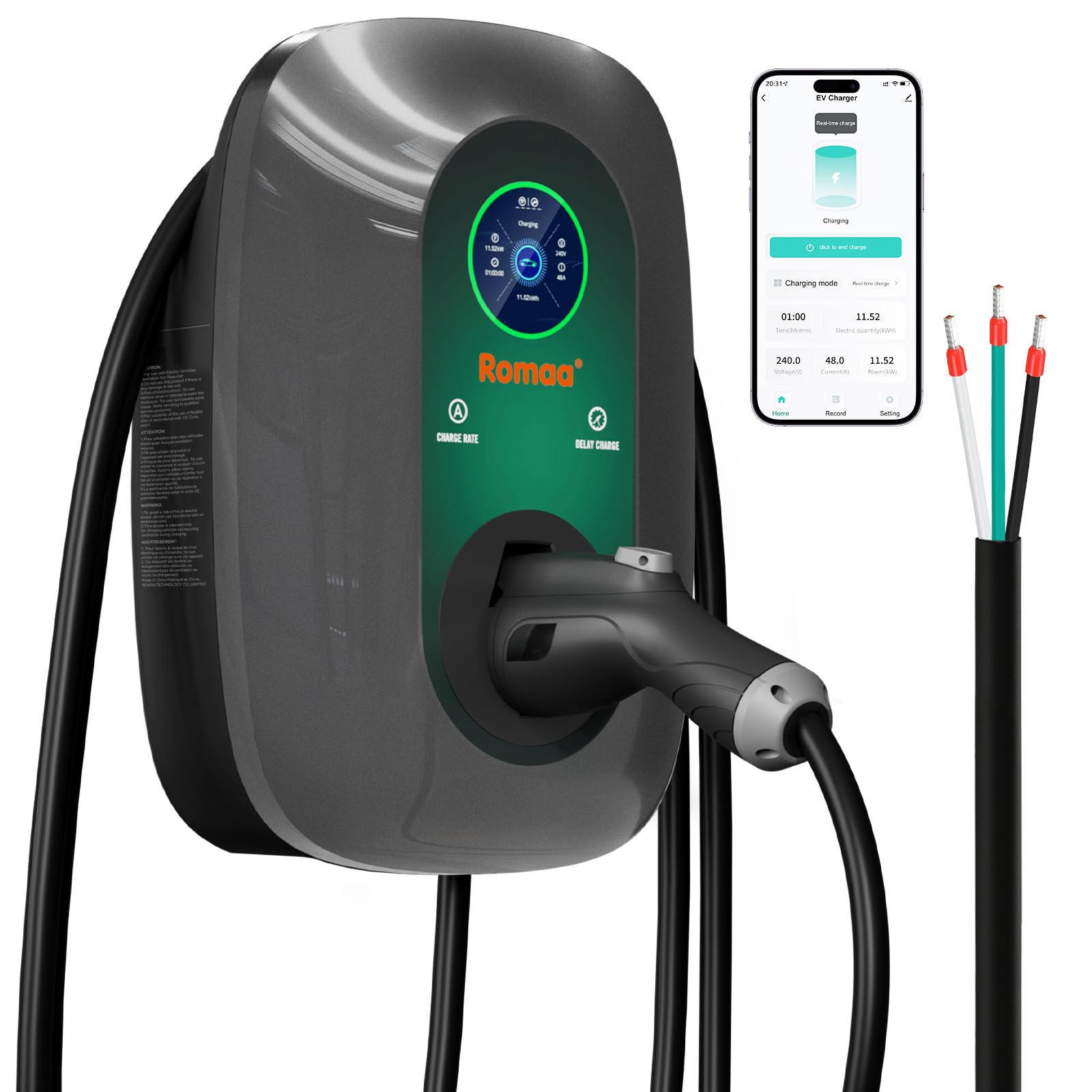
The Romaa Level 2 charger hits 48A hardwired output at 11.5 kW, controlled through a 4.3-inch color LCD screen that displays charging status, schedule, and energy delivered. ETL listing confirms compliance with UL standards including UL 2594 and UL 2231, and FCC Part 15 certification verifies wireless reliability. The NEMA Type 4 IP66 enclosure seals against dust and powerful water jets, making it suitable for exposed outdoor mounting in rainy or snowy climates.
The WiFi app monitors charging in real time, sends notifications, and logs energy usage history. For a 65 kWh battery pack, the 11.5 kW rate cuts the 10-to-80-percent recharge window to roughly 4 hours. The J1772 connector works natively with Chevrolet Bolt, Ford Mustang Mach-E, Hyundai Ioniq 5 and 6, Volkswagen ID.4, and similar EVs—Tesla needs a separately purchased adapter.
The construction uses a polycarbonate housing rather than metal, which keeps weight lower but reduces impact resistance compared to aluminum-enclosure competitors. The app is functional but lacks the polish and frequent updates seen from Emporia or Autel. At the entry-level price point for a full 48A unit, this is the most affordable way to unlock 11.5 kW charging.
What works
- 48A hardwired at a budget-friendly price
- IP66 / NEMA Type 4 weather protection
- 4.3-inch color LCD screen
What doesn’t
- Polycarbonate housing less durable than metal
- App lacks advanced features of premium competitors
6. EVIQO NACS Charger for Tesla (48 Amp)
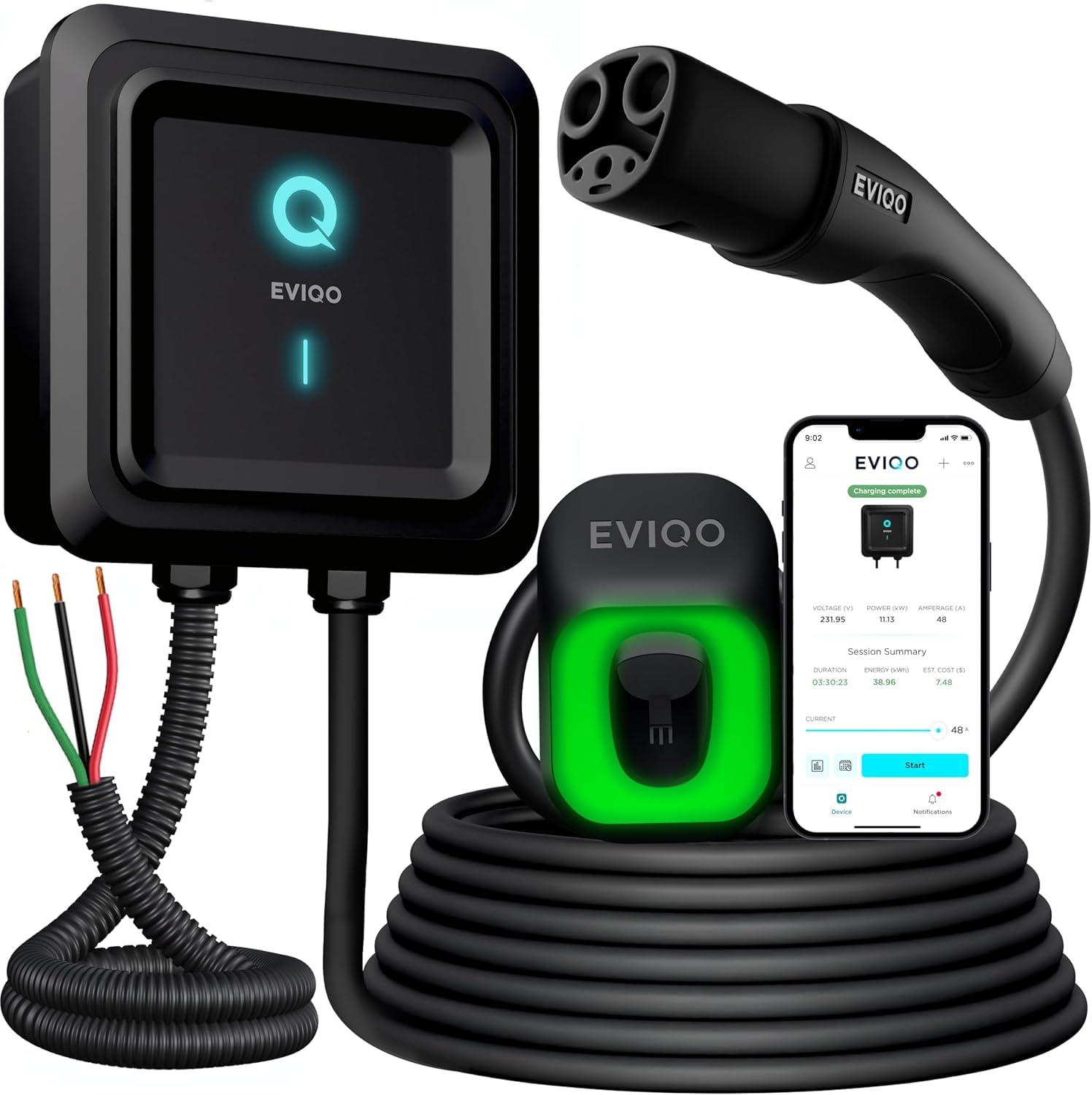
The EVIQO EVIPOWER is a hardwired Level 2 charger with a native NACS connector, meaning Tesla Model S, 3, X, and Y vehicles plug directly without any adapter. The unit delivers 48A at 11.5 kW on a 60A circuit, with an optional DIP switch setting that unlocks 50A output on a 70A circuit if your vehicle supports it. UL, ETL, FCC, and ENERGY STAR certifications cover safety and efficiency standards, and the IP66/NEMA-4 enclosure resists rain, snow, and dust.
The smart app connects over 2.4 GHz WiFi and includes a high-gain antenna that maintains connectivity through garage walls and basement concrete. Scheduled charging, consumption tracking, and 6A-to-48A current adjustment are available in the app. The fluorescent holster makes the connector easy to locate in a dark garage, and the side reset button clears faults without opening the unit or flipping a breaker. The 25-foot cable provides generous reach for front- or rear-port vehicles.
Non-Tesla EVs require a NACS-to-J1772 adapter, which the unit does not include. The hardwired-only design means you cannot simply unplug and move it to a new house—you will need an electrician for de-installation and re-installation. For a single-Tesla household, the native NACS connector eliminates the adapter clutter and provides the most streamlined daily charging experience.
What works
- Native NACS for Tesla vehicles—no adapter needed
- 50A output option via DIP switch
- Fluorescent holster for low-light visibility
What doesn’t
- Hardwired only—not portable
- Non-Tesla requires separate adapter purchase
7. Grizzl-E Ultimate 48A Level 2 EV Charger
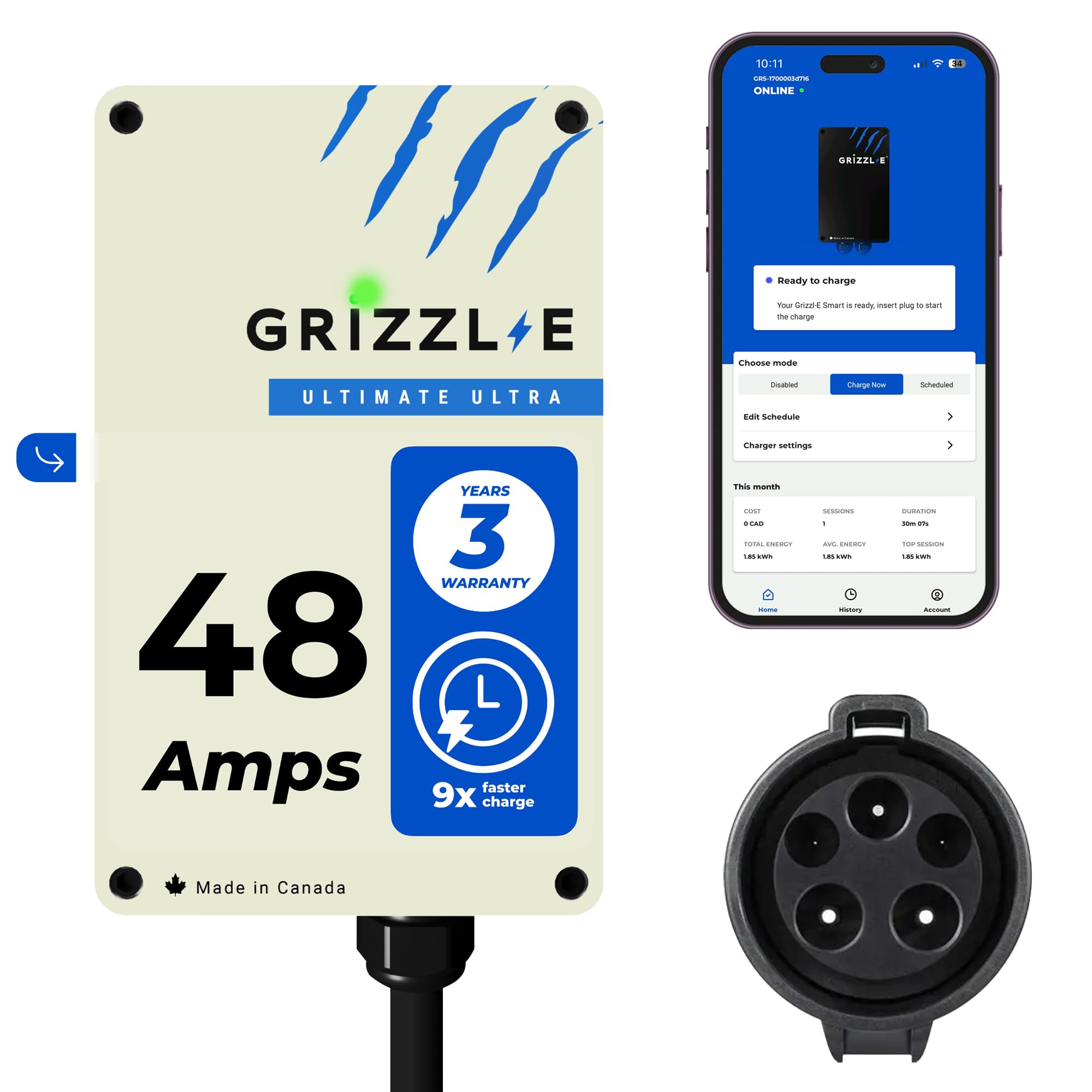
The Grizzl-E Ultimate 48A is built around a die-cast aluminum enclosure rated UL Type 4, which dissipates heat effectively and withstands physical impacts that would crack polycarbonate housings. Made in Canada, this hardwired charger delivers 48A at 11.5 kW and includes a 25-foot J1772 cable designed for extreme cold. The Grizzl-E Connect software provides real-time monitoring, scheduled charging, and energy consumption statistics through the app or a web dashboard.
A key differentiator is premium OCPP (Open Charge Point Protocol) support, which unlocks advanced load balancing across multiple chargers and integration with third-party energy management systems. A one-time activation fee applies for OCPP, but the feature set appeals to households with two EVs or those who want to participate in utility demand-response programs. The external antenna improves WiFi connectivity for garages with thick walls or metal structures.
The initial setup requires hardwiring by a licensed electrician, and the unit is heavier than plastic-bodied competitors due to the metal enclosure. The OCPP activation fee may surprise buyers who expect all software features to be included at this price tier. For buyers who value mechanical durability and future-ready smart charging, the Grizzl-E Ultimate justifies its premium positioning.
What works
- Die-cast aluminum enclosure with UL Type 4 rating
- OCPP support for advanced load management
- External antenna for robust WiFi connectivity
What doesn’t
- Heavier than plastic competitors
- OCPP features require paid activation fee
8. ChargePoint HomeFlex Level 2 EV Charger

The ChargePoint HomeFlex connects to the ChargePoint network, giving you access to 274,000-plus public charging stations across North America through the same mobile app you use for home charging. The hardwired NACS version delivers up to 50A at 12 kW, though the actual output depends on your circuit breaker—20A to 80A are configurable during installation. The UL-certified unit includes a cold-resistant cable rated for outdoor use in freezing temperatures.
The app tracks charging history, sends reminders, integrates with smart home platforms, and lets you schedule sessions around time-of-use rates. The interface is one of the most polished in the category, with clear energy cost breakdowns and station availability maps for road trips. The unit itself has a compact footprint at 7.06 x 11.19 x 5.2 inches, saving wall space compared to bulkier competitors.
The NACS connector is native to Tesla vehicles; non-Tesla EVs require a J1772 adapter. The 50A rating requires a hardwired connection to fully unlock—plug-in configurations will be limited by the receptacle derating rules. For buyers who want a single app for both home charging and public network access, ChargePoint remains the gold standard.
What works
- Access to 274k+ public charging stations via app
- Polished app with detailed energy tracking
- Compact wall footprint
What doesn’t
- NACS native—Tesla focused
- Full 50A requires hardwired install
9. Autel MaxiCharger AC Elite (50 Amp)
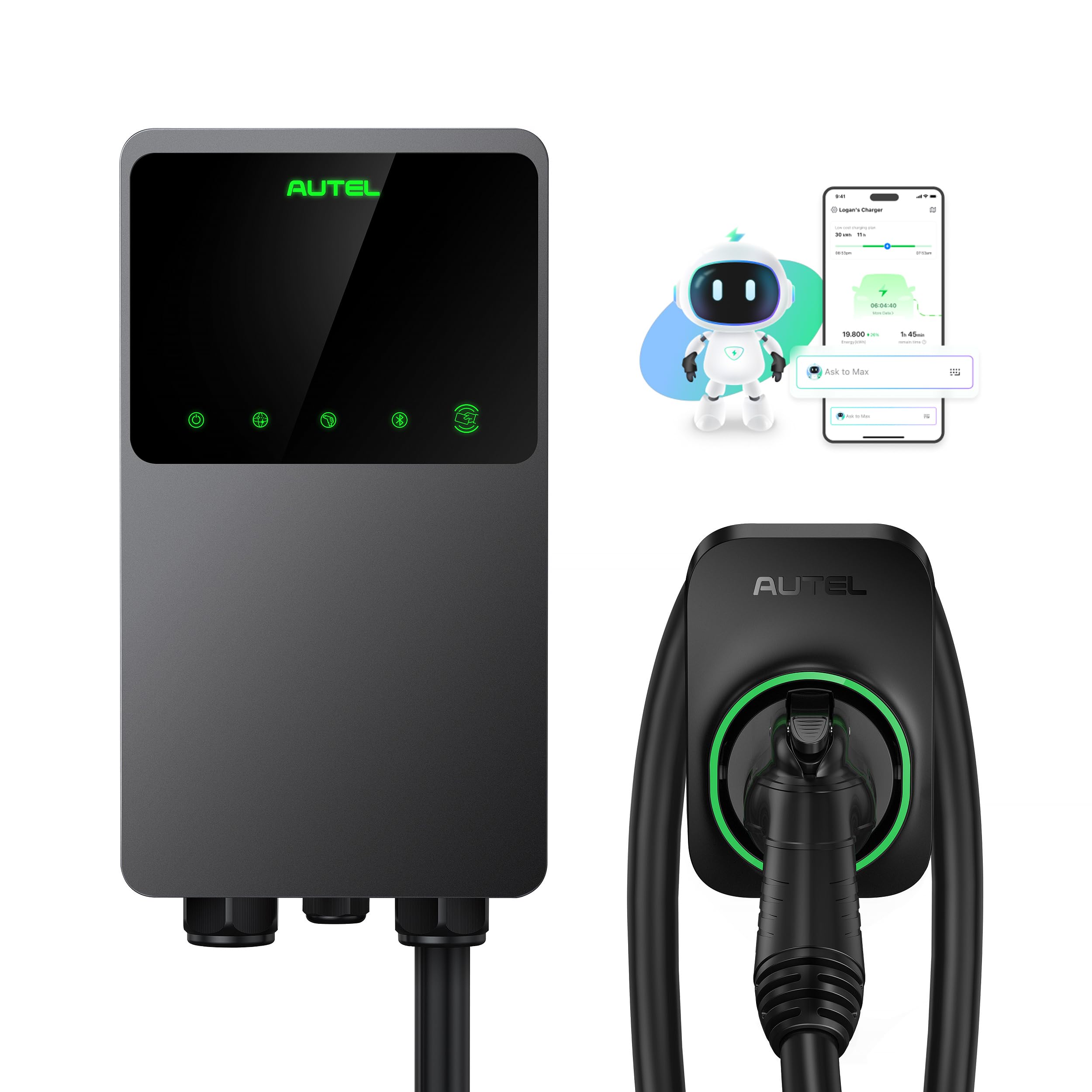
The Autel MaxiCharger AC Elite pushes output to 50A / 12 kW—among the highest current ratings available for residential Level 2 charging. This adds roughly 37 miles of range per charging hour, and the 25-foot cable is engineered to stay flexible down to -40°F, making this a strong choice for owners in northern climates who leave the charger mounted outside. CSA certification confirms compliance with North American safety standards, and the NEMA Type 4 enclosure handles direct weather exposure.
The Autel Charge app provides Bluetooth, WiFi, and Ethernet connectivity options, with OTA firmware updates and 24/7 customer support. The RFID card reader secures the charger against unauthorized use, and the 3-year warranty gives long-term coverage. The larger 50A output requires a 70A circuit breaker and hardwired installation, which may require a panel upgrade in older homes.
The unit’s size is noticeably larger than the 40A Autel model, and the extra cost over the 48A competitors is justified only if your vehicle’s onboard charger accepts the full 12 kW. For a Ford F-150 Lightning or a Rivian R1T that can utilize 48A or higher, the AC Elite provides maximum home charging velocity.
What works
- 50A output at 12 kW—top-tier home speed
- Flexible cable rated to -40°F
- Bluetooth, WiFi, and Ethernet connectivity
What doesn’t
- Requires 70A circuit and panel capacity
- Larger physical footprint
10. Tesla Universal Wall Connector

The Tesla Universal Wall Connector is the only unit on this list with a built-in dual connector system that switches between NACS (native Tesla) and J1772 without an external adapter. The internal mechanism detects which connector is inserted and routes power accordingly, making it the optimal solution for households with both a Tesla and a non-Tesla EV. Output reaches 48A at 11.5 kW, configurable down to 12A for lower-capacity circuits.
The PowerShare feature, currently available for Cybertruck, allows the charger to draw power from the vehicle during a grid outage—effectively turning your EV into a home backup battery. The 24-foot cable is slightly shorter than the 25-foot standard, but the difference is negligible in most garage layouts. Variable amperage lets you set the max output to match your existing breaker, minimizing installation costs.
The premium cost reflects the dual-connector hardware and Tesla ecosystem integration. Non-Tesla households that rely solely on J1772 will pay for the NACS capability they do not use. For a mixed-fleet home or a Tesla owner who plans to add a non-Tesla EV later, this is the most future-proof single-unit solution available.
What works
- Built-in NACS + J1772—no external adapter needed
- PowerShare backup capability for Cybertruck
- Configurable amperage up to 48A
What doesn’t
- Premium price for dual-connector hardware
- Overkill for single-vehicle J1772 households
11. Enphase HCS-40 (Formerly ClipperCreek)

The Enphase HCS-40, formerly the ClipperCreek HCS-40, is a hardwired 32A charger delivering 7.6 kW at 240V—roughly 31 miles of range per hour. This is slower than any 48A unit on this list, but the HCS-40 is built for pure durability: ETL safety certification to UL 2594, ENERGY STAR certification, and a fully sealed NEMA 4 enclosure that has proven itself in commercial car charging stations and extreme-temperature environments for years.
The 25-foot J1772 cable, integrated cable wrap, and wall-mounted holster provide organized storage. Enphase backs the unit with a 5-year warranty, the longest of any product reviewed here, reflecting confidence in the internal components and build quality. The unit is designed for vehicles with 32A or lower onboard acceptance rates, including the Tesla Model 3, Jeep Wrangler 4xe, Kia Soul EV, and Hyundai Kona Electric.
The higher cost for 32A output is a clear trade-off: you are paying for reliability and warranty length, not charge speed. Buyers with a lower-mileage daily commute or a vehicle that cannot accept 48A will find the HCS-40 provides flawless overnight charging without the complexity of smart apps or WiFi connectivity. There is no app, no screen, and no scheduled charging—just plug-and-charge simplicity backed by a half-decade warranty.
What works
- 5-year warranty—longest in category
- Commercial-grade NEMA 4 sealed enclosure
- ETL and ENERGY STAR certified
What doesn’t
- Limited to 32A (7.6 kW) output
- No smart app or WiFi features
Hardware & Specs Guide
Continuous Amperage & Circuit Requirements
The National Electrical Code requires that EV chargers be treated as continuous loads, meaning the circuit breaker must be rated at 125 percent of the charger’s current draw. A 48A charger needs a 60A circuit minimum; a 40A charger needs a 50A circuit; and a 32A charger needs a 40A circuit. Plug-in chargers using a NEMA 14-50 receptacle are derated to 80 percent, capping them at 40A continuous. Hardwired units avoid this derating, which is why every 48A charger on this list requires hardwiring to reach full output.
Connector Standards: J1772 vs NACS
The SAE J1772 connector is the North American standard for Level 2 AC charging across all non-Tesla EVs. The NACS (North American Charging Standard), formerly Tesla’s proprietary connector, is now being adopted by other automakers and integrates a thinner, more compact plug. Tesla Universal Wall Connector and the EVIQO NACS charger support NACS natively. All other units use J1772. A J1772-to-NACS adapter or NACS-to-J1772 adapter costs between and and works for occasional use, but a native connector simplifies daily plug-in.
FAQ
Can I install a 48A charger on a 50A breaker?
Do I need a smart charger or can I use a dumb unit?
What cable length do I need for my garage?
Will my electrician need to upgrade my panel for a 48A charger?
Final Thoughts: The Verdict
For most buyers, the best residential ev charger winner is the Emporia Level 2 EV Charger because it combines full 48A hardwired output with UL certification, a polished energy-tracking app, and a price point that undercuts premium competitors while delivering identical charging speed. If you want a native NACS connector for a Tesla household, grab the EVIQO NACS Charger for the streamlined adapter-free experience. And for long-term durability and warranty coverage with no app complexity, nothing beats the Enphase HCS-40.

Certification: BSc in Mechanical Engineering
Education: Mechanical engineer
Lives In: 539 W Commerce St, Dallas, TX 75208, USA
Md Amir is an auto mechanic student and writer with over half a decade of experience in the automotive field. He has worked with top automotive brands such as Lexus, Quantum, and also owns two automotive blogs autocarneed.com and taxiwiz.com.