A Group 31 battery is the de facto standard for high-demand 12-volt systems, whether you’re cranking a large diesel engine, running a trolling motor all weekend, or powering an off-grid solar array. The physical footprint — roughly 13 inches long by 6.8 inches wide by 9.5 inches tall — is the same across brands, but what changes drastically is the internal chemistry, the cold cranking amps, the reserve capacity, and the cycle life. Choosing the wrong one leaves you stranded or without power halfway through a trip.
I’m Amir — the founder and writer behind Four Wheel Ask. I’ve spent years analyzing battery discharge curves, BMS configurations, and real-world owner feedback across lead-acid, AGM, and lithium chemistries to pinpoint which Group 31 batteries actually deliver on their printed specs.
This guide focuses on the group 31 batteries that balance cold cranking power, deep-cycle endurance, and long-term reliability for RV, marine, solar, and heavy-truck use cases.
How To Choose The Best Group 31 Batteries
Every Group 31 battery shares the same BCI footprint, but that’s where the similarity ends. Your choice hinges on chemistry, intended duty cycle, and charging infrastructure. Below are the three most critical factors to weigh before buying.
Chemistry: Lead-Acid, AGM, or LiFePO4
Flooded lead-acid batteries are the cheapest entry point but require venting and periodic water checks. AGM (Absorbent Glass Mat) is sealed, spill-proof, and delivers strong CCA, making it the standard for dual-purpose starting and deep-cycle use. Lithium iron phosphate (LiFePO4) weighs roughly one-third of an equivalent AGM, provides over 5,000 cycles, and holds steady voltage under load — but it demands a compatible charger or BMS integration. Many LiFePO4 Group 31 units also include a 100A BMS that protects against over-discharge, short circuits, and low-temperature charging.
Cold Cranking Amps vs. Reserve Capacity
Cold Cranking Amps (CCA) measures starting power at 0°F — critical for diesel engines and cold climates. Reserve capacity (RC) is the minutes a battery can sustain a 25-amp load before dropping to 10.5 volts. A dual-purpose battery needs both: 800+ CCA for reliable starts and 150+ minutes RC to run lights, pumps, or appliances when the engine is off. Specialty deep-cycle LiFePO4 batteries often list amp-hours instead of CCA because they are not designed for starting duty.
Terminal Type and Orientation
Group 31 batteries come with SAE automotive posts, stainless steel studs, or marine terminals. Some offer dual terminal configurations that accept both. The height can vary slightly — up to 9.5 inches — which may interfere with battery box lids or hold-down brackets. Always measure your tray clearance and verify the terminal type matches your cable ends before committing to a purchase.
Quick Comparison
On smaller screens, swipe sideways to see the full table.
| Model | Category | Best For | Key Spec | Amazon |
|---|---|---|---|---|
| OPTIMA D31M BLUETOP | AGM / SpiralCell | Dual-purpose marine/RV | 900 CCA / 75 Ah | Amazon |
| OPTIMA DH6 YELLOWTOP | AGM / SpiralCell | High-vibration vehicles | 800 CCA / 72 Ah | Amazon |
| Interstate 8-31MAGMDC | Pure Lead AGM | Marine dual-purpose | 825 CCA / 100 Ah | Amazon |
| Litime Self-Heating 100Ah | LiFePO4 | Cold-climate solar/RV | 100 Ah / 23.3 lbs | Amazon |
| Power Queen 100Ah | LiFePO4 | Lightweight solar/backup | 100 Ah / 24 lbs | Amazon |
| GOLDENMATE Bluetooth 100Ah | LiFePO4 | Bluetooth monitoring / marine | 100 Ah / IP67 rated | Amazon |
| WEIZE 100Ah Deep Cycle | Sealed Lead Acid | Budget backup / solar | 100 Ah / 63 lbs | Amazon |
| Timeusb 100Ah LiFePO4 | LiFePO4 | Value lithium upgrade | 100 Ah / 23 lbs | Amazon |
| DUNFUME 100Ah LiFePO4 | LiFePO4 | Entry-level lithium / RV | 100 Ah / 21.6 lbs | Amazon |
In‑Depth Reviews
1. OPTIMA D31M BLUETOP

The OPTIMA D31M BLUETOP is the benchmark for dual-purpose marine and RV batteries. Its SpiralCell design packs 99.99% pure lead into a compact cylindrical grid that withstands vibration 15 times better than a standard flooded battery. With 900 CCA and 1125 MCA, this unit fires large outboards and diesel generators with authority, while 155 minutes of reserve capacity keeps house loads running for hours.
Terminals are dual-configuration — SAE posts and 5/16-inch stainless steel studs — so you can connect both your cranking cables and accessory wiring without adapters. At 59.8 pounds, it is heavier than a lithium equivalent, but the sealed AGM construction means zero maintenance and no off-gassing, even when mounted in confined bilge compartments or battery boxes.
For boat owners who need one battery to start the engine and run a trolling motor or fishfinder without switching, the BLUETOP delivers consistent voltage sag that stays above 12.0V far longer than typical alloy AGM batteries. The 36-month warranty reflects the confidence in this build.
What works
- Exceptional vibration resistance for marine use
- Dual terminal design fits most setups
What doesn’t
- Heavier than LiFePO4 options
- Not designed for ultra-deep (>80%) daily cycling
2. OPTIMA DH6 YELLOWTOP

The OPTIMA DH6 YELLOWTOP is a Group 48 battery, but it earns a mention here because it competes in the same high-performance, dual-purpose space as Group 31 units. Its 800 CCA and 140-minute reserve capacity are tuned for trucks, SUVs, and passenger cars with high electrical demands — winches, aftermarket lighting, and sound systems. The pure lead spiral grid resists corrosion and shedding better than flat-plate AGM designs.
Faster charging recovery sets this apart from flooded batteries: after a deep discharge, the YELLOWTOP accepts charge more readily, reducing downtime between uses. The sealed, maintenance-free case allows mounting in virtually any orientation except inverted, which is a real advantage in tight engine bays or underbody trays.
For owners of overland rigs or lifted trucks who subject their battery to constant jarring on rough terrain, the 15x vibration resistance of the SpiralCell construction translates directly into longer service life. Expect 3 years of daily abuse before any noticeable capacity fade, compared to 12-18 months for a standard flooded battery in the same environment.
What works
- Nearly unbreakable in high-vibration installs
- Fast recharge after deep discharge cycles
What doesn’t
- Group 48 case size may not fit all Group 31 trays
- Higher cost per amp-hour than flooded options
3. Interstate Batteries 8-31MAGMDC

Interstate Batteries brings decades of distribution credibility to the 8-31MAGMDC, a pure lead AGM battery designed for dual-purpose marine and RV service. Its 825 CCA rating ensures reliable cold starts in 4-stroke outboards and V8 stern drives, while the deep-cycle construction uses thick lead plates to withstand repeated discharges to 50% depth without rapid capacity loss.
Service life is 2 to 3 times longer than conventional alloy AGM units, according to Interstate’s testing, thanks to the non-alloy pure lead composition that minimizes grid corrosion. The sealed case is completely maintenance-free and spill-proof, making it safe for installations inside living compartments or under seats.
At 64.5 pounds, this is one of the heaviest options in the review, but that weight comes from the dense lead plates that deliver genuine deep-cycle endurance. For boaters who want a single battery to handle cranking and house loads without carrying a separate lithium bank, the 8-31MAGMDC is a proven workhorse.
What works
- True dual-purpose with strong deep-cycle plates
- Pure lead construction resists corrosion
What doesn’t
- Heavy — over 64 pounds
- Shorter cycle life than LiFePO4 alternatives
4. Litime 12V 100Ah Self-Heating LiFePO4
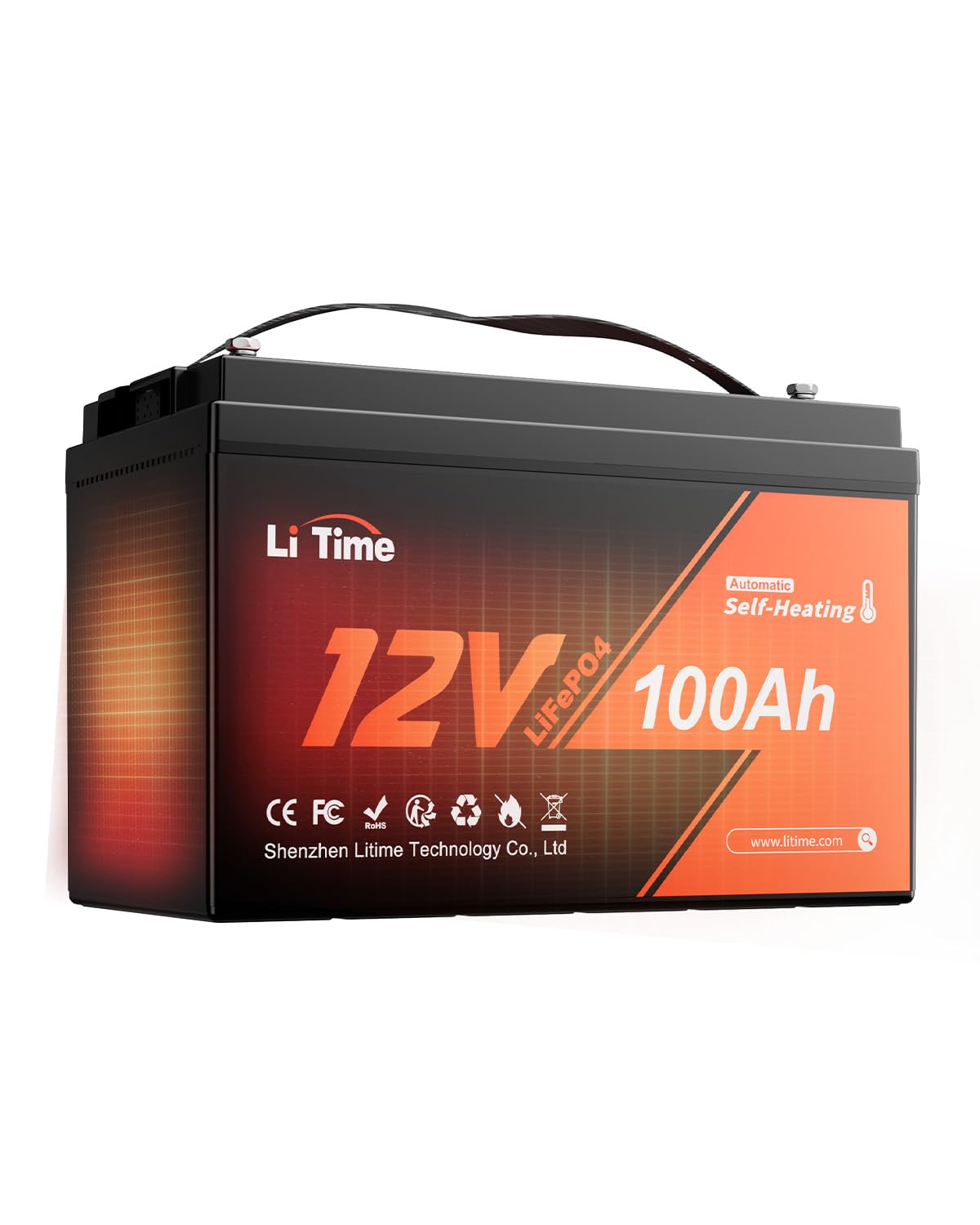
The Litime 100Ah Self-Heating battery solves the biggest problem with lithium in cold climates: charging below freezing. The built-in BMS activates internal heating elements when temperature drops below 41°F, raising the cells to a safe charging temperature before accepting current. That means you can install this in an unheated cabin or an RV stored through northern winters without worrying about permanent cell damage.
It delivers 1280Wh of usable energy at just 23.3 pounds, which is roughly one-third the weight of an equivalent AGM battery. The 100A BMS covers over-temperature, over-current, over-charge, and short-circuit protection, and the battery is rated for over 10,000 cycles at 80% depth of discharge — a lifespan that far exceeds any lead-acid option on this list.
For trolling motor applications in the 20-70 pound thrust range, this battery provides steady voltage that keeps your motor running at full power until the battery is nearly empty. The only catch is that you must use a LiFePO4-compatible charger or a solar charge controller with a lithium profile to avoid triggering the BMS protection.
What works
- Enables safe charging down to -20°C
- Ultra-lightweight for easy installation
What doesn’t
- Not suitable for engine starting duty
- Requires dedicated lithium charger
5. Power Queen 12V 100Ah LiFePO4
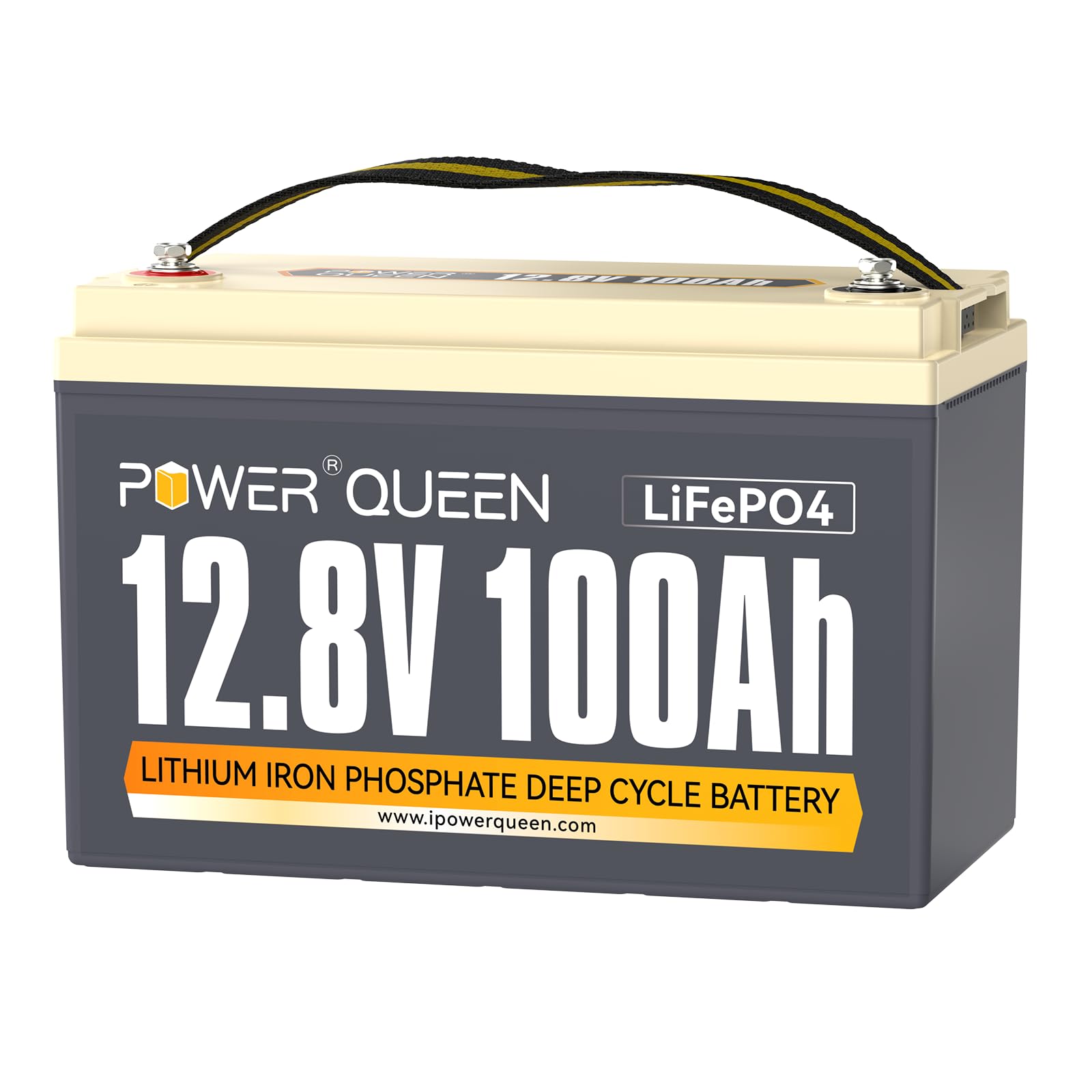
Power Queen’s 12V 100Ah LiFePO4 battery nails the combination of weight, capacity, and price for solar and RV users who don’t need Bluetooth or self-heating features. At 24 pounds, it is easy to carry and install in a Group 31 tray, and the 1280Wh capacity is enough to run a 12V fridge for 24-36 hours depending on ambient temperature and insulation.
The Grade A LiFePO4 cells are paired with a 100A BMS that handles all standard protections, and the battery supports series and parallel connections up to 4S4P — allowing a 48V 400Ah (20.48kWh) bank for home backup systems. The 5-year warranty adds peace of mind for a purchase that should last a decade or more in typical off-grid service.
Owners report that voltage holds steady at 13.2-13.4V under moderate loads, unlike lead-acid batteries that sag below 12.5V at 50% discharge. That stable voltage profile means your inverter, lights, and electronics all perform consistently until the battery reaches its low-voltage cutoff.
What works
- Stable voltage output under sustained load
- Scalable to 48V 400Ah bank
What doesn’t
- No Bluetooth for state-of-charge monitoring
- Not designed for cold-weather charging
6. GOLDENMATE 12V 100Ah Bluetooth LiFePO4
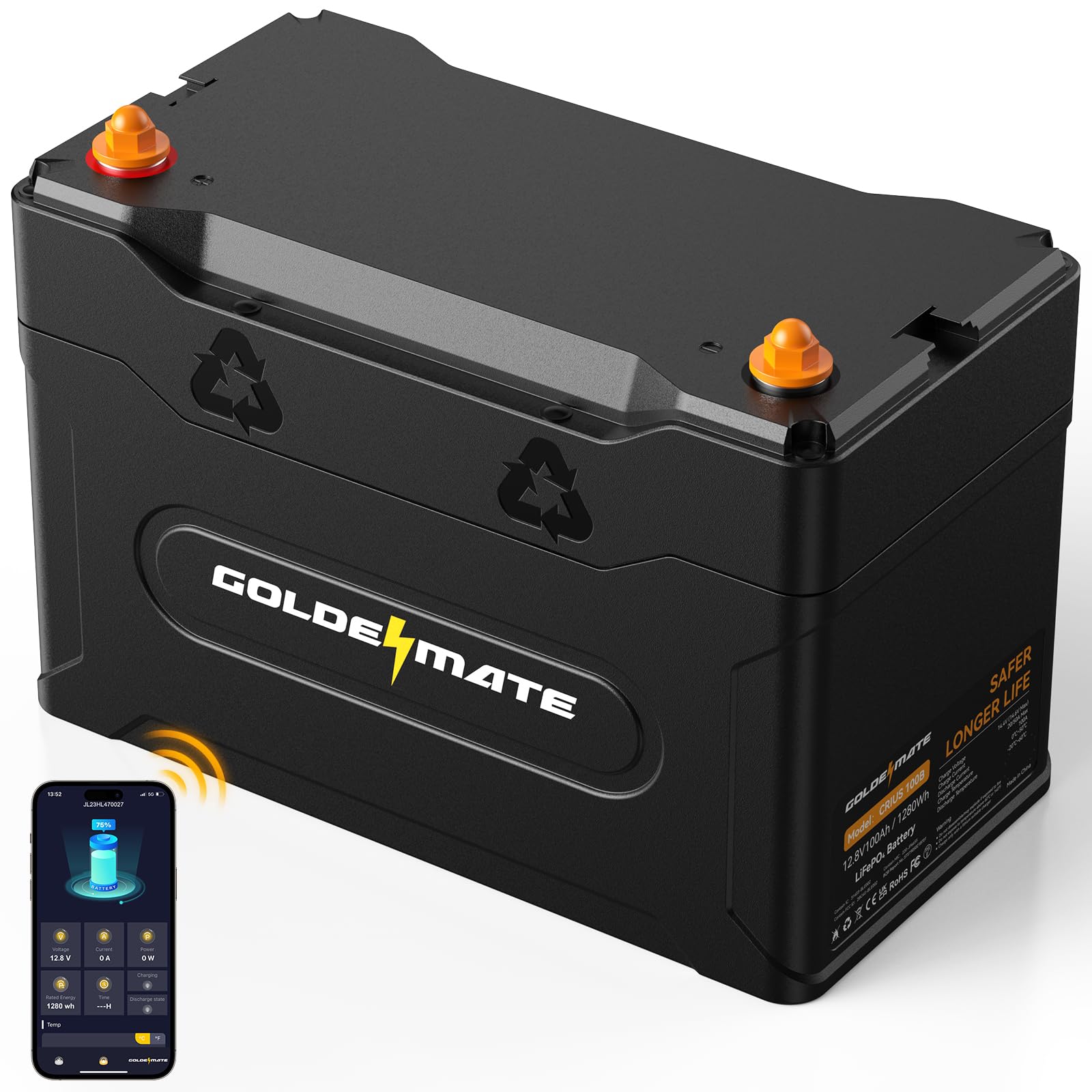
GOLDENMATE integrates a Bluetooth module directly into the BMS, letting you monitor voltage, current, remaining capacity, and cycle count from a smartphone app. That is a genuine convenience for RVers and boat owners who want to track state-of-charge without walking to the battery compartment or installing a separate shunt-based monitor.
The IP67 rating is rare in the lithium battery space — it means the case is fully dust-tight and can survive submersion in 1 meter of water for 30 minutes. For trolling motor applications in kayaks or open skiffs, that water resistance removes the anxiety of splash damage or deck washdowns. Weight is 29.3 pounds, still significantly lighter than any AGM equivalent.
It supports up to 16 batteries in parallel or series for a theoretical 20.48kWh system, and the 100A continuous discharge rating handles medium loads like inverters up to 1200W. The Bluetooth app also logs historical data, which helps you spot a failing cell or an unbalanced bank before it causes a system shutdown.
What works
- Real-time battery data via phone app
- IP67 waterproof construction
What doesn’t
- 1-year warranty is shorter than some competitors
- Heavier than other 100Ah LiFePO4 units
7. Timeusb 12V 100Ah LiFePO4

Timeusb’s 100Ah LiFePO4 battery uses an “Energy Core” BMS that integrates low-voltage disconnect, high-voltage cutoff, and temperature compensation into a single compact board. The IP65-rated shell resists dust and hose-down splashes, making it suitable for exposed marine and RV compartments where humidity is a constant issue.
Automotive-grade LiFePO4 cells deliver 4000 cycles at 100% depth of discharge and up to 15,000 cycles at 60% DoD. At 23 pounds, it is one of the lightest Group 31 lithium options, and the 55 Wh/lb energy density means you get maximum power per pound of installed weight — valuable for weight-sensitive setups like towable campers.
It supports 4P4S expansion to 48V 400Ah, and the battery can be mounted in any orientation except upside-down. The 5-year warranty is competitive, though some users report that the included terminal bolts require a slight modification to fit standard SAE cable ends.
What works
- Excellent cycle life at deep discharge levels
- Lightweight with IP65 weather resistance
What doesn’t
- Terminal bolts may not fit all cables without adjustment
- No Bluetooth or self-heating options
8. WEIZE 12V 100Ah Deep Cycle SLA

WEIZE offers a sealed lead-acid Group 31 battery that delivers 100Ah of capacity at a weight of 63 pounds. It is a maintenance-free, spill-proof AGM battery that serves as a direct replacement for standard lead-acid units in wheelchairs, floor scrubbers, trolling motors, and entry-level solar setups where budget is the primary concern.
The 1150A max discharge current provides enough surge to start small engines or power a 1000W inverter for short bursts, but this is fundamentally a deep-cycle battery — repeated high-current starting draws will shorten its life. The 3% self-discharge rate is excellent for seasonal storage; you can leave it connected over winter and still have usable charge in spring.
At this price point, the trade-off is cycle life: expect roughly 300-500 cycles to 50% depth of discharge before capacity drops noticeably. That makes it a good match for occasional-use applications like a backup sump pump, cabin lighting, or a weekend trolling motor battery, but not for daily off-grid living.
What works
- Very low self-discharge for seasonal use
- Maintenance-free sealed construction
What doesn’t
- Heavy — 63 pounds is hard to move
- Limited to ~500 cycles compared to lithium
9. DUNFUME 12V 100Ah LiFePO4
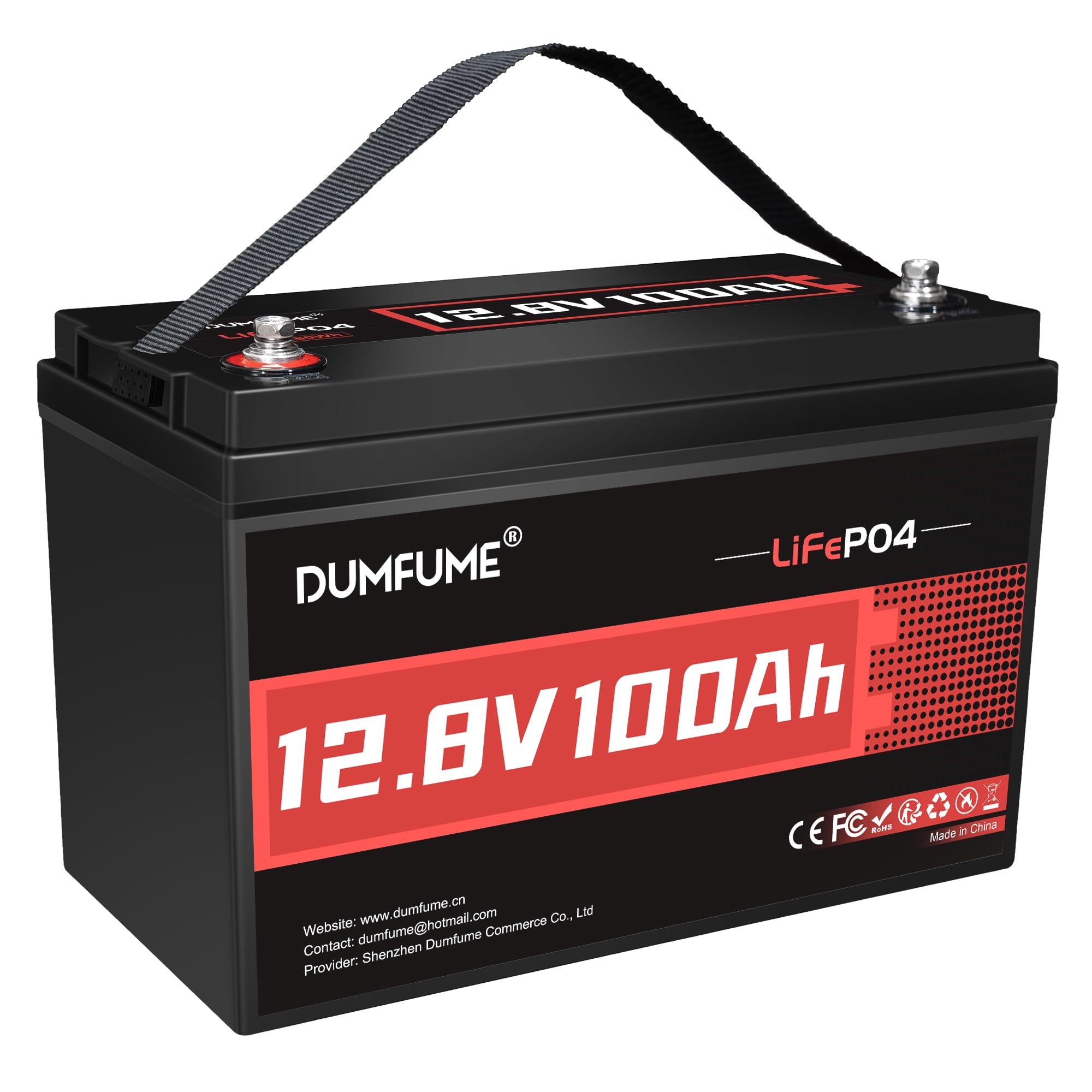
DUNFUME brings a 100Ah LiFePO4 battery to market at an aggressive price point, targeting budget-conscious RV and solar users who want lithium performance without the premium markup. It weighs just 21.6 pounds — the lightest battery in this review — and packs 1.28kWh of energy into a Group 31 footprint that is 25% smaller in volume than standard lithium cases.
The built-in 100A BMS covers overcharge, over-discharge, short circuit, and over-temperature protection, and the Grade A cells are rated for 4000 cycles at 100% DoD. The ABS plastic casing is dust-resistant and weather-resistant (not waterproof), making it suitable for indoor and outdoor installations as long as it is not submerged.
One limitation is that the BMS cuts off charging below 5°C — there is no self-heating function — so this battery is not ideal for unheated winter installations. It also explicitly warns against use as a starting battery. For warm-climate solar banks and RV house systems, however, it delivers excellent value per amp-hour.
What works
- Lightest Group 31 option at 21.6 pounds
- Very competitive price for lithium performance
What doesn’t
- No low-temperature charging protection
- Not designed for engine starting
Hardware & Specs Guide
Cold Cranking Amps vs. Amp-Hours
CCA measures the battery’s ability to start an engine at 0°F. High CCA (800+) is critical for diesel engines and cold climates. Amp-hours (Ah) measure total energy storage — how long the battery can run a 1-amp load. Dual-purpose AGM batteries often balance both, while LiFePO4 batteries prioritize Ah over CCA because they are not intended for starting duty.
BMS Protection Functions
Lithium batteries rely on a Battery Management System to prevent over-charge, over-discharge, short circuits, and over-temperature. A 100A BMS can handle continuous loads up to 100 amps (roughly 1200W at 12V) before tripping. High-quality BMS units also balance individual cell voltages, extending overall pack life and preventing capacity drift between cells over hundreds of cycles.
FAQ
Can I replace my flooded Group 31 battery with a LiFePO4 battery?
What is the real difference between Group 31 and Group 27 batteries?
How many cycles can I expect from a Group 31 AGM battery?
Final Thoughts: The Verdict
For most buyers, the group 31 batteries winner is the OPTIMA D31M BLUETOP because it combines 900 CCA, 155 minutes of reserve capacity, and SpiralCell durability in a true dual-purpose AGM package. If you want the lightest possible weight and the longest cycle life for off-grid solar, grab the Power Queen 100Ah LiFePO4. And for cold-climate charging where lithium usually fails, nothing beats the Litime Self-Heating 100Ah.

Certification: BSc in Mechanical Engineering
Education: Mechanical engineer
Lives In: 539 W Commerce St, Dallas, TX 75208, USA
Md Amir is an auto mechanic student and writer with over half a decade of experience in the automotive field. He has worked with top automotive brands such as Lexus, Quantum, and also owns two automotive blogs autocarneed.com and taxiwiz.com.