Every mile you drive is a potential insurance claim waiting for the right video evidence. A single-car accident, a phantom parking lot dent, or a staged collision can turn your day upside down, and without rock-solid footage from both ends of your vehicle, you’re left arguing he-said-she-said. That’s why a dual-lens system isn’t a luxury anymore—it’s a non-negotiable layer of protection that captures the road ahead and what’s trailing behind you in one synchronized recording.
I’m Amir — the founder and writer behind Four Wheel Ask. I’ve spent countless hours analyzing dash cam specifications, comparing sensor technologies like STARVIS 2 versus conventional CMOS, and cross-referencing real-world owner feedback to separate marketing noise from genuinely reliable hardware.
Whether you’re a rideshare driver logging 12-hour shifts, a commuter navigating congested highways, or a weekend traveler wanting to preserve the journey, the right car camera dual lens setup can mean the difference between a smooth insurance process and a costly headache.
How To Choose The Best Car Camera Dual Lens
Not every dual-lens system delivers the same level of protection. The gap between a budget-friendly entry-level setup and a premium flagship can mean the difference between catching a license plate at night or staring at a blurry mess. Here are the three specs that matter most when shopping for a car camera dual lens.
Resolution Balance: Front vs. Rear Clarity
Most dual-lens cameras split processing power between the front and rear channels. A 4K front combined with a 1080P rear is the most common configuration, and it works well for most drivers because the front camera bears the heaviest evidentiary load. However, some premium units now offer 4K front paired with 2K rear, which gives you significantly more detail on tailgaters or rear-end collisions. Be wary of cheap twin-cams that claim “4K” but actually record both channels at 2.7K or lower when running simultaneously—check the fine print on simultaneous recording resolution.
Sensor Technology: The Night-Vision Decider
The image sensor is the heart of any dash cam. Standard CMOS sensors struggle in low light, introducing grain and motion blur exactly when you need clarity most. Sony’s STARVIS 2 sensors (the IMX678 and IMX675) are the current gold standard, offering 4x better low-light sensitivity than conventional sensors. If you frequently drive after sunset, park in dim garages, or commute through tunnels, prioritize a camera with STARVIS 2 technology. The F-number aperture (F1.5 to F1.8 range) also matters—a lower F-number lets in more light, improving night performance without washing out highlights.
Parking Mode: Real Protection or Power Drain?
A dash cam that only records while your engine runs leaves huge gaps in your coverage. True parking mode requires a hardwire kit that taps into your car’s fusebox, allowing the camera to run on a low-power trickle. There are three common parking modes: time-lapse records a single frame per second, compressing hours into minutes; motion detection wakes the camera only when something moves within its field of view; collision detection uses the G-sensor to trigger an event recording only upon impact. Time-lapse is the most reliable for continuous coverage, but it consumes the most storage. Make sure the camera you choose supports the specific parking mode that matches your parking environment.
Quick Comparison
On smaller screens, swipe sideways to see the full table.
| Model | Category | Best For | Key Spec | Amazon |
|---|---|---|---|---|
| ROVE R2-4K Dual PRO | Premium | Ultimate clarity and transfer speed | Front: 4K (IMX678), Rear: 2K (IMX675) | Amazon |
| VIOFO A229 Pro 3CH | Premium | Full cabin + road coverage | Triple channel: 4K+2K+1080P, STARVIS 2 | Amazon |
| REDTIGER F7N Pro | Mid-Range | Balanced price-to-performance ratio | Front: 4K STARVIS 2, Rear: 1080P | Amazon |
| FAIMEE 3CH 4K+2K+2K | Mid-Range | Three-channel coverage without premium cost | Triple: 4K front + 2K interior + 2K rear | Amazon |
| FAIMEE 4K+2K Dual | Mid-Range | Strong dual-lens video quality | Front: 4K UHD, Rear: 2K | Amazon |
| 70mai A410 | Value | Feature-rich on a budget | Front: 2.5K, Rear: 1080P, 64GB included | Amazon |
| Pelsee P1 Pro | Value | Entry-level 4K with voice control | Front: 4K STARVIS 2, Rear: 1080P WDR | Amazon |
In‑Depth Reviews
1. ROVE R2-4K Dual PRO Dash Cam
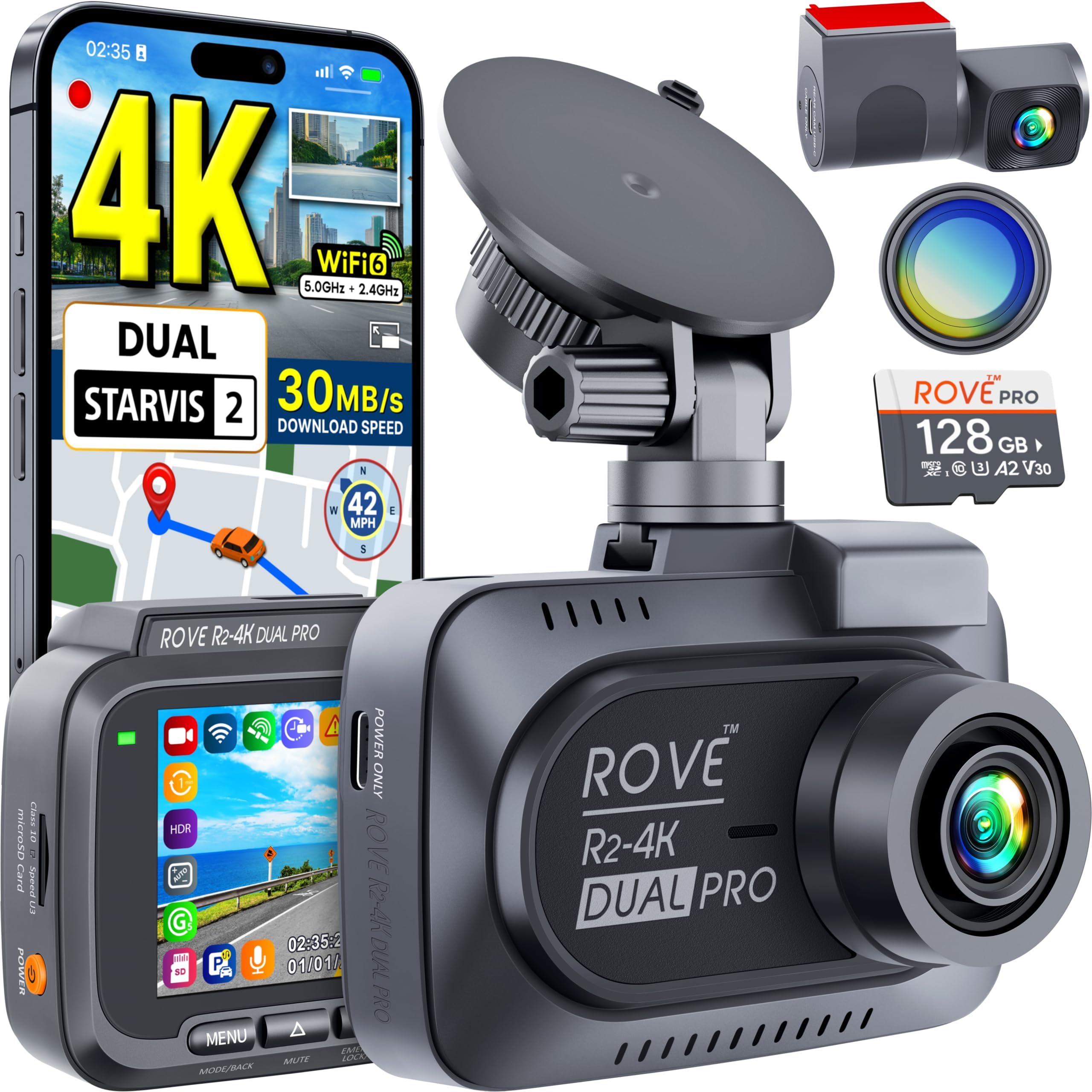
The ROVE R2-4K Dual PRO stands at the top of the dual-lens hierarchy because it pairs Sony’s latest STARVIS 2 IMX678 front sensor with a IMX675 rear sensor—meaning both ends of your vehicle get premium low-light treatment. The front captures crisp 4K at 30fps while the rear records 2K at 30fps, a rare symmetric high-resolution setup that leaves nothing to chance when reading plates from tailgaters. The F1.7 front and F1.55 rear apertures let in ample light, and the 150-degree front / 140-degree rear angles cover wide swaths without fisheye distortion at the edges.
What truly sets this unit apart is the WiFi 6 integration, which delivers download speeds up to 30MB/s—roughly three times faster than conventional 5GHz dash cam Wi-Fi. Grabbing a 4K clip to share with insurance or social media takes seconds rather than minutes. The included 128GB ROVE PRO microSD card and CPL filter mean you don’t have to spend extra out of the box, and the Quad-Mode GPS (GPS/BEIDOU/GALILEO/GLONASS) pins your location and speed with satellite redundancy even in dense urban canyons.
The 24-hour parking mode offers three intelligent options: time-lapse at 1FPS, motion detection, and collision detection. When an event triggers, the camera locks a full one-minute video with a voice alert on your next startup. The main trade-off is the premium positioning—this is an investment for drivers who demand forensic-grade footage from both cameras, not just the front lens. For owner-operators, long-haul truckers, or anyone who parks in high-risk lots, the dual-STARVIS 2 setup justifies every penny.
What works
- Dual STARVIS 2 sensors deliver identical night clarity on front and rear channels
- WiFi 6 enables blazing-fast 30MB/s file transfers
- Comes with 128GB card and CPL filter included in the box
- Quad-mode GPS ensures reliable route logging
What doesn’t
- Premium price point places it above casual-buyer budgets
- Hardwire kit for parking mode sold separately
- Suction mount can be bulky on smaller windshields
2. VIOFO A229 Pro 3 Channel 4K HDR Dash Cam

The VIOFO A229 Pro is the benchmark for multi-channel dash cams, offering a true 3-channel 4K front, 2K rear, and 1080P interior recording system. Both the front and rear cameras are powered by STARVIS 2 sensors—the IMX678 for the front and IMX675 for the rear—while the interior camera uses a STARVIS sensor with four infrared LEDs that activate in complete darkness. This makes it an obvious choice for rideshare drivers (Uber/Lyft) who need to document passenger behavior without turning on the cabin light.
HDR is enabled on all three channels simultaneously, which is rare in this price bracket. This means when you’re driving through a tunnel exit with harsh sunlight pouring in, the camera balances highlights and shadows without blowing out plate details. The 12-voice-command system allows hands-free operation—saying “Lock the video” preserves the current clip without taking your hands off the wheel. The included CPL filter for the front lens reduces windshield glare, and the 5GHz Wi-Fi makes app-based file retrieval reasonably fast.
One nuance: the A229 Pro does not include a memory card, so you must budget for a high-endurance microSD (VIOFO recommends their own industrial cards for optimal compatibility). The parking mode is robust with three options (auto event detection, low bitrate, time lapse), but the HK4 hardwire kit is sold separately. The build quality is famously reliable, with a built-in temperature sensor that auto-shuts the camera under extreme heat to prevent damage—a crucial feature for vehicles parked in direct sun in warmer climates.
What works
- True HDR on all three channels simultaneously
- Infrared cabin camera captures clear footage in total darkness
- Heat-protection auto-shutdown prevents sensor damage
- Quad-mode GPS for precise location logging
What doesn’t
- No SD card included in the package
- Hardwire kit required for parking mode is an extra purchase
- Interior camera cable routing can be tricky in larger vehicles
3. REDTIGER 4K Dash Cam Front and Rear (F7N Pro)
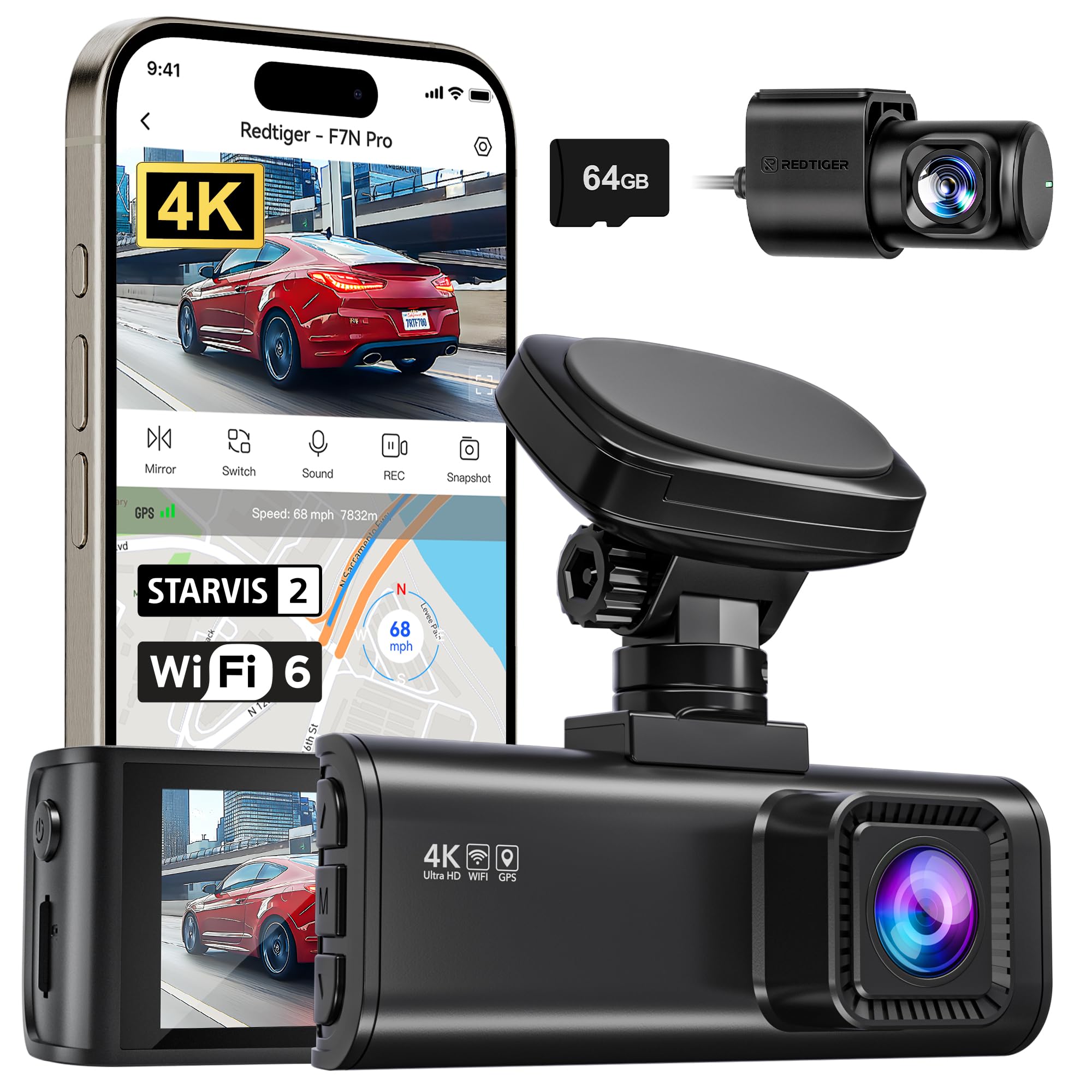
The REDTIGER F7N Pro hits a sweet spot for drivers who want 4K front coverage with STARVIS 2 sensor performance but don’t need the triple-channel complexity. The front camera records at true 4K (3840x2160P) using a STARVIS 2 sensor, while the rear records at 1080P FHD—a common and effective combination that prioritizes the front lens for the most critical evidence. The F1.5 front aperture is exceptionally wide, letting in more light than the typical F1.8, which makes a tangible difference on unlit roads.
The 170-degree front and 140-degree rear angles cover six lanes of traffic, reducing blind spots substantially. The built-in GPS module embeds speed, location, and route data directly into the video file, and the REDTIGER app provides OTA firmware updates so you don’t need to mess with a memory card reader for system upgrades. The included 64GB card is enough for about 5-6 hours of continuous 4K+1080P recording before loop recording kicks in.
Where the F7N Pro falls slightly short is the rear resolution—1080P is adequate for general surveillance, but you won’t be reading plates from the rear at highway speeds the way you could with a 2K rear camera. The app interface has been described as somewhat clunky compared to more polished competitors, and the parking mode requires a separate hardwire kit. Still, for drivers whose primary concern is front-facing incident documentation with a solid rear safety net, this unit delivers excellent real-world performance without stretching into premium territory.
What works
- STARVIS 2 front sensor with F1.5 aperture for superior low-light capture
- Wide 170-degree front angle covers multiple lanes
- OTA firmware updates via app simplify maintenance
- 64GB memory card included for immediate use
What doesn’t
- Rear camera limited to 1080P—fine for context, not plate reading
- App interface feels dated compared to newer competitors
- No interior cabin camera option in this model
4. FAIMEE 4K+2K+2K 3 Channel Dash Cam
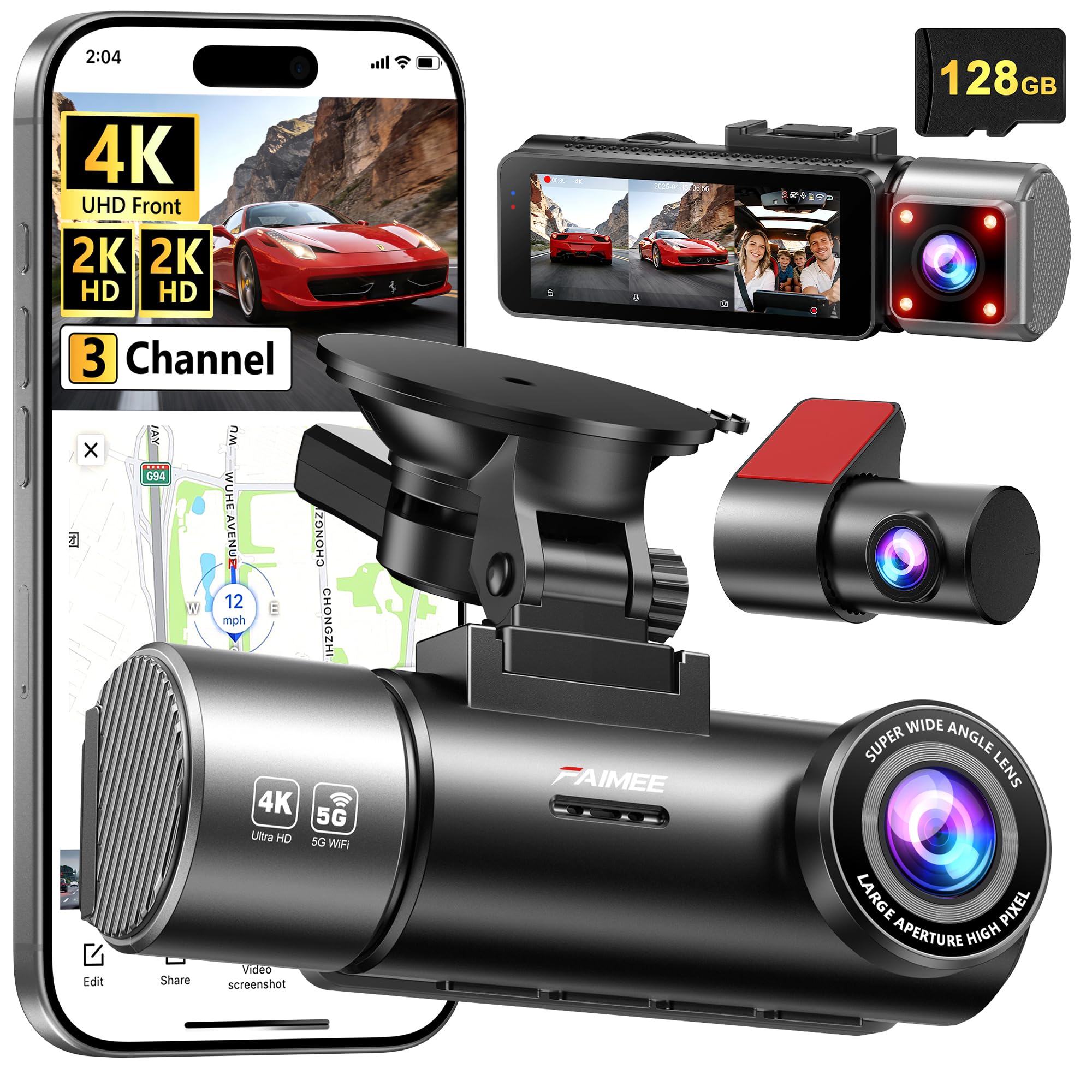
FAIMEE’s 3-channel offering brings a rare spec combination to the mid-range bracket: a 4K front camera paired with 2K interior and 2K rear cameras, all recording simultaneously. The rear camera at 2K is a standout feature here—most triple-channel setups drop the rear to 1080P to save processing bandwidth, but FAIMEE maintains 2K resolution on both the interior and rear lenses. The 170-degree front and 150-degree rear angles cover blind spots effectively, and the F1.8 aperture on the front lens handles dusk and dawn transitions competently.
The package includes a 128GB high-endurance microSD card, which is double what most competitors include at this level. This gives you roughly 10-12 hours of 4K+2K+2K recording before loop recording begins overwriting. The dual-band Wi-Fi (5.8GHz and 2.4GHz) offers stable connectivity, and the built-in GPS logs real-time speed and route data that can be reviewed on Google Maps through the FAIMEE app. For fleet managers or rideshare drivers who need to monitor both road conditions and passenger interactions, this configuration is hard to beat at the price point.
The main compromises are in the app polish and the slightly bulkier form factor of the front unit—the 3-channel processing generates more heat, though the camera includes thermal protection. The parking mode requires a hardwire kit (not included), and the G-sensor sensitivity sometimes triggers false events on rough roads unless you dial it down. Still, for anyone wanting three-channel coverage with rear and interior resolution that doesn’t fall off a cliff, the FAIMEE delivers surprising value.
What works
- Interior and rear both record at 2K, not the typical 1080P
- 128GB memory card included saves immediate upgrade cost
- Dual-band Wi-Fi for stable app connectivity
- Google Maps route integration for verifying locations
What doesn’t
- App interface less refined than VIOFO or ROVE
- G-sensor can be overly sensitive on bumpy pavement
- Larger front unit occupies more windshield space
5. FAIMEE 4K+2K Recording Dash Cam
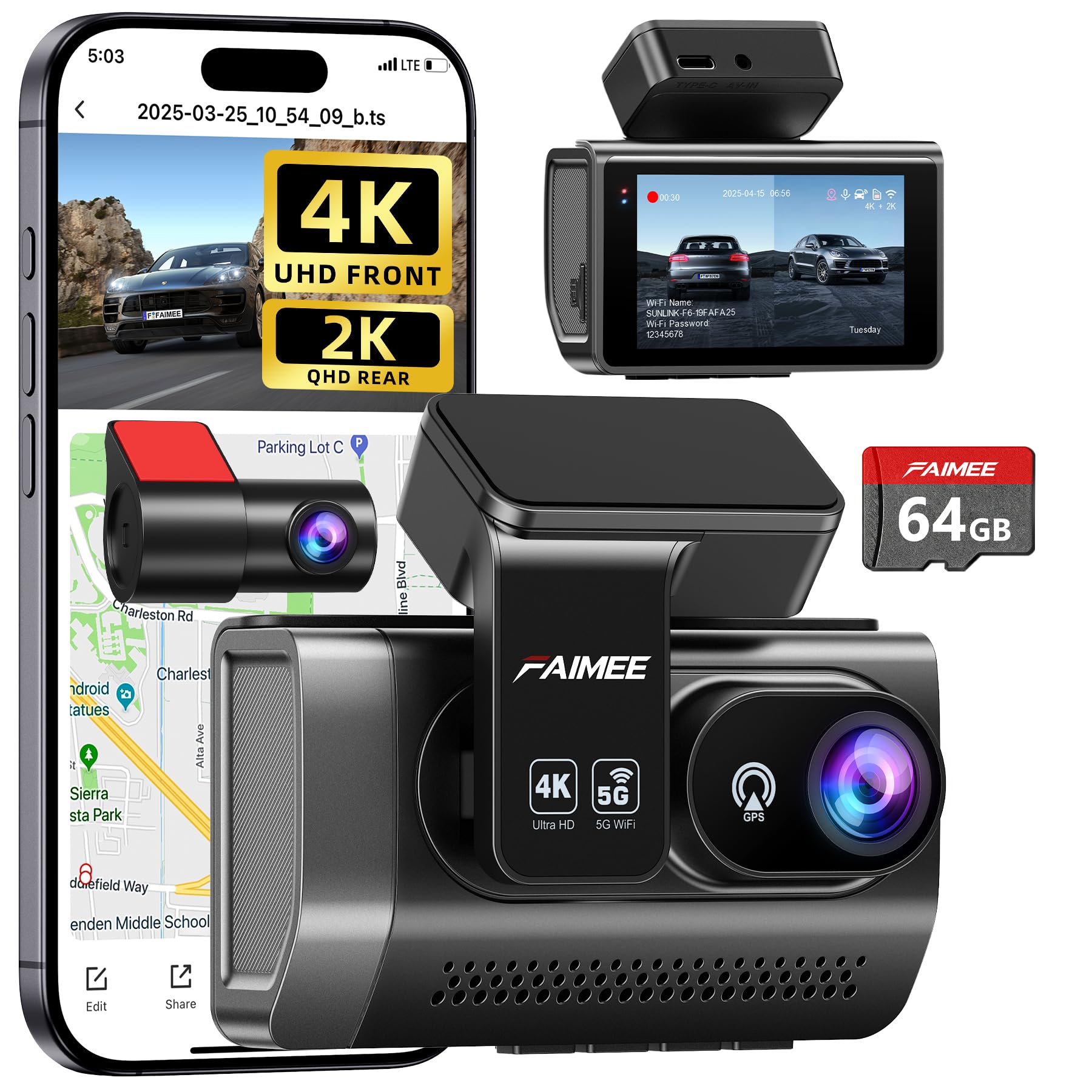
This dual-channel FAIMEE model strips away the interior camera to focus purely on front and rear recording, and it does so with a 4K front and 2K rear combination that rivals cameras costing more. The 170-degree front lens with F1.8 aperture and 6-layer glass optics capture broad, sharp footage, while the rear camera’s 2K resolution gives you substantially more detail than the 1080P rear cameras found on similarly priced competitors. The WDR and night vision processing handles high-contrast scenes—like headlights in a tunnel—without crushing shadows.
The 3-inch IPS screen is compact enough to tuck behind the rearview mirror without obstructing your forward view. The mount uses a secure adhesive sticker rather than a suction cup, which means no rattling or falling off on hot days. The included 64GB card supports up to 256GB expansion, and the G-sensor emergency lock preserves critical clips during loop recording. The dual-band Wi-Fi (5.8GHz and 2.4GHz) provides app connectivity for live previews and downloads, and the brand offers an 18-month warranty with 24/7 support.
Where this camera saves money is in the lack of STARVIS 2 sensor technology—the front sensor is a capable CMOS but not the latest Sony generation. Night performance is good but won’t match the REDTIGER F7N Pro or the ROVE R2-4K Dual PRO in extreme low-light conditions. The parking mode once again requires a separate hardwire kit. For drivers who prioritize a high-resolution rear camera and don’t need triple-channel coverage, this is a compelling mid-range pick that gets the fundamentals right.
What works
- Rear camera records at true 2K, superior to 1080P alternatives
- 170-degree front lens covers six lanes of traffic
- Compact 3-inch screen tucks neatly behind the mirror
- 18-month warranty with reliable customer support
What doesn’t
- No STARVIS 2 sensor—night clarity is good but not elite
- Hardwire kit needed for parking monitor, sold separately
- App navigation can be slightly unintuitive
6. 70mai Dash Cam Front and Rear (A410)
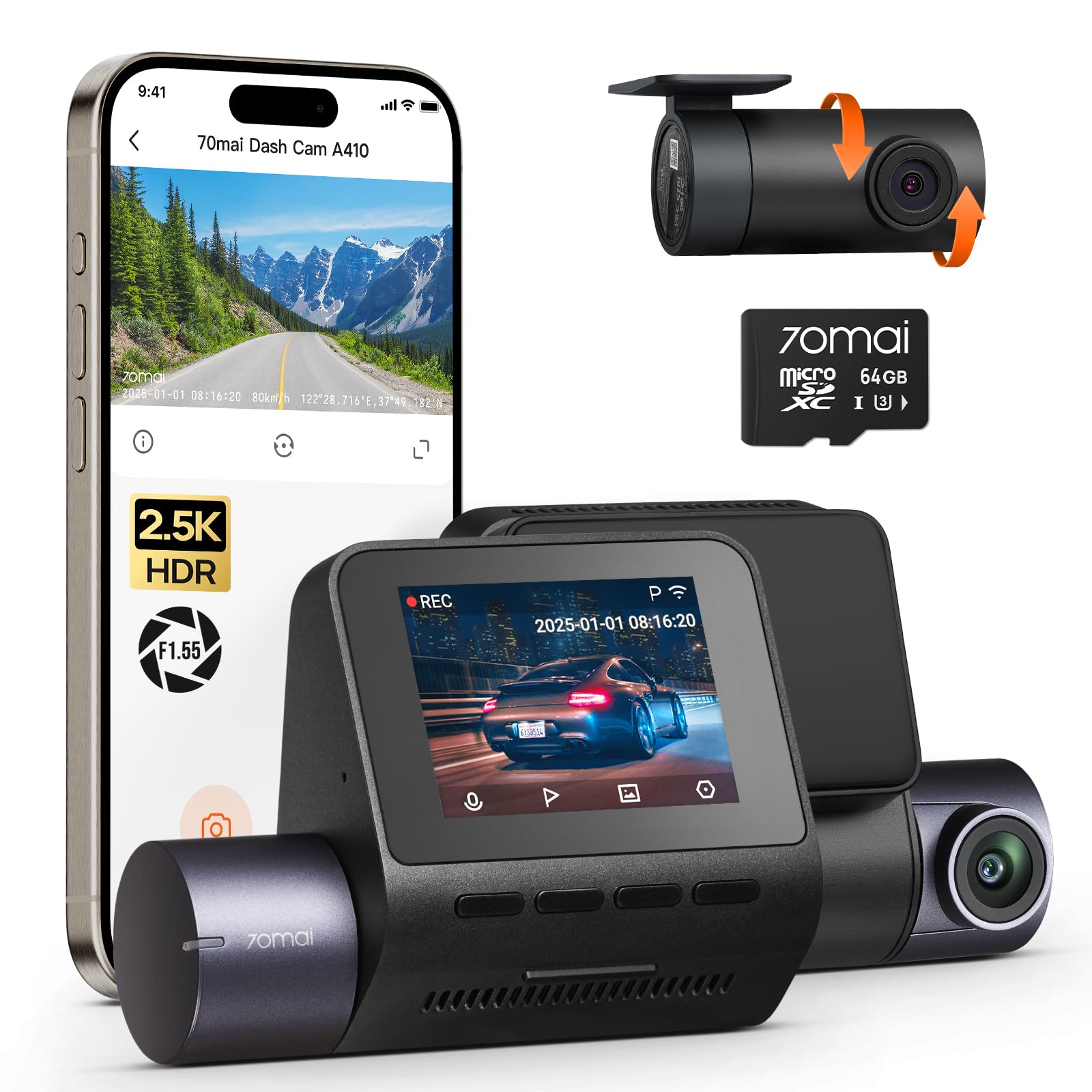
The 70mai A410 is the efficiency champion of the dual-lens dash cam world, packing a 2.5K (2560x1440P) front camera and 1080P rear camera into a sub-premium package that still includes a 64GB SD card in the box. The F1.55 front aperture with HDR and enhanced night vision produces surprisingly clean footage in low-light conditions, and the 125-degree front angle—narrower than the 170-degree competitors—actually reduces fisheye distortion, making license plates easier to read in the center of the frame.
What pushes the A410 ahead of other budget options is the built-in GPS module. At this price tier, many cameras omit GPS entirely or charge extra for the module. The 70mai embeds speed, coordinates, and timestamps directly onto the footage, creating court-admissible records. The electrostatic sticker mount holds firmly without leaving residue, ideal for leased vehicles. The Wi-Fi and app integration allows you to download clips wirelessly, though transfer speeds are slower than the WiFi 6 units in the premium tier.
The trade-offs are straightforward: the 2.5K front resolution is a step below 4K, so fine details like plates from a distance will be less crisp, and the 1080P rear is adequate but not exceptional. The parking mode (24/7 time-lapse) requires the UP03 hardwire kit (sold separately), and the app, while functional, has a slightly dated interface. For the driver who wants a reliable dual-lens system with GPS and a memory card included—without stretching into mid-range pricing—the 70mai A410 is a genuinely impressive budget-friendly option.
What works
- Built-in GPS at a sub-premium price point
- 64GB SD card included for immediate use
- F1.55 aperture and HDR deliver strong night footage for the resolution
- Electrostatic sticker mount leaves no sticky residue
What doesn’t
- 2.5K front resolution limits distant plate reading
- Rear camera is standard 1080P, not enhanced
- Parking mode hardwire kit is an add-on purchase
7. Pelsee P1 Pro 4K Dash Cam Front and Rear
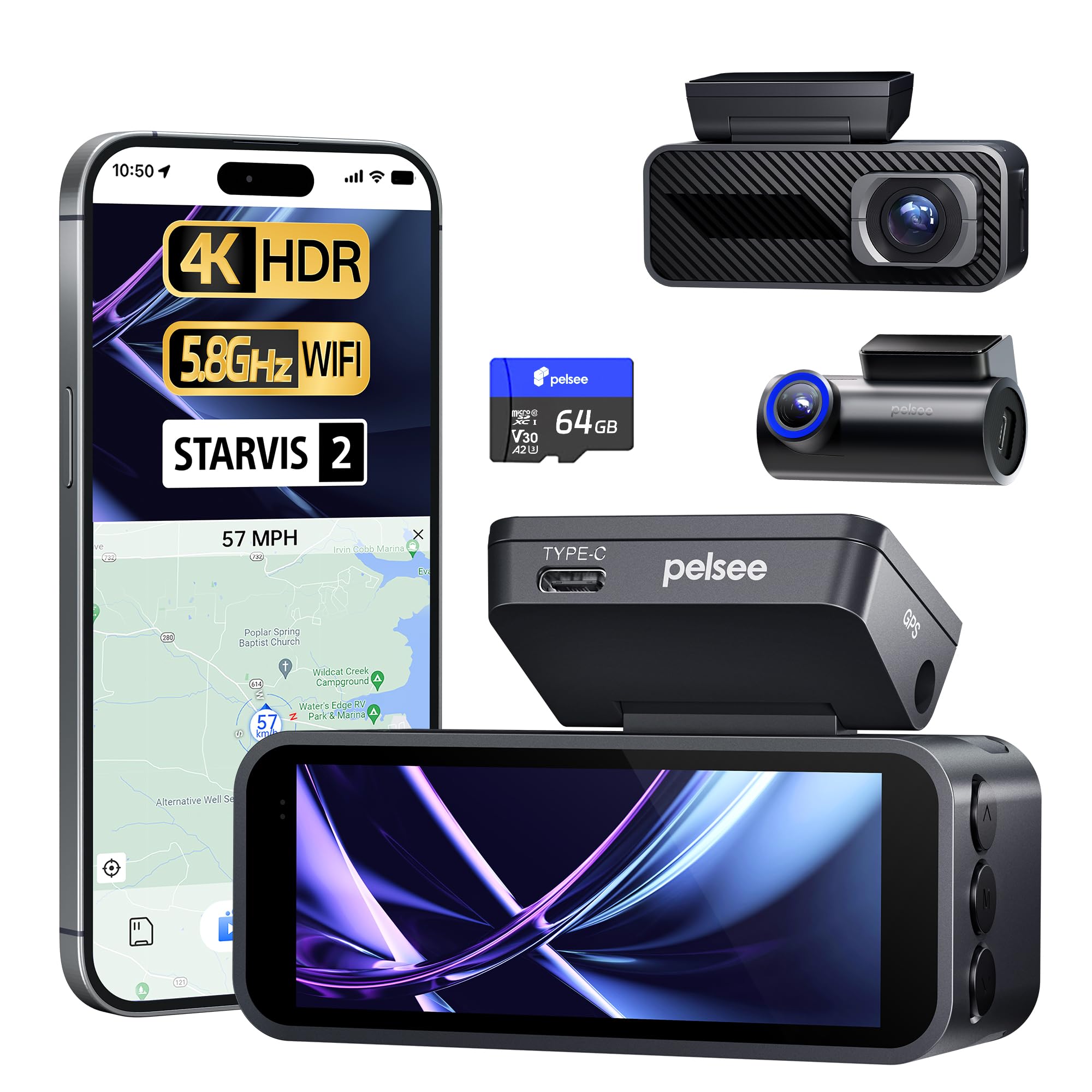
The Pelsee P1 Pro is the most affordable way to get a STARVIS 2 front sensor into your car. While most STARVIS 2 cameras sit firmly in the mid-range or premium tiers, the P1 Pro brings this technology at a budget-friendly price point without skimping on the core sensor advantage. The front 4K camera uses Sony’s STARVIS 2 sensor with HDR to cut through glare and capture plates in challenging light, while the rear records at 1080P with WDR to balance exposure in backlit scenarios.
The 3.39-inch HD IPS screen is larger than average, making menu navigation and live previews easier on the eyes. Voice control with eight commands—including “Lock the video!”—works through noise-canceling microphones that filter road noise, allowing true hands-free operation. The 5.8GHz Wi-Fi enables real-time viewing and downloading through the Pelsee Cam app, and the built-in GPS embeds speed, coordinates, and timestamps onto footage. The package includes a 64GB card, so you can start recording immediately.
The compromises are predictable at this entry-level price: the rear camera is limited to 1080P, and while the STARVIS 2 front handles night well, the overall processing pipeline doesn’t match the sophistication of premium units. The parking mode requires a hardwire kit (sold separately), and the ADAS (Advanced Driver Assistance System) warnings for lane departure and collision can be overly sensitive—some users disable them entirely. For the budget-conscious driver who absolutely wants STARVIS 2 front performance and doesn’t mind a more basic rear setup, the P1 Pro is a smart entry point.
What works
- STARVIS 2 front sensor at a budget-friendly price tier
- Large 3.39-inch screen for easy menu navigation
- Voice control with noise cancellation works reliably
- 64GB card included for out-of-box usability
What doesn’t
- Rear camera limited to 1080P resolution
- ADAS alerts can be overly sensitive and distracting
- Parking mode hardwire kit requires separate purchase
Hardware & Specs Guide
STARVIS 2 Sensor Technology
Sony’s STARVIS 2 (IMX678 and IMX675) sensors represent the current pinnacle of dash cam imaging. These back-illuminated CMOS sensors deliver approximately 4x greater low-light sensitivity compared to standard sensors. The key difference is how they handle near-infrared wavelengths—STARVIS 2 sensors can read license plates in conditions where the human eye struggles to see more than a few meters. When shopping a dual-lens system, check whether both the front and rear use STARVIS 2, or just the front. Premium units like the ROVE R2-4K Dual PRO and VIOFO A229 Pro use STARVIS 2 on both channels, while budget-friendly options like the Pelsee P1 Pro reserve it for the front only.
Simultaneous Recording Resolution
Dual-lens cameras split the image signal processor (ISP) resources between front and rear channels. A camera advertised as “4K” may drop to a lower resolution when the rear camera is active. Always look for the simultaneous recording resolution spec. For example, the FAIMEE 4K+2K model maintains full 4K front and 2K rear at the same time, while some cheaper units drop both channels to 2.7K when dual-recording. The ROVE R2-4K Dual PRO runs 4K front at 30fps and 2K rear at 30fps simultaneously without downscaling, which is why it requires a more powerful ISP and costs more. For accident evidence, higher simultaneous resolution means you can zoom into frames without pixelation.
Wi-Fi Generation and Transfer Speed
Dash cam Wi-Fi is used for pulling video clips directly to your phone without removing the SD card. Standard 2.4GHz Wi-Fi delivers transfers around 5-8MB/s, which means a 4K clip can take several minutes to download. Dual-band 5.8GHz Wi-Fi (found in Pelsee P1 Pro, FAIMEE models) boosts that to roughly 10-15MB/s. The ROVE R2-4K Dual PRO introduces WiFi 6 (802.11ax), which pushes transfer speeds up to 30MB/s—cutting download time for a 1-minute 4K clip from several minutes to under 30 seconds. If you frequently share footage for insurance or social media, WiFi 6 is a meaningful upgrade. The VIOFO A229 Pro uses 5GHz Wi-Fi, which is faster than 2.4GHz but not as quick as WiFi 6.
Parking Mode and Hardwire Kits
All seven cameras reviewed support some form of parking mode, but none include the required hardwire kit in the box. A hardwire kit connects the dash cam to your vehicle’s fusebox, providing constant power while preventing battery drain via a low-voltage cutoff. The three common parking modes are: time-lapse (1 frame per second, continuous), motion detection (wakes on movement in frame), and collision detection (wakes on G-sensor impact). Time-lapse is the most comprehensive but uses the most storage; collision detection saves battery and storage but can miss slow-speed incidents. If you park in a garage overnight, motion detection is usually sufficient. If you park on the street, time-lapse or collision detection offers better 24/7 protection.
FAQ
Should I get a 2-channel or 3-channel dash cam?
What does STARVIS 2 mean for night recording?
Can I use any microSD card in a dash cam?
Is hardwiring necessary for parking mode?
Final Thoughts: The Verdict
For most buyers, the car camera dual lens winner is the ROVE R2-4K Dual PRO because it combines dual STARVIS 2 sensors, true 4K+2K simultaneous recording, and WiFi 6 transfer speeds that make pulling footage effortless. If you want the ultimate three-channel coverage for rideshare driving, grab the VIOFO A229 Pro for its full HDR across all three lenses and infrared cabin camera. And for budget-conscious drivers who still want reliable dual-lens coverage with built-in GPS, nothing beats the 70mai A410.

Certification: BSc in Mechanical Engineering
Education: Mechanical engineer
Lives In: 539 W Commerce St, Dallas, TX 75208, USA
Md Amir is an auto mechanic student and writer with over half a decade of experience in the automotive field. He has worked with top automotive brands such as Lexus, Quantum, and also owns two automotive blogs autocarneed.com and taxiwiz.com.