A fuel regulator that drifts under load or surges at idle turns a crisp-running engine into a frustrating puzzle. Carbureted fuel systems depend on consistent pressure — too high floods the bowls, too low starves the jets. The right regulator locks in the sweet spot and keeps it there regardless of pump output or temperature swings.
I’m Amir — the founder and writer behind Four Wheel Ask. My approach to fuel system components comes from years of cross-referencing manufacturer flow curves, reviewing owner-reported pressure drift data, and evaluating machining tolerances across dozens of aftermarket regulators.
Whether restoring a classic muscle car or tuning a daily driver, finding the best fuel regulator for carburetors ensures a stable idle and reliable performance every time.
How To Choose The Best Fuel Regulator For Carburetors
Carbureted engines live in a narrow pressure band — usually between 1 and 7 PSI. A regulator that cannot hold steady within that window causes hard starts, flat spots, or fuel spillage. Three factors separate a reliable unit from a frustrating one: adjustable range, internal construction, and gauge readability.
Pressure Range and Adjustability
Single-carb setups typically need 3 to 5 PSI. Dual-carb or performance builds might require 5 to 7 PSI. A regulator with a numbered dial or threaded adjuster lets you dial in the exact pressure without guesswork. Avoid units that only offer a fixed pressure — carburetors respond differently to fuel delivery based on weather, elevation, and engine load.
Material and Build Quality
Zinc alloy and billet aluminum resist corrosion and vibration fatigue better than cast pot metal or plastic. Chrome-plated brass internals reduce wear from ethanol-blended fuels. Look for machined sealing surfaces rather than stamped gaskets — the difference shows up after a few thousand miles.
Gauge Accuracy and Dampening
A glycerin-filled gauge dampens needle flutter caused by pump pulses, giving you a true average reading rather than a bouncing guess. The scale should cover 0 to 15 PSI for carburetor use — anything wider makes fine adjustments harder to read. Verify that the gauge is replaceable; some budget regulators bond the gauge permanently into the body.
Quick Comparison
On smaller screens, swipe sideways to see the full table.
| Model | Category | Best For | Key Spec | Amazon |
|---|---|---|---|---|
| Holley 12-804 Chrome | Performance | Street and strip carb builds | 1-4 PSI, 3/8 NPT, chrome finish | Amazon |
| Spectre Performance 2518 | Mid-Range | Daily drivers and mild builds | 1-4 PSI, 3/8 barb, aluminum body | Amazon |
| YESHMA 1-5 PSI with Gauge | Value | First-time tuners and restorations | 1-5 PSI, glycerin gauge, zinc alloy | Amazon |
| Speedway Motors 5-12 PSI | Premium | High-output and boosted carb engines | 5-12 PSI, billet aluminum, non-return | Amazon |
| LVOUP Manual Adjustable | Budget | Basic single-carb setups | 1-5 PSI, zinc alloy, deadhead style | Amazon |
| YESHMA EFI 0-100 PSI Kit | Specialty | EFI conversions and high-pressure systems | 30-70 PSI, 6AN fittings, black aluminum | Amazon |
| Mr. Gasket 9710 | Heritage | Traditional builds with chrome look | 1-4 PSI, chrome finish, lightweight | Amazon |
In‑Depth Reviews
1. Holley 12-804 Chrome Carbureted Fuel Pressure Regulator

Holley’s 12-804 has been a staple in the carbureted performance world for years, and the engineering behind it explains the longevity. The aluminum body with chrome finish resists corrosion from ethanol fuels, while the internal restriction orifice — measured at 0.220 inches — prevents pressure spikes that can overwhelm needle-and-seat assemblies. The adjustable range from 1 to 4 PSI covers the vast majority of street and strip carburetor applications without unnecessary complexity.
The regulator uses three 3/8-inch NPT ports — one inlet, two outlets — which simplifies plumbing for dual-feed carburetors or return-style setups. A mounting bracket is included, and the unit weighs only 1.6 ounces, so unsprung weight on the firewall or fender apron is negligible. Owner reports consistently note that the 12-804 holds pressure within 0.25 PSI of the set point even after extended high-temperature runs.
Some users mention that the included bracket uses thin metal that can flex if over-torqued. The chrome finish also shows fingerprints and smudges readily, though that is purely cosmetic. For a mid-range price, the build consistency and parts support make this a low-risk choice for anyone serious about carburetor tuning.
What works
- Proven internal restriction design prevents overpressure
- Dual outlet ports simplify dual-carb plumbing
- Lightweight aluminum body resists corrosion
What doesn’t
- Mounting bracket feels thin at higher torque
- Chrome finish requires regular cleaning
- No gauge included for visual verification
2. Spectre Performance 2518 Fuel Pressure Regulator

Spectre’s 2518 targets the builder who wants a straightforward, no-nonsense regulator without unnecessary features. The aluminum body is machined to consistent tolerances, and the bright plated finish adds a clean look under the hood. Adjustability spans 1 to 4 PSI, which suits the majority of four-barrel and two-barrel carburetor applications found on small-block V8s and inline-six engines alike.
The regulator ships with 3/8-inch barb fittings and mounting hardware, so builders running rubber fuel line can install it without sourcing additional adapters. Spectre recommends pairing it with their 2515 or 59013 gauge for visual pressure confirmation. The unit weighs just over 11 ounces, making it light enough for panel mounting without additional bracing.
A few owners note that the barb fittings can feel loose in some grades of fuel hose unless a quality clamp is used. The adjustment screw also lacks a locking mechanism, so vibration could in theory shift the setting over extended use — though real-world reports of drift are infrequent. For a clean, simple regulator at a reasonable investment, the 2518 delivers reliable performance.
What works
- Barb fittings included for rubber hose installations
- Bright plated finish resists basic corrosion
- Lightweight aluminum body for easy mounting
What doesn’t
- No locking mechanism on adjustment screw
- Barb fittings may need aftermarket clamps
- Gauge sold separately
3. YESHMA 1-5 PSI Universal Fuel Pressure Regulator with Gauge

YESHMA’s universal regulator brings a complete kit approach — the regulator, a glycerin-filled gauge, steel clamps, rubber hoses, and brass fittings for both 5/16-inch and 3/8-inch fuel lines all arrive in one box. The zinc alloy body with chrome finish offers solid corrosion resistance, and the numbered dial on top allows fine adjustments between 1 and 5 PSI. The glycerin-filled gauge reads from 0 to 15 PSI, which is the ideal scale for carburetor work.
Glycerin dampening smooths out needle bounce caused by mechanical fuel pump pulses, giving a steady reading instead of a blur of movement. The kit includes adapters for single or dual carb setups, and the deadhead-style design works well when placed between the pump and carburetor. Maximum input pressure should not exceed 7 PSI, so this regulator is not intended for high-pressure electric pumps without a pre-regulator.
Some owners report that the gauge mounting thread can be delicate — over-tightening may deform the seal. The instructions are also minimal, so first-time installers should reference online guides. For a complete ready-to-run package at a budget-friendly price, this kit removes the hassle of sourcing separate components.
What works
- Complete kit includes gauge, hoses, and fittings
- Glycerin-filled gauge dampens pump pulses
- Numbered dial for repeatable adjustments
What doesn’t
- Gauge thread seal can deform if over-tightened
- Instructions are sparse for beginners
- Not for use with ethanol or leaded fuels
4. Speedway Motors Fuel Pressure Regulator, 5-12 PSI, Non-Return Style
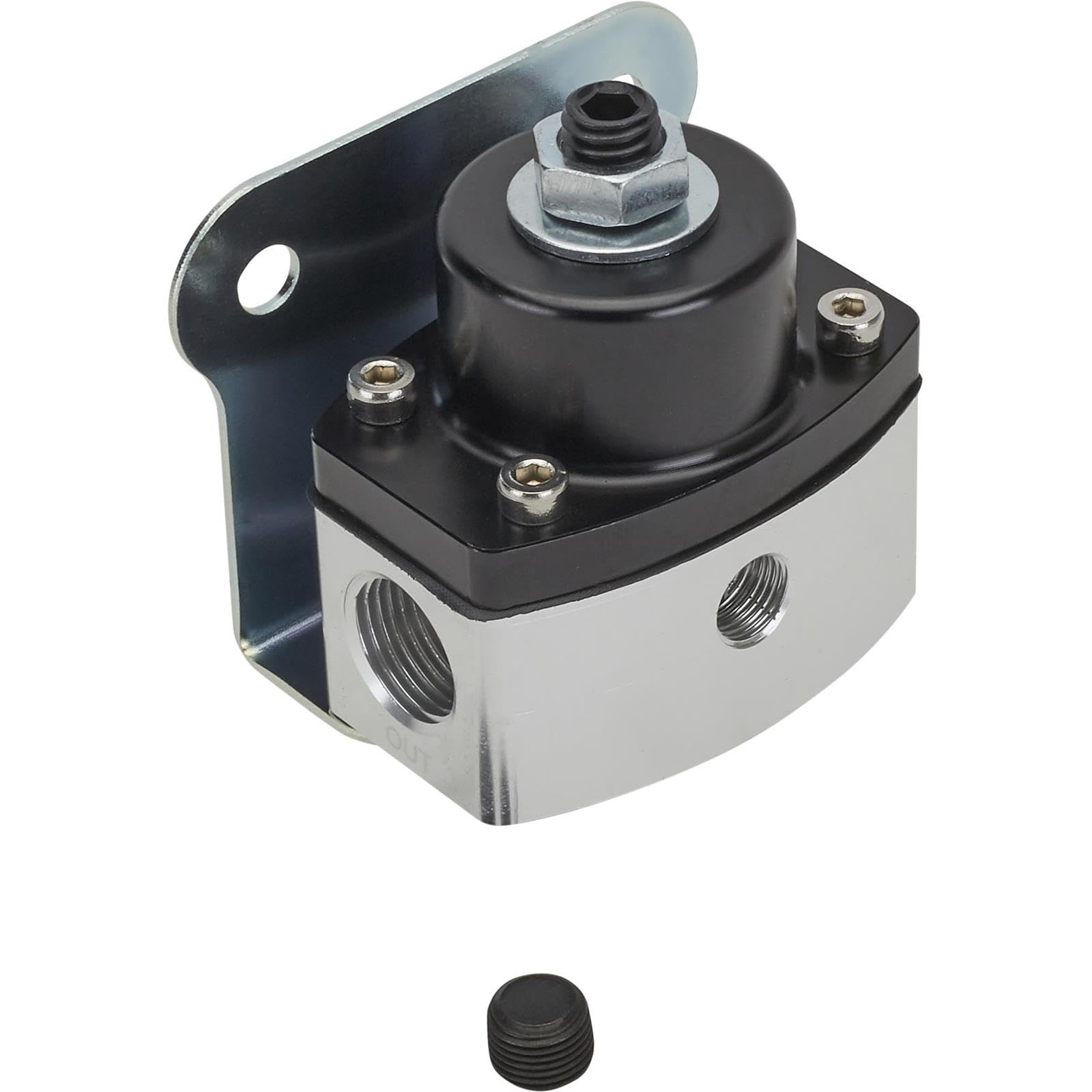
Speedway Motors steps into the higher-pressure arena with a 5 to 12 PSI non-return regulator machined from CNC billet aluminum. The wider pressure range suits boosted carburetor applications, high-output mechanical pumps, or engines that require elevated fuel bowl pressure to prevent vapor lock in hot climates. The non-return design means the regulator deadheads the fuel flow rather than bypassing excess back to the tank, which simplifies plumbing in space-constrained engine bays.
Internal components include a quality spring and diaphragm that maintain consistent pressure across the adjustment range. The machined exterior looks purposeful without being flashy, and the compact dimensions — 4 by 3.5 by 1 inches — allow mounting in tight locations. Owner reports indicate that the regulator holds set pressure within 0.5 PSI even under sustained high-load operation.
Because this is a non-return style, it is not compatible with return-style fuel systems that expect a bypass regulator. The 5 PSI minimum also rules out most stock carburetors that require 3 to 4 PSI. For builders running aggressive cam profiles or forced induction on carbureted engines, this regulator fills a specific gap that lower-pressure units cannot address.
What works
- CNC billet aluminum construction holds tolerances
- 5-12 PSI range suits boosted carb applications
- Non-return design simplifies underhood plumbing
What doesn’t
- Minimum 5 PSI too high for stock carburetors
- Not compatible with return-style fuel systems
- No gauge port included for monitoring
5. LVOUP Manual Adjustable 1-5 PSI Fuel Pressure Regulator

LVOUP’s AP107 offers an entry point into adjustable fuel regulation without demanding a premium investment. The deadhead-style regulator uses a numbered dial on top to adjust pressure between 1 and 5 PSI, and the zinc alloy body provides decent durability for the price point. Maximum input pressure should stay under 7 PSI, which aligns with typical mechanical fuel pump output on older engines.
The regulator is designed for single or twin carburetor applications and sits between the fuel pump and carburetor. The chrome-polished dial adds a clean visual element, and the included 0-15 PSI gauge allows basic pressure monitoring. At just over one pound, the unit feels solid in hand without being overly heavy for firewall mounting.
Some owners note that the adjustment dial can feel slightly imprecise — fine-tuning takes a few extra turns to find the exact PSI. The deadhead design also means that any pressure fluctuation from the pump goes directly to the carburetor, so consistent pump output is important. For a basic setup on a budget build, this regulator gets the job done without overcomplicating the fuel system.
What works
- Simple numbered dial adjustment
- Zinc alloy body provides decent durability
- Gauge included for pressure verification
What doesn’t
- Dial lacks fine-tuning precision
- Deadhead design passes pump fluctuations through
- Not suitable for fuel injection systems
6. YESHMA EFI Fuel Pressure Regulator Kit 0-100 PSI
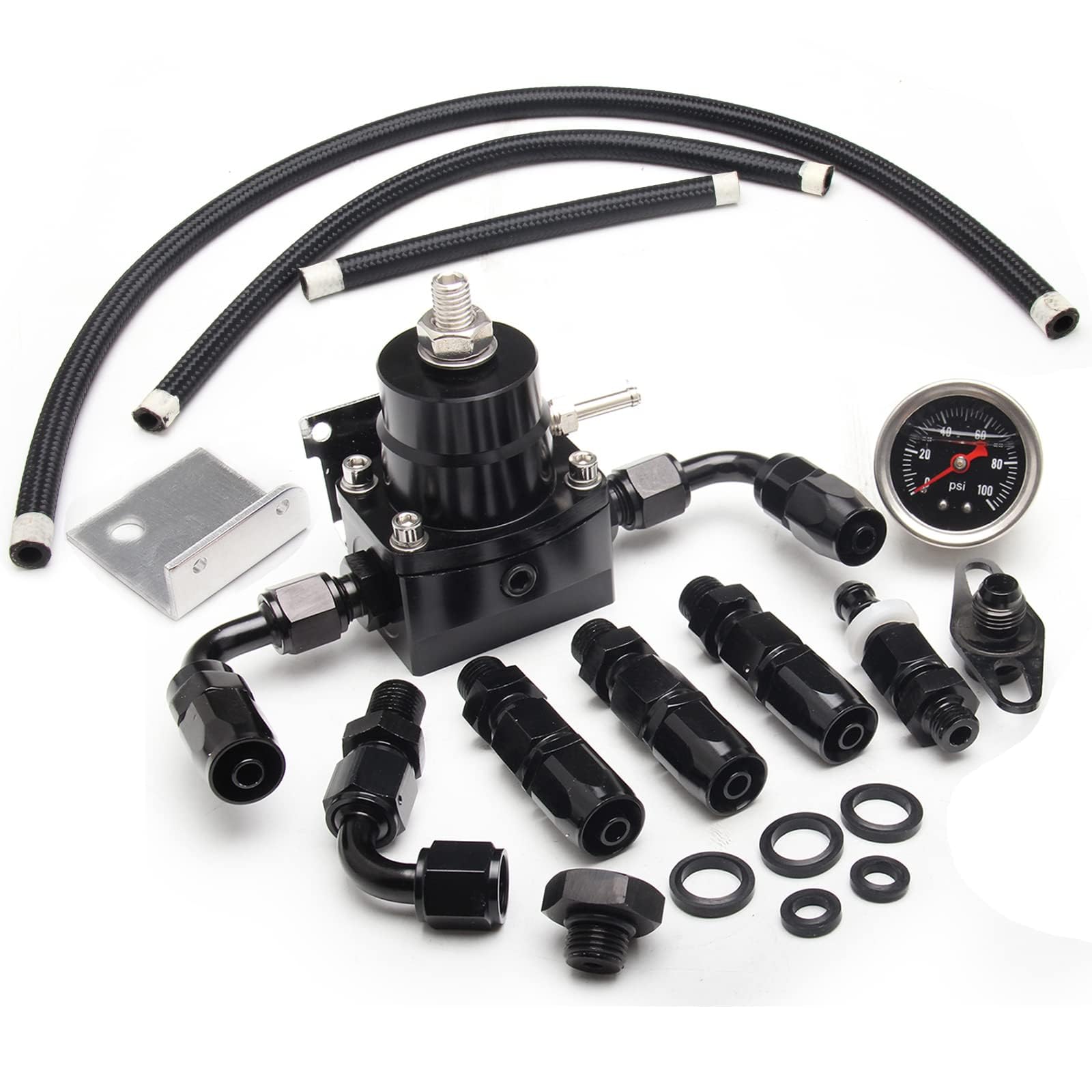
YESHMA’s EFI regulator kit addresses a different audience — builders converting a carbureted engine to electronic fuel injection or maintaining an existing EFI system. The aluminum regulator adjusts from 30 to 70 PSI, which covers the range required by most aftermarket throttle-body and multi-port injection setups. The black anodized finish blends into modern engine bays, and the kit includes a 0-100 PSI gauge for setup and monitoring.
The package is comprehensive: the regulator, gauge, three 6AN straight adapters, three 6AN 90-degree adapters, a fuel rail adapter, a mounting bracket, and three lengths of 6AN fuel line. The 304 stainless steel braided hose with CPE synthetic rubber liner offers good resistance to fuel degradation and abrasion. The 2.75-pound kit weight reflects the included hardware rather than the regulator alone.
This product is explicitly designed for EFI systems and should not be used with traditional carburetors. The pressure range is far too high for carburetor needle-and-seat assemblies, and the return-style design requires a fuel return line to the tank. For anyone planning an EFI swap, this kit consolidates most of the required fuel system hardware into a single purchase.
What works
- Complete EFI conversion kit with all fittings
- 30-70 PSI range covers most EFI systems
- Stainless braided hose with synthetic rubber liner
What doesn’t
- Not compatible with carbureted fuel systems
- Requires return line to fuel tank
- Professional installation recommended
7. Mr. Gasket 9710 Fuel Pressure Regulator, Chrome
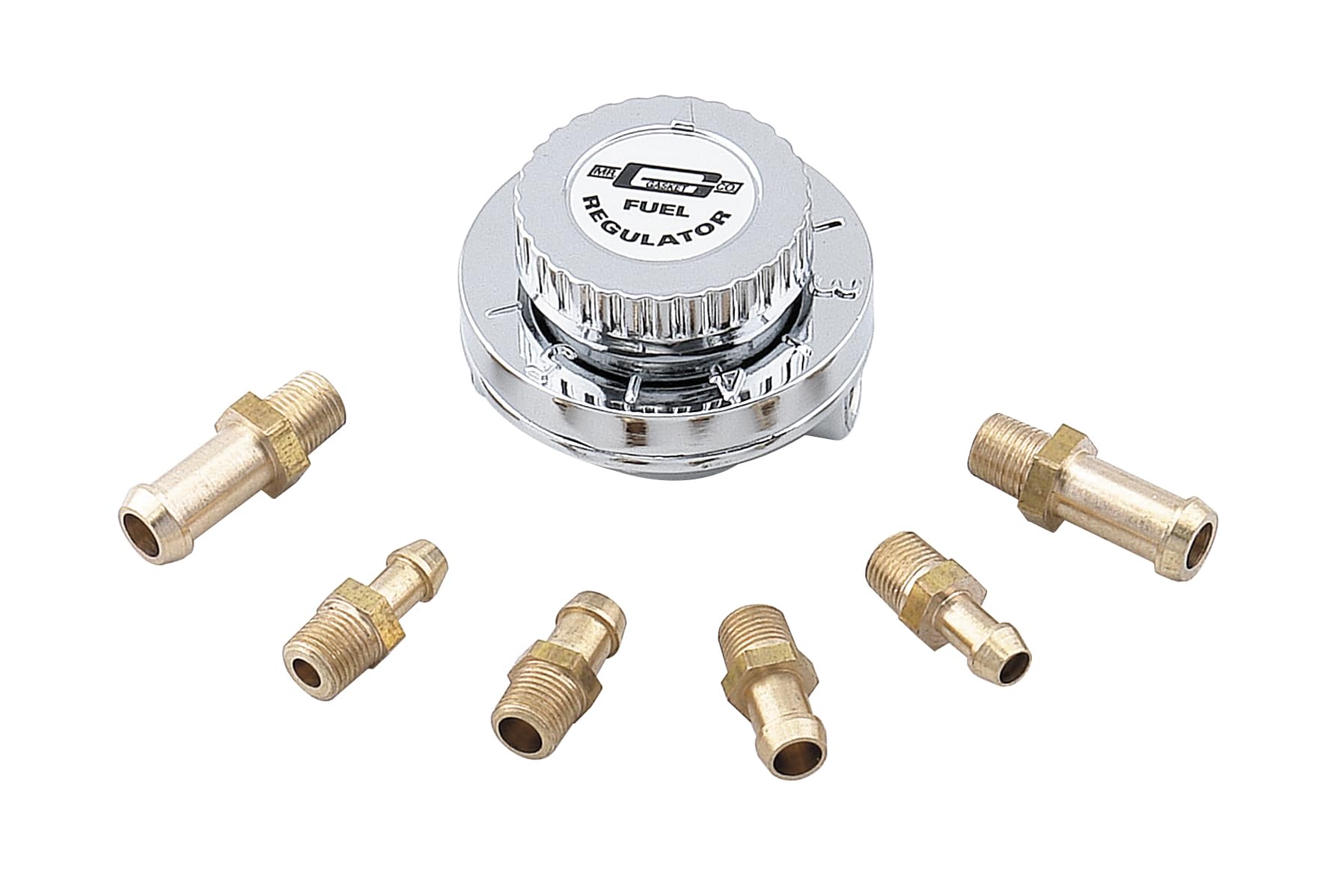
Mr. Gasket’s 9710 has been on the market since 2004, and its longevity speaks to its straightforward design and reliable performance. The chrome-plated exterior gives a classic polished look that appeals to restorers and traditional hot rod builders. The regulator adjusts within the 1 to 4 PSI range, which covers the requirements of most stock and mildly modified carbureted engines. At only 8 ounces, it is one of the lightest options available, reducing stress on mounting surfaces.
The unit includes mounting hardware and uses a simple screw-type adjuster for pressure changes. The plastic internal material noted in the specifications is a consideration — while it keeps weight down and cost accessible, long-term exposure to ethanol fuels may accelerate wear compared to all-metal internals. The compact dimensions — 7.5 by 5.4 by 1.5 inches — fit easily into tight engine compartments.
Some owners report that the adjustment screw can be sensitive, requiring small turns to avoid overshooting the target pressure. The chrome finish also requires care to prevent pitting in humid environments. For a traditional appearance and a brand name that has supported the automotive aftermarket for decades, the 9710 remains a viable option for light-duty carbureted applications.
What works
- Classic chrome finish suits restoration builds
- Very lightweight at 8 ounces
- Simple screw adjustment with included hardware
What doesn’t
- Plastic internals may degrade with ethanol fuel
- Adjustment screw is sensitive to small turns
- Chrome can pit in humid conditions
Hardware & Specs Guide
Deadhead vs. Return-Style Regulators
Deadhead regulators restrict flow between the pump and carburetor, slowing fuel delivery to lower pressure. They are simpler to install and work well with mechanical pumps that produce steady output. Return-style regulators bleed excess fuel back to the tank, which helps manage heat and pressure in high-output electric pump systems. For carbureted builds below 5 PSI, deadhead is usually sufficient; for boosted or high-flow setups, a bypass design is preferable.
Glycerin-Filled vs. Dry Gauges
A glycerin-filled gauge uses viscous fluid to dampen needle oscillation caused by pump pulses. This gives a readable average pressure rather than a bouncing needle. Dry gauges are cheaper but suffer from needle flutter that makes fine tuning difficult. For carburetor work where 0.25 PSI adjustments matter, a glycerin-filled gauge provides the stability needed for accurate settings.
Port Size and Fitting Compatibility
Most carburetor regulators use 3/8-inch NPT ports or barb fittings for 5/16-inch and 3/8-inch fuel hose. NPT ports allow the use of AN adapters for braided hose setups, while barb fittings simplify rubber hose connections. Verify that the regulator ports match your existing fuel line size — mismatched fittings create flow restrictions and potential leak points.
Material Selection and Fuel Compatibility
Zinc alloy and billet aluminum resist corrosion from ethanol-blended gasoline better than untreated steel or pot metal. Chrome plating adds a layer of protection but can chip if overtightened. Plastic internal components should be avoided for long-term use with E10 or E15 fuels, as ethanol can degrade certain polymers over time. Brass internals offer the best compatibility with oxygenated fuels.
FAQ
What PSI should I set my carburetor fuel regulator to?
Can I use a fuel injection regulator on a carbureted engine?
Do I need a return line for a carburetor fuel pressure regulator?
How do I know if my fuel regulator is failing?
Will a fuel pressure regulator increase horsepower?
Final Thoughts: The Verdict
For most buyers, the best fuel regulator for carburetors winner is the Holley 12-804 Chrome because it combines proven internal restriction design, dual outlet ports, and corrosion-resistant construction at a mid-range price point. If you want a complete kit with a glycerin-filled gauge, grab the YESHMA 1-5 PSI Universal Regulator. And for high-output or boosted carbureted engines, nothing beats the Speedway Motors 5-12 PSI Non-Return Regulator.

Certification: BSc in Mechanical Engineering
Education: Mechanical engineer
Lives In: 539 W Commerce St, Dallas, TX 75208, USA
Md Amir is an auto mechanic student and writer with over half a decade of experience in the automotive field. He has worked with top automotive brands such as Lexus, Quantum, and also owns two automotive blogs autocarneed.com and taxiwiz.com.