A sagging front end and limited ground clearance are the two complaints that come up most often when owners start researching suspension upgrades for the first-generation Frontier. The factory rake leaves the nose low, and the stock ride height barely clears moderate trails without scraping. A well-chosen lift addresses both issues while maintaining daily-driver comfort.
I’m Amir — the founder and writer behind Four Wheel Ask. My approach centers on cross-referencing manufacturer engineering claims with long-term owner reports to identify which suspension components actually hold up to real-world use and which ones introduce new problems.
Finding the ideal best 2001 nissan frontier lift kit requires matching your off-road goals with the right suspension components and build quality.
How To Choose The Best 2001 Nissan Frontier Lift Kit
Selecting a lift for a first-gen Frontier involves more than picking a height number. The 2001 model uses a torsion bar front suspension and leaf spring rear setup, which limits certain types of lifts and makes component compatibility critical. Understanding the trade-offs between budget-friendly spacer kits and full suspension replacements will save you from buying parts that don’t work together.
Spacer Lifts vs Full Suspension Kits
Spacer lifts — aluminum pucks that sit on top of the strut assembly — are the most affordable way to gain ride height. They retain factory springs and shocks, so the ride feel stays close to stock. The downside is minimal gain in wheel travel and no improvement in damping control. Full suspension kits replace struts and shocks with longer units designed for the increased height, offering better off-road control and consistent damping at the cost of a higher entry point.
Supporting Components You Cannot Skip
Once you exceed roughly 2 inches of front lift, the upper control arms on the Frontier reach the limit of their ball joint angle. Stock control arms bind at full droop and accelerate ball joint wear. Upgraded aftermarket control arms with revised geometry restore proper alignment range and prevent premature failure. Tie rod ends and sway bar links may also need attention depending on lift height and intended use.
Material Quality and Hardware Considerations
Look for T6061 billet aluminum spacers rather than cast or welded units — the material grade directly affects long-term fatigue resistance. Hardware should be Grade 8 steel for critical fasteners. Kits that include pre-assembled components reduce installation complexity, while those requiring spring compressor work demand more mechanical experience. Warranty coverage from established brands provides a useful signal of manufacturer confidence.
Quick Comparison
On smaller screens, swipe sideways to see the full table.
| Model | Category | Best For | Key Spec | Amazon |
|---|---|---|---|---|
| Rough Country 2.5″ w/N3 Struts | Premium | Full suspension upgrade | 2.5 in lift, N3 monotube struts | Amazon |
| Rough Country 2.5″ Anodized Red | Spacer Lift | Budget-friendly leveling | 2.5 in lift, billet aluminum spacers | Amazon |
| Detroit Axle 4pc Control Arms | Suspension | Front end rebuild after lift | Upper + lower arms, pre-assembled ball joints | Amazon |
| Detroit Axle 8pc Suspension Kit | Full Front | Complete front suspension refresh | 4 arms + 4 tie rods, 10-year warranty | Amazon |
| Rough Country 2″ TJ/LJ Lift | Off-Road | Jeep Wrangler lift reference | 2 in lift, N3 shocks, coil spacers | Amazon |
| TORCH 3″ Chevy/GMC Lift | Torsion Key | GM torsion bar suspension reference | 3 in lift, torsion keys, lift blocks | Amazon |
In‑Depth Reviews
1. Rough Country 2.5″ Lift Kit w/N3 Struts & Shocks

This kit delivers a genuine 2.5-inch front lift using a combination that addresses both height and damping: precision aluminum spacers mount to the factory strut towers, and the included N3 monotube struts and rear shocks replace the stock units entirely. The result is a controlled ride that resists bottoming on washboard roads while maintaining composed highway manners. Rough Country specifies this for 2005–2026 Frontier 4WD models, so first-gen owners should verify cross-compatibility before ordering.
The build quality stands out in the details — the front spacers are machined from T6061 billet aluminum rather than cast material, and the rear lift shackles use 3/8-inch plate steel with DOM-tubed bolt sleeves and Grade 8 hardware. The N3 shocks use a monotube design that dissipates heat faster than twin-tube alternatives, which matters during extended off-road use. No spring compressor is needed for installation since the spacers mount on top of the assembled strut.
Owner feedback consistently highlights the transformed ride quality compared to spacer-only kits, with particular praise for the rear shackles that maintain the factory leaf spring arch without introducing driveline vibration. The limited lifetime warranty backs the entire package, and Rough Country’s support network makes replacement parts easy to source if needed. This is the most complete option for buyers who want a genuine suspension upgrade rather than a simple height gain.
What works
- Monotube struts and shocks provide real damping improvement over stock
- T6061 billet spacers and Grade 8 hardware indicate long-term durability
- Bolt-on design requires no spring compressor for installation
- Limited lifetime warranty covers the complete kit
What doesn’t
- Officially fits 2005 and newer Frontier models, not direct for 2001
- Premium pricing reflects full strut and shock replacement
- Heavier overall weight adds to shipping and handling
2. Rough Country 2.5″ Lift Kit Anodized Red (867RED)

The 867RED kit uses a straightforward spacer-and-shackle approach to gain 2.5 inches of front lift and roughly 1.5 inches of rear lift, leveling the factory rake without replacing the struts or shocks. The front spacers are machined from T6061 aircraft-quality billet aluminum with a red anodized finish, and the rear lift is achieved through 1.5-inch lifted shackles that bolt directly to the leaf spring eyes. This is a clean, no-surprises design for buyers who want height without complexity.
Fitment is listed for 2005–2024 Nissan Frontier models, so 2001 owners need to confirm suspension compatibility before purchase — the torsion bar front end on first-gen trucks uses a fundamentally different geometry than the coilover strut setup on the 2005+ generation. The included hardware is sufficient for a weekend installation, and Rough Country’s limited lifetime warranty provides coverage on the aluminum components. The kit weighs only 4.3 pounds, making shipping and handling effortless.
Owner reports on later-model Frontiers note that the ride quality remains very close to stock since the factory springs and dampers are retained, though the front lift can introduce a slightly firmer feel at the limit of compression. The red anodized spacers add visual appeal under the hood for those who appreciate a coordinated engine bay. For budget-conscious builders who can verify fitment, this kit offers the lowest entry point to a leveled stance.
What works
- T6061 billet aluminum spacers resist fatigue and corrosion
- Retains factory struts and shocks, keeping cost low
- Lightweight at 4.3 pounds with simple bolt-on installation
- Limited lifetime warranty from an established brand
What doesn’t
- Officially fits 2005–2024 Frontier, not direct for 2001 model year
- No improvement in damping or wheel travel over stock
- Red anodized finish may not appeal to all buyers
3. Detroit Axle 4pc Front Control Arms (2000–2004 Frontier)
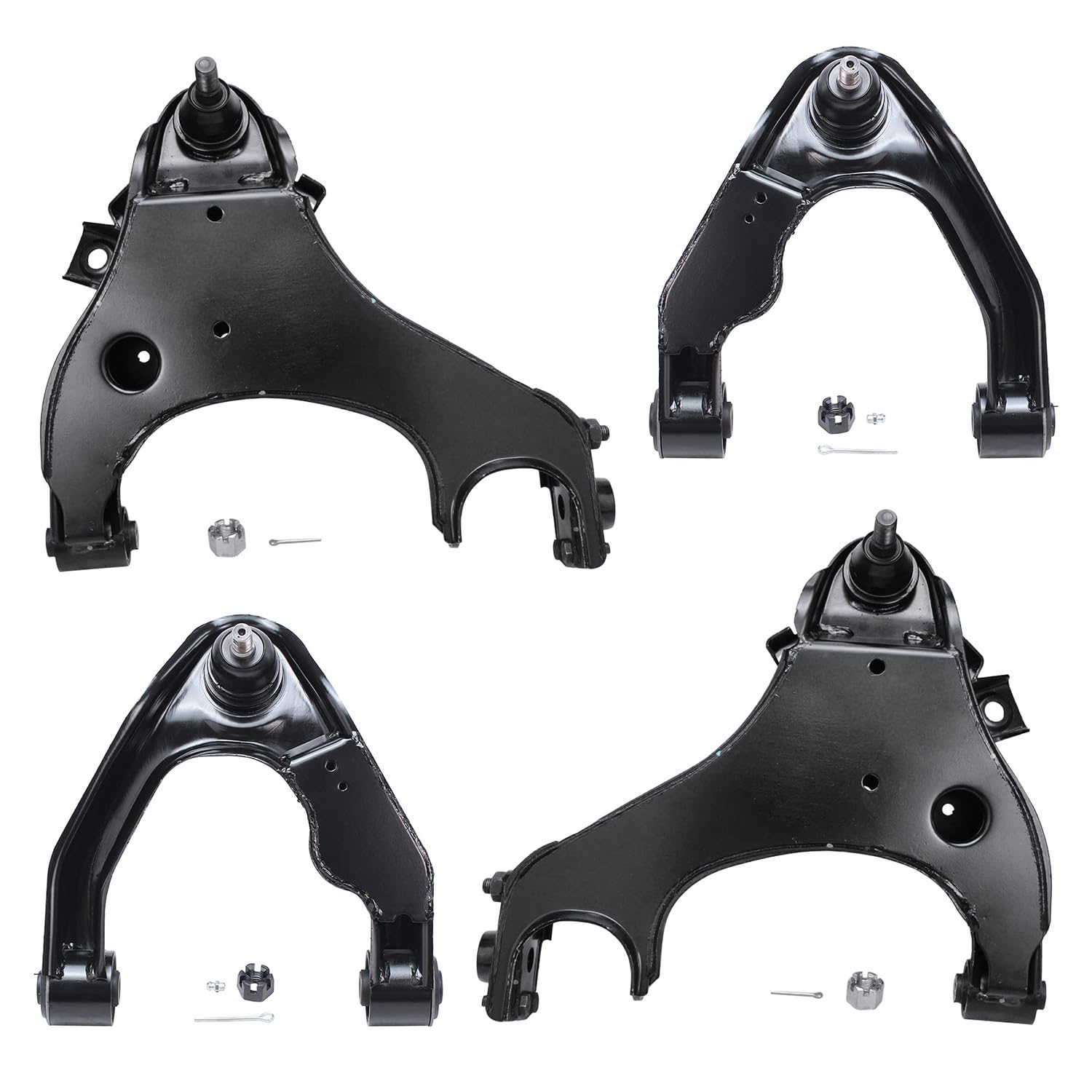
This kit delivers four replacement control arms — two upper and two lower — with ball joints pre-assembled, making it a direct bolt-in upgrade for 2000–2004 Nissan Frontier models equipped with the 3.3L V6 and built after September 1999. The arms are designed to restore factory geometry after the front end sags or when upgrading to a taller ride height. Pre-assembled ball joints eliminate the need for a press during installation, which saves significant shop time.
Detroit Axle subjects these components to impact, wear, and fatigue testing, and the 10-year warranty signals confidence in the manufacturing process. The control arms are finished in black e-coat for corrosion resistance, and the bushings are pre-installed with the correct interference fit. For a lifted Frontier, these arms become particularly relevant because stock upper arms often max out their ball joint angle past 2 inches of lift, causing binding and premature wear.
Owner feedback from first-gen Frontier and Xterra owners indicates that the replacement arms restore proper alignment range and eliminate clunking noises from worn factory ball joints. The 47.93-pound total weight reflects the solid construction of the stamped steel arms and integrated ball joints. This kit addresses the most critical wear point in the front suspension after a lift is installed, making it a logical supporting purchase alongside any lift kit.
What works
- Pre-assembled ball joints eliminate press work during installation
- Direct fit for 2000–2004 Frontier 3.3L models
- 10-year warranty provides long-term coverage
- Restores proper alignment range after front lift installation
What doesn’t
- Stamped steel construction rather than tubular aftermarket design
- Heavy at nearly 48 pounds for the full set
- Does not include tie rod ends or sway bar links
4. Detroit Axle 8pc Front Suspension Kit (2000–2004 Frontier)

This expanded kit builds on the four control arms by adding inner and outer tie rod ends, creating a comprehensive front suspension refresh package for 2000–2004 Nissan Frontier models with the 3.3L V6. The eight-piece set includes two upper control arms, two lower control arms, two inner tie rods, and two outer tie rod ends — everything needed to restore steering precision and suspension geometry in one order. Like the four-piece set, all ball joints come pre-assembled.
The tie rod ends are often overlooked during lift installations, but the increased ride height alters the steering arm angle and accelerates wear on the factory units. Replacing them simultaneously with the control arms ensures the entire front end is operating with fresh components that share the same wear cycle. Detroit Axle applies the same impact and fatigue testing to the tie rods as the arms, and the 10-year warranty covers the entire kit.
At 52.7 pounds, this is a substantial package that covers nearly every wear item in the front suspension. Owner reports note that the combination of fresh control arms and new tie rods eliminates steering play and wandering that develops as factory components age. For a lifted 2001 Frontier, this kit represents the most thorough approach to front-end restoration, ensuring that the lift installation starts from a fully refreshed foundation rather than masking worn parts.
What works
- Complete front end refresh with control arms and tie rods in one kit
- Pre-assembled ball joints save installation time and labor cost
- 10-year warranty covers all eight components
- Direct fit for 2000–2004 Frontier with 3.3L engine
What doesn’t
- Heavy package at over 52 pounds increases shipping cost
- Stamped steel arms rather than tubular performance design
- Does not include sway bar links or bushings
5. Rough Country 2″ Suspension Lift Kit for Jeep Wrangler TJ/LJ

This lift kit is engineered specifically for the 1997–2006 Jeep Wrangler TJ and LJ, using a coil spring spacer design with N3 shock absorbers and shock relocation brackets to deliver 2 inches of lift. The front spacers mount above the coil springs with a spring retention design that keeps the coils seated during extreme articulation. This is not a Frontier-compatible kit — it is included here as a reference point for understanding how a complete spacer-plus-shock system works on a different platform.
The N3 shocks included in this kit are the same monotube design used in Rough Country’s other applications, featuring nitrogen-charged construction for consistent damping. The shock relocation brackets are necessary on the TJ platform to correct the shock angle at increased ride height. The kit maintains a factory-like ride quality according to Wrangler owner reports, with notable improvement in off-road control compared to stock shocks alone.
At 15.42 kilograms (approximately 34 pounds), the kit is relatively lightweight for a complete suspension set. The limited lifetime warranty applies to all Rough Country components. For Frontier owners evaluating lift options, studying this kit’s combination of spacers and shocks illustrates the trade-off between simple height gain and genuine suspension performance improvement — the same principle applies when choosing between a Frontier spacer kit and a full strut replacement system.
What works
- N3 monotube shocks provide real damping improvement over stock
- Spring retention design prevents coil separation during flex
- Limited lifetime warranty covers all components
- Bolt-on installation with relocation brackets included
What doesn’t
- Designed for Jeep Wrangler TJ/LJ, not Nissan Frontier
- 2-inch lift is modest compared to other options
- Spacer-based front lift limits wheel travel gain
6. TORCH 3″ Lift Kit for Chevy Silverado GMC Sierra 1500

This TORCH kit is built for 1999–2007 Chevy Silverado and GMC Sierra 1500 4WD trucks with torsion bar front suspension — a system that shares conceptual similarities with the 2001 Frontier’s front suspension but uses different components and geometry. The kit includes adjustable torsion keys, front shock extenders, tapered rear lift blocks, extended U-bolts, and a torsion key unloading tool. The lift height reaches 3 inches when properly adjusted.
The torsion key design allows the front ride height to be fine-tuned by rotating the keys, which increases preload on the torsion bars. While this is an effective method for gaining height on torsion bar trucks, it comes at the cost of ride firmness — more preload means a stiffer front end. The rear uses tapered blocks between the axle and leaf springs to match the front lift, with extended U-bolts to maintain clamping force. TORCH provides a lifetime warranty and step-by-step instructions.
This kit serves as an educational reference for Frontier owners because the 2001 Frontier also uses torsion bar front suspension, though the specific components differ between Nissan and GM platforms. Understanding the torsion key lift method — its adjustability advantages and its ride quality trade-offs — helps Frontier owners evaluate whether a similar approach or a spacer-based system better suits their goals. The included unloading tool is a practical addition that makes the job safer.
What works
- Adjustable torsion keys allow fine-tuning of front ride height
- Includes unloading tool for safer torsion bar service
- Lifetime warranty on all components
- Complete kit with shock extenders and rear blocks
What doesn’t
- Designed for Chevy/GMC trucks, not Nissan Frontier
- Torsion key preload increase results in firmer ride quality
- 3-inch lift may require additional supporting modifications
Hardware & Specs Guide
Spacer Material Grades
The quality of aluminum spacers varies significantly between kits. T6061 billet aluminum is the industry standard for automotive suspension spacers because of its high tensile strength (45,000 psi), excellent corrosion resistance, and good machinability. Lower-cost kits may use cast aluminum or 6063 alloy, which are softer and more prone to cracking under cyclical loads. Always verify the specific alloy grade listed in the manufacturer specifications before purchasing. Forged steel spacers exist but are rare in this category — the weight penalty usually outweighs the strength benefit.
Ball Joint Angle and Lift Height
Every front suspension has a maximum ball joint operating angle. On the 2001 Frontier, lifting beyond 2 inches typically pushes the upper ball joint past its designed range of motion, causing binding at full droop and accelerated wear during normal driving. Aftermarket control arms with revised ball joint mounting angles restore proper geometry. The critical spec to check is the ball joint’s angular travel range — most stock arms provide around 20–22 degrees, while lifted-specific arms often increase this to 28–30 degrees.
Shock Absorber Damping Types
Twin-tube shocks are the standard budget option — they use an inner working tube and an outer reserve tube, which allows for a lower manufacturing cost but limits heat dissipation during sustained off-road use. Monotube shocks use a single tube with a floating piston that separates oil from nitrogen gas, providing more consistent damping over rough terrain and better heat rejection. The N3 monotube design used in Rough Country kits is a nitrogen-charged monotube built to a price point that balances performance and affordability.
Hardware Grade and Fastener Standards
Hardware quality determines whether a lift kit stays tight over years of vibration. Grade 8 fasteners have a minimum tensile strength of 150,000 psi, compared to Grade 5 at 120,000 psi and Grade 2 at 74,000 psi. Kits that include Grade 8 hardware with zinc or chrome plating resist corrosion and maintain clamp load longer. The bolt diameter and thread pitch must match factory specifications — using oversized or undersized fasteners creates stress risers in the mounting points and can lead to component fatigue.
FAQ
What is the maximum safe lift height for a 2001 Nissan Frontier?
Do I need new control arms when lifting a 2001 Frontier?
Will a lift kit affect my Frontier ride quality?
What supporting parts should I replace when lifting a 2001 Frontier?
Final Thoughts: The Verdict
For most buyers, the best 2001 nissan frontier lift kit winner is the Detroit Axle 4pc Front Control Arms because it directly addresses the most common front-end wear point on lifted first-gen Frontiers while being specifically engineered for the 2000–2004 model years. If you want a complete front-end refresh with tie rods included, grab the Detroit Axle 8pc Suspension Kit. And for a full suspension upgrade with monotube damping, the Rough Country 2.5″ w/N3 Struts offers the best performance package.

Certification: BSc in Mechanical Engineering
Education: Mechanical engineer
Lives In: 539 W Commerce St, Dallas, TX 75208, USA
Md Amir is an auto mechanic student and writer with over half a decade of experience in the automotive field. He has worked with top automotive brands such as Lexus, Quantum, and also owns two automotive blogs autocarneed.com and taxiwiz.com.