Choosing a converter to turn your vehicle’s 12V DC power into usable AC current sounds straightforward — until you realize that waveform type, continuous wattage, and port layout make the difference between a reliable road trip companion and a device that leaves your laptop dead on the side of the highway.
I’m Amir — the founder and writer behind Four Wheel Ask. I’ve spent countless hours dissecting product specifications, comparing build quality reports, and aggregating owner feedback across hundreds of models to separate the units that deliver stable, clean power from those that merely advertise it.
After evaluating five distinct contenders that span modified sine wave efficiency and pure sine wave precision, I’ve identified the models that earn a spot in your vehicle. This guide helps you find the best ac/dc power inverter for your specific gear and driving habits without overspending on features you don’t need.
How To Choose The Best AC/DC Power Inverter
Selecting the right inverter comes down to understanding three core factors: the electrical waveform it produces, the wattage it can sustain, and the safety systems it includes. Each factor dictates what devices you can power reliably and how long the unit will last under load.
Waveform Type: Pure vs. Modified Sine Wave
Modified sine wave inverters are more affordable and work fine for resistive loads like string lights, basic tools, and simple chargers. However, sensitive electronics — laptops with precision power supplies, medical devices, or audio equipment — require pure sine wave output to operate without hum, overheating, or erratic behavior. Pure sine wave inverters generate power closer to what you get from a wall outlet at home.
Continuous vs. Peak Wattage
Every inverter lists two power numbers. Continuous wattage is the amount it can deliver indefinitely. Peak (or surge) wattage is what it can handle for a brief moment, usually when a motor starts. A 500W continuous inverter with a 1000W peak can handle a small fridge that draws 80W continuously but spikes to 600W on startup. Never buy based on peak wattage alone.
Quick Comparison
On smaller screens, swipe sideways to see the full table.
| Model | Category | Best For | Key Spec | Amazon |
|---|---|---|---|---|
| ALLWEI 500W Pure Sine Wave | Pure Sine | Sensitive Electronics | 500W Continuous, USB-C PD65W | Amazon |
| Giandel 300W Pure Sine Wave | Pure Sine | Compact Daily Use | 300W Continuous, Super Low Idle | Amazon |
| Pro Chaser 400W | Modified Sine | Budget-Friendly Versatility | 400W Continuous, USB-C 65W | Amazon |
| MOVFFGGRM 500W | Modified Sine | High-Port Count | 500W Continuous, 4 USB Ports | Amazon |
| POTEK 500W | Modified Sine | Simple Reliable Setup | 500W Continuous, UL Listed | Amazon |
In‑Depth Reviews
1. ALLWEI 500W Pure Sine Wave Power Inverter

The ALLWEI 500W Pure Sine Wave Inverter sits at the intersection of clean power delivery and modern connectivity. With 500 watts of continuous output and a peak capacity of 1000 watts, it handles sensitive electronics like laptops, CPAP machines, and audio gear without introducing noise or instability. The pure sine wave output mirrors standard household AC power, making it a top contender for anyone who values device protection.
Port selection is forward-looking with two AC outlets, a USB-C port delivering 65W PD, and a standard USB-A port with 18W QC. This setup lets you charge a high-powered laptop and a smartphone simultaneously without sacrificing an AC port. The aluminum alloy housing and built-in cooling fan contribute to thermal management, while the included battery clip and cigarette lighter cable offer flexible installation options.
Owner feedback consistently highlights the low idle current draw and the reliability of the short circuit and reverse polarity protections. The smart cooling fan runs quietly under normal operation and ramps up only when internal temperatures climb, a feature that extends component life. For those who need a robust inverter that won’t compromise on power quality, this model represents a strong return on investment.
What works
- Pure sine wave output protects sensitive electronics
- USB-C PD65W enables fast laptop charging
- Comprehensive protection suite
What doesn’t
- Larger footprint than some compact models
2. Giandel 300W Pure Sine Wave Power Inverter

The Giandel PS-300B delivers a focused solution for owners who need clean power in a compact, well-constructed package. Rated at 300 watts continuous, it suits smaller loads like laptops, tablets, cameras, and CPAP devices. The pure sine wave output is its defining strength — sensitive equipment runs smoothly without the audible hum or electrical noise common with modified sine wave inverters.
Build quality stands out with a solid aluminum alloy housing that resists drops and bumps. The two smart USB ports auto-detect connected devices to deliver up to 2.4 amps each, and the two AC outlets provide enough capacity for typical travel gear. Giandel includes an external replaceable 30-amp fuse, and the idle current draw is remarkably low at just 0.35 amps — a detail that matters when the unit stays plugged in between uses.
Protection coverage includes overheating, under and over voltage, short circuit, and overload safeguards, plus a low voltage alarm. The silent cooling fan only activates when needed, reducing cabin noise during overnight use. For travelers who prioritize waveform purity over raw wattage, this inverter offers a refined experience backed by an 18-month warranty from the manufacturer.
What works
- Excellent build quality with aluminum housing
- Very low idle current drain
- Silent fan operation under normal loads
What doesn’t
- 300W continuous limit restricts larger devices
3. Pro Chaser 400W Power Inverter
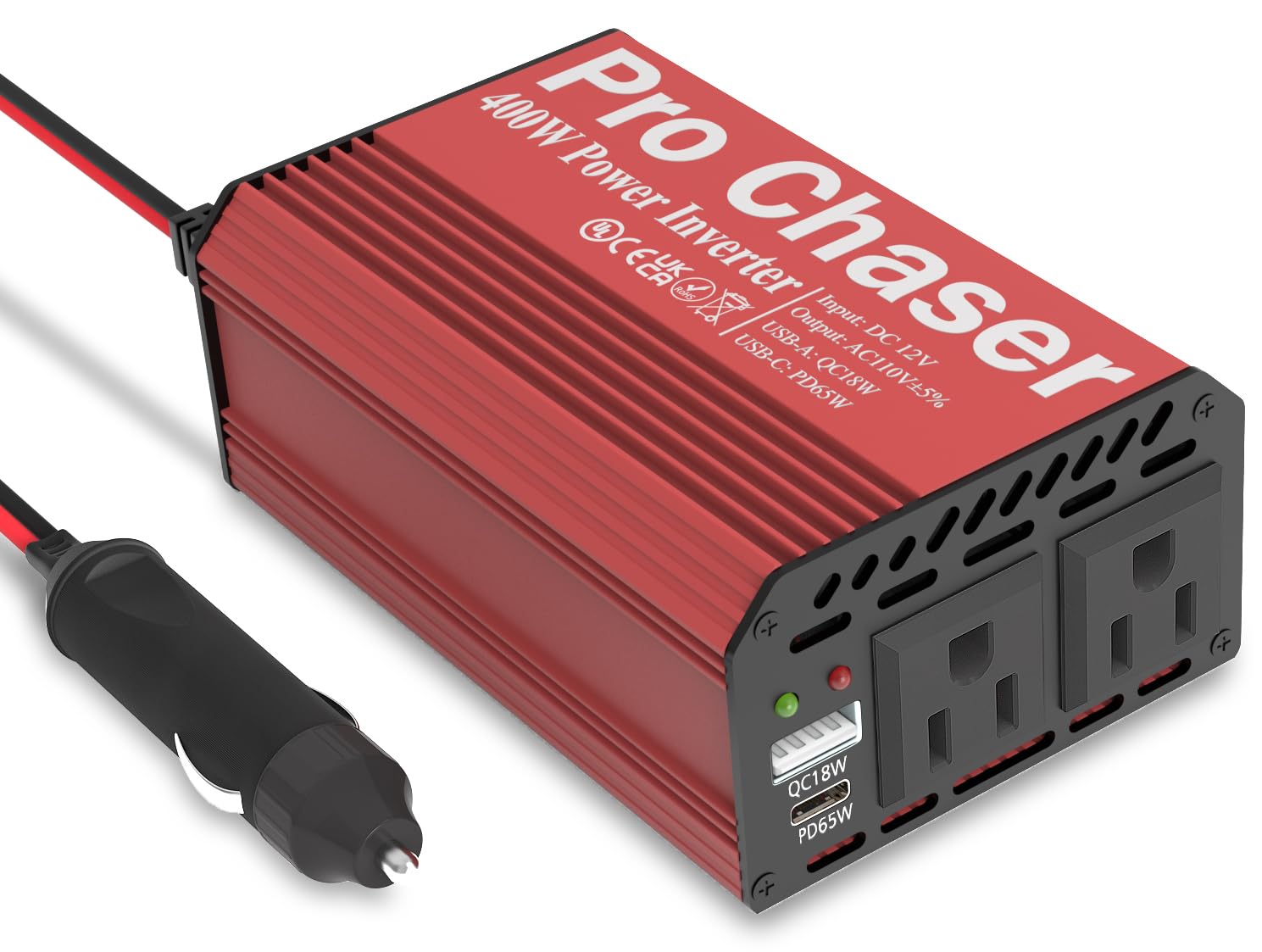
The Pro Chaser 400W Inverter offers a compelling value proposition for drivers who need moderate power with modern charging ports. Its 400-watt continuous and 800-watt peak output handles laptops, DVD players, and small appliances, while the modified sine wave waveform keeps costs accessible. The compact, cellphone-sized form factor makes storage easy in glove compartments or center consoles.
Port versatility is a highlight here. Dual 110V AC outlets sit alongside a USB-A port with 18W QC and a USB-C port with 65W PD — an unusual combination at this wattage level. The 30-inch cord provides enough reach for back-seat passengers. The built-in fuse and automatic cooling fan kick in at 113°F to maintain safe operating temperatures, and the five-layer protection system covers short circuits, overloads, and voltage anomalies.
Several users note that running the AC outlet and the USB-C port simultaneously at full load may trip the vehicle socket’s fuse, so the manufacturer recommends connecting only one high-power device at a time. For light travel use where convenience and port count matter more than raw waveform purity, this unit delivers solid everyday performance without straining the budget.
What works
- USB-C PD65W at an accessible price point
- Very compact and easy to store
- Effective automatic cooling fan
What doesn’t
- Modified sine wave limits compatibility with sensitive gear
- Simultaneous high-power port use limited by vehicle socket
4. MOVFFGGRM 500W Power Inverter

The MOVFFGGRM 500W Inverter targets users who prioritize port count and visual monitoring. With three AC outlets and four USB 2.4A ports plus a cigarette lighter adapter, it can simultaneously power string lights, a laptop, and multiple phones. The modified sine wave output delivers efficiency above 90%, making it a practical choice for resistive loads and basic charging.
The integrated LCD display gives real-time feedback on input voltage and output power — a feature usually found on more expensive models. The pure aluminum alloy body provides effective heat dissipation, and the silent fan only activates under load. The package includes both a cigarette lighter plug and battery clip, with the manual advising battery clip use for loads above 150W to avoid blowing the vehicle fuse.
Reports from owners confirm that the over-temperature and voltage protections work reliably. Some note that the four USB ports share a total output rather than supplying 2.4A each simultaneously, which is typical for multi-port units at this level. For drivers who need maximum device capacity in a single unit and appreciate a built-in display, this inverter offers a unique feature set.
What works
- Large number of simultaneous charging ports
- LCD display for real-time monitoring
- Aluminum housing aids heat management
What doesn’t
- Modified sine wave not ideal for sensitive audio gear
- USB ports have shared output limit
5. POTEK 500W Power Inverter

The POTEK 500W Inverter has been a consistent entry in the segment thanks to its clean, simplified design and UL recognition. Rated at 500 watts continuous with a 1000-watt surge capacity, it provides enough headroom for laptops, game consoles, and small kitchen appliances. The modified sine wave output keeps costs manageable while still delivering stable power for most travel electronics.
The unit’s compact dimensions (6.7 x 4.1 x 2.2 inches) make it one of the more space-efficient options in the 500W class. It includes two AC outlets and two 2A USB ports, which is sufficient for a laptop and a couple of phones. The aluminum housing contributes to heat dissipation, and the multi-protection system covers overload, overheat, and short circuit scenarios. The inclusion of a car cigarette plug and battery clip allows flexible installation.
Long-term owner reviews frequently mention that the inverter maintains stable output over hours of continuous use, and the UL listing provides an extra layer of confidence regarding safety standards. The design doesn’t include advanced features like USB-C PD or an LCD display, but its reliable track record and straightforward operation appeal to users who want a dependable tool without extra complexity.
What works
- UL listed for safety compliance
- Compact and easy to store
- Proven reliability over many owner cycles
What doesn’t
- No USB-C fast charging ports
- Modified sine wave limits device compatibility
Hardware & Specs Guide
Pure Sine Wave vs. Modified Sine Wave
Pure sine wave inverters produce a smooth, clean current that matches utility power. They are essential for sensitive electronics like laptops, CPAP machines, and audio gear. Modified sine wave units generate a stepped waveform that works for resistive loads and basic chargers but can cause hum, overheating, or erratic operation in sensitive equipment.
Continuous vs. Peak Wattage Ratings
Continuous wattage indicates the power the inverter can deliver indefinitely. Peak wattage is a short-term surge capacity, typically needed when motors start (e.g., a fridge compressor or fan). Always verify the continuous rating against your devices’ operating power draw and ensure the peak rating covers startup surges.
Built-in Protection Systems
Key protections include over-voltage, under-voltage, short circuit, overload, and over-temperature detection. Some models also feature reverse polarity protection, which prevents damage if the battery cables are connected incorrectly. A low voltage alarm or auto-shutoff keeps your starting battery from draining completely.
USB-C PD and Fast Charging Standards
USB-C Power Delivery (PD) can provide up to 65W or more, enabling rapid charging for modern laptops and tablets. USB-A Quick Charge (QC) supports 18W for compatible phones and devices. These ports allow simultaneous AC and USB charging, reducing the need for separate wall adapters during travel.
FAQ
How do I determine the right wattage for my needs?
Can I run a pure sine wave inverter with any battery?
Why does my inverter shut off after a few minutes?
Is it safe to leave an inverter plugged in when not in use?
Final Thoughts: The Verdict
For most buyers, the ac/dc power inverter winner is the ALLWEI 500W Pure Sine Wave Inverter because it delivers clean power, modern USB-C fast charging, and robust protections — a combination that covers nearly every real-world travel scenario. If you want a compact option for sensitive gear without paying for extra wattage, grab the Giandel 300W Pure Sine Wave Inverter. And for a budget-friendly unit that still offers USB-C 65W, nothing beats the Pro Chaser 400W.

Certification: BSc in Mechanical Engineering
Education: Mechanical engineer
Lives In: 539 W Commerce St, Dallas, TX 75208, USA
Md Amir is an auto mechanic student and writer with over half a decade of experience in the automotive field. He has worked with top automotive brands such as Lexus, Quantum, and also owns two automotive blogs autocarneed.com and taxiwiz.com.