A blown fuse in the middle of nowhere or a rat’s nest of loose wires behind your dash can turn any drive into a headache. A proper fuse block transforms chaotic electrical additions into a clean, protected, and serviceable system that keeps your accessories running and your vehicle safe from shorts or fire hazards.
I’m Amir — the founder and writer behind Four Wheel Ask. I spend my time digging into electrical component specifications, comparing material quality across brands, and aggregating owner feedback from real-world installations to separate the durable designs from the disposable ones.
Whether you are wiring auxiliary lights, a stereo amplifier, or a full accessory bank, finding the right distribution hub matters. After evaluating dozens of units and reviewing owner feedback, this guide helps you find the best fuse block for car for your specific electrical setup.
How To Choose The Best Fuse Block For Car
A fuse block is more than just a distribution point — it is the central nervous hub for every aftermarket electrical accessory you add. Choosing the wrong one can lead to voltage drop, difficult troubleshooting, or even an electrical fire. Here are the key factors that separate a smart buy from a regret.
Circuit Count & Current Capacity
Count every accessory you plan to power now and add a few extra slots for future expansion. A 6-circuit block suits minimal builds with lights and a charger, while 12 circuits handle full accessory banks including inverters, fans, and refrigeration. Equally important is the panel’s total amperage rating — a 100A block serves most light-to-medium builds, but high-draw setups require a 300A rated unit like the ELECTOP to avoid bottlenecking the main feed.
Build Materials & Terminal Quality
Look for nickel-plated copper bus bars and fuse clips that resist corrosion and maintain stable conductivity over years of vibration and temperature swings. The housing should be PBT or PC material — these offer mechanical strength, flame retardance, and heat resistance up to 150°C. Cheap ABS blocks can become brittle under the hood and crack, exposing live terminals.
LED Indicators & Diagnostic Features
A blown-fuse LED per circuit is not a gimmick — it saves hours of probing when an accessory stops working on the trail or at the dock. Blocks with individual indicator lights let you spot the failed circuit instantly without pulling each fuse. This feature is standard on most modern units and is well worth the slight premium.
Form Factor & Mounting Flexibility
Measure the space you have available before choosing. A compact single-sided block like the Blue Sea Systems 5045 fits into tight glove box or under-seat locations, while larger 12-way panels need more clearance for wiring and cover removal. Look for units with a transparent or removable cover that protects terminals from accidental shorts and splash exposure.
Quick Comparison
On smaller screens, swipe sideways to see the full table.
| Model | Category | Best For | Key Spec | Amazon |
|---|---|---|---|---|
| Blue Sea Systems 5045 | Fuse Block | Clean, compact power distribution | 4 Circuit, 100A, tin-plated copper bus | Amazon |
| ELECTOP 300A 12 Way | Fuse Block | High-amp accessory banks | 12 Circuit, 300A, dual positive inputs | Amazon |
| Cyrico 12 Circuits | Fuse Block | Value with full diagnostic features | 12 Circuit, 100A, LED indicators | Amazon |
| DaierTek 12 Way | Fuse Block | Budget-friendly multi-circuit setup | 12 Circuit, 100A, includes 36 fuses | Amazon |
| PSEQT 6-Way Marine | Fuse Block | Compact builds with limited space | 6 Circuit, 75A, includes negative bus | Amazon |
In‑Depth Reviews
1. Blue Sea Systems ST Blade Fuse Block Compact 4 Circuit With Cover, 100 Amps, 5045
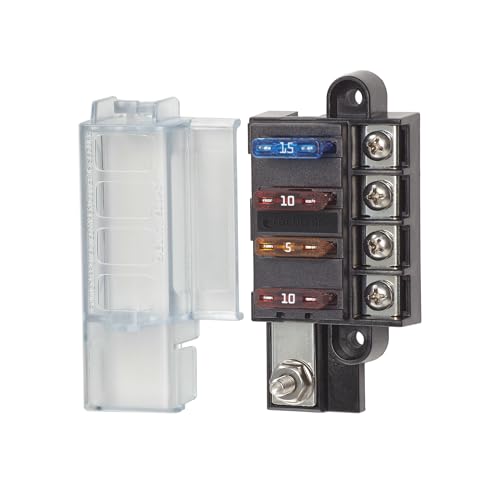
Blue Sea Systems has built a reputation in marine and automotive electrical circles for components that withstand harsh environments and deliver consistent performance. The 5045 model is a 4-circuit blade fuse block rated at 100A total with up to 30A per circuit, housed in a compact footprint that fits into spaces where most panels simply will not go. All terminals are located on one side, which dramatically simplifies wire routing in tight compartments under dashboards, inside center consoles, or on tractor fenders.
The construction quality stands out immediately — tin-plated copper buses resist corrosion far better than bare brass or steel, and the fuse clips grip ATO and ATC blades firmly without feeling brittle. Owner reports from boat rewires, golf cart restorations, and compact tractor accessory additions consistently highlight the clean layout and the confidence that comes from a brand that publishes real electrical ratings rather than vague marketing numbers. The clear insulating cover provides protection against accidental shorts while leaving the circuits visible for inspection.
One recurring note across long-term reviews is that the cover snaps on securely but some units have covers that feel less snug than expected. This is a minor frustration rather than a functional failure — the block continues to perform reliably once wired. For anyone who values a compact, corrosion-resistant distribution hub from a manufacturer with decades of field data, this 4-circuit block is the most trustworthy choice in the segment.
What works
- Compact single-sided design fits tight spaces
- Tin-plated copper bus resists corrosion long-term
- Clear cover adds protection without hiding terminals
What doesn’t
- Cover retention can feel loose on some units
- Only 4 circuits limits larger builds
2. ELECTOP 300A 12 Way Blade Fuse Block with Dual Positive Inputs

The ELECTOP 12-way block steps up the capability with a 300A panel rating and dual positive power inputs, a design that effectively turns the block into two separate distribution zones within one housing. This is particularly useful for classic car restorations where you want one feed for always-on circuits and a second for switched accessories — something owner reviews from a 1974 VW Bus and a 1965 Galaxie build confirm as a game-changer for organizing mixed power sources. Each circuit supports up to 40A with standard ATO and ATC fuses.
The housing uses PBT material rated to 150°C with flame-retardant properties, and the included transparent cover protects terminals from splash and dust while allowing visual inspection of fuse status. Every circuit has a red LED that illuminates when the fuse blows, which owners consistently describe as a time-saver during trail-side or dock-side diagnostics. The kit ships with 20 fuses across five amp ratings plus spare fuse slots built into the cover, so you are ready to wire immediately without hunting for extra hardware.
The main trade-off is physical size — 12 circuits plus dual inputs require more mounting space, and the cover does not create a watertight seal. It is a splash guard rather than a submersible enclosure, so mounting location matters in marine or off-road applications. For high-amp builds, full accessory rewires, or any project where future expansion is planned, the ELECTOP delivers capacity that most budget blocks cannot touch.
What works
- Dual positive inputs allow separated power feeds
- 300A total rating handles heavy accessory loads
- Comes with 20 fuses and spare slots included
What doesn’t
- Large footprint requires ample mounting space
- Cover is splash-proof, not waterproof
3. Cyrico 12 Circuits Fuse Block with LED Indicator and Waterproof Cover

Cyrico’s 12-circuit block delivers an impressive feature set at a price that undercuts most competitors with similar specifications. The housing is molded from PBT and PC materials that offer mechanical strength and flame resistance, while all internal bus bars and fuse clips use nickel-plated copper for corrosion resistance and stable conductivity. At 100A total with 30A per circuit, it covers the majority of light to medium accessory loads found on SUVs, boats, and overland trailers.
Owner feedback from boat installations and dune buggy rewires highlights the integrated negative bus bar as a standout convenience — no need to run individual ground wires back to a separate terminal strip. The LED indicators on each circuit light up instantly when a fuse blows, and the kit includes 24 blade fuses across common ratings plus labeling stickers for circuit identification. The twist-lock mounting screws simplify installation, and the compact form factor fits into spaces where full-width 12-way blocks often struggle.
The cover design draws mixed reactions from long-term users. While it provides dust and splash protection, some owners report that the cover feels slightly loose when fully closed, and the hinge mechanism does not inspire the same confidence as premium marine-grade enclosures. For dry or sheltered mounting locations, this is negligible. For anyone after a fully featured 12-circuit block with LED diagnostics and a negative bus at a sharp price, the Cyrico represents exceptional value.
What works
- 12 circuits plus negative bus in one compact unit
- Nickel-plated copper terminals resist corrosion
- 24 fuses included across six amp ratings
What doesn’t
- Cover fit is not as tight as premium alternatives
- Not fully waterproof for submerged use
4. DaierTek 12 Way Blade Fuse Block with LED Indicator and Waterproof Cover

DaierTek’s 12-way block takes a thoughtful approach to everyday usability with a push-lock cover that secures positively and a layout that keeps positive and negative terminals clearly separated for mistake-free wiring. The block accepts standard ATO and ATC blade fuses and is rated at 100A total with 30A per circuit, making it suitable for cars, trucks, golf carts, and small marine installations where moderate accessory loads are the norm. The kit includes 36 fuses — six each of five common amp ratings — so you have spares for nearly any circuit you add.
Each circuit features a red LED that illuminates when the fuse blows, and the included sticker set allows you to label every circuit on the cover for quick identification. Owner reviews from golf cart restorations and pontoon boat rewires note that the installation is straightforward and the compact footprint fits well in battery compartments and helm consoles. The stainless steel construction references in the specifications point to corrosion resistance in the mounting hardware, and the included terminal set saves the hassle of sourcing ring terminals separately.
The adhesive quality of the labeling stickers drew criticism from several owners, with reports that they peeled off over time in humid or warm environments. This is a minor issue — permanent markers or printed labels on tape solve it easily. The cover also lacks a gasket for true waterproof sealing, so mounting in a dry or sheltered location is recommended. For a budget-friendly 12-way block with LED diagnostics, a full fuse kit, and a secure cover latch, the DaierTek is a smart pick.
What works
- Push-lock cover stays secure during vibration
- 36 fuses included cover common amp ratings
- Clear layout with separated positive and negative sides
What doesn’t
- Stickers lose adhesion in humid environments
- Cover is not fully gasketed for waterproof use
5. PSEQT Mini 6-Way Marine Blade Fuse Block with Negative Bus

The PSEQT 6-way block strips away unnecessary bulk and focuses on doing one thing well: providing a clean, compact distribution point for smaller accessory setups. Each of the six circuits has its own positive and negative screw terminal, eliminating the need for a separate ground bus bar and keeping wiring tidy even in tight engine bays, under seats, or inside small boat consoles. The block accepts standard ATO and ATC fuses, with a maximum of 20A per circuit and 75A total panel rating — ideal for lighting, radios, fans, and other moderate-draw accessories.
The housing is made from PBT material that offers good insulation, heat resistance, and flame retardance, and the included DIY labeling stickers help identify circuits at a glance. Owner reviews from truck installations, adventure bike builds, and compact tractor upgrades consistently praise the compact size — several mounted it under a seat or inside a small weatherproof enclosure with room to spare. The negative terminals per circuit simplify wiring for applications where a common ground bus is not convenient.
The splash guard cover shown in product images is basic and does not create a watertight seal — submerged or direct-spray mounting will lead to short circuits. Some owners also noted that the block works with mini fuses despite being marketed for standard ATO/ATC, so verify fuse fitment before buying. For anyone with a minimal accessory list who values a small footprint and integrated ground points, the PSEQT delivers a clean, organized result without wasted space.
What works
- Very compact with individual negative terminals per circuit
- PBT housing resists heat and flame
- Easy to mount in tight locations
What doesn’t
- Cover does not seal against water ingress
- Total 75A limit restricts high-draw builds
Hardware & Specs Guide
Bus Bar Materials
The bus bar is the backbone of any fuse block. Nickel-plated copper offers the best balance of conductivity and corrosion resistance for automotive environments. Tin-plated copper, used by Blue Sea Systems, provides excellent long-term protection in salt-air marine conditions. Bare brass or steel buses corrode faster and increase resistance over time, leading to voltage drop and heat buildup at the terminals.
Circuit Count Planning
A 6-circuit block suits builds with 3–4 accessories and room for future expansion. A 12-circuit block is the sweet spot for most full builds including lights, compressors, audio systems, and charging ports. Going beyond 12 circuits adds complexity without benefit unless you are running separate always-on and switched feeds — the ELECTOP dual-input design addresses that scenario cleanly.
LED Indicators vs. Manual Probing
Fuse blocks with per-circuit LED indicators reduce diagnostic time from minutes to seconds. When an accessory fails, the corresponding LED lights up immediately, pinpointing the blown fuse without pulling each one. This feature is standard on most modern blocks in the budget-to-mid-range segment and is absent only on the most basic utility panels.
Housing Material & Temperature Rating
PBT (polybutylene terephthalate) and PC (polycarbonate) are the standard materials for quality fuse block housings. Both offer mechanical strength, electrical insulation, and flame retardance with upper temperature ratings around 150°C. Avoid blocks made from generic ABS plastic that can warp or become brittle under hood heat. The PBT material used by Cyrico, ELECTOP, and PSEQT meets this standard.
FAQ
What size fuse block do I need for my car accessories?
Can I use a marine fuse block in a car or truck?
How do I wire a fuse block to my car battery?
What gauge wire should I use for a fuse block?
Final Thoughts: The Verdict
For most buyers, the best fuse block for car winner is the Blue Sea Systems 5045 because it combines marine-grade corrosion resistance, a compact footprint, and a trusted brand reputation in a package that fits nearly any installation. If you need high capacity and dual power feeds for a full accessory bank, grab the ELECTOP 300A 12 Way. And for a budget-friendly 12-circuit build with LED diagnostics and a negative bus, nothing beats the value of the Cyrico 12 Circuits.

Certification: BSc in Mechanical Engineering
Education: Mechanical engineer
Lives In: 539 W Commerce St, Dallas, TX 75208, USA
Md Amir is an auto mechanic student and writer with over half a decade of experience in the automotive field. He has worked with top automotive brands such as Lexus, Quantum, and also owns two automotive blogs autocarneed.com and taxiwiz.com.