A car frame lives in the harshest environment imaginable—road salt, gravel spray, moisture, and temperature swings that shrink and expand metal hourly. Most owners discover rust only after it has quietly consumed structural strength. The difference between a frame that lasts twenty years and one that fails in five often comes down to the coating applied at the right moment. Choosing the wrong product means trapping moisture against metal, accelerating the very corrosion you wanted to stop.
I’m Amir — the founder and writer behind Four Wheel Ask. I’ve spent years studying owner reports, cross-referencing spec sheets, and analyzing how different coatings behave under real-world conditions to identify which formulations deliver lasting protection.
Navigating the options requires understanding how moisture-cure urethanes differ from wax-based sprays and which scenarios demand a full encapsulator. This guide breaks down the key technologies and trade-offs to help you select the best paint for car frame based on your specific rust risk and surface condition.
How To Choose The Best Paint For Car Frame
The best coating for a car frame depends on three variables: the current state of the metal, the environment the vehicle operates in, and the application tools you have available. A frame that already shows surface rust needs a product that chemically neutralizes oxidation. A clean frame needs a barrier that blocks moisture and oxygen without trapping existing corrosion underneath. The coating’s chemistry—whether it cures by moisture absorption or solvent evaporation—determines how well it bonds to the metal and how durable it remains after years of thermal cycling.
Understanding Coating Chemistries
Moisture-cure urethane formulations, such as those used by POR-15 and KBS Coatings, react with ambient humidity to form a hard, impermeable shell. These coatings bond aggressively to properly etched metal and create a barrier that resists chipping and chemical exposure. Solvent-based paints, including aerosol enamel and acrylic lacquer, dry through evaporation and typically offer less abrasion resistance. Wax-based corrosion inhibitors, like CRC Heavy Duty Corrosion Inhibitor, remain flexible and self-healing, making them ideal for cavities and enclosed sections where hard paints might crack from flexing. For frames exposed to road salt, a moisture-cure urethane provides the most reliable long-term protection when applied over clean or chemically treated metal.
Surface Preparation Is Non-Negotiable
No coating performs well on a poorly prepared surface. Loose rust, oil, grease, and existing paint prevent adhesion and create pathways for moisture to migrate underneath the coating. Products that claim to bond directly to rust still require removal of loose scale and contamination. The most effective approach involves wire brushing or sandblasting loose rust, applying a metal etch or rust converter to stabilize remaining surface oxidation, and degreasing the entire area before coating. Skipping these steps guarantees delamination within a single winter season.
Quick Comparison
On smaller screens, swipe sideways to see the full table.
| Model | Category | Best For | Key Spec | Amazon |
|---|---|---|---|---|
| POR-15 Rust Preventive Coating | Moisture-Cure Urethane | Maximum corrosion barrier on frames and chassis | 16 oz; hard, glossy finish; moisture-cured | Amazon |
| KBS Coatings RustSeal | Moisture-Cure Urethane | High-temp and chemical-resistant frame coating | 1 quart; satin black; withstands 600°F | Amazon |
| Eastwood Internal Frame Coating | Aerosol Rust Converter | Inside closed frame rails and box sections | 14 oz; 360° spray wand included | Amazon |
| 3M Rubberized Undercoating | Rubberized Aerosol | Sound dampening and chip resistance on exposed areas | 6-pack of 16 oz; textured finish | Amazon |
| CRC Heavy Duty Corrosion Inhibitor | Wax-Based Spray | Inside cavities, links, and electrical connections | 4-pack of 10 oz; long-term flexible film | Amazon |
| Eastwood 2K Clear Coat Aerosol | Isocyanate Clear Coat | Topcoat over base paint on frame surfaces | 11.8 oz; high-gloss; durable finish | Amazon |
| 2 in 1 Rust Converter & Metal Primer | Water-Based Rust Converter | Budget-friendly rust neutralization on surface rust | 35 oz; matte black; brush application | Amazon |
In‑Depth Reviews
1. POR-15 Rust Preventive Coating

POR-15 has earned its reputation as a benchmark for frame coating. The chemistry is unique: it cures by absorbing moisture from the air rather than evaporating, which means it continues to harden in humid environments where most paints fail. When applied over properly prepared metal, the coating forms a dense, non-porous shell that blocks oxygen and water. Owner reports consistently note that frames treated with POR-15 and left visible under vehicles show no new rust after several years of exposure.
The product works as part of a three-step system that includes a cleaner-degreaser and a metal-prep etch. Users who follow the full sequence—removing grease, etching the surface, and applying thin coats—report the best adhesion and longest protection. The coating dries to a high-gloss finish that handles UV exposure reasonably well for a frame paint, though long-term sunlight can cause chalking. Inside the frame rails or under the vehicle, this is rarely a concern.
Application requires stirring, not shaking, and thin coats yield better results than heavy layers. Open cans should be transferred to a glass jar to prevent the lid from sealing permanently. The price sits above entry-level options, but the coating’s durability and owner feedback showing ten-year performance make it a strong candidate for those serious about frame preservation.
What works
- Forms an exceptionally hard, moisture-proof barrier
- Proven track record of multi-year frame protection
- Resists chemicals, salt, and abrasion better than most paints
What doesn’t
- Requires strict surface preparation for best adhesion
- Cans can seal shut if not stored properly after opening
2. KBS Coatings RustSeal

KBS RustSeal is a direct competitor to POR-15, and in some owner comparisons it earns higher marks for application smoothness and final appearance. This is a moisture-cure urethane that self-levels remarkably well, reducing brush marks and leaving a finish that resembles powder coating. The satin black version offers a slightly less reflective surface than gloss alternatives, which some users prefer for undercarriage work where glare is undesirable.
The formulation is rated to withstand continuous temperatures up to 600°F, making it suitable for frame sections near exhaust components or for coating engine bay parts. It resists fuel, oil, and most solvents, which is critical for a frame coating that will encounter road chemicals and occasional spills during maintenance. Coverage is generous—one quart covers roughly 50 square feet, enough for a full frame on most passenger vehicles.
Owner feedback emphasizes that this product benefits from very thin coats. Heavy applications can trap solvent and lead to soft spots. Multiple thin layers with adequate flash time between coats produce the hardest, most uniform finish. Some users note that the can’s lid requires care when resealing; storing leftover paint in a mason jar prevents waste.
What works
- Exceptional self-leveling that minimizes brush marks
- High temperature tolerance for use near heat sources
- Strong resistance to fuels, oils, and chemicals
What doesn’t
- Requires UV-resistant topcoat if exposed to direct sunlight
- Can packaging may arrive dented due to shipping
3. Eastwood Internal Frame Coating

Closed frame rails and box sections are the most vulnerable areas on a vehicle. Moisture enters through open ends, drain holes, and seam gaps, then settles inside where no brush or spray gun can reach. Eastwood addresses this with an aerosol that includes a long flexible wand tipped with a 360-degree spray nozzle. Insert the wand into a bolt hole or frame opening, press the button, and pull the wand back while the coating fans outward to cover all interior surfaces.
The formula functions both as a rust converter and a protective coating. It chemically neutralizes thin surface rust while forming a black barrier that seals the metal from further moisture contact. Users report that a single can covers the interior of a full-length frame rail on a Jeep Wrangler or pickup truck, though larger vehicles may require two cans. The coating dries to a glossy finish within a few hours and is fully cured in 24 hours.
The wand attachment lacks internal support, so some users recommend taping it to a straightened coat hanger for better directional control inside longer cavities. Fumes are strong, making a respirator mandatory for enclosed spaces. Despite these handling quirks, owners consistently cite the 360-degree coverage as a game-changer for preventing the corrosion that starts unseen inside the frame.
What works
- Reaches every surface inside closed frame sections
- Combines rust conversion with protective coating
- Dries quickly and provides glossy, durable finish
What doesn’t
- Wand is flimsy and requires reinforcement for long cavities
- Potent fumes require excellent ventilation and PPE
4. 3M Professional Grade Rubberized Undercoating

3M’s rubberized undercoating is a different approach from the hard urethane paints above. Rather than forming a rigid shell, this product dries to a flexible, textured film that absorbs impacts and dampens road noise. The rubberized composition is ideal for the underside of floor pans and wheel wells where gravel strikes are common, but it also works well on frame sections that experience vibration and slight flexing.
The aerosol format sprays evenly with minimal running when applied in light coats. Multiple cans are included in the pack, providing coverage for a full vehicle undercarriage. Owner feedback from snow-belt states is particularly strong, with users reporting that annual refresh applications keep frames rust-free even on trucks used daily in salted road conditions. The coating stays slightly tacky to the touch, which helps it self-seal minor chips and scratches.
This product is not meant for cavity injection—it is an exposed-surface coating. It also does not contain rust converters, so it should be applied over clean or rust-stabilized metal. The textured finish can trap dirt over time, but the protection underneath remains intact as long as the coating is not physically scraped away.
What works
- Excellent impact and chip resistance from rubberized formula
- Reduces road noise noticeably when applied to floor pans
- Easy to spray evenly without runs
What doesn’t
- Not suitable for internal frame cavities
- Requires annual inspection and touch-up in harsh climates
5. CRC Heavy Duty Corrosion Inhibitor

CRC’s Heavy Duty Corrosion Inhibitor is not a paint in the traditional sense; it is a wax-based spray that leaves a semi-dry, flexible film on metal surfaces. This makes it uniquely suited for areas where hard paints might crack, such as hinges, linkages, electrical connections, and the inside of frame channels where slight movement occurs. The wax film self-heals from minor scratches, re-covering exposed metal without manual touch-up.
The four-pack provides enough material to treat an entire vehicle’s undercarriage, including steering components, suspension points, and bolt heads. Users in northern states pair this product with a harder frame paint, using the CRC spray on fasteners and cavity openings to prevent moisture ingress at vulnerable points. The spray dries to a tack-free finish within a few hours, though it remains somewhat flexible.
This product is not designed for visible exterior frame surfaces where a glossy finish is desired. It also requires reapplication after high-pressure washing or abrasive exposure. Owner reviews highlight that it stays wet longer than aerosol paints, which aids capillary penetration into lap joints but also means it can drip if over-applied. For internal frame protection as a first line of defense, it works well alongside a moisture-cure urethane.
What works
- Penetrates into tight joints and seam gaps
- Self-healing wax film reseals minor scratches
- Four-pack provides generous coverage
What doesn’t
- Not a hard finish; won’t match gloss for visible areas
- Some cans may have leaky spray nozzles reported
6. Eastwood 2K Aerosol Clear Coat

Eastwood’s 2K aerosol is a two-component clear coat packaged in a single can with an internal activator. Pressing the button releases the hardener, giving the user approximately 48 hours to spray the entire can before the mixture cures. This product is intended as a topcoat over color paint on frame sections that are visible, offering UV protection and a high-gloss appearance that resists yellowing and chemical attack.
The coating applies best in light passes with 50 percent overlap, delivering about 1.2 mil of thickness per coat. Full cure occurs in 12 hours at room temperature, or faster with infrared drying. Owner reports from restorers and custom builders highlight that the gloss level matches OEM finishes when applied correctly, making it suitable for show-quality frame work where appearance matters alongside protection.
This clear coat does not contain rust inhibitors or primers—it is purely a protective top layer. It should be used only over properly cured base paint or bare metal that has been primed and sealed. The 2K chemistry creates potent fumes requiring respiratory protection, and the activated can must be used within its pot life or discarded safely.
What works
- Produces a durable, high-gloss automotive-grade clear coat
- Resists UV damage and chemical staining
- Activator in the can simplifies mixing for DIY users
What doesn’t
- Not a standalone frame paint; requires primer or base coat
- Cannot be stored after activation button is pressed
7. 2 in 1 Rust Converter & Metal Primer
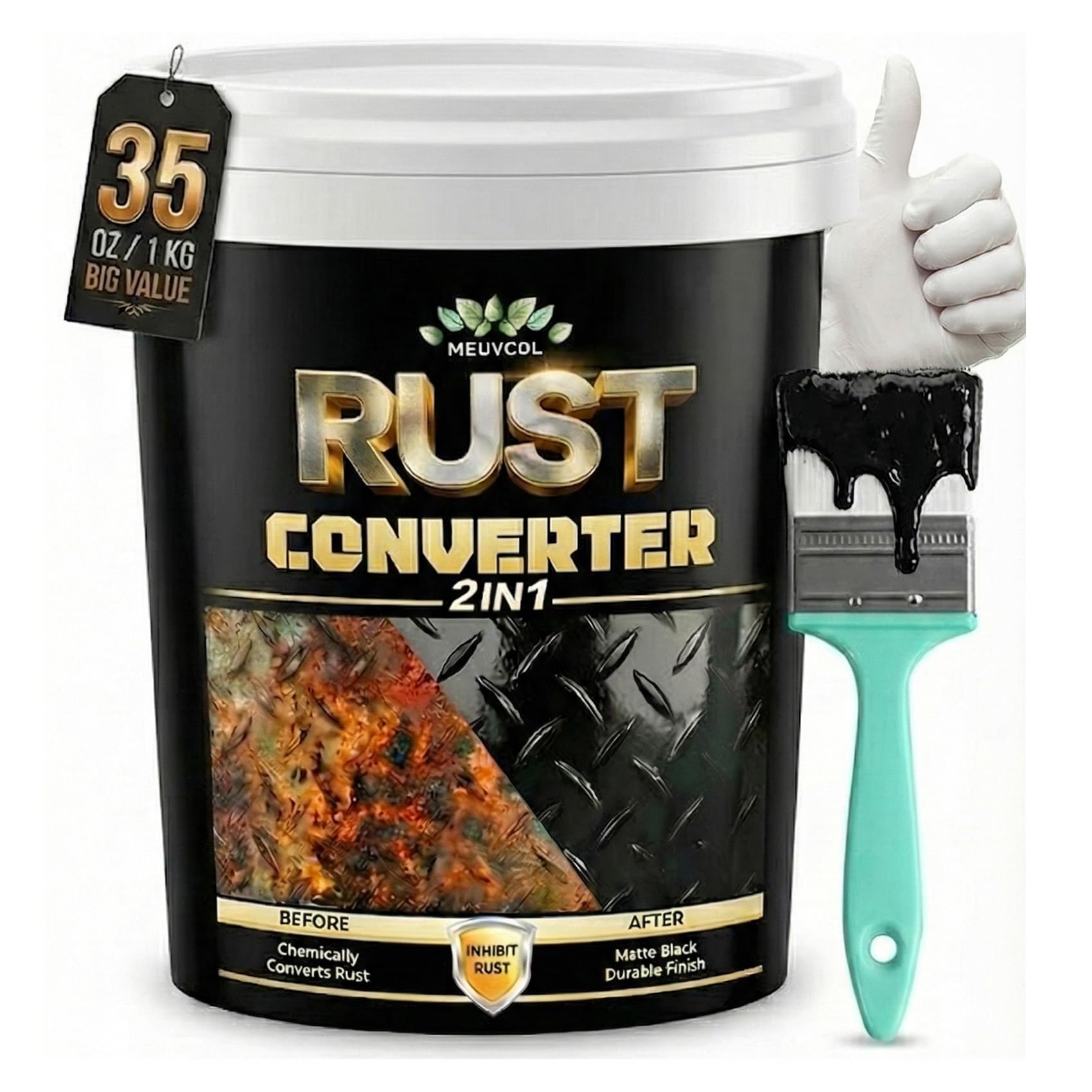
This product fills a specific niche: it converts thin surface rust into a stable black primer while simultaneously providing a protective coating. The water-based formulation has low odor compared to solvent-based options, making it more comfortable to use in less ventilated spaces. The included brush and gloves simplify setup for smaller frame repairs or touch-ups on chassis sections with light corrosion.
Owner feedback after two months of use shows no chipping or peeling when applied to properly degreased metal. The coating dries to a hard matte finish that accepts top paints well if additional UV protection is needed. Users who applied it to metal railings and tools report that the rust conversion effect holds up to outdoor exposure, though the coating is not optimized for the constant abrasion a frame undercarriage sees.
This is a budget-friendly entry point, but its durability under heavy salt exposure and stone impact remains unproven over multiple winters. It is best suited for owners addressing localized rust spots on a frame before paint or for hobbyists who want a simple, low-odor solution for non-critical surfaces. For full-frame restoration, a moisture-cure urethane remains the more resilient choice.
What works
- Converts light rust into a paintable, stable primer
- Low odor and easy cleanup with water
- Large 35-ounce can covers significant area
What doesn’t
- Long-term abrasion resistance not established for frames
- Requires thin coats and 24-hour dry time between layers
Hardware & Specs Guide
Moisture-Cure Urethane
This chemistry dominates the premium frame paint category for good reason. Unlike conventional paints that dry by solvent evaporation, moisture-cure urethanes react with water vapor in the air to form long polymer chains. The result is a dense, cross-linked film that adheres aggressively to metal and resists chemical penetration. Brands like POR-15 and KBS rely on this mechanism. The coating continues to cure over time and actually improves its barrier properties in humid environments, which is exactly what a frame under a vehicle faces. Application requires careful surface etching to provide a mechanical anchor, but the payoff in durability and longevity is substantial.
Wax-Based Corrosion Inhibitors
Products such as CRC Heavy Duty Corrosion Inhibitor use a wax carrier that deposits a flexible, semi-dry film on metal. The wax remains slightly plastic, allowing it to flow into microscopic surface pores and self-heal from light scratches. This makes wax-based inhibitors ideal for cavity injection and fastener protection. They do not form a hard structural barrier like urethane, but they prevent moisture contact by capillary action. The trade-off is that they attract and hold dirt over time and require periodic reapplication after pressure washing or heavy rain exposure.
Rust Converters vs. Encapsulators
A rust converter chemically reacts with iron oxide (rust) to form a stable, inert compound—typically iron tannate—that stops further oxidation. The Eastwood Internal Frame Coating and the 2 in 1 Rust Converter & Metal Primer both include converter chemistry. An encapsulator, by contrast, simply seals existing rust under an impermeable layer without chemically neutralizing it. Encapsulators such as POR-15 require the rust to be mechanically abraded and etched first, while converters can bond directly to thin rust layers. For frame repairs where complete rust removal is impossible, a converter provides a more forgiving path to long-term protection.
Aerosol vs. Brush-On vs. Sprayable
Each application method suits different frame access scenarios. Aerosols, including Eastwood and 3M, excel in tight spaces and hard-to-reach cavities when fitted with extension wands. Brush-on coatings like POR-15 and KBS RustSeal allow precise thickness control and better coverage on flat surfaces but require more labor. Sprayable versions of these same coatings can be thinned and applied with HVLP equipment for larger projects. The choice depends on whether you prioritize coverage speed (spray), control (brush), or access (aerosol with wand). Most frame restoration projects benefit from a combination of brush-on for exposed rails and aerosol for internal sections.
FAQ
Can I paint directly over rust on my car frame?
What is the difference between undercoating and frame paint?
How long does frame paint last before needing reapplication?
Do I need to remove all rust before painting a frame?
Final Thoughts: The Verdict
For most buyers, the paint for car frame winner is the POR-15 Rust Preventive Coating because it combines proven chemistry, owner-verified longevity, and abrasion resistance that outlasts nearly every alternative. If you need high-temperature tolerance and a self-leveling satin finish, grab the KBS Coatings RustSeal. And for protecting the vulnerable interior of closed frame rails, nothing beats the Eastwood Internal Frame Coating with its 360-degree spray wand.

Certification: BSc in Mechanical Engineering
Education: Mechanical engineer
Lives In: 539 W Commerce St, Dallas, TX 75208, USA
Md Amir is an auto mechanic student and writer with over half a decade of experience in the automotive field. He has worked with top automotive brands such as Lexus, Quantum, and also owns two automotive blogs autocarneed.com and taxiwiz.com.