When the cabin air turns tepid and the compressor cycles erratically, the culprit often hides in the electrical and mechanical backbone of your system—the AC condenser parts. Ignoring a failing contactor, capacitor, or fan motor leads to total cooling loss on the hottest days.
I’m Amir — the founder and writer behind Four Wheel Ask. My process involves cross-referencing OEM specifications with owner-reported failure data to identify which replacement parts genuinely restore factory performance without introducing new problems.
This guide evaluates seven critical components based on build materials, electrical ratings, and real-world longevity reports to help you select the right best ac condenser parts for a reliable, long-lasting repair.
How To Choose The Best AC Condenser Parts
Selecting a replacement component requires matching the exact electrical and mechanical footprint of the original. A mismatch in voltage, amperage, or shaft dimensions can cause immediate failure or inefficient operation. Prioritize parts that carry UL or ETL listings and use copper windings over aluminum for motors and transformers. For contactors, silver-cadmium-oxide contacts handle higher inrush currents better than standard silver.
Electrical Ratings Matter Most
The contactor must match the coil voltage (24V or 120V) and the full-load amp rating of the compressor. Capacitors need microfarad values within the manufacturer’s tolerance, and voltage ratings should meet or exceed the original. Fan motors require matching horsepower, RPM, rotation direction, and frame size to ensure proper airflow and secure mounting.
Material Selection And Build Quality
Condenser fan motors with sealed ball bearings outlast sleeve-bearing units in outdoor environments exposed to moisture and debris. Cooling fan assemblies with glass-reinforced nylon shrouds resist cracking from UV exposure. Power whip kits using THHN wire and liquid-tight conduit prevent wire chafing and short circuits. Prioritize OEM or OEM-spec replacements that use the same supplier tooling and materials as the original equipment.
Quick Comparison
On smaller screens, swipe sideways to see the full table.
| Model | Category | Best For | Key Spec | Amazon |
|---|---|---|---|---|
| York F48AA68A50 | Condenser Fan Motor | OEM replacement for Luxaire/York units | 1/4 HP, 850 RPM, 230V | Amazon |
| VEVOR 1/5HP Motor | Condenser Fan Motor | Universal replacement with capacitor included | 1/5 HP, 1075 RPM, 208-230V | Amazon |
| TYC 610530 Cooling Fan | Cooling Fan Assembly | Drop-in replacement for 2002-2006 Honda CR-V | 3.32 lbs, 3500 RPM, PA material | Amazon |
| AmRad Turbo 200 Capacitor | Capacitor | Universal replacement for wide capacitance needs | 200 µF, 440V, ±5% tolerance | Amazon |
| Sealproof Power Whip Kit | Power Whip | Pre-assembled AC hook-up conduit | 6 ft, 8 gauge, 3/4-in dia | Amazon |
| SunLee 3 Pole Contactor | Contactor | 120V coil replacement for HVAC systems | 3 Pole, 40 Amp, 120V coil | Amazon |
| Protactor 1 Pole Contactor | Contactor | Budget-friendly 24V coil replacement | 1 Pole, 40 Amp, 24V coil | Amazon |
In-Depth Reviews
1. York F48AA68A50 Condenser Fan Motor
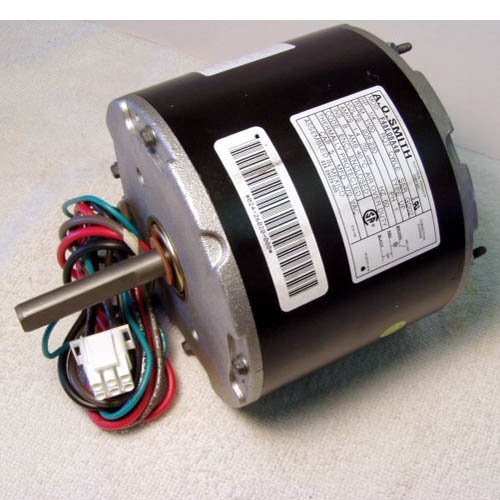
The York F48AA68A50 is a factory-grade 1/4 HP condenser fan motor designed specifically for Luxaire and York heat pumps and air conditioners. Its 850 RPM output and 230-volt operation match the original electrical footprint, and the copper windings provide reliable heat dissipation under continuous load. The motor uses a 48-frame mounting pattern that aligns directly with older condensers without requiring bracket modifications.
Owner feedback consistently highlights the dramatically quieter operation compared to aging original motors, along with a noticeable improvement in air movement across the condenser coil. The motor’s sealed bearings reduce the risk of moisture ingress, which is a common failure point in units exposed to rain and sprinklers. Several reviews confirm this motor as a direct bolt-in replacement that eliminates the need to re-drill mounting holes or splice wiring harnesses.
Given that this part carries the York OEM badge, it comes with a higher outlay. However, owners who installed it report that the motor resolved persistent knocking and grinding noises that generic replacements could not silence. For those with York or Luxaire equipment, this component ensures that the fan curve and airflow dynamics remain identical to the factory design.
What works
- Exact OEM fit for York/Luxaire units
- Runs much quieter than aging original motors
- Copper windings for reliable heat dissipation
What doesn’t
- Premium price point compared to aftermarket options
- Not compatible with non-York/Luxaire equipment without modifications
2. VEVOR OEM Upgraded Condenser Fan Motor

The VEVOR 1/5 HP condenser fan motor is designed as a universal replacement for units requiring a 1075 RPM, 208-230-volt motor. Its reversible rotation feature allows it to work with either clockwise or counterclockwise setups, and the included 5 µF CBB65 capacitor eliminates the need to purchase a separate starting component. The motor’s overheat protection and 60°C ambient temperature rating suit outdoor condenser environments.
Data from verified installations shows that the motor dimensions and bolt hole pattern match many Carrier, Bryant, Payne, and Emerson units without drilling new holes. The extended 47-inch wiring harness provides enough slack for routing through tight condenser compartments. Owners report that the motor runs quietly and restores full condenser airflow after replacing worn-out sleeve-bearing units that had seized or started vibrating.
While the motor is marketed as an OEM upgrade, its build quality is comparable to midline aftermarket units rather than premium brands. Several long-term reviewers noted that the capacitor included in the kit is a welcomed addition, as failing capacitors often accompany motor failures. The reversible feature makes it a safe choice for technicians who need one motor to cover multiple service calls.
What works
- Includes matching capacitor for a complete swap
- Reversible rotation fits CW and CCW setups
- Extra-long wiring simplifies installation
What doesn’t
- Not a true OEM part despite the marketing
- Capacitor brand can vary
3. TYC 610530 Cooling Fan Assembly

The TYC 610530 is a complete cooling fan assembly engineered as a direct OE replacement for 2002-2006 Honda CR-V and 2003-2006 Honda Element models. It arrives fully assembled with the motor, blade, shroud, and wiring harness pre-attached, eliminating the need to swap components from the old assembly. TYC licenses Bosch and Continental VDO design patents for the shroud and blade, ensuring airflow characteristics match the original.
Verified owner reports show this assembly fits perfectly with no drilling or adapter plates required. Users noted that the PA (polyamide) material used in the shroud withstands engine bay temperatures better than generic ABS plastic, and the motor operates at 3500 RPM to deliver adequate airflow across the condenser. One owner documented the fan lasting over 100,000 miles in a 2005 CR-V before a bearing failure occurred, which represents a solid service life for a non-OEM part.
The fan’s 4-decibel noise rating is inaudible inside the cabin during normal driving, which is a common complaint with cheap aftermarket fans that produce a noticeable whir. Because the assembly includes both motor and shroud, it speeds up the repair and reduces the risk of breaking plastic clips during a motor-only swap. For Honda owners facing a failed condenser fan, this part simplifies the job to a handful of bolts and a plug connector.
What works
- Drop-in fit for CR-V and Element models
- Quiet operation with factory airflow
- Complete assembly reduces installation time
What doesn’t
- Limited to Honda application
- Not covered by Honda’s warranty
4. AmRad Turbo 200 Motor Run Capacitor
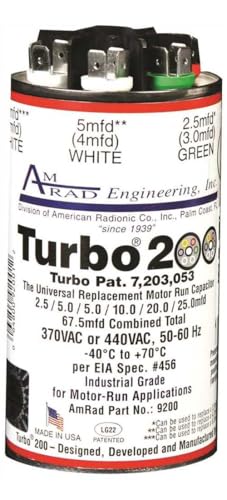
The AmRad Turbo 200 is a premium universal motor run capacitor manufactured in the United States by American Radionic Company. Its patented Ultramet technology produces six capacitors from a single continuous winding, allowing it to replace a wide range of microfarad and voltage configurations common in AC condenser fan and compressor circuits. The 440-volt rating and ±5% tolerance provide headroom for voltage spikes that can damage lower-rated capacitors.
Installation feedback indicates that the Turbo 200 can be configured to match the original capacitor’s capacitance value by using the supplied jumper wires to combine terminals. This flexibility makes it a service technician’s favorite for stock trucks because it covers dozens of applications in one package. Owners who replaced swollen or leaking capacitors report that the AC compressor starts reliably and the fan runs at full speed without excessive heat buildup in the capacitor case.
The domestic manufacturing and metal case design contrast sharply with economy capacitors that use plastic shells and overseas tolerances. While the initial outlay is higher than generic capacitors, the Turbo 200’s track record of surviving high-cycle applications justifies the cost for those who want to avoid repeat failures. For homeowners performing a one-time repair, the convenience of universal fit reduces the confusion of matching exact microfarad numbers.
What works
- Universal configuration replaces many fixed-value capacitors
- Made in the USA with metal case construction
- Handles high inrush currents without failure
What doesn’t
- Higher cost than single-value capacitors
- Requires understanding of jumper configuration
5. Sealproof Power Whip Assembly

The Sealproof Power Whip Assembly combines a 6-foot length of 3/4-inch nonmetallic liquid-tight conduit with pre-installed 8-gauge THHN conductors and a 10-gauge ground wire. It is designed to simplify the electrical connection between a disconnect box and an air conditioner, heat pump, or other outdoor equipment. The kit includes an elbow connector for a low-profile entry into the condenser panel, and the gray flexible conduit resists UV radiation and moisture.
DIY installers and electricians alike praise the time savings compared to piecing together conduit, wire, and fittings individually. The 8-gauge wire is suitable for 30-amp and 40-amp circuits commonly found in residential HVAC installations. Multiple verified reviews confirm that the whip fits standard 3/4-inch knockouts on disconnect boxes and condenser panels without requiring adapter bushings. One RV owner used the kit to wire a 30-amp outlet for shore power, demonstrating its versatility beyond condenser hookups.
The only installation caveat is that the twist-on connector fittings can require significant torque to seat fully, and some users reported the fittings loosening if not tightened with a wrench. However, once assembled, the connection remains watertight and secure. For anyone replacing an old, cracked whip or running a new circuit for a condenser, this kit offers a safe, code-compliant solution that eliminates the mess of threading small wires through flexible conduit.
What works
- Complete pre-assembled kit reduces installation time
- UV-resistant conduit suitable for outdoor use
- 8-gauge wire supports standard condenser amperage
What doesn’t
- Twist-on connectors require strong hand tightening
- Not suitable for sub-panel or main panel connections
6. SunLee 3 Pole 40 Amp Contactor

The SunLee DRC-3XT04CG is a 3-pole contactor rated for 40 amps with a 120-volt coil, designed as a replacement for HVAC systems that require three-phase switching or separate fan and compressor circuits. It carries UL 508 and UL 60947-4-1 listings, and its silver-cadmium-oxide contacts handle the high inrush current of compressor start-up without welding. The base molding uses bulk dough compounds that resist heat and arc tracking better than standard phenolic.
Verified owner reports show that this contactor resolved issues where the compressor would run continuously because the contacts stuck in the closed position. Several users noted that they saved hundreds of dollars in service call fees by diagnosing a stuck contactor and swapping this part in under 15 minutes. The copper wiring terminals accept both ring terminals and push-on spade connectors, providing flexibility for different OEM wiring harnesses.
While the contactor is A2L-compliant for use with newer low-GWP refrigerants, its physical size is slightly larger than some OEM contactors, which can make mounting in tight enclosures tricky. Some owners mentioned that the mounting holes did not perfectly align with existing brackets and required a small amount of adjustment. For technicians or homeowners with basic electrical skills, this contactor provides a robust solution at a fraction of the dealer’s part price.
What works
- UL listed with silver-cadmium-oxide contacts
- A2L compliant for modern refrigerant systems
- Significant savings over HVAC service replacement
What doesn’t
- Mounting holes may need slight modification
- Larger footprint than some OEM contactors
7. Protactor 1 Pole 40 Amp Contactor

The Protactor PT-C140A is a 1-pole contactor rated for 40 amps with a 24-volt coil, designed to replace single-pole contactors across a wide range of residential HVAC brands including Carrier, Rheem, Lennox, Trane, and York. It features enclosed contacts that shield the switching surfaces from dust and moisture, and the encapsulated coil protects against voltage fluctuations. The heavy lug terminals accept wiring up to #8 AWG for the line and load sides.
Owner reviews from DIY users highlight how this contactor resolved issues of the outdoor unit running constantly or failing to start after storms. Many users photographed their old wiring before disconnecting it, and reported that the Protactor’s terminal labeling—T1/T2 and L1/L2—aligns logically, though some had to mentally map T2 to T3 from the old unit. The contactor’s compact size fits inside tight condenser compartments where larger 3-pole models cannot.
While the plastic construction feels less robust than metal-case contactors, the UL listing and 5.1-watt coil draw confirm it meets safety standards for the intended 24-volt control circuit. Several long-term reviews note that the contactor continues to switch reliably after multiple seasons of use. For homeowners with a failed contactor and basic electrical knowledge, this is the most accessible entry point to restoring condenser operation without calling a technician.
What works
- Universal fit for many major HVAC brands
- Enclosed contacts prevent contamination
- Easy installation with clear terminal markings
What doesn’t
- Plastic housing less durable than metal
- Terminal labels differ from some OEM labeling schemes
Hardware & Specs Guide
Motor Power Ratings
Condenser fan motors list horsepower (1/5 HP, 1/4 HP) and speed in RPM (850, 1075). The horsepower must match the original blower load to maintain correct torque without overloading the motor. Speed directly affects airflow across the condenser coil—too slow reduces heat rejection, too fast can cause noise and over-amping. Always verify the frame size (48-frame is common for residential) and shaft diameter (typically 1/2 inch) for a direct mechanical fit.
Capacitor Ratings and Selection
Run capacitors provide a continuous phase shift to help the motor maintain torque. The microfarad (µF) value must be within ±5% of the original specification, and the voltage rating should be at least as high as the original (common values: 370V and 440V). A higher voltage rating is safe, but a lower one is dangerous. The Turbo 200’s multitap design allows one unit to replace many single-value capacitors via jumper combinations.
FAQ
How do I know if my AC condenser contactor is bad?
Can I replace a condenser fan motor myself?
Final Thoughts: The Verdict
For most buyers, the best ac condenser parts winner is the TYC 610530 Cooling Fan Assembly because it bundles a quiet, high-output motor with a durable shroud for a straightforward drop-in replacement on Honda CR-V and Element models. If you want the versatility of a universal capacitor that covers dozens of HVAC applications, grab the AmRad Turbo 200. And for a budget-conscious contactor swap on most residential condensers, nothing beats the Protactor 1 Pole 40 Amp Contactor.

Certification: BSc in Mechanical Engineering
Education: Mechanical engineer
Lives In: 539 W Commerce St, Dallas, TX 75208, USA
Md Amir is an auto mechanic student and writer with over half a decade of experience in the automotive field. He has worked with top automotive brands such as Lexus, Quantum, and also owns two automotive blogs autocarneed.com and taxiwiz.com.