A dead battery does not announce itself at a convenient time. Whether you left the interior lights on overnight or the battery has simply reached the end of its service life, the result is the same: a vehicle that will not start and a schedule that gets derailed. The right charging equipment transforms this frustration into a manageable task with predictable outcomes.
I’m Amir — the founder and writer behind Four Wheel Ask. My work involves dissecting battery charger specifications, comparing charging algorithms across voltage platforms, and aggregating thousands of owner reports to identify which units consistently deliver reliable results without damaging battery chemistry.
From smart maintainers that prevent sulfation to high-amperage units that bring deeply discharged batteries back to life, the market offers solutions for every scenario. Finding a reliable best dead battery charger means choosing between smart maintainers, desulfators, and jump starters that match your specific vehicle needs.
How To Choose The Best Dead Battery Charger
Buying a battery charger for a deeply discharged battery requires more consideration than picking the cheapest unit on the shelf. Voltage compatibility, amperage output, charging stage count, and safety certifications all determine whether the charger will revive your battery or damage it further. Here are the core factors to evaluate before making a purchase.
Amperage Output and Charging Speed
Amperage determines how quickly a charger replenishes a depleted battery. A low-amperage unit in the 0.75A to 2A range works well for maintaining a battery over weeks or months but can take days to recover a deeply discharged battery. Mid-range options at 5A to 10A balance speed and safety for most passenger car batteries. High-amperage chargers at 15A to 20A deliver rapid recovery for larger batteries in trucks and SUVs but require careful monitoring to avoid overheating. Match the amperage to your battery capacity: a 50Ah battery benefits from a 5A to 10A charger, while a 100Ah battery can safely accept 15A to 20A.
Battery Chemistry Compatibility
Lead-acid batteries remain the most common type in vehicles, but lithium iron phosphate batteries are becoming more popular in modern cars, motorcycles, and marine applications. Many chargers now support both chemistries, but some lithium-compatible units require a dedicated charging mode to prevent overvoltage damage. If you own a LiFePO4 battery, verify that the charger explicitly lists lithium compatibility rather than assuming lead-acid settings will work. Chargers that offer separate modes for AGM, Gel, Wet, and lithium batteries provide the most flexibility across a multi-vehicle household.
Smart Charging Stages and Safety Protections
A modern smart charger uses multiple charging stages to safely recover a dead battery without overcharging. Look for units that include desulfation or pulse repair modes, which use high-frequency pulses to break down lead sulfate crystals that form during deep discharge. At minimum, a quality charger should offer bulk charge, absorption, and float modes. Safety protections such as reverse polarity detection, spark-proof circuitry, over-temperature shutoff, and automatic voltage compensation prevent damage to both the charger and the battery during extended charging sessions.
Quick Comparison
On smaller screens, swipe sideways to see the full table.
| Model | Category | Best For | Key Spec | Amazon |
|---|---|---|---|---|
| NOONE Smart Charger | Smart Charger | Multi-current daily use | 15A peak, 7-stage, ETL certified | Amazon |
| BatteryMINDer 1510 | Desulfator | Battery life extension | 1.5A, 4-bank, temp compensation | Amazon |
| Huiaipaic 20-Amp | Fast Charger | Rapid high-capacity recovery | 20A peak, 300W, pulse repair | Amazon |
| ECO-WORTHY 5A | Maintainer | Lithium and lead-acid care | 5A, LCD display, SAE connector | Amazon |
| NOCO Boost GB40 | Jump Starter | Emergency roadside power | 1000A peak, 12V lithium pack | Amazon |
| YONHAN 15A | Value Charger | Budget-friendly 12V/24V use | 15A, 9-stage, temp compensation | Amazon |
| Battery Tender Junior | Maintainer | Powersports long-term storage | 0.75A, 4-stage, spark-proof | Amazon |
In-Depth Reviews
1. NOONE Smart Car Battery Charger

The NOONE Smart Car Battery Charger strikes an impressive balance between features and accessibility. It offers three selectable current levels at 2A, 8A, and 15A, making it suitable for everything from a small motorcycle battery to a large SUV battery. The ETL certification provides independent verification of safety, which matters when you are charging a battery overnight in a closed garage.
The engine start mode delivers a 25A boost current that can activate a deeply discharged battery in roughly 60 seconds, which is rare among chargers in this segment. The winter mode increases charging voltage by 0.2V to maintain charging efficiency in cold conditions, and the metal housing with an integrated cooling fan keeps internal temperatures regulated during extended use. The 7-stage charging sequence includes desulfation, soft start, bulk charge, absorption, analysis, repair, and float modes.
Compatibility spans 6V and 12V lead-acid batteries including AGM, Gel, EFB, and lithium iron phosphate chemistries. The HD LCD display shows the current charging stage, voltage, and amperage in real time, which helps you monitor battery health without guesswork. The three-year warranty adds confidence for long-term ownership.
What works
- Three selectable current levels for flexible charging
- Engine start mode delivers 25A boost for quick recovery
- ETL certified with comprehensive safety protections
What doesn’t
- Metal case adds weight compared to plastic competitors
- Operating manual could provide clearer mode descriptions
2. BatteryMINDer 1510

The BatteryMINDer 1510 distinguishes itself through its patented desulfation technology, which uses a range of high frequencies to safely remove lead sulfate crystals that accumulate during deep discharge and idle storage. This unit functions as a charger, maintainer, and desulfator in one package, and owner reports consistently note that it revives batteries other chargers label as unrecoverable.
A built-in ambient temperature sensor adjusts charging voltage in real time based on environmental conditions, ensuring the battery receives the correct voltage whether the charger is in a freezing garage or a warm basement. The unit can maintain up to four batteries simultaneously when connected in parallel using optional Y-connectors, making it ideal for households with multiple seasonal vehicles like motorcycles, ATVs, and boats.
The FCC certification and California Energy Commission compliance indicate strong efficiency standards. The 90-240V AC input allows worldwide use, and the reverse polarity, short-circuit, and over-temperature protections provide solid safety coverage. At 1.5A, this is not a fast charger, but the desulfation capability makes it a long-term investment in battery health.
What works
- Patented desulfation extends battery life up to four times
- Ambient temperature sensor for precise voltage compensation
- Maintains up to four batteries simultaneously
What doesn’t
- 1.5A output is slow for deeply discharged large batteries
- Y-connectors for multi-bank use sold separately
3. Huiaipaic 20-Amp Charger
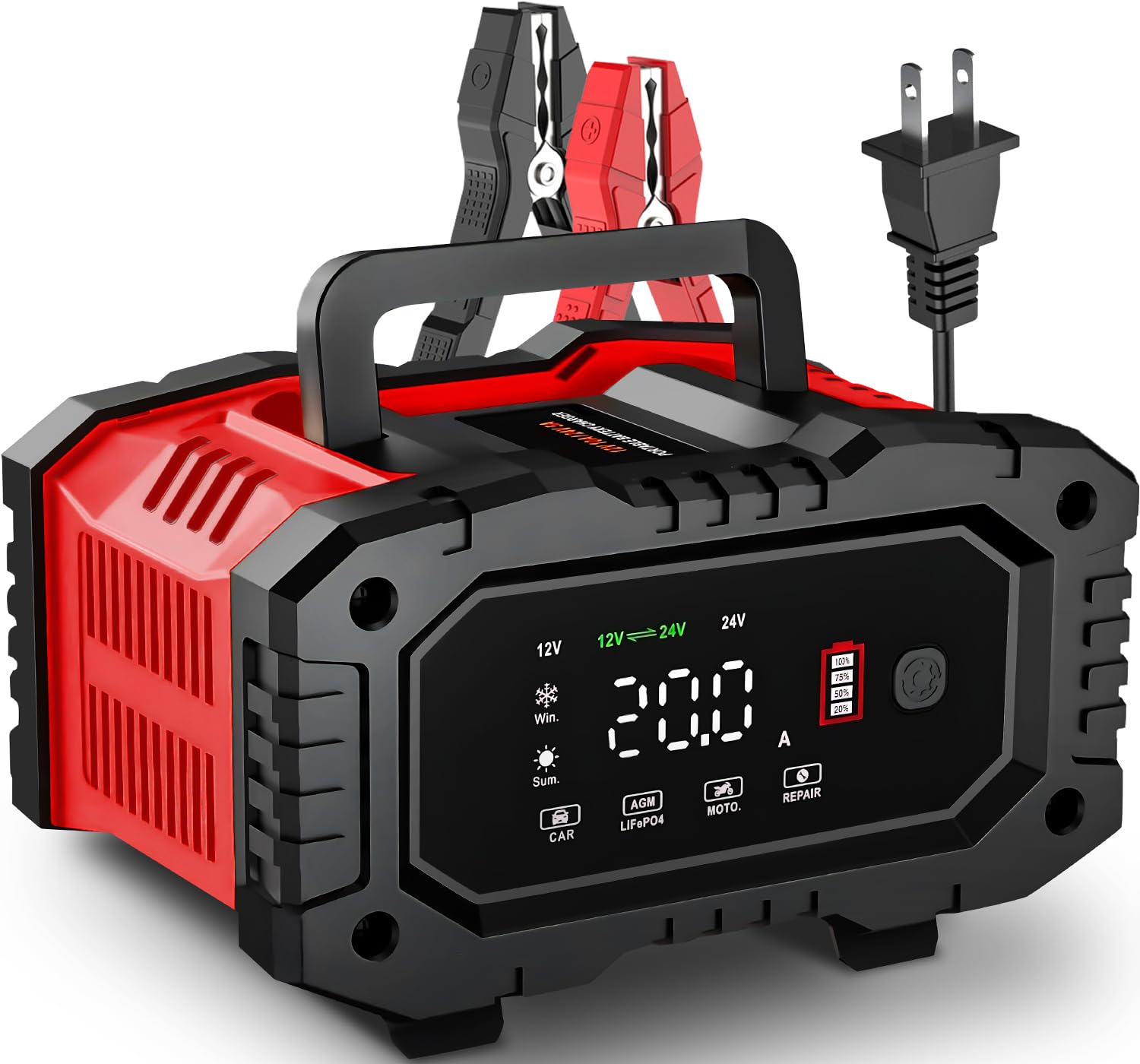
The Huiaipaic 20-Amp Charger delivers the highest amperage in this comparison at 12V and 24V operation, making it the fastest option for recovering large batteries in trucks, SUVs, and marine applications. The 300W output power means this unit charges significantly faster than typical 10A or 15A chargers, which matters when you need a vehicle back on the road the same day.
The pulse repair technology uses high-frequency and low-frequency pulses to address sulfation and acid stratification in lead-acid batteries, with a dedicated Repair mode for batteries that have been idle for extended periods. The large LCD display shows charging voltage, current, percentage, battery full status, temperature, and seasonal mode selection. The summer and winter modes adjust charging parameters based on ambient conditions to prevent undercharging or overcharging.
Physical design considerations include a clip organizer on the back for storing power cords, a foldable handle for carrying, and a bottom bracket that tilts the display for comfortable viewing. The heavy-duty copper alligator clips use heat-resistant and oxidation-resistant wire. Compatibility covers LiFePO4 and lead-acid types including AGM, Gel, SLA, VRLA, Flooded, and Calcium batteries from 6Ah to 200Ah.
What works
- 20A output provides fastest charging in this lineup
- Pulse repair mode helps recover sulfated batteries
- Well-designed cable management and foldable handle
What doesn’t
- Lithium battery charging is disabled on this unit
- Cannot activate completely dead or severely damaged batteries
4. ECO-WORTHY 12V 5A Charger

The ECO-WORTHY 12V 5A Automatic Smart Charger stands out for its clean design language and straightforward compatibility with both lead-acid and lithium iron phosphate batteries. The 5A output sits in the sweet spot for maintaining and moderately charging car, motorcycle, lawn mower, ATV, and boat batteries without the risk profile of higher-amperage units.
The LCD display provides real-time feedback on charging status, and the intelligent detection system automatically identifies low voltage, sulfation, or capacity loss conditions, prompting the user to activate repair charging or indicating that the battery may need replacement. The fully automated charging cycle switches to maintenance mode once the battery reaches full charge, preventing overcharging during long-term storage.
The included SAE connector with a 10A fuse adds flexibility for permanent installation on vehicles with hard-to-reach batteries. The package comes with battery clips and O-ring terminal cables, covering the most common connection scenarios. The compact dimensions make this unit easy to store in a glove box or tool kit, and the universal input voltage range from 100V to 240V AC ensures compatibility with international power standards.
What works
- Compatible with both lead-acid and LiFePO4 batteries
- SAE connector with fuse for permanent installation
- Intelligent detection alerts for battery health issues
What doesn’t
- 5A output is slow for deeply discharged large batteries
- No desulfation mode for lead-acid recovery
5. NOCO Boost GB40 Jump Starter

The NOCO Boost GB40 takes a different approach to the dead battery problem by delivering instant starting power from a compact lithium-ion pack rather than charging the battery over time. With 1000 peak amps, this unit can start engines up to 6.0L gasoline and 3.0L diesel, covering the vast majority of passenger vehicles and light trucks. The patented spark-proof technology and reverse polarity protection eliminate the two biggest risks associated with traditional jumper cables.
The integrated 100-lumen LED flashlight includes seven light modes including SOS and strobe, which adds utility for nighttime roadside emergencies and low-light repairs. The built-in power bank functionality allows charging of smartphones, tablets, and other USB devices, making this a multi-purpose emergency tool rather than a single-function charger. The rechargeable lithium battery powers up to 20 jump starts per full charge and recharges in roughly three hours via the included USB-C cable.
The IP65-rated housing with rubberized over-molding protects against water, dust, and impact, making this unit suitable for storage in a glove box or trunk through all seasons. The heavy-duty clamps provide maximum energy transfer during starting attempts. At 2.5 pounds, this is not a traditional battery charger, but it is the fastest way to get a vehicle running when the battery is completely dead.
What works
- Instant engine start without waiting for a charge cycle
- Spark-proof and reverse polarity protected for safe use
- Dual function as power bank and emergency flashlight
What doesn’t
- Does not recharge a depleted battery, only jump starts
- Must be recharged periodically to maintain readiness
6. YONHAN 15A Battery Charger

The YONHAN 15A Battery Charger brings a 9-stage charging algorithm to the budget-friendly segment, offering more charging phases than many chargers at higher price points. The nine stages include pulse repair technology that automatically detects sulfation and acid stratification, applying corrective pulses to improve performance. The unit operates on both 12V and 24V systems, making it useful for cars, trucks, motorcycles, lawn mowers, and boats.
The temperature-adaptive float mode automatically adjusts charging voltage based on ambient conditions between -15C and 45C, which prevents undercharging in cold weather and overcharging in hot weather. The intelligent memory function remembers the last selected mode, so you do not need to reconfigure settings for repeated use on the same vehicle. The comprehensive safety system covers reverse polarity, short circuit, overcharging, overheating, over-voltage, and over-current conditions.
One-touch operation simplifies the user experience, and the universal input voltage range from 110V to 230V AC makes this charger usable across different regions. The unit delivers 15A at 12V and 8A at 24V, providing ample charging speed for most passenger vehicle batteries. Note that this charger cannot revive batteries that are completely dead with zero voltage.
What works
- Nine-stage charging algorithm at an accessible price point
- Dual voltage operation for 12V and 24V systems
- Temperature compensation adapts to seasonal conditions
What doesn’t
- Cannot revive completely dead batteries with zero voltage
- LiFePO4 charging not supported on this model
7. Battery Tender Junior 021-0123
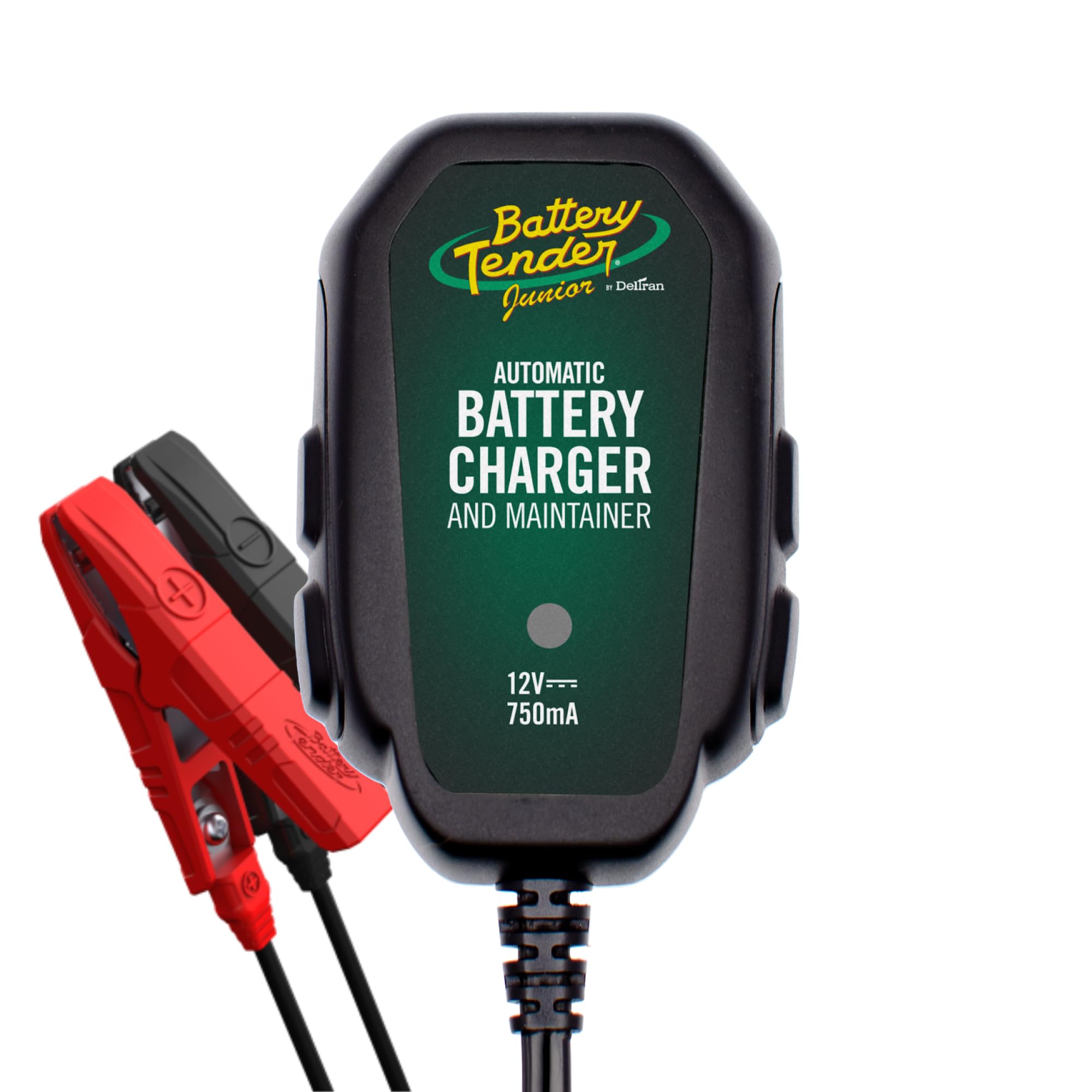
The Battery Tender Junior is the most established name in the battery maintainer category, and the 021-0123 model continues that reputation with a proven 4-step charging program. The initialization, bulk charge, absorption mode, and float mode sequence ensures that 12V lead-acid, flooded, AGM, and gel cell batteries receive optimal charging without the risk of overcharging. The 750mA output is modest, but this unit is designed for maintenance rather than rapid recovery.
The spark-proof circuitry prevents dangerous sparks during connection, and the automatic reversed hook-up detection verifies correct polarity before charging begins. The two-color charge status LED provides clear feedback on whether the battery is charging, fully charged, or if the voltage has dropped enough to trigger adaptive charging. The 12-foot output cord provides ample reach for accessing batteries in awkward locations on motorcycles, ATVs, and lawn tractors.
The package includes fused-ring terminal harnesses for hard-to-reach batteries and alligator clip accessory cables, covering the two most common connection scenarios. The compact dimensions make this unit easy to mount permanently or store in a small space. The 5-year warranty and lifetime customer support from Deltran provide long-term peace of mind for buyers who want a reliable maintainer rather than a fast charger.
What works
- Proven 4-step charging program prevents overcharging
- Spark-proof circuitry for safe connections every time
- 5-year warranty with lifetime customer support
What doesn’t
- 750mA output is very slow for deeply discharged batteries
- No LiFePO4 or desulfation mode available
Hardware and Specs Guide
Charging Stages and Algorithms
Modern battery chargers use multiple stages to safely recover a depleted battery without causing heat damage or overvoltage stress. A basic 4-stage sequence includes initialization to assess battery condition, bulk charge to deliver maximum current, absorption to top off the charge without exceeding voltage limits, and float to maintain the battery at full charge indefinitely. Higher-stage chargers add desulfation, analysis, and repair modes that address specific battery health issues. The number of stages does not always correlate with quality, but a unit with at least 7 stages typically offers more comprehensive battery management than a basic 4-stage unit.
Voltage and Amperage Matching
Selecting the correct voltage and amperage for your battery is critical to safe charging. Most passenger vehicles use 12V systems, but some heavy-duty trucks and marine applications use 24V systems. The charger must match the battery voltage exactly. For amperage, a general guideline is to charge at 10% to 20% of the battery’s amp-hour capacity. A 50Ah battery charges safely at 5A to 10A, while a 100Ah battery can accept 10A to 20A. Charging at higher amperage reduces charging time but generates more heat, which can accelerate battery degradation if not properly managed by the charger’s thermal controls.
Battery Chemistry and Mode Selection
Different battery chemistries require different charging profiles. Lead-acid batteries including Wet, AGM, Gel, and EFB types charge at specific voltage thresholds that vary by type. Lithium iron phosphate batteries require a higher absorption voltage and a lower float voltage compared to lead-acid, and they cannot tolerate the equalization charge that some lead-acid chargers apply. Chargers with automatic chemistry detection use voltage response patterns to identify the battery type and apply the correct profile. Manual mode selection is common on mid-range units and requires the user to know their battery type before charging.
Safety Certifications and Protections
Safety certifications from independent testing laboratories indicate that a charger has passed rigorous testing for electrical and fire safety. ETL and FCC certifications are common in North America, while CE and UKCA marks apply to European markets. Beyond certifications, look for built-in protections including reverse polarity detection that prevents charging when clamps are connected incorrectly, spark-proof circuitry that eliminates ignition risks, over-temperature shutoff that pauses charging if the unit overheats, and over-voltage clamping that prevents voltage spikes from reaching the battery. These features are especially important when charging batteries in enclosed spaces or near flammable materials.
FAQ
Can a dead battery charger revive a completely dead battery?
How long does it take to charge a dead battery?
What is the difference between a battery charger and a battery maintainer?
Is it safe to leave a battery charger connected overnight?
Can I use a 12V charger on a 6V battery or vice versa?
Final Thoughts: The Verdict
For most buyers, the best dead battery charger winner is the NOONE Smart Car Battery Charger because it combines three selectable current levels, engine start capability, winter mode, and ETL certification in a single package that works across multiple battery chemistries. If you want desulfation technology that can extend the life of aging batteries, grab the BatteryMINDer 1510 for its proven pulse repair and multi-bank maintenance. And for emergency roadside situations where you need the engine running immediately, nothing beats the compact power of the NOCO Boost GB40 jump starter.

Certification: BSc in Mechanical Engineering
Education: Mechanical engineer
Lives In: 539 W Commerce St, Dallas, TX 75208, USA
Md Amir is an auto mechanic student and writer with over half a decade of experience in the automotive field. He has worked with top automotive brands such as Lexus, Quantum, and also owns two automotive blogs autocarneed.com and taxiwiz.com.