Fuel line disconnect pliers sit in that frustrating category of tools you do not think about until you are wedged under a dash with a seized quick-connect fitting and skinned knuckles. The right pair turns a thirty-minute curse-fest into a two-second click, but the wrong design leaves you stacking adapters and fighting angles. That gap between convenience and frustration is exactly where this guide lives.
I’m Amir — the founder and writer behind Four Wheel Ask. I’ve spent countless hours analyzing product specifications, build quality metrics, and owner feedback across dozens of fuel line disconnect tools to identify what truly works in the garage.
Most kits look similar on a shelf, but subtle differences in jaw geometry, steel hardness, and handle ergonomics separate the tools you reach for every time from the ones that collect rust. After reviewing hundreds of owner reports and spec sheets, the truth about the best fuel line disconnect pliers is surprisingly straightforward.
How To Choose The Best Fuel Line Disconnect Pliers
Fuel line disconnect pliers look simple, but small design choices determine whether a tool works on your specific vehicle or leaves you hunting for a backup plan. Three factors separate the keepers from the return pile.
Jaw Design and Reach
The angle of the jaw dictates which fittings you can access. Straight jaws work on open lines, but a 30-degree, 45-degree, or 80-degree bend reaches into the gap between the fuel tank and body or behind an intake manifold. Low-profile heads matter more than most buyers realize — a tool that is too thick simply will not fit between closely stacked components. Measure the clearance on your toughest repair before choosing an angle.
Material and Build Quality
Heat-treated alloy steel resists spreading under the high clamping force needed to compress stubborn quick-connect tangs. Cheaper tools made from soft metal deform after a few uses, turning a precision action into a sloppy grip that slips off fittings. PVC or rubber overmolded handles provide grip when your hands are oily, but the core steel determines whether the tool survives its first real test.
Kit Versatility
Single pliers handle one job well, but multi-piece kits include hose remover pliers, fuel filter calipers, and clamp pliers that cover the full fuel system repair cycle. If you work on multiple vehicles, a set with interchangeable adapters or multiple jaw angles saves trips to the toolbox. The trade-off is bulk — larger kits take up more drawer space, and some pieces may never leave the case.
Quick Comparison
On smaller screens, swipe sideways to see the full table.
| Model | Category | Best For | Key Spec | Amazon |
|---|---|---|---|---|
| TOOLEAGUE 6Pcs Set | Kit | Comprehensive fuel system jobs | 6 pieces, hardened CRV steel, 30° pliers | Amazon |
| AutoWanderer 6 PCS Set | Kit | Multi-angle fitting access | 6 pieces, 80° pliers, alloy steel | Amazon |
| AutoWanderer 4-in-1 Set | Kit | Entry-level all-in-one value | 4 pieces, 80° pliers, 9″ caliper | Amazon |
| Lisle 37140 | Single | Tight tank-to-body clearance | 45° bend, low-profile, lifetime warranty | Amazon |
| Lisle 34750 | Adapter Set | GM Ford Chrysler specific lines | 4 adapters, 3/8″ and 5/16″, compact | Amazon |
In‑Depth Reviews
1. TOOLEAGUE Fuel Line Pliers Set 6Pcs

The TOOLEAGUE 6Pcs set delivers the most complete fuel line toolkit in this roundup without pushing into specialist pricing territory. It pairs a 30-degree bent disconnect pliers with a hose remover pliers, a 9-inch fuel filter caliper, a hose clamp removal pliers, a flat hose clamp pliers, and a trim removal tool. That range covers everything from quick-connect fuel fittings to spring-type coolant clamps, which means one case replaces a drawer full of singles.
The core disconnect pliers use hardened CRV steel that resists jaw spread under heavy clamping force, and the 30-degree bend provides enough offset to access fittings tucked behind intake runners or along the firewall. The hose remover pliers grip lines from 5/32-inch up to 1/2-inch, which spans most domestic and import fuel, water, and transmission hoses. Owner reports consistently highlight that the set handles repeated use without the hinge loosening up, a common failure point on cheaper kits.
The flat hose clamp pliers open to 1-3/4 inches with a swivel tip that traps and holds ring-type clamps, making it genuinely useful for coolant pipe work that usually requires a separate tool. The inclusion of a trim removal tool feels like a bonus rather than filler, and the PVC handle grips stay secure even with solvent on your hands. For anyone maintaining multiple vehicles, this set eliminates the need to buy supplementary tools later.
What works
- Comprehensive 6-piece kit covers nearly every fuel system task
- Hardened CRV steel jaws resist deformation under load
- Hose remover handles multiple line diameters without swapping
What doesn’t
- Storage case is basic and does not hold tools tightly in place
- Trim tool is functional but not as refined as dedicated panel tools
2. AutoWanderer 6 PCS Fuel Line Disconnect Pliers Set
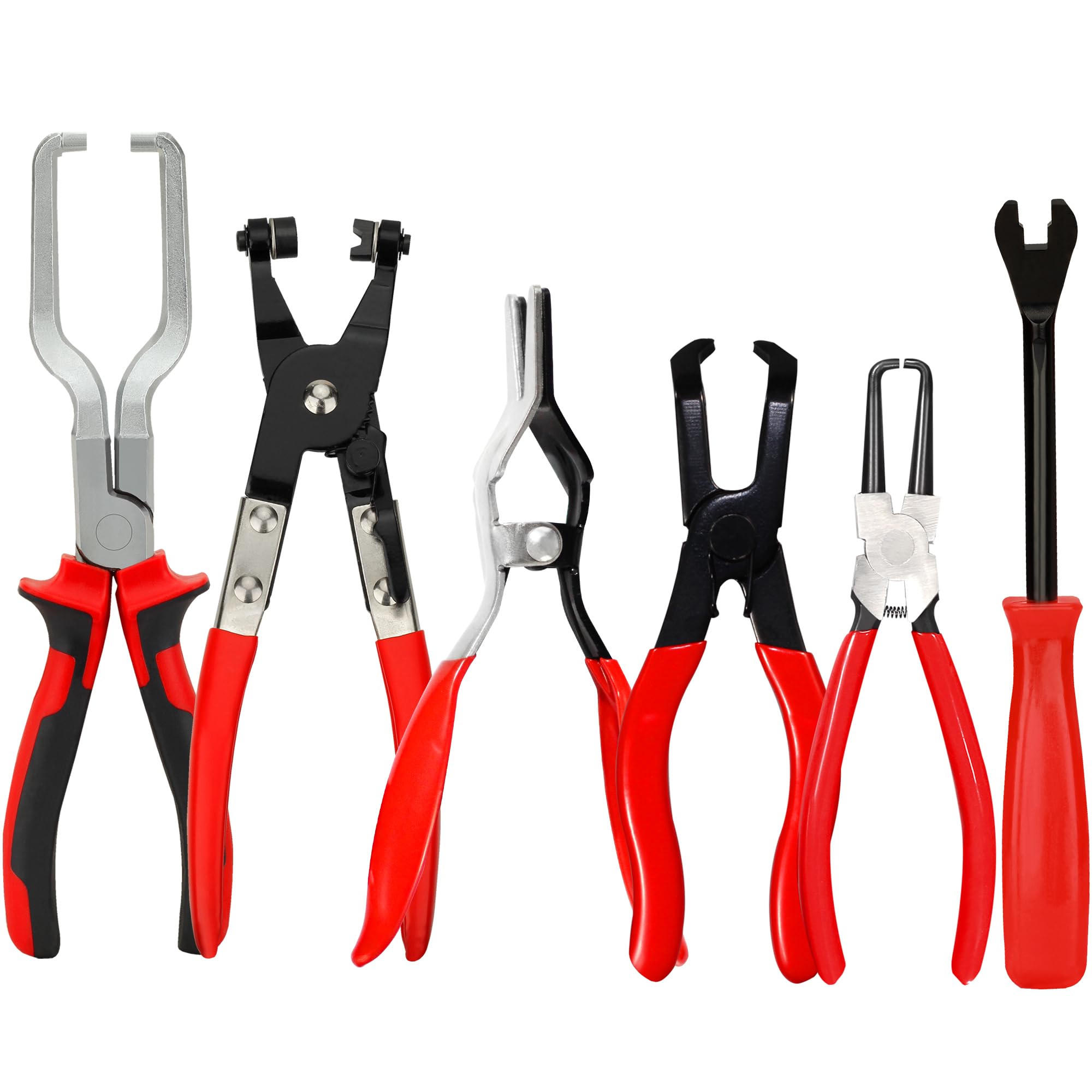
The AutoWanderer 6 PCS set differentiates itself with an 80-degree bent disconnect pliers that reaches into the tightest corners of modern engine bays. Where a 30 or 45-degree tool still struggles to align with fittings buried between the intake manifold and the firewall, the steeper angle on this pliers slides in and compresses the tangs without requiring you to bend fuel lines out of the way. That extra reach makes it a strong choice for full-size trucks and SUVs with packed engine compartments.
Beyond the headline pliers, the set includes a hose remover, a flat hose clamp pliers, and a fuel filter caliper built from alloy steel with an ergonomic grip. The hose clamp pliers open to 3.66 inches, which accommodates the larger spring clamps found on diesel and heavy-duty cooling systems. The alloy steel construction provides a good balance between weight and strength, keeping the set manageable for extended sessions without sacrificing bite on stubborn connectors.
Owner feedback emphasizes that the 80-degree pliers handle the notoriously tight fuel line connections on GM trucks and select Ford applications where other tools simply cannot get square on the fitting. The set does not include a storage case, which is a minor inconvenience, but the tools themselves pack enough capability to justify the drawer space. For mechanics who regularly fight inaccessible quick-connects, this kit delivers exactly the angle advantage needed.
What works
- 80-degree bend reaches fittings other tools cannot access
- Alloy steel holds up well against repeated high-force use
- Hose clamp pliers open wide enough for diesel applications
What doesn’t
- No included storage case for organization
- 80-degree angle can feel awkward on easier-to-reach lines
3. AutoWanderer Tool 4-in-1 Fuel Line Disconnect Tool Set

The AutoWanderer 4-in-1 set distills the fuel line tool concept down to four focused pieces: an 80-degree disconnect pliers, a hose remover pliers, a 9-inch fuel filter caliper, and a hose pipe clamp. This is not a sprawling kit trying to be everything — it targets the four operations that actually slow down a fuel system repair and executes each one without unnecessary extras. The result is a set that fits in a smaller toolbox drawer while still covering the critical tasks.
The 80-degree disconnect pliers use the same aggressive angle as the larger AutoWanderer set, giving it the same deep-access capability for tight quick-connect fittings. The hose remover pliers handle diameters from 5/32 to 1/2 inch across fuel, water, transmission, and cooler lines, and the rubber overmold on the handles provides a secure grip even when hands are wet with fuel or coolant. The 9-inch fuel filter caliper features bent jaws and spring-loaded action for one-handed operation on diesel leak-off connections and standard fuel filter housings.
Build quality is solid for the price point — the alloy steel jaws show consistent heat treatment without soft spots, and the pivot pins stay tight after repeated use. The hose pipe clamp pliers open to 3.66 inches, which matches the larger kits for spring clamp capacity. Owner reports note that the set works particularly well on older, stubborn fittings where corrosion has made the tangs less compliant, suggesting the jaw hardness is adequate for real-world abuse.
What works
- Focused 4-piece kit covers essential fuel system tasks without bulk
- 80-degree pliers access deep fittings effectively
- Rubber overmold handles provide secure grip with oily hands
What doesn’t
- No flat hose clamp pliers for ring-type clamps
- Not enough variety for technicians working across many platforms
4. Lisle 37140 Disconnect Pliers, 45 Degree

The Lisle 37140 takes a focused single-tool approach with a 45-degree low-profile design engineered specifically for the gap between the top of the fuel tank and the vehicle body. That narrow use case — accessing fittings in the tightest vertical clearance situations — is exactly where multi-piece kits fall short. Rather than providing adapters that stack thickness, Lisle sculpted the head to be as thin as possible while maintaining structural integrity, and the 45-degree bend lets the tool approach fittings from a natural angle without fighting the surrounding structure.
The tool handles not only fuel line quick-connects but also EVAP line fittings and DEF fittings, which expands its utility beyond just fuel system work. The plastic handle grips are ergonomically shaped and provide a comfortable purchase point, though they lack the rubber overmold found on some competitors. The steel construction feels robust in hand, and the Lisle name carries a reputation for professional-grade tooling that holds up in daily shop use.
The lifetime warranty is a significant differentiator here — Lisle stands behind this tool for the long haul, which signals confidence in the build quality. Owner feedback consistently praises the low-profile head for fitting where nothing else will, particularly on GM full-size trucks and SUVs where the fuel tank sits close to the body. If your primary challenge is tank-to-body clearance, this single tool solves that problem more elegantly than any kit.
What works
- Low-profile head fits the tightest tank-to-body gaps
- Lifetime warranty provides long-term confidence
- Works on fuel, EVAP, and DEF fittings
What doesn’t
- Single tool covers only one use case
- Plastic handles lack rubber grip for oily conditions
5. Lisle 34750 Low Profile Fuel Line Disconnect Set

The Lisle 34750 takes a different approach than the plier-style tools on this list — it uses a set of four adapter pieces (two 3/8-inch and two 5/16-inch) that slide over quick-connect fittings to depress the release tangs in hard-to-reach locations. This design prioritizes thinness above all else, making it the go-to solution when even low-profile pliers cannot squeeze into the available space. The adapters add minimal thickness to the fitting itself, which matters enormously on GM 5.3-liter applications where clearance is measured in millimeters.
The 3/8-inch adapters target the fuel lines on GM trucks including Suburban, Tahoe, Yukon, Avalanche, and select Silverado and Sierra models, while the 5/16-inch adapters cover Ford and Chrysler applications. This vehicle-specific focus means the set is not a universal solution, but for owners of those platforms it works better than any plier-style tool. The adapters are made from durable plastic with metal reinforcing where needed, and the compact package stores easily in a glovebox or tool pouch.
Owner reports confirm that the adapter approach eliminates the risk of damaging plastic quick-connect retainers that can crack under the leverage of pliers. The trade-off is that you need the correct adapter size for your vehicle, and the set only covers two common diameters. For DIYers working on a single GM or Ford platform, this is a budget-friendly precision tool that outperforms more expensive universal kits in its specific application.
What works
- Ultra-thin adapter design fits where pliers cannot
- Vehicle-specific sizing ensures positive tang engagement
- Compact and easy to store in any toolbox
What doesn’t
- Limited to 3/8-inch and 5/16-inch fittings only
- Not a universal solution for all fuel line types
Hardware & Specs Guide
Jaw Angle and Reach
The jaw angle determines which fuel line fittings a tool can access without bending lines or removing surrounding components. Straight jaws work on open-access fittings, while 30-degree bends clear intake runners, 45-degree bends target tank-to-body gaps, and 80-degree bends reach deeply buried connectors behind the engine or under the dash. Low-profile head thickness is equally critical — a head that is too thick will not fit between stacked fittings even if the angle is correct.
Steel Hardness and Construction
Heat-treated alloy steel or CRV (chromium-vanadium) steel provides the hardness needed to compress quick-connect tangs without the jaws spreading or deforming. Softer steel tools lose their precise fit after a few uses, leading to slipped grips and damaged fittings. The pivot pin construction also matters — a riveted or pinned hinge that develops play reduces control and increases the risk of slipping off the connector under force.
Handle Ergonomics and Grip
Rubber overmolded handles provide better traction when hands are wet with fuel, oil, or coolant compared to bare plastic or PVC. The handle shape should allow you to apply maximum clamping force without your hand slipping forward onto the jaws. Some tools add a spring-loaded return action that keeps the jaws open between compressions, reducing hand fatigue during repetitive disconnects on multi-line systems.
Kit Composition and Adaptability
Multi-piece kits expand a tool’s usefulness beyond quick-connect fuel lines to include hose removal, filter caliper work, and spring clamp handling. Adapter-based systems like the Lisle 34750 trade versatility for ultra-thin access on specific fitting sizes. The best choice depends on whether you need a single dedicated tool for a recurring repair or a comprehensive set that handles the full range of fuel system maintenance tasks across multiple vehicles.
FAQ
What size fuel line disconnect pliers do I need for my vehicle?
Can fuel line disconnect pliers damage plastic quick-connect fittings?
How do I use fuel line disconnect pliers on a stuck or corroded fitting?
Are fuel line disconnect pliers the same as fuel filter removal tools?
Final Thoughts: The Verdict
For most buyers, the best fuel line disconnect pliers winner is the TOOLEAGUE 6Pcs Set because it combines hardened CRV steel construction, a versatile 30-degree pliers, and a comprehensive six-piece kit that eliminates the need for secondary tool purchases. If you need the deepest reach for the tightest engine bay corners, grab the AutoWanderer 6 PCS Set with its 80-degree disconnect pliers. And for a precise, vehicle-specific solution on GM or Ford platforms, nothing beats the ultra-thin Lisle 34750 Adapter Set.

Certification: BSc in Mechanical Engineering
Education: Mechanical engineer
Lives In: 539 W Commerce St, Dallas, TX 75208, USA
Md Amir is an auto mechanic student and writer with over half a decade of experience in the automotive field. He has worked with top automotive brands such as Lexus, Quantum, and also owns two automotive blogs autocarneed.com and taxiwiz.com.