A weak or corroded ground cable is one of the most overlooked causes of intermittent electrical failures, slow cranking, and mysterious parasitic drains. The connection between your battery’s negative terminal and the chassis is the foundation of the entire electrical system, and when that path degrades, every component downstream suffers. Choosing the right replacement means understanding gauge, copper purity, and terminal construction rather than just grabbing the cheapest option on the shelf.
I’m Amir — the founder and writer behind Four Wheel Ask. I’ve spent years analyzing automotive electrical system specifications, comparing cable construction methods across dozens of manufacturers, and studying owner-reported failure patterns to determine which ground cables actually hold up over time.
Whether you are dealing with a no-start condition, chasing voltage drop, or simply upgrading an aging factory strap, the best car battery ground cable ensures reliable engine starts every time through a fully corrosion-resistant, low-resistance connection between the battery and the vehicle chassis.
How To Choose The Best Car Battery Ground Cable
A ground cable may look like a simple wire, but the materials and construction methods used determine whether it delivers consistent performance for years or becomes a hidden source of electrical gremlins. Focus on these three factors when making your selection.
Gauge Size and Current Capacity
The American Wire Gauge rating directly determines how much current the cable can carry without excessive voltage drop. For most passenger vehicles, 4 AWG provides adequate capacity for starter circuits and accessory loads. Larger engines, diesel trucks, or vehicles with high-output alternators benefit from 2 AWG or even 1/0 AWG cable. Thicker gauge also leaves headroom for future electrical additions such as inverters or auxiliary lighting.
Copper Purity and Stranding
Pure copper offers the lowest resistance per foot, but not all cables labeled copper are equal. Some budget cables use copper-clad aluminum (CCA) which sacrifices conductivity and durability. Look for cables explicitly stating 99.9 percent pure copper with fine-stranded wire construction. Fine stranding improves flexibility, making routing around engine bay obstacles easier without kinking or breaking internal strands.
Terminal Lugs and Corrosion Protection
The interface between cable and battery terminal is the most common failure point. Quality cables use tinned copper lugs that resist oxidation, along with adhesive-lined heat shrink tubing that creates a moisture-proof seal at the crimp junction. Marine-grade tinning provides an extra layer of protection in environments exposed to road salt or humidity. Avoid bare copper lugs without heat shrink coverage as they will corrode rapidly in real-world conditions.
Quick Comparison
On smaller screens, swipe sideways to see the full table.
| Model | Category | Best For | Key Spec | Amazon |
|---|---|---|---|---|
| End Game 4 AWG | Ground Cable | Best Overall | 4 AWG, EPDM Insulation | Amazon |
| End Game 2 AWG Marine | Marine Cable | Heavy Duty & Corrosion Resistance | 2 AWG, Tinned Lugs, USCG | Amazon |
| WindyNation 2 AWG | Ground Cable | Value & Flexibility | 2 AWG, Ultra-Flexible, 600V | Amazon |
| TUELETFU 4 AWG Set | Cable Set | Dual Cable Installations | 4 AWG, Red/Black Pair, 5ft | Amazon |
| TOPDC 4 AWG | Ground Cable | Entry-Level Replacement | 4 AWG, Pure Copper, 24in | Amazon |
In‑Depth Reviews
1. End Game 4 AWG Fully Assembled Battery Cable

The End Game 4 AWG cable strikes an excellent balance between build quality and everyday usability. It uses 99.9 percent pure fine-strand copper for low resistance and excellent flexibility, while the EPDM rubber jacket provides superior oil and fuel resistance compared to standard PVC insulation. Each cable is crimped with a 10-ton hydraulic press and sealed with adhesive-lined heat shrink, eliminating the moisture ingress that causes internal corrosion over time.
Owner feedback consistently highlights the professional-grade crimp quality and the durability of the EPDM jacket in engine bay environments. Users have installed these cables on Chevy Astro vans, race motorcycle starters, and truck ground strap replacements with no reported issues. The USA-made construction adds confidence in material sourcing and quality control, and the availability of multiple lengths and lug sizes makes it easy to match your exact vehicle configuration.
For the majority of passenger cars, trucks, and SUVs, this cable delivers all the reliability you need without overspending on marine-grade features you may never use. The combination of pure copper, robust insulation, and precision crimping makes it the most well-rounded choice for a permanent ground cable upgrade.
What works
- Hydraulic-crimped lugs with fully sealed heat shrink
- EPDM jacket resists oil, fuel, and abrasion
- Made in the USA with fine-strand pure copper
What doesn’t
- Limited to 4 AWG; not ideal for high-amperage diesel applications
- EPDM can feel stiffer than PVC in extreme cold
2. End Game 2 AWG Marine Grade Battery Cable

When the application demands maximum corrosion resistance and higher current capacity, the End Game 2 AWG Marine Grade cable steps up with tinned copper lugs and PVC insulation that exceeds USCG and ABYC standards. The 2 AWG gauge supports significantly more amperage than standard 4 AWG cables, making it suitable for diesel trucks, large RV systems, marine environments, and high-output alternator setups where voltage drop must be minimized.
The tinned closed-end lugs provide a layer of oxidation protection that bare copper cannot match, which is critical in salt-belt regions or coastal areas where road salt and humidity accelerate corrosion. Each lug is crimped and sealed with adhesive heat shrink, creating a watertight barrier at the connection point. The PVC insulation offers better dielectric properties than EPDM and remains flexible across a wide temperature range.
Owners running heavy electrical loads or operating in harsh environments will appreciate the extra margin this cable provides. The marine-grade construction means it handles vibration, moisture, and temperature cycling better than standard automotive cables, reducing the likelihood of ground-side failures in demanding conditions.
What works
- Tinned marine lugs resist corrosion far longer than bare copper
- Meets USCG and ABYC specifications for marine use
- 2 AWG gauge handles high-amperage loads with minimal drop
What doesn’t
- Higher cost than 4 AWG options for basic passenger car needs
- PVC insulation less abrasion-resistant than EPDM in some engine bay layouts
3. WindyNation 2 AWG Single Black Cable
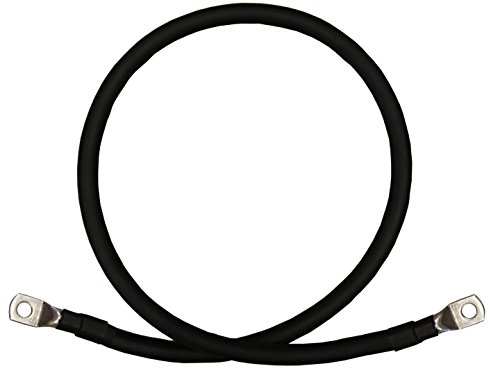
The WindyNation 2 AWG cable delivers premium gauge at a mid-range price point, making it a strong value proposition for buyers who want the capacity of 2 AWG without paying marine-grade premiums. The ultra-flexible WindyNation cable uses 100 percent fine-stranded pure copper and is SAE J1127 compliant, rated for 600 volts across a temperature range of -50°C to +105°C. The tinned copper lugs feature a closed-end design that provides basic corrosion protection out of the box.
What sets this cable apart is the customization flexibility. Buyers can select from multiple length options ranging from 9 inches to 7 feet and choose between 5/16-inch or 3/8-inch terminal stud sizes on each end independently. This makes it easy to fit unusual battery post configurations or tight routing paths where a pre-set length would not work. The polyolefin heat shrink applied at each lug creates a protective seal that prevents moisture from wicking into the stranded wire.
For budget-conscious owners who still want the performance of 2 AWG cable, this option provides genuine pure copper construction with verified SAE compliance. The flexibility of the fine-strand cable makes routing around engine bay obstacles straightforward, and the made-in-USA manufacturing adds assurance regarding material quality.
What works
- Customizable length and terminal size for non-standard installations
- Ultra-flexible fine-strand copper simplifies routing in tight spaces
- SAE J1127 compliant with full 600V rating
What doesn’t
- Heat shrink coverage less extensive than fully sealed marine-grade cables
- Single black cable only; red or set options require separate purchase
4. TUELETFU 4 AWG Battery Cable Set

The TUELETFU 4 AWG set stands out by including both a red positive and black negative cable in one package, saving the hassle of buying cables individually. Each cable is constructed from 4 AWG pure copper with tin-plated solid copper lugs at both ends, terminated with 3/8-inch ring terminals. The cables are sealed with adhesive heat shrink at each connection point, providing heat insulation and moisture resistance suitable for automotive, marine, RV, solar, and motorcycle applications.
Owner reports from Subaru Outback camping setups, golf cart conversions, and Kawasaki Mule modifications indicate the cables handle moderate loads well. The 5-foot length provides enough reach for routing from a starter battery to a power inverter mounted on the floorboard or connecting dual batteries in a camper setup. Several users noted the cable quality is excellent for the segment, though a minority reported that the crimp tension on the lugs was not always consistent and required re-crimping on some units.
For installations requiring both positive and negative cables simultaneously, this set eliminates the need to match two separate purchases. The tin-plated lugs offer improved corrosion resistance over bare copper, and the color-coded insulation makes polarity identification immediate during installation.
What works
- Includes both red and black cables for a complete installation
- Tin-plated lugs provide corrosion protection out of the box
- 5-foot length works well for inverter and dual-battery setups
What doesn’t
- Crimp quality inconsistency reported on some units
- Not available in gauges larger than 4 AWG for heavy-duty use
5. TOPDC 4 AWG Battery Cable 24-Inch

The TOPDC 4 AWG cable is a straightforward, no-frills ground cable aimed at budget-conscious replacements. It uses pure copper conductor wire with 3/8-inch ring terminals at both ends, enclosed in a flexible PVC insulation jacket. The cable ends are sealed with heat shrink tubing, providing basic resistance against moisture, abrasion, and flame. The 24-inch (2-foot) length works well for short ground runs where the battery is mounted close to the chassis ground point.
Customer feedback across multiple installations — including lift gates, boat bus bars, and general automotive ground replacements — consistently mentions the solid build quality relative to the low cost. Users describe the cables as having heavy-duty feel with solid terminal attachments that do not feel cheap. The PVC jacket provides adequate flexibility for most engine bay routing, though it is noticeably stiffer than the ultra-flexible fine-strand cables in the premium segment.
For a simple ground cable replacement on a daily driver where extreme corrosion resistance or high-amperage capacity is not required, this cable gets the job done without overspending. The pure copper construction ensures proper conductivity, and the heat-sealed ends protect against the most common failure point. It is a practical entry-level option that outperforms generic hardware-store cable assemblies.
What works
- Pure copper construction at a very accessible price point
- Heat shrink sealed ends prevent moisture wicking
- Solid terminal attachments with good hand-feel
What doesn’t
- PVC jacket less durable than EPDM against oil and heat
- Limited to 24-inch length and 3/8-inch lugs only
Hardware & Specs Guide
Understanding Cable Gauge (AWG)
The American Wire Gauge system uses a descending scale where a lower number means thicker cable. 4 AWG is the most common size for passenger vehicle ground cables, handling up to approximately 100 amps over short distances. 2 AWG roughly doubles the cross-sectional area, allowing higher current flow with less voltage drop — critical for diesel glow plugs, high-compression starters, or auxiliary loads. Going thicker than necessary does not harm performance, but it does increase cost and reduce flexibility, so match gauge to your vehicle’s actual electrical demand.
Copper Purity and Strand Configuration
Pure copper (minimum 99.9 percent) offers the lowest resistivity per unit length. Fine-strand cables use many thin wires twisted together rather than a few thick strands, which dramatically improves flexibility and resistance to vibration fatigue. Copper-clad aluminum (CCA) cables appear copper-colored but use an aluminum core that has roughly 60 percent of the conductivity of pure copper — avoid these for ground cable applications where every milliohm counts toward reliable starting and stable system voltage.
FAQ
What gauge ground cable do I need for my car battery?
Can I use a thicker ground cable than the original factory strap?
How do I know if my car battery ground cable is failing?
Is pure copper or copper-clad aluminum better for a ground cable?
Final Thoughts: The Verdict
For most buyers, the car battery ground cable winner is the End Game 4 AWG because it combines pure copper construction, EPDM insulation, and precision hydraulic crimping into a package that fits the needs of nearly every passenger vehicle at a fair price. If you need maximum corrosion resistance for marine or salt-belt conditions, grab the End Game 2 AWG Marine Grade with its tinned lugs and USCG compliance. And if value is your priority with the flexibility of custom lengths, the WindyNation 2 AWG delivers genuine pure copper performance without the premium upcharge.

Certification: BSc in Mechanical Engineering
Education: Mechanical engineer
Lives In: 539 W Commerce St, Dallas, TX 75208, USA
Md Amir is an auto mechanic student and writer with over half a decade of experience in the automotive field. He has worked with top automotive brands such as Lexus, Quantum, and also owns two automotive blogs autocarneed.com and taxiwiz.com.