When the summer heat hits and your vehicle’s AC starts blowing warm air, the difference between a fast, affordable recharge and an expensive shop visit comes down to the refrigerant kit you choose. A weak or incorrect recharge leaves you sweating through the commute, while a properly selected kit restores cold airflow without the headache.
I’m Amir — the founder and writer behind Four Wheel Ask. I’ve spent years analyzing product specifications, studying build quality data, and cross-referencing owner feedback to separate the kits that deliver consistent results from those that fall short.
After comparing specs, build quality, and owner reports, the best r134a refrigerant choices deliver reliable AC cooling across various vehicle systems.
How To Choose The Best R134A Refrigerant
Selecting an R134A refrigerant kit goes beyond grabbing the first can on the shelf. The right choice depends on your AC system type, the condition of your components, and how much diagnostic insight you want from the recharge process. Here are three factors that separate a smooth recharge from a frustrating experience.
Can Tap Compatibility
The can tap is the interface between your refrigerant can and the charging hose. Puncture-type taps pierce the can seal and are common on older-style cans, while self-sealing taps (SSV) allow you to stop and restart the flow without wasting gas. Check whether your refrigerant cans use a traditional puncture seal or the newer self-sealing valve before choosing a kit, as mismatching the tap type leads to leaks and lost refrigerant.
Hose Length and Gauge Readability
Longer hoses offer more flexibility when attaching to hard-to-reach low-side service ports, but they also introduce more resistance and potential for pressure drop. Kits with 19- to 24-inch hoses work well for vehicles with accessible ports under the hood, while 51- to 59-inch hoses help on larger trucks or systems where the port sits deeper. The gauge must show clear graduations for R134A pressure ranges so you can monitor the charge level in real time without guesswork.
Build Quality and Leak Prevention
Refrigerant systems operate under significant pressure, so the materials used in connectors, hoses, and seals directly affect safety and service life. Kits with brass or aluminium alloy fittings resist corrosion better than all-plastic alternatives. Integrated O-rings or internal gaskets at the ports reduce the chance of refrigerant escaping during the charge. A well-sealed kit not only charges more accurately but also protects your system from moisture ingress.
Quick Comparison
On smaller screens, swipe sideways to see the full table.
| Model | Category | Best For | Key Spec | Amazon |
|---|---|---|---|---|
| ZeroR AC Recharge Kit | Premium | Complete recharge with SSV cans | 6oz SSV cans, 24″ hose, gauge | Amazon |
| Aupoko R134A Recharge Hose Kit | Mid-Range | Long hose reach & puncture tap | 59″ hose, aluminium alloy tap | Amazon |
| Wadoy Refrigerant Recharge Kit | Mid-Range | Versatile with BPV31 piercing valve | 4.3ft hose, bullet tap, gauge | Amazon |
| Belleone R134A Recharge Kit | Budget | Entry-level recharge with clear gauge | 19″ hose, 3-scale gauge | Amazon |
| gohantee R134A Recharge Hose Kit | Budget | Basic kit with self-sealing tap | 51″ hose, 200 PSI gauge | Amazon |
In‑Depth Reviews
1. ZeroR AC Recharge Kit R134a Replacement
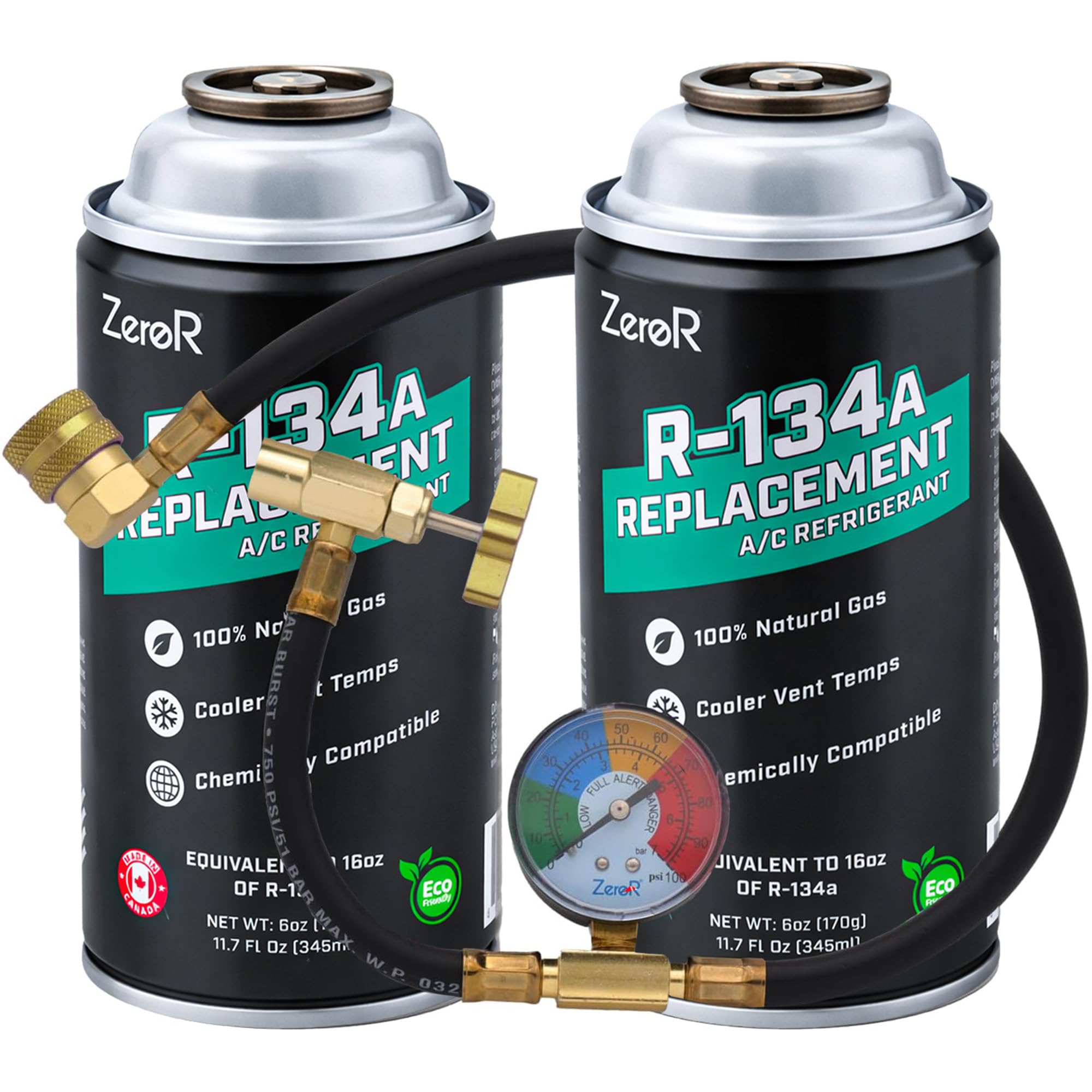
The ZeroR AC Recharge Kit stands apart from commodity refrigerant kits by pairing a hydrocarbon-blend gas that is chemically compatible with R134A systems alongside a purpose-built charging tool. The 6oz SSV cans use a self-sealing valve that allows storage of unused gas, eliminating the waste common with puncture-style cans. An extra-long 24-inch hose provides ample reach to low-side ports on trucks and SUVs, while the gauge reads R134A system pressures directly for accurate monitoring during the charge.
This kit is designed for users who want a complete recharge experience rather than just a hose and tap. The gas is a natural hydrocarbon blend that does not deplete the ozone and has a low global warming footprint, making it a cleaner alternative to traditional chemical refrigerants. The included UV dye is sufficient for basic leak tracing, though not concentrated enough for a full professional leak detection procedure. ZeroR explicitly advises verifying that your vehicle uses R134A before purchase, since the system compatibility depends on the correct refrigerant type.
Build quality focuses on the SSV can construction and the tap mechanism, both of which feel more robust than the thin metal found on budget tap valves. The 24-inch hose is reinforced rubber with solid brass fittings that resist corrosion over multiple uses. For owners who recharge annually or want a kit that stores partial cans without losing gas, this is the most complete solution in the lineup.
What works
- SSV cans allow partial use without wasting remaining gas
- Hydrocarbon blend is ozone-safe with low environmental impact
- Long 24-inch hose reaches ports on larger vehicles
- Includes UV dye for basic leak tracing
What doesn’t
- Requires verifying R134A system before purchase
- Not designed for full professional leak detection
- Gas is flammable; requires proper handling precautions
2. Aupoko R134A Recharge Hose Kit

The Aupoko Recharge Hose Kit delivers a 59-inch charging hose, the longest in this comparison, paired with a puncture-type can tap made from aluminium alloy for high heat resistance. The extended hose length makes it the top choice for vehicles where the low-side service port sits deep in the engine bay or behind structural components. The gauge provides R134A pressure readings on a clear dial, and the push-and-lock quick coupler includes an auto shut-off feature that simplifies connection and disconnection.
Construction quality leans on a combination of aluminium alloy for the can tap and brass alloy for the R410A mini split adapter, giving the kit better corrosion resistance than all-steel alternatives. The 1/2-inch female to 1/4-inch SAE male tap opener works with standard R134A puncture cans, and the included R410A straight swivel adapter broadens compatibility to home mini-split AC systems. This dual-use capability makes the kit a practical investment for anyone who services both vehicle and residential refrigeration equipment.
Owner feedback consistently highlights the smooth threading on the can tap and the secure seal at the quick coupler, which reduces the chance of refrigerant escaping during the charge. The gauge scale includes temperature markings for R-12, R-22, and R-134A, allowing the same kit to be used across different system types. For users who need maximum reach and versatile compatibility, the Aupoko kit offers strong value without stepping into premium pricing territory.
What works
- 59-inch hose reaches difficult service ports with ease
- Aluminium alloy tap resists heat and corrosion
- Includes R410A adapter for home mini-split systems
- Quick coupler with auto shut-off simplifies use
What doesn’t
- Puncture-type tap does not allow partial can storage
- Maximum pressure rating of 5 bars limits heavy-duty use
- Packaging may not include storage case for hose
3. Wadoy Refrigerant Recharge Kit
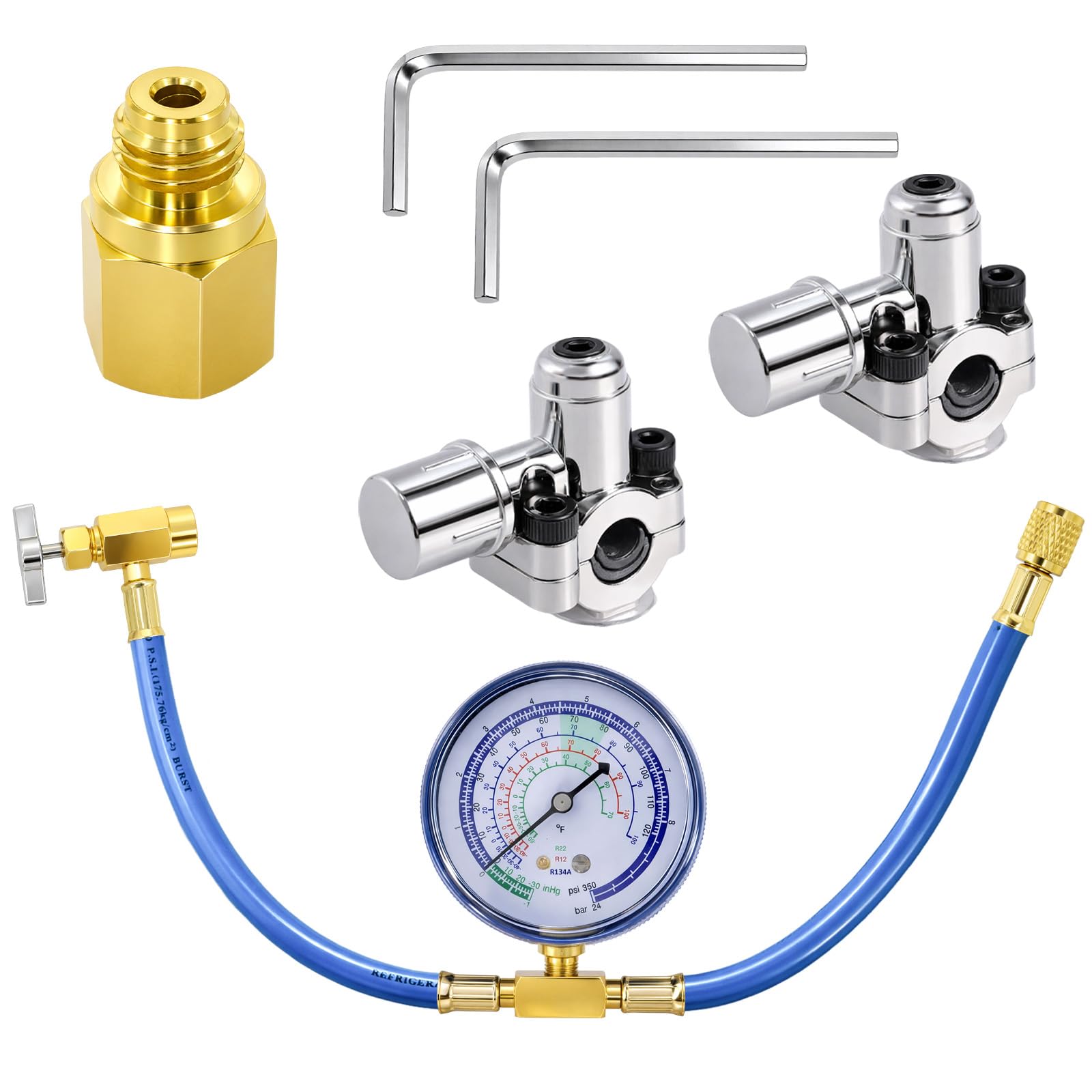
The Wadoy Refrigerant Recharge Kit brings a different approach by including a BPV31 bullet piercing tap valve that works with tubing diameters of 1/4 inch, 5/16 inch, and 3/8 inch. This makes the kit particularly suited for home refrigerators, freezers, and other sealed refrigeration systems in addition to vehicle AC. The 19-inch hose connects R134A cans to R-12 and R-22 service ports, and the large gauge features three scale readings for R134, R12, and R22, giving clear visual feedback across multiple chemistries.
Material selection focuses on durable metal components and reinforced rubber hoses that handle up to 250 PSI. The internal gaskets at the port connections provide leak-proof performance under pressure, which is critical when charging systems that have already lost refrigerant due to wear. An included R134A self-sealing adapter lets the kit work with both traditional puncture cans and newer self-sealing cans, bridging the gap between older and newer can formats without needing a second tool.
What makes the Wadoy kit stand out in the value category is the combination of the BPV31 valve, self-sealing adapter, and the wide application range. It covers vehicle AC, home refrigeration, and general HVAC maintenance from a single package. The 4.3-foot hose offers a middle ground between compact storage and reach, and the gauge clarity earns positive marks from owners who appreciate being able to read pressure without squinting at tiny markings.
What works
- BPV31 bullet valve fits multiple tubing sizes for home systems
- Includes self-sealing adapter for newer R134A cans
- 250 PSI rating handles most vehicle and home AC pressures
- Three-scale gauge for R134, R12, and R22 compatibility
What doesn’t
- 19-inch hose may be short for some vehicle service ports
- Bullet valve adds complexity for first-time users
- No included carrying case for organized storage
4. Belleone R134A Refrigerant Recharge Kit

The Belleone R134A Recharge Kit focuses on simplicity and visual clarity with its 19-inch hose, clear three-scale gauge, and straightforward blue-and-copper metal construction. The gauge displays scale readings for R134, R12, and R22, allowing the user to verify pressure across different refrigerant types without converting between dial faces. The 1/4-inch SAE port connections fit R-12 and R-22 fittings, making this kit a viable option for older vehicle AC systems that predate the R134A transition.
Material quality centers on corrosion-resistant metal components and a rubber hose rated to 350 PSI, which provides a safety margin above standard AC operating pressures. The internal gaskets inside the ports help prevent leaks at the connection points, an area where budget kits often cut corners. The piercing tap works with both traditional R134A cans and self-sealing cans when used with the R134A adapter, giving users flexibility in can selection depending on local availability.
Owners who have used this kit frequently mention the easy-to-read gauge markings and the secure seal at the can tap. The 19-inch hose length is compact enough to store in a glove box or small tool bag, making it convenient for emergency roadside recharges. For drivers who want a no-frills recharge option that covers multiple refrigerant standards without complicating the process, the Belleone kit delivers a clean, functional design at a practical investment level.
What works
- Three-scale gauge is clear and easy to read under hood lighting
- 350 PSI maximum pressure provides good safety margin
- Compact 19-inch hose stores easily in tight spaces
- Works with both R134A and older R12/R22 systems
What doesn’t
- Short hose limits reach on larger vehicles
- No self-sealing adapter included in base package
- Plastic components on gauge housing feel less durable
5. gohantee R134A Recharge Hose Kit

The gohantee R134A Recharge Hose Kit is built around a 51-inch charging hose paired with a self-sealing can tap that does not puncture the can, allowing the user to stop and restart the recharge without wasting refrigerant. This makes it a strong choice for topping off systems where only a partial charge is needed. The gauge reads up to 200 PSI and displays temperature scales for R-12, R-22, and R-134A on both outer and inner dial rings, giving the user thermal context for the pressure readings.
Construction combines copper fittings with a rubber hose and metal tap components, resulting in a kit that feels more substantial than the price point suggests. The self-sealing tap uses a 1/2-inch ACME female thread with a 1/4-inch SAE male connection, a standard interface that works with most modern R134A self-sealing cans. The low-side quick coupler is designed for R134A service ports and includes an auto-shut-off valve that minimizes gas loss when disconnecting.
Owner feedback emphasizes the convenience of the self-sealing mechanism, particularly for those who recharge multiple vehicles or want to store a partially used can for later use. The 51-inch hose provides sufficient reach for most passenger cars and light trucks without being unwieldy to coil and store. For budget-conscious buyers who prioritize the flexibility of partial-can recharges and need a longer hose, the gohantee kit offers a balanced intersection of reach, tap type, and cost.
What works
- Self-sealing tap allows partial can use without gas waste
- 51-inch hose reaches ports across most engine bays
- Copper and metal construction feels durable for the category
- Temperature scales on gauge provide useful system diagnostics
What doesn’t
- 200 PSI maximum pressure is lower than some alternatives
- Gauge dial can be hard to read in low light conditions
- No adapter for R410A or other non-automotive systems
Hardware & Specs Guide
Refrigerant Types and Compatibility
R134A refrigerant operates at different pressure-temperature relationships than older R-12 or R-22 systems. Kits that include multi-scale gauges let you monitor pressure for all three chemistries, which is essential when working on mixed-fleet vehicles or home refrigeration equipment. Always confirm your system’s refrigerant type on the under-hood service sticker before charging — using the wrong chemistry can damage the compressor and void the warranty.
Can Tap Mechanisms
Puncture-type taps pierce the can seal and start the flow, but they do not allow stopping mid-charge without losing the remaining refrigerant. Self-sealing taps (SSV) use a valve that opens only when the tap is threaded onto the can, letting you disconnect and store partially used cans. For infrequent recharges, a puncture tap is simpler and cheaper. For multi-vehicle households or annual top-offs, an SSV tap pays for itself by eliminating waste.
Hose Length and Pressure Ratings
Hose length affects both reach and flow resistance. Shorter hoses (19 inches) store compactly but limit access on vehicles where the low-side port is buried. Longer hoses (51-59 inches) improve reach but add bulk. Pressure ratings from 200 PSI to 350 PSI cover normal R134A operating ranges (typically 25-50 PSI on the low side), though higher-rated hoses offer more safety margin if the system is overcharged or experiences a surge.
Gauge Scale Types
Gauges with multiple scale markings for R134A, R-12, and R-22 allow the same kit to be used across different refrigerant types without mental conversion. The blue scale typically indicates R134A temperature, while black scales show pressure in PSI and kg/cm². Red circles on some gauges display R-12 and R-22 temperature ranges. Clear, large markings reduce the chance of misreading the pressure, which is the most common source of overcharging errors.
FAQ
Can I use R134A refrigerant in a system designed for R-12?
How do I know if my vehicle uses R134A refrigerant?
What PSI should I see on the low-side gauge when charging?
Is hydrocarbon-blend refrigerant safe for R134A systems?
Why does my recharge kit include a UV dye?
Final Thoughts: The Verdict
For most buyers, the best r134a refrigerant winner is the ZeroR AC Recharge Kit because it combines eco-friendly hydrocarbon gas, SSV cans that store unused refrigerant, and a purpose-built charging tool with a 24-inch hose. If you want maximum hose reach and puncture-tap simplicity, grab the Aupoko R134A Recharge Hose Kit with its 59-inch hose and aluminium alloy construction. And for home refrigerator and vehicle dual-use at a practical investment, nothing beats the Wadoy Refrigerant Recharge Kit with its BPV31 bullet valve and self-sealing adapter.

Certification: BSc in Mechanical Engineering
Education: Mechanical engineer
Lives In: 539 W Commerce St, Dallas, TX 75208, USA
Md Amir is an auto mechanic student and writer with over half a decade of experience in the automotive field. He has worked with top automotive brands such as Lexus, Quantum, and also owns two automotive blogs autocarneed.com and taxiwiz.com.