Choosing the wrong deep cycle battery means replacing it every season, sagging voltage under load, and a wallet that never catches a break. The difference between a setup that runs flawlessly for a decade and one that dies mid-trip comes down to chemistry, build quality, and BMS design — details most buyers never see on the product page.
I’m Amir — the founder and writer behind Four Wheel Ask. I spend my time dissecting battery test reports, comparing cycle life curves across chemistries, and aggregating thousands of verified owner experiences to separate marketing claims from real-world performance.
This guide breaks down the top contenders by capacity, longevity, and real-world reliability so you can buy with confidence. Whether you’re powering an RV, a solar array, or a marine rig, the best deep cycle batteries deliver consistent discharge, long service life, and proper safety protections for demanding applications.
How To Choose The Best Deep Cycle Batteries
Deep cycle batteries are built to deliver steady power over long periods, unlike starter batteries that dump high current in short bursts. The right choice depends on your chemistry preference, cycle life expectations, and total energy needs. Here are the key factors to evaluate before buying.
Chemistry: LiFePO4 vs AGM vs Gel vs Flooded
Lithium iron phosphate (LiFePO4) dominates the premium tier with 4000-plus cycles, half the weight of lead-acid, and consistent voltage until empty. AGM batteries offer a solid middle ground with decent cycle life and no maintenance, while Gel cells handle deep discharges better than standard AGM in extreme temperatures. Flooded lead-acid is the budget entry but requires regular water checks and venting.
Capacity, Voltage, and Usable Energy
A 100Ah LiFePO4 battery delivers roughly 1280Wh of usable energy, and you can safely drain it to 80–100% depth of discharge without damaging cells. Lead-acid batteries should only be discharged to 50% to preserve cycle life, which means you effectively get half the rated capacity. Always calculate your daily load in watt-hours and multiply by your desired days of autonomy.
BMS Quality and Safety Protections
The Battery Management System is the brain of any lithium pack. A quality BMS prevents overcharge, over-discharge, short circuits, and overheating. Low-temperature charging cutoff is critical for LiFePO4 — charging below freezing permanently damages cells. Look for a BMS with at least 100A continuous rating for moderate loads and automatic cell balancing.
Series and Parallel Expandability
If you plan to expand your bank later, confirm the battery supports both series and parallel connections. Most LiFePO4 batteries allow up to 4S4P configurations, giving you flexibility to increase voltage (for 24V or 48V systems) or capacity while keeping the same battery model. Mismatched batteries in parallel cause uneven wear and reduced lifespan.
Quick Comparison
On smaller screens, swipe sideways to see the full table.
| Model | Category | Best For | Key Spec | Amazon |
|---|---|---|---|---|
| Redodo 12V 100Ah LiFePO4 | LiFePO4 | All-around solar & RV | 100Ah, 4000–15000 cycles | Amazon |
| Battle Born 100Ah LiFePO4 | LiFePO4 | Premium off-grid & marine | 100Ah, 3000–5000 cycles | Amazon |
| OPTIMA 34M BLUETOP AGM | AGM | Dual-purpose start/deep cycle | 50Ah, 800 CCA, SpiralCell | Amazon |
| ECO-WORTHY 12V 100Ah Bluetooth | LiFePO4 | Tech-savvy monitoring | 100Ah, Bluetooth SOC display | Amazon |
| Power Queen 12V 100Ah LiFePO4 | LiFePO4 | Compact RV & trolling motor | 100Ah, 1280Wh, 15000 cycles | Amazon |
| WEIZE 12V 100Ah AGM | AGM | Budget solar & cabin backup | 100Ah, 1150A max discharge | Amazon |
| DUMFUME 12V 150Ah LiFePO4 | LiFePO4 | High-capacity on a budget | 150Ah, 1920Wh, 100A BMS | Amazon |
| Mighty Max ML100-12 GEL | GEL | Extreme temp & vibration | 100Ah, UL Certified | Amazon |
| LiTime 12V 20A LiFePO4 Charger | Charger | Dedicated LiFePO4 charging | 20A, Anderson connector | Amazon |
In‑Depth Reviews
1. Redodo 12V 100Ah LiFePO4 Battery

Redodo’s 12V 100Ah LiFePO4 battery strikes an exceptional balance between cycle life, build quality, and cost. It uses automotive-grade lithium iron phosphate cells rated for 4000 cycles at 100% depth of discharge and up to 15000 cycles at 60% DOD, which translates to roughly a decade of daily use before capacity drops to 80%. The built-in 100A BMS covers overcharge, over-discharge, over-current, short circuit, and high-temperature scenarios, making it a safe drop-in replacement for Group 31 lead-acid setups.
At just 22 pounds, this battery weighs about a third of an equivalent lead-acid unit while delivering the same usable capacity. The physical dimensions — 13 x 6.77 x 8.43 inches — fit standard Group 31 battery boxes without modification. Redodo supports both series and parallel connections up to 4S or 4P, giving you flexibility to scale to 48V or 400Ah banks. Owner reports highlight consistent voltage output under load and zero maintenance requirements over extended off-grid periods.
The 5-year warranty reflects confidence in the cell quality and BMS design. While this battery is not recommended for starting applications or golf cart use, it excels in solar storage, RV house banks, trolling motors up to 70 lbs thrust, and home backup systems. For most buyers seeking a long-term lithium investment without paying premium-tier prices, this is the benchmark.
What works
- Exceptional 4000–15000 cycle range at various DOD levels
- Lightweight 22-pound design fits Group 31 boxes
- Reliable 100A BMS with full safety protections
What doesn’t
- Not intended for engine starting or golf cart use
- No built-in Bluetooth or SOC display
2. Battle Born 100Ah 12V LiFePO4 Battery
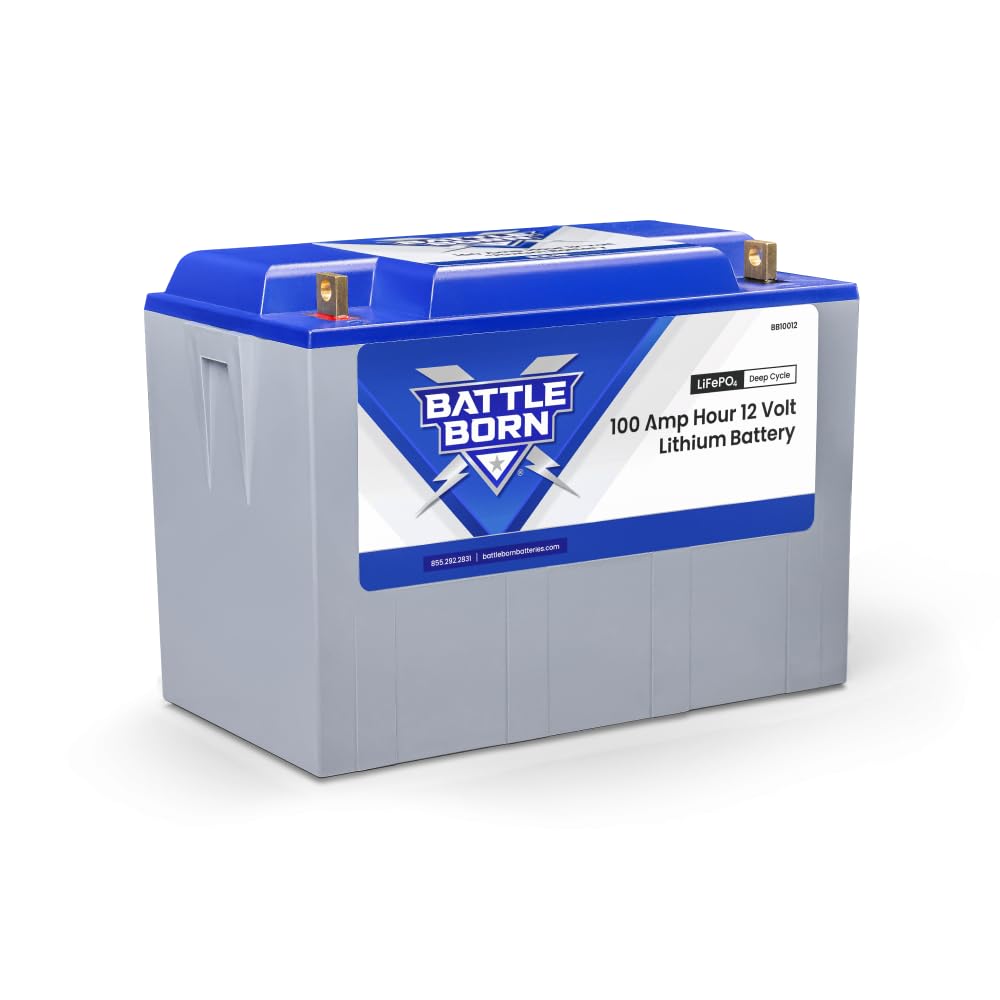
Battle Born has built a reputation as the gold standard in drop-in LiFePO4 replacements, and the BB10012 justifies the premium with robust internal engineering. Rated for 3000 to 5000 deep discharge cycles, this battery delivers up to 15 years of service in typical RV and marine applications. The internal BMS includes low-temperature charging protection, high and low voltage cutoff, short circuit protection, and individual cell balancing — all packaged in a sealed, vibration-resistant case that can be mounted in any orientation.
Weighing 31 pounds for 100Ah of usable power, the Battle Born is heavier than some lithium competitors but still roughly half the weight of a lead-acid equivalent. It fits Group 27 and Group 31 battery trays, making it a straightforward swap for existing flooded or AGM banks. The 10-year warranty is among the longest in the industry and covers defects and capacity loss, which speaks to the quality of the LiFePO4 cells and assembly.
Owner feedback consistently highlights fast recharge rates with solar arrays, consistent voltage output under loads up to 100A continuous, and trouble-free operation in sub-freezing conditions thanks to the low-temperature cutoff. The battery supports both series and parallel wiring for expanded banks. It is purpose-built for deep cycle use — not for engine starting — and excels in camper vans, boats, trolling motors, and off-grid residential backup systems.
What works
- Industry-leading 10-year warranty with real coverage
- Temperature protection for charging below freezing
- Flexible mounting in any orientation
What doesn’t
- Premium price significantly higher than comparable LiFePO4 packs
- Heavier than some 100Ah lithium competitors
3. OPTIMA 34M BLUETOP AGM Battery

The OPTIMA 34M BLUETOP is a dual-purpose sealed AGM battery that bridges the gap between engine starting and deep cycle use. Its patented SpiralCell technology wraps 99.99% pure lead plates in a spiral configuration, delivering 800 cold cranking amps for reliable starts while still offering 50Ah of deep cycle capacity. The reserve capacity of 100 minutes ensures consistent power delivery for house loads without sacrificing starting ability.
At 38.4 pounds and measuring 10 x 6.88 x 7.94 inches, this battery is compact enough for tight engine compartments and battery boxes. The dual-terminal design — SAE posts plus 5/16-inch stainless steel studs — simplifies connections for both starting and auxiliary circuits. OPTIMA claims 15 times more vibration resistance than standard flooded batteries, and owner reports confirm durability in marine, off-road, and heavy-equipment applications over many years.
One of the standout features is the maintenance-free, spill-proof design that allows mounting in any position except inverted. While the 50Ah capacity is lower than dedicated deep cycle batteries, the BLUETOP excels in applications where one battery must handle both cranking and house loads. Owners consistently report 8–10 years of service in boats and RVs, making it a long-term value despite the higher upfront cost versus standard AGM batteries.
What works
- True dual-purpose starting and deep cycle performance
- Exceptional vibration resistance for marine and off-road use
- Compact footprint with dual terminal options
What doesn’t
- Only 50Ah capacity limits deep cycle-only applications
- Premium pricing compared to standard AGM batteries
4. ECO-WORTHY 12V 100Ah LiFePO4 with Bluetooth
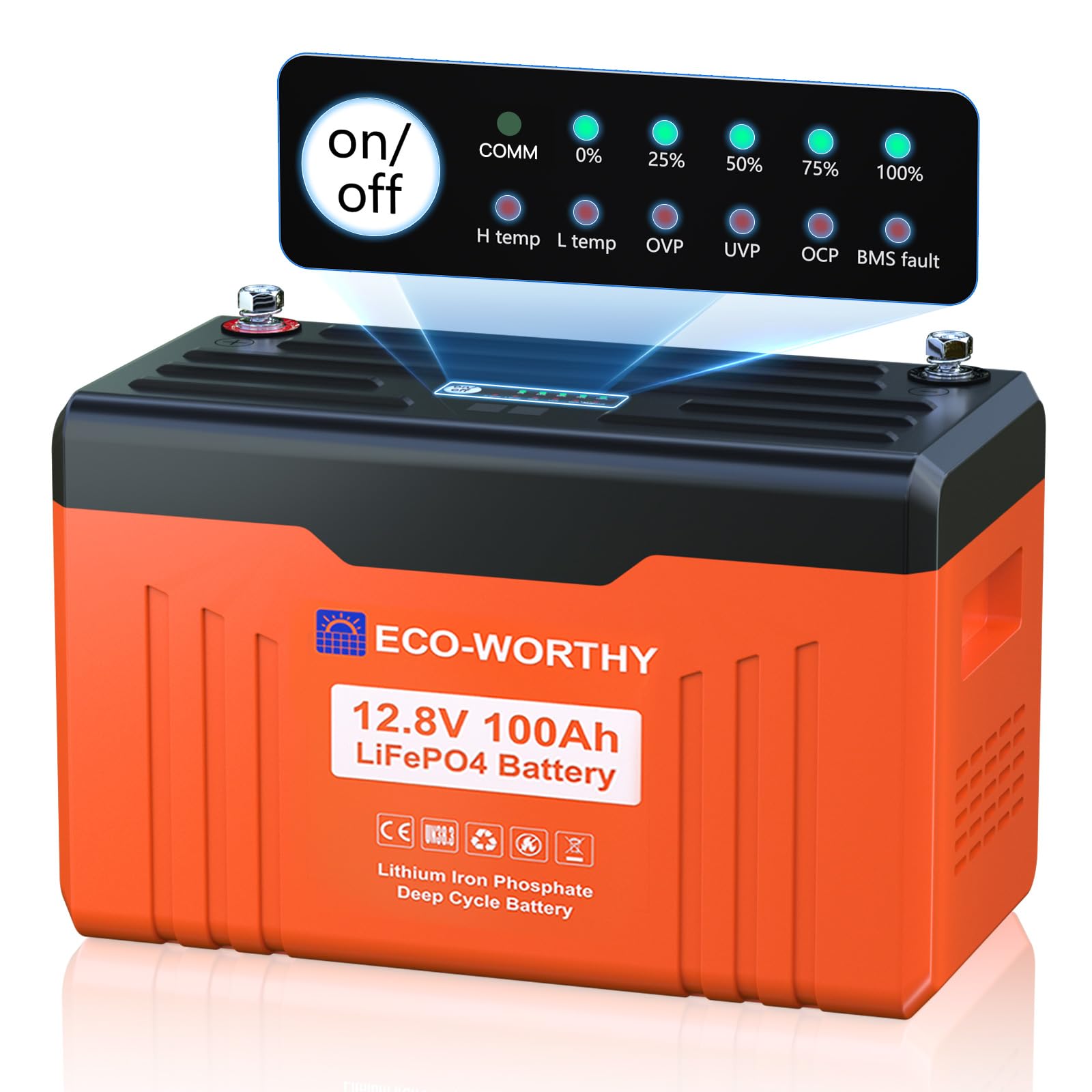
ECO-WORTHY upgraded its popular 100Ah LiFePO4 battery with integrated Bluetooth monitoring and a built-in SOC display, addressing the two most common complaints about basic lithium packs. The ECO-WORTHY companion app lets you check voltage, current, state of charge, runtime, individual cell voltages, and cell balance within 98 feet, giving you real-time insight into battery health without requiring a separate shunt or monitor.
The battery features a unique metal cell-fixture design that prevents cell expansion and internal short circuits, addressing a known failure mode in lower-cost LiFePO4 packs. It also includes a smart buzzer that alerts you to BMS faults instantly. The 100A BMS provides standard protections, and the low-temperature cutoff prevents charging below freezing. Weighing just 25.12 pounds and measuring 11.8 x 6.9 x 8.7 inches, it fits Group 27 trays and is easy to transport and install.
Supporting up to 4P2S expansion for a maximum of 10.24kWh, this battery works well in home solar storage, RVs, campers, and trolling motors. The 3-year warranty is reasonable for the price point, and the combination of Bluetooth, visual SOC, and metal cell fixture makes this a compelling choice for buyers who want premium monitoring features without paying Battle Born prices.
What works
- Built-in Bluetooth with full cell-level monitoring
- Metal cell fixture prevents expansion damage
- Visual SOC display eliminates guesswork
What doesn’t
- App interface can feel basic compared to dedicated monitors
- Low-temperature cutoff may trigger unexpectedly in cold climates
5. Power Queen 12V 100Ah LiFePO4 Battery
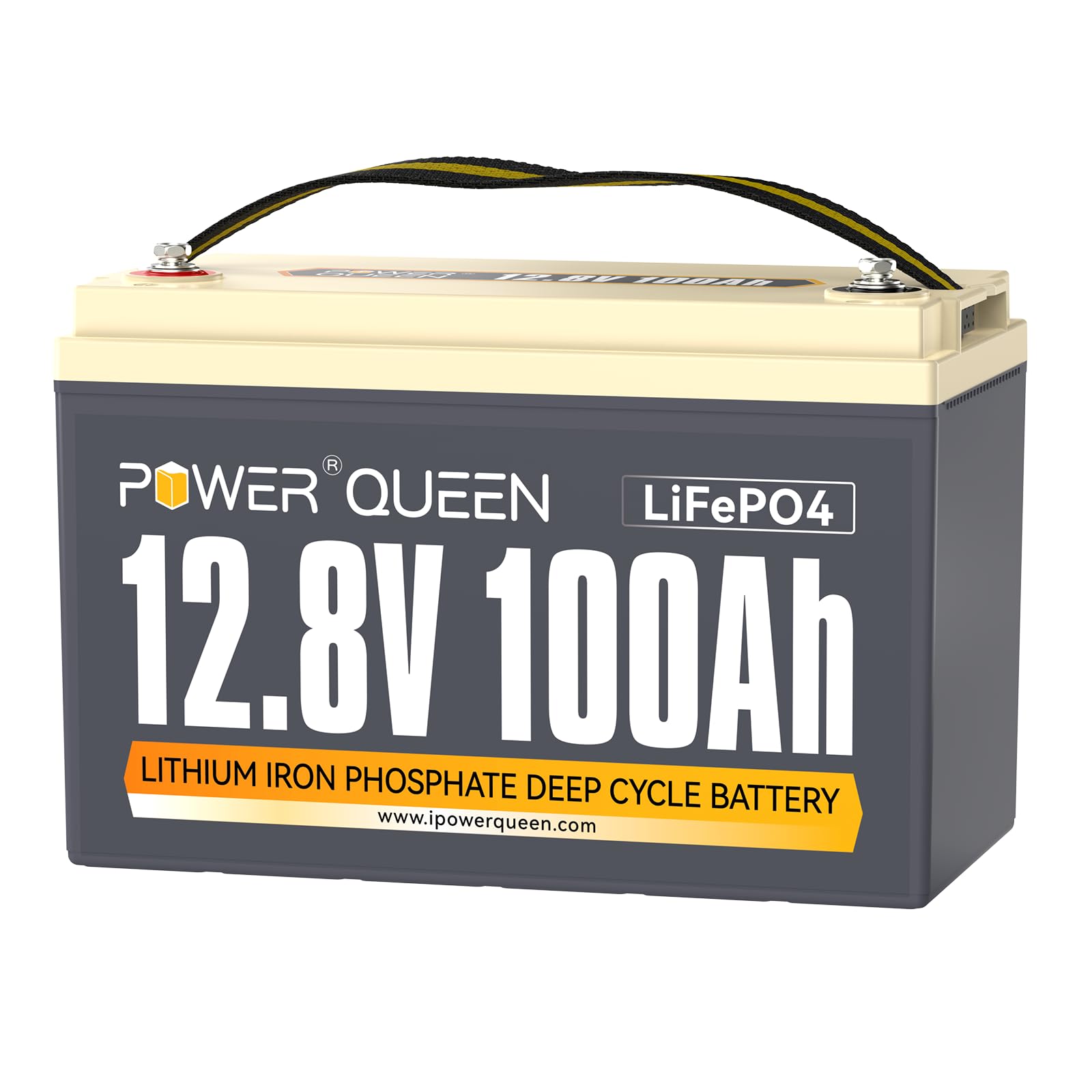
Power Queen’s 12V 100Ah LiFePO4 battery delivers 1280Wh of usable energy in a compact Group 31 form factor that weighs just 24 pounds — roughly one-third the weight of a lead-acid equivalent. It uses Grade-A lithium iron phosphate cells that provide stable voltage output throughout the discharge curve, and the 100A BMS protects against overcharge, over-discharge, short circuits, and overheating. The manufacturer rates it for up to 15000 cycles at shallow discharge depths, with a 5-year warranty backing the cells and BMS.
This battery supports series and parallel connections up to 4S4P, allowing configurations up to 51.2V and 400Ah (20.48kWh). The low self-discharge rate of 3% per month makes it suitable for seasonal use where the battery sits idle for extended periods. Owners report reliable performance in RV trailer house banks, 30–70 lb thrust trolling motors, and small off-grid solar arrays, with consistent voltage and no swelling or BMS faults over multiple seasons.
The build quality is solid, with reinforced terminal posts and a sealed ABS case that withstands vibration and minor impacts. While it lacks built-in Bluetooth or a display, the straightforward design and proven cell chemistry make it a reliable workhorse. For buyers who want a no-fuss lithium upgrade with strong cycle life and don’t need smartphone monitoring, this is a well-executed mid-range option.
What works
- Grade-A LiFePO4 cells deliver consistent voltage
- Lightweight 24-pound design for easy handling
- Flexible 4S4P expansion for large banks
What doesn’t
- No Bluetooth or SOC display included
- Not suitable for engine starting applications
6. WEIZE 12V 100Ah Deep Cycle AGM Battery

WEIZE’s 12V 100Ah AGM battery is a sealed lead-acid deep cycle option that offers reliable performance at a significantly lower upfront cost than lithium. With a maximum discharge current of 1150A and a self-discharge rate of just 3% per month, it holds its charge well during storage. The Group 31 size (12.99 x 6.73 x 8.34 inches) and 60-pound weight are typical for this class, and the maintenance-free, spill-proof design allows safe installation in RVs, cabins, and marine environments.
Owner reports spanning two years of off-grid use confirm that the WEIZE AGM holds voltage well under moderate loads and accepts charging efficiently from solar panels and converters. Multiple buyers note that batteries arrived fully charged (around 13.2V) and performed as expected when paired with 150W solar panels for boondocking. The threaded terminal posts accept standard ring terminals and simplify connections for parallel banks.
While AGM chemistry limits cycle life to roughly 500 cycles at 50% depth of discharge — far less than lithium — the WEIZE delivers solid value for applications where budget is the primary constraint. It works well for emergency backup, occasional camping, and systems where the battery is charged and discharged infrequently. Just factor in that you’ll need double the Ah capacity compared to lithium to get the same usable energy, since discharging below 50% accelerates AGM degradation.
What works
- Excellent value for sealed AGM deep cycle capacity
- Low self-discharge rate ideal for seasonal use
- Maintenance-free and spill-proof design
What doesn’t
- Only 500 cycles at 50% DOD limits long-term value
- Heavy 60-pound weight complicates installation
7. DUMFUME 12V 150Ah LiFePO4 Battery
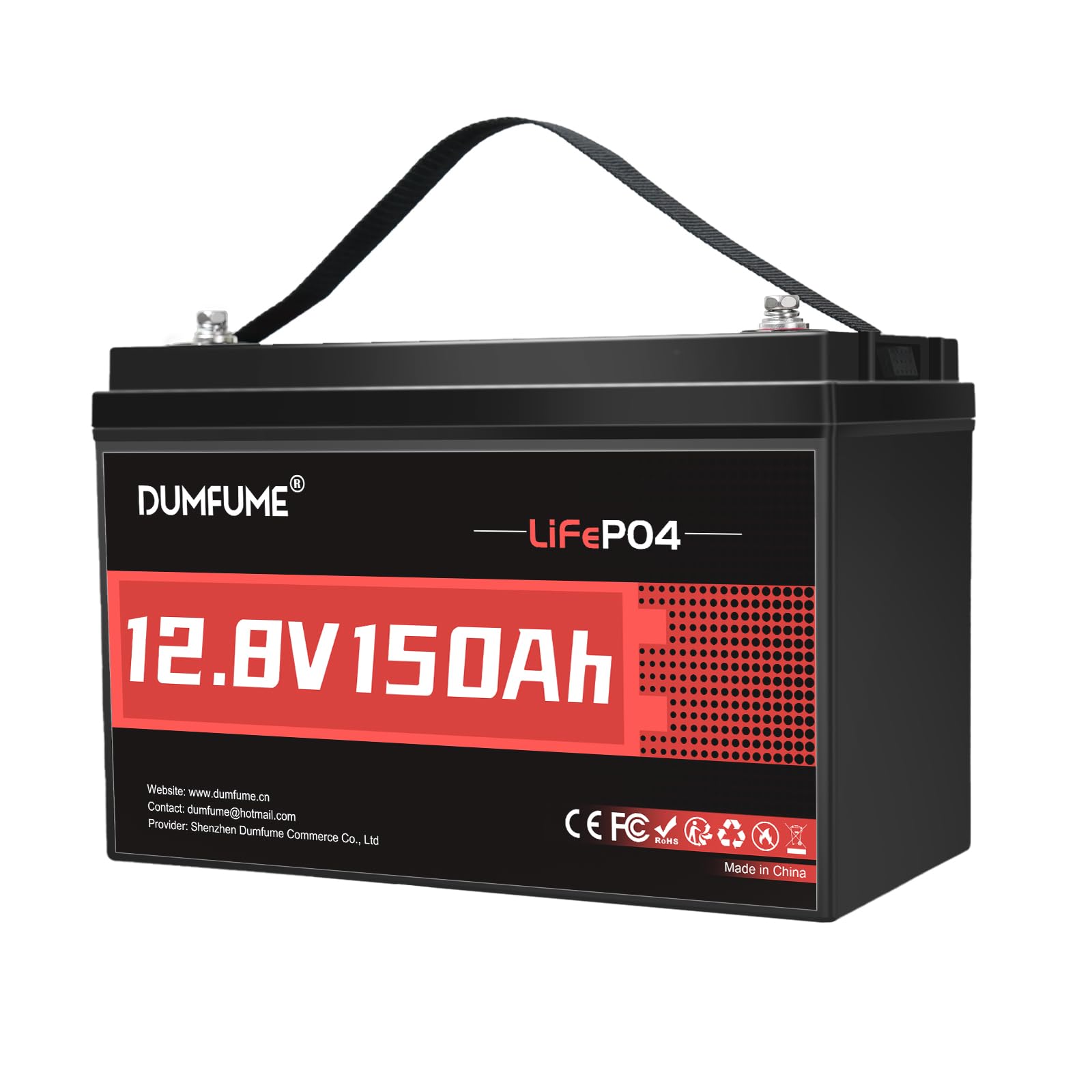
DUMFUME packs 150Ah of LiFePO4 capacity into a compact footprint that weighs only 22.05 pounds — about the same as a 100Ah lithium pack from most competitors. With 1920Wh of usable energy, this battery delivers 50% more runtime than a standard 100Ah unit without requiring additional space or wiring. The built-in 100A BMS covers overcharge, over-discharge, short circuit, and overheating, and the low-temperature charging cutoff protects cells in cold weather.
The battery supports series and parallel connections up to 4S4P, allowing 48V systems or massive 600Ah banks. Multiple owners report that individual units tested slightly above rated capacity when new, suggesting conservative cell grading. The 5-year warranty adds peace of mind, and the price per Ah is among the most competitive in the lithium market. Users have successfully run diesel heaters, RV appliances, and solar backup systems for extended periods without voltage sag.
One caveat: the low-temperature protection can be aggressive and may prevent charging if the battery sits in a cold environment, even if the cells are warm from discharging. Owners in freezing climates should store the battery in a conditioned space or add a heating pad. Additionally, DUMFUME specifies a full maintenance cycle every six months during storage, which is easy to overlook but important for long-term cell health.
What works
- 150Ah capacity at the weight of a typical 100Ah pack
- Excellent price per Ah for LiFePO4 chemistry
- 5-year warranty supports long-term ownership
What doesn’t
- Low-temperature cutoff can be overly sensitive
- Requires maintenance cycle every 6 months in storage
8. Mighty Max ML100-12 GEL Battery

Mighty Max’s ML100-12 GEL is a 12V 100Ah sealed lead-acid battery that uses gelled electrolyte instead of the absorbed glass mat found in AGM batteries. This chemistry offers distinct advantages: slower self-discharge than AGM, better performance in extreme temperature ranges, and superior resistance to vibration and shock. The gel paste is non-spillable and produces minimal fumes, making it safer for enclosed spaces like cabins and small RVs. UL certification adds a layer of independent safety verification.
Measuring 12.1 x 6.56 x 8.47 inches and weighing 60 pounds, the ML100-12 GEL fits standard Group 31 trays. The internal thread (INT) terminal design accepts bolt-in connections, which some users prefer over threaded posts for vibration-prone applications. Mighty Max specifically positions this battery as a drop-in upgrade from standard AGM, citing the gel formulation’s resilience in climates that swing between hot summers and freezing winters.
The trade-off with gel chemistry is charge voltage sensitivity: overcharging can create permanent voids in the gel, reducing capacity. You need a charger specifically calibrated for gel batteries or one with a gel setting. Cycle life is similar to AGM — roughly 500 cycles at 50% DOD — so this is not a buy-it-for-life solution. It works best for seasonal cabin power, alarm systems, floor scrubbers, and lawn equipment where consistent deep cycling is not the primary demand.
What works
- Superior temperature tolerance compared to AGM
- Non-spillable gel safer for enclosed spaces
- Slow self-discharge ideal for infrequent use
What doesn’t
- Requires gel-specific charger to avoid damage
- Heavy 60-pound weight and limited cycle life
9. LiTime 12V 20A LiFePO4 Battery Charger

The LiTime 12V 20A LiFePO4 charger is a dedicated AC-DC smart charger designed specifically for 12.8V lithium iron phosphate batteries. It delivers 20 amps of charging current — enough to fully recharge a 100Ah LiFePO4 battery in approximately 5 hours — and features a fully automatic three-stage profile: constant current bulk, constant voltage absorption, and float or cutoff. The 0V activation function can revive deeply discharged lithium packs that have triggered BMS shutdown, a feature that can save a battery from being bricked.
This charger includes an Anderson 50A connector and M8 ring terminals, making it compatible with most LiFePO4 battery terminals and common quick-connect systems. The aluminum alloy housing with an integrated cooling fan provides effective thermal management during sustained high-current charging. LED indicators clearly show charging status at a glance. LiTime has tested it to FCC, CE, and RoHS standards, and multilevel protections guard against over-temperature, over-voltage, short circuit, over-current, low-voltage, and reverse polarity.
For anyone building a lithium battery bank, a dedicated LiFePO4 charger is essential — standard lead-acid chargers either undercharge (leaving capacity on the table) or overcharge (triggering BMS faults). This LiTime unit pairs well with any of the 12V LiFePO4 batteries in this guide. The 2-year warranty and responsive customer support give confidence for regular use in RVs, off-grid systems, and solar setups.
What works
- Full three-stage LiFePO4 charging profile
- 0V activation revives deeply discharged batteries
- Durable aluminum housing with efficient cooling
What doesn’t
- Only 20A output limits charging speed for large banks
- Fan noise may be noticeable in quiet environments
Hardware & Specs Guide
Battery Chemistry Explained
LiFePO4 (lithium iron phosphate) is the dominant chemistry for premium deep cycle batteries due to its 4000–15000 cycle lifespan, consistent voltage curve, and thermal stability. AGM (absorbed glass mat) is a sealed lead-acid variant with moderate cycle life and no maintenance, ideal for budget builds. Gel cells use a silica-thickened electrolyte that resists vibration and extreme temperatures but requires careful charging. Flooded lead-acid is the lowest-cost option but needs ventilation and periodic water refills.
Understanding BMS Protection
The Battery Management System monitors individual cell voltages, pack current, and temperature. Key protections include overcharge (prevents cell voltage exceeding ~3.65V per cell), over-discharge (cuts load at ~2.5V per cell), short circuit (instant disconnect), and over-temperature (halts charge/discharge outside safe range). Low-temperature charging cutoff is critical for LiFePO4 — charging below freezing causes permanent damage from lithium plating.
Cycle Life & Depth of Discharge
Cycle life is the number of charge-discharge cycles before capacity drops to 80% of original. LiFePO4 batteries achieve 4000 cycles at 100% DOD, 6000 at 80% DOD, and 15000 at 60% DOD. AGM and Gel batteries typically deliver 300–500 cycles at 50% DOD, meaning you must buy more Ah to get the same usable lifetime energy. Matching discharge depth to your daily load profile directly impacts long-term value.
Series vs Parallel Configurations
Wiring batteries in series increases voltage (e.g., two 12V batteries in series = 24V) while keeping capacity the same. Parallel wiring keeps voltage the same and adds capacity (e.g., two 100Ah batteries in parallel = 200Ah at 12V). Most LiFePO4 batteries support up to 4S or 4P, but always verify the BMS is rated for series configurations. Mixing batteries of different ages or capacities in parallel causes uneven load sharing and premature failure.
FAQ
What is the difference between a deep cycle battery and a starting battery?
How many amp-hours do I need for my RV or solar setup?
Can I charge a LiFePO4 battery with a regular lead-acid charger?
Why does my lithium battery shut off when it gets cold?
Is it safe to mount a lithium battery inside my RV or boat?
Final Thoughts: The Verdict
For most buyers, the best deep cycle batteries winner is the Redodo 12V 100Ah LiFePO4 because it delivers the best balance of cycle life, weight, BMS protection, and price per Ah for RV, solar, and marine use. If you want premium build quality and the longest warranty in the industry, grab the Battle Born 100Ah LiFePO4. And for a dual-purpose battery that handles both engine starting and deep cycle loads, nothing beats the OPTIMA 34M BLUETOP.

Certification: BSc in Mechanical Engineering
Education: Mechanical engineer
Lives In: 539 W Commerce St, Dallas, TX 75208, USA
Md Amir is an auto mechanic student and writer with over half a decade of experience in the automotive field. He has worked with top automotive brands such as Lexus, Quantum, and also owns two automotive blogs autocarneed.com and taxiwiz.com.