A dash cam is your silent witness on the road, but choosing one under a reasonable budget means navigating a maze of sensor specs, resolution claims, and feature lists that don’t always deliver. Most models promise 4K clarity, but real-world performance varies wildly depending on the sensor, aperture, and image processing under the hood. The right pick captures license plates at night, handles heat without failing, and stores footage reliably when you need it most.
I’m Amir — the founder and writer behind Four Wheel Ask. I’ve spent years analyzing dash cam specifications, comparing sensor performance across price tiers, and aggregating owner feedback to identify which models deliver reliable evidence capture without exceeding a reasonable budget.
Whether you’re a daily commuter or a weekend road-tripper, the right camera gives you peace of mind without emptying your wallet. After evaluating specs and owner feedback on dozens of models, these picks represent the best dash cam under balancing quality and essential features.
How To Choose The Best Dash Cam Under
Selecting a dash cam in this price range requires understanding which features actually matter for reliable evidence capture. Entry-level models often cut corners on sensors or software stability, while premium options pack genuine STARVIS sensors, dual-band WiFi, and robust parking monitoring. Knowing what to prioritize helps you avoid wasted spend on flashy specs that don’t translate to real-world performance.
Sensor Quality and Night Performance
The image sensor is the heart of any dash cam. Sony STARVIS and STARVIS 2 sensors offer significantly better low-light sensitivity than generic CMOS sensors, capturing color details in near-darkness that cheaper sensors miss. Aperture size also matters — F1.5 to F1.8 lenses let in more light, reducing motion blur and improving license plate readability at night. Don’t let a 4K resolution claim fool you if the sensor behind it can’t handle low-light conditions.
Channel Configuration and Coverage
Single-channel front-only cameras are the most affordable, but front-and-rear dual-channel systems provide essential rear-end collision evidence. Three-channel systems add interior cabin recording — ideal for rideshare drivers or parents monitoring backseat passengers. Consider your primary use case: a dual-channel setup with a reliable rear camera adds minimal cost for significantly expanded protection.
Storage, Loop Recording, and Emergency Locking
Loop recording ensures continuous capture by overwriting the oldest unprotected footage, while G-sensor collision detection automatically locks critical clips from deletion. Look for models that support at least 256GB expandable storage and come with a branded high-endurance microSD card. Parking monitoring adds another layer of protection, but requires a hardwire kit for true 24/7 operation rather than relying on the camera’s internal battery.
Quick Comparison
On smaller screens, swipe sideways to see the full table.
| Model | Category | Best For | Key Spec | Amazon |
|---|---|---|---|---|
| 70mai T800E | 3-Channel | Full Coverage | 4K Front + 1080P Interior + 1080P Rear | Amazon |
| REDTIGER 4K | Front/Rear | Night Vision | 4K+1080P STARVIS 2, 5.8GHz WiFi | Amazon |
| ROVE R2-4K | Front | GPS Tracking | 4K 2160P, WiFi 6, Supercapacitor | Amazon |
| Jzones 3CH | 3-Channel | Interior Monitoring | 4K+1080P+1080P, STARVIS 2 | Amazon |
| Coolcrazy 4K | Front/Rear | Storage Value | 4K+1080P, 128GB Card, 60fps | Amazon |
| Pelsee P1 Pro | Front/Rear | Voice Control | 4K+1080P, STARVIS 2, 64GB Card | Amazon |
| FAIMEE 4K+2K | Front/Rear | Dual-Band WiFi | 4K Front + 2K Rear, 5.8GHz/2.4GHz | Amazon |
In‑Depth Reviews
1. 70mai 4K Dash Cam Front and Rear Inside T800E

The 70mai T800E stands out with a genuine three-channel configuration that captures 4K front, 1080P interior, and 1080P rear simultaneously — a rarity at this price point. The F1.55 aperture and HDR imaging with 3D noise reduction deliver sharp footage across varied lighting conditions, making license plates readable even during dusk or tunnel transitions. The interior camera includes switchable infrared recording, which adds clarity for rideshare drivers monitoring passengers or parents keeping an eye on rear-seat activity.
WiFi 6 support is a meaningful upgrade over typical dash cam WiFi, pushing file transfer speeds up to 10 MB/s through the 70mai app. The 5-mode GPS provides accurate location, speed, and route logging, while hands-free voice control allows locking footage or snapping photos without reaching for buttons. The supercapacitor design ensures stable operation in extreme temperatures from 14°F to 140°F, eliminating the swelling and failure risks associated with lithium battery-powered cameras.
The included 64GB SD card gets you started immediately, with support for expansion up to 512GB for extended recording. Parking monitoring works with an optional hardwire kit, and the adhesive mount makes installation straightforward. Owner feedback consistently highlights the reliable app connection and stable long-term performance, though the rear camera cable length may require careful routing in larger vehicles. For comprehensive coverage without exceeding a practical budget, this is the most well-rounded option available.
What works
- True 3-channel recording with dedicated interior camera
- WiFi 6 enables fast app-based file transfers
- Supercapacitor handles extreme temperatures reliably
- Switchable IR on interior camera for low-light cabin capture
What doesn’t
- Rear camera cable routing can be tight in larger vehicles
- Parking mode requires separate hardwire kit purchase
- 4G connectivity is not supported despite GPS integration
2. REDTIGER Dash Cam 4K Front and 1080P Rear
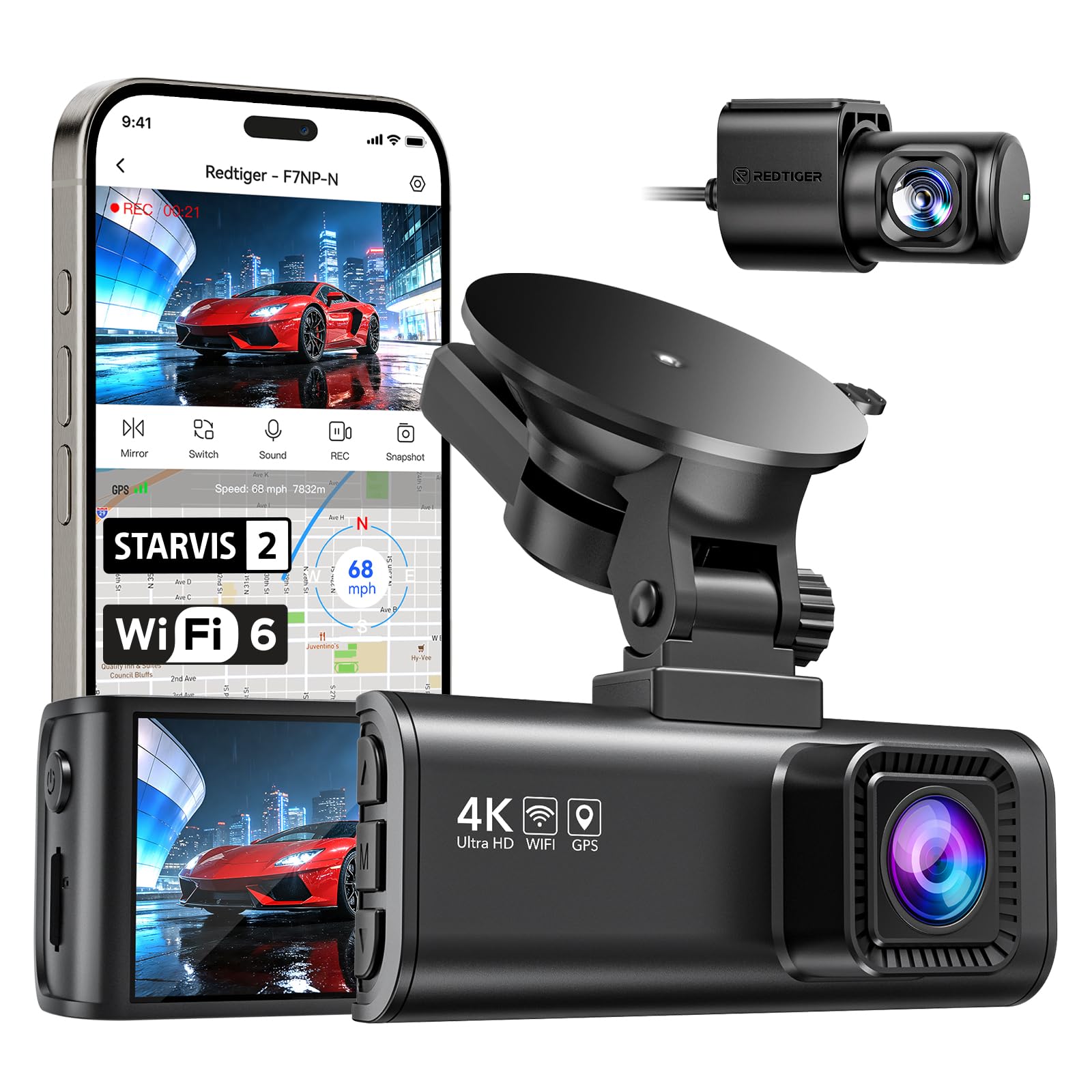
The REDTIGER dual-channel system pairs a 4K front camera powered by a STARVIS 2 sensor with a 1080P rear unit, creating a combination that excels in low-light environments. HDR and WDR technologies work together to balance exposure across high-contrast scenes — think bright headlights against dark pavement — preserving license plate detail that lesser sensors would clip into pure black or blown-out white. The 170-degree wide-angle front lens covers up to six lanes, reducing blind spots during lane changes and intersection crossings.
Built-in 5.8GHz WiFi delivers download speeds up to 20 MB/s through the Redtiger Cam app, enabling quick access to footage without removing the SD card. The app also supports GPS data viewing for route, speed, and location, plus over-the-air firmware updates. The supercapacitor power system improves heat resistance and lifespan compared to lithium batteries, making it suitable for vehicles parked in direct sunlight or hot climates.
The G-sensor emergency lock protects critical collision footage from being overwritten during loop recording, and the 24-hour parking monitoring offers time-lapse and impact detection modes. An 18-month warranty backs the unit, though the hardwire kit for parking mode is sold separately. Owner reports note that the included GPS suction mount is sturdy, and the compact form factor fits neatly behind the rearview mirror. The lack of an included memory card is a minor inconvenience, but the overall sensor performance at this tier is impressive.
What works
- STARVIS 2 sensor delivers class-leading night clarity
- Fast 5.8GHz WiFi with 20 MB/s download speeds
- Supercapacitor handles heat better than battery units
- 170-degree front lens covers wide field of view
What doesn’t
- No memory card included in the package
- Hardwire kit required for 24-hour parking mode
- Rear camera resolution limited to 1080P
3. ROVE R2-4K Dash Cam

The ROVE R2-4K is a front-facing single-channel camera that focuses on doing one thing exceptionally well: capturing ultra-high-definition 2160P footage with reliable GPS and connectivity features. The Sony IMX335 sensor paired with an F1.5 aperture and 6-glass lens delivers some of the best low-light performance in this tier, with the large aperture pulling in enough light to read plates under dim street lighting. The 150-degree A+ wide-angle lens provides broad coverage without the fisheye distortion that plagues cheaper wide-angle lenses.
WiFi 6 integration enables download speeds up to 6 MB/s through the ROVE app, and the built-in GPS embeds location, speed, and route data directly onto video files for insurance verification. The ROVE app supports free over-the-air firmware updates, and the GPS player lets you review driving routes on Google Maps. The supercapacitor power system adds heat tolerance and longevity, making this a durable choice for long-term installation.
The parking mode with motion detection and G-sensor emergency lock provides basic protection when parked, though it relies on impact detection rather than continuous time-lapse recording. The camera supports microSD cards up to 512GB, but none is included, and the brand recommends using their own ROVE U3-rated cards for best performance. Owner feedback frequently praises the build quality and consistent video output, while noting that the single-channel design limits rear coverage. For drivers who prioritize front-facing video quality and GPS logging above all else, this is a strong contender.
What works
- Sony IMX335 sensor with F1.5 aperture excels in low light
- WiFi 6 enables fast wireless file transfers
- Built-in GPS with Google Maps route playback
- Supercapacitor improves heat and longevity performance
What doesn’t
- Single-channel front-only design limits coverage
- No memory card included in the package
- Parking mode lacks continuous time-lapse option
4. Jzones 3 Channel Dash Cam 4K Front and Rear
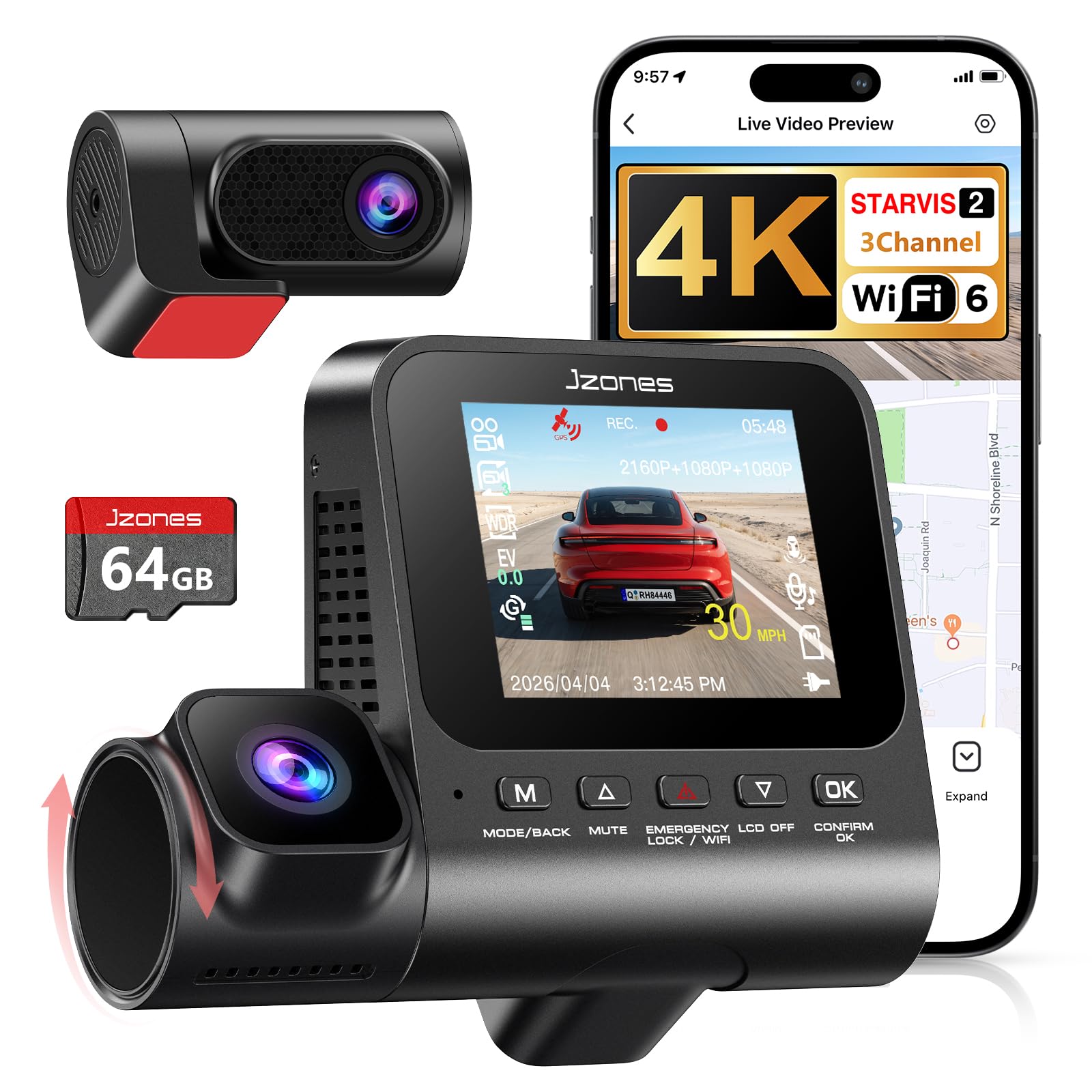
The Jzones three-channel system brings 4K front, 1080P rear, and 1080P interior recording into a single package that competes directly with higher-priced multi-channel units. The STARVIS 2 sensor in the front camera, paired with F1.8 and F2.0 apertures across the channels, ensures the interior and rear cameras maintain usable low-light performance rather than becoming unusable in dark conditions. HDR technology helps preserve detail during sudden light changes, such as emerging from a tunnel into bright sunlight or passing under overhead street lights.
Dual-band WiFi 6 with optimized app performance delivers genuine 20 MB/s transfer speeds, making 4K footage preview and download smooth on both iOS and Android devices. The built-in GPS logs driving routes, real-time speed, location, and compass data directly onto recorded footage. The 155-degree ultra-wide front lens combined with rear and cabin coverage creates near 360-degree visibility, which is particularly valuable for rideshare drivers or families monitoring child passengers in the back seat.
A genuine branded 64GB microSD card is included — a meaningful advantage over packages that rely on generic cards with higher failure rates. Loop recording with G-sensor event locking protects critical clips, and the 24-hour parking mode works with an optional hardwire kit. The 18-month warranty provides reasonable coverage, and owner feedback highlights the stable WiFi connection and straightforward installation. The interior camera resolution is capped at 1080P, but for a system at this tier, the balance of channels and sensor quality is hard to beat.
What works
- Three-channel capture with STARVIS 2 front sensor
- Includes branded 64GB microSD card, not generic
- WiFi 6 achieves 20 MB/s transfer speeds
- Near 360-degree coverage with 155-degree front lens
What doesn’t
- Interior and rear cameras limited to 1080P resolution
- Parking mode hardwire kit sold separately
- Maximum storage support limited to 256GB
5. Coolcrazy 4K Dash Cam Front and Rear
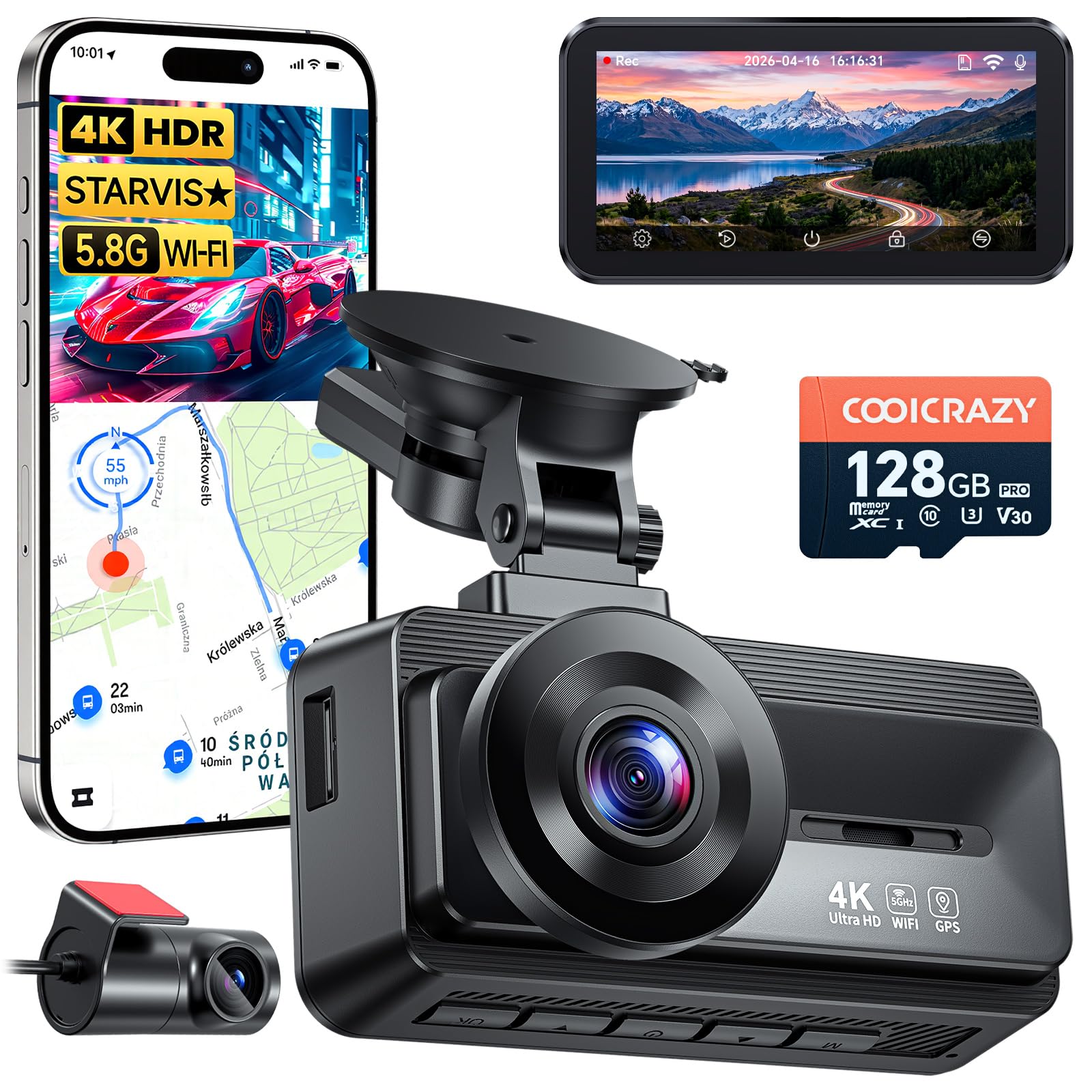
The Coolcrazy dual-channel system distinguishes itself with a 128GB memory card included out of the box — double the storage capacity of most competitors at similar price points. The front camera records at 4K UHD 60fps, a higher frame rate than the typical 30fps, which translates to smoother footage and better clarity when capturing fast-moving vehicles or pedestrians. The 170-degree front and 150-degree rear wide-angle lenses provide comprehensive coverage without significant blind spots on either end of the vehicle.
The STARVIS starlight night vision sensor combined with large-aperture WDR technology handles challenging lighting scenarios effectively. Rainy nights, tunnel transitions, and unlit rural roads are captured with enough detail to distinguish license plates and road signs, though the rear camera uses a standard CMOS sensor rather than STARVIS for night recording. The 5GHz WiFi enables high-speed phone connection for quick video downloads and social sharing via the companion app.
Built-in GPS tracks location, speed, and route data, embedding this information onto footage for insurance claims. The G-sensor locks critical clips during collisions, and the 24-hour parking monitoring with time-lapse mode provides protection while parked. The adhesive mount and included installation tools make setup accessible for novice users. Owner feedback notes that the 60fps front recording is noticeably smoother than standard 30fps cameras, though the rear camera image quality drops more significantly in low light compared to the front unit.
What works
- 128GB memory card included removes initial purchase friction
- 60fps front recording captures smoother motion detail
- STARVIS sensor with WDR handles varied lighting well
- 5GHz WiFi enables quick app-based file access
What doesn’t
- Rear camera lacks STARVIS sensor for night recording
- Maximum card support capped at 256GB
- Rear camera drops in quality more noticeably in low light
6. Pelsee P1 Pro 4K Dash Cam Front and Rear
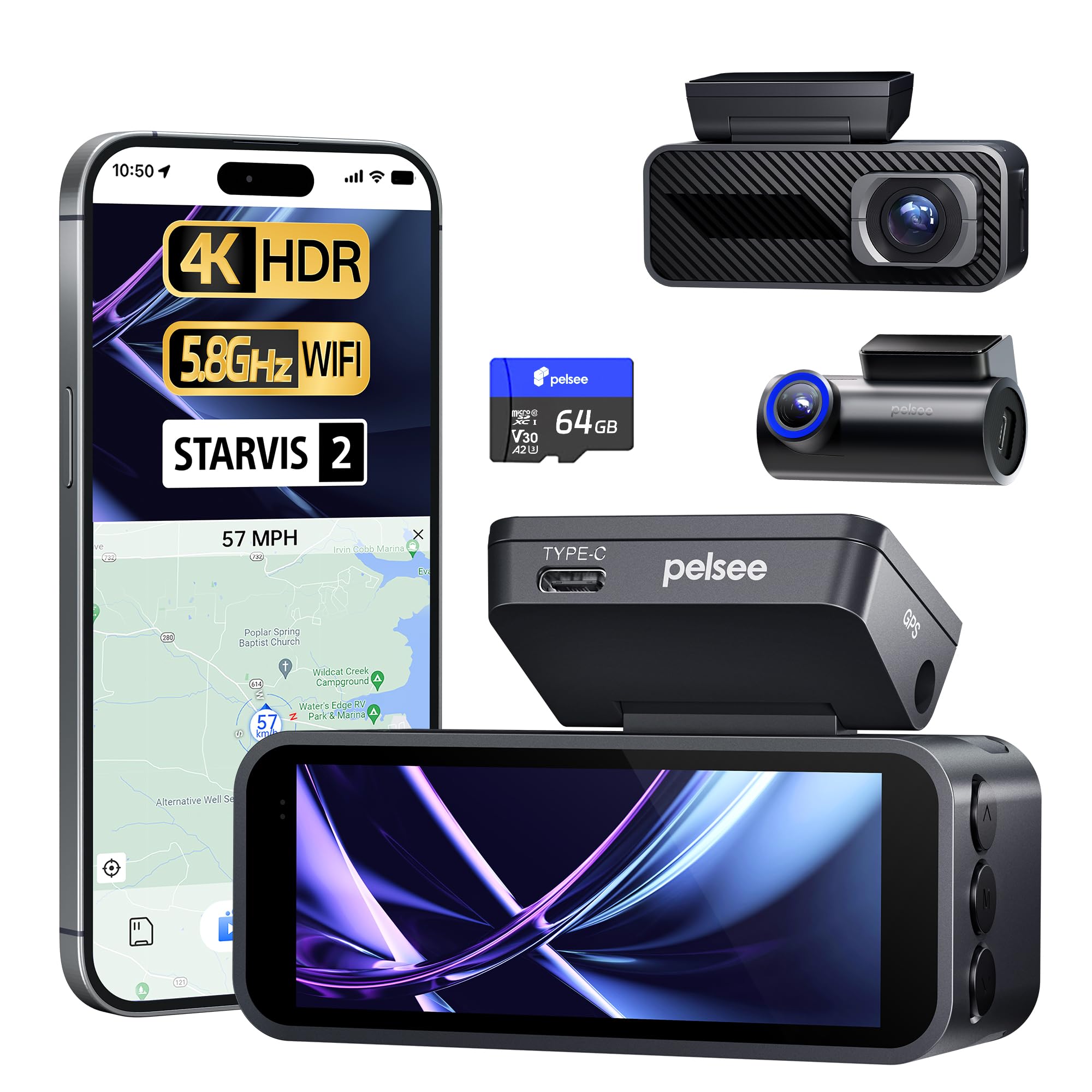
The Pelsee P1 Pro packs a STARVIS 2 sensor into its front camera with 4K HDR recording that slices through glare and overexposed scenes, while the rear camera uses WDR for balanced exposure in backlit conditions. The 3.39-inch HD IPS screen is noticeably larger than the typical 2- to 3-inch displays found on competing models, making live previews, menu navigation, and footage playback more comfortable without requiring the app. The front HDR and rear WDR combination means the system handles challenging lighting from both ends of the vehicle simultaneously.
Eight hands-free voice commands — including “Lock the video!” — allow safe operation without reaching for buttons, with noise-canceling microphones that respond accurately even with road noise and music playing. The 5.8GHz WiFi enables real-time viewing and downloading through the Pelsee Cam app, and the built-in GPS embeds speed, coordinates, and timestamps onto recordings. The ADAS system provides forward collision, pedestrian collision, lane departure, and front vehicle start alerts with 0.8- to 2-second reaction times.
The 24-hour parking mode uses G-sensor impact detection and time-lapse recording for efficient continuous surveillance. A 64GB SD card is included and pre-installed, with support for expansion up to 512GB. The 3-step tool-free installation — snap the camera onto the windshield, conceal cables, plug into the charger — is genuinely straightforward. Owner feedback often praises the voice control accuracy and large display, while noting that the ADAS alerts can occasionally trigger unnecessarily on winding roads.
What works
- STARVIS 2 sensor with 4K HDR front recording
- Large 3.39-inch IPS screen for easy menu navigation
- Reliable voice control with noise-canceling microphones
- Includes 64GB card, expandable to 512GB
What doesn’t
- ADAS alerts can be overly sensitive on curved roads
- Parking mode hardwire kit required for 24/7 operation
- Rear camera is 1080P, not matching front 4K resolution
7. FAIMEE Dash Cam Front and Rear 4K+2K
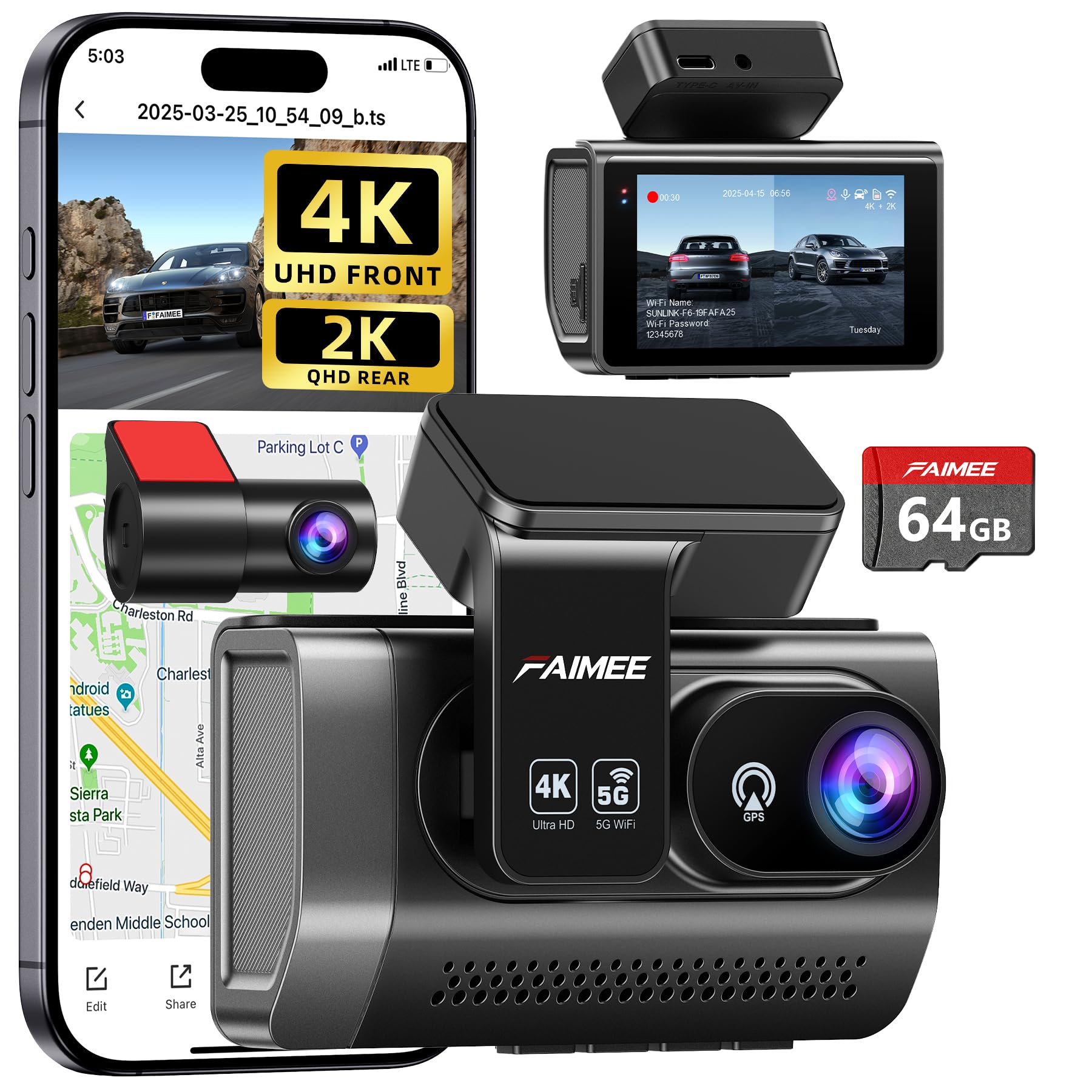
The FAIMEE system offers an unusual resolution split with 4K UHD front recording and 2K rear recording, providing higher rear detail than typical 1080P rear cameras in this tier. The F1.8 aperture front lens combined with WDR and night vision captures usable footage across varied lighting conditions, while the rear 2K sensor pulls more detail from following vehicles than a standard 1080P unit would. The 170-degree wide-angle lenses cover up to six lanes, reducing peripheral blind spots during merging and lane changes.
Dual-band WiFi with both 5.8GHz and 2.4GHz bands provides connection flexibility, with the 5.8GHz band enabling faster app-based file transfers and live preview. Built-in GPS logs speed, route history, and location coordinates, which is helpful for fleet management or personal trip logging. The 64GB high-endurance memory card is included and ready to record out of the box, with support for expansion up to 256GB. Loop recording automatically overwrites the oldest unprotected footage, and the G-sensor locks collision clips to prevent deletion.
The 24-hour parking monitor with time-lapse recording and impact detection provides protection while parked, though the hardwire kit is sold separately. The compact 3-inch IPS screen mounts discreetly behind the rearview mirror without obstructing visibility. An 18-month warranty with 24/7 technical support backs the purchase. Owner feedback notes that the rear 2K resolution genuinely improves clarity over typical 1080P rear cameras, though the front camera’s low-light performance doesn’t quite match STARVIS-equipped competitors at similar price points.
What works
- 2K rear resolution provides above-average rear detail
- Dual-band WiFi for flexible connection options
- 64GB card included and ready for immediate use
- Compact 3-inch screen fits discreetly behind mirror
What doesn’t
- Front sensor lacks STARVIS for premium night performance
- Limited to 256GB maximum storage expansion
- Parking mode hardwire kit requires separate purchase
Hardware & Specs Guide
Image Sensor Technology
The sensor is the single most important component in a dash cam’s image quality. Sony STARVIS and STARVIS 2 sensors use back-illuminated pixel technology that dramatically improves sensitivity in low-light conditions, capturing usable color footage in near-darkness where standard CMOS sensors produce only noise and black shapes. STARVIS 2 doubles the near-infrared sensitivity of the original generation, further improving night performance. Models without STARVIS sensors can still produce acceptable daytime footage, but their nighttime license plate readability drops significantly. When comparing cameras, prioritize sensor generation over resolution bumps — a STARVIS 2 4K sensor will consistently outperform a generic 4K sensor in real-world conditions.
Resolution and Frame Rate
True 4K in dash cams means 3840x2160P resolution, providing enough pixel density to read license plates at reasonable distances. Some budget models label 2K or 1440P as “4K” in marketing materials, so verify the actual recording resolution in the specifications. Frame rate matters more than many buyers realize: 60fps captures smoother motion and sharper freeze-frames of fast-moving vehicles compared to the standard 30fps. However, higher frame rates require more storage space and faster memory cards. For most drivers, 30fps at 4K is sufficient, but if you frequently drive on highways or in heavy traffic, 60fps provides noticeably better evidence capture.
HDR and WDR Imaging
High Dynamic Range and Wide Dynamic Range technologies address high-contrast scenes where part of the image is brightly lit and another part is in shadow — think driving toward a sunset or passing under a bridge into bright sunlight. HDR captures multiple exposures and combines them to preserve detail in both highlights and shadows, while WDR adjusts exposure levels across the frame in real time. Both technologies are essential for reading license plates in challenging lighting, and they are most effective when paired with a quality sensor like STARVIS. Models that lack HDR or WDR will frequently blow out bright areas or crush shadows to black.
Storage and Endurance
Dash cam storage requirements depend on resolution, frame rate, and channel count. A 4K 30fps front camera uses roughly 10-12 GB per hour, while adding a 1080P rear camera doubles that consumption. Loop recording automatically overwrites old footage when the card is full, but critical clips protected by G-sensor locking are preserved indefinitely. High-endurance memory cards are strongly recommended over standard cards because they handle the constant read-write cycles and higher operating temperatures inside a parked car. A 128GB card provides about 10-12 hours of 4K dual-channel recording, while 64GB offers 5-6 hours — sufficient for most daily commutes but requiring more frequent offloading on longer trips.
FAQ
What resolution should I look for in a dash cam under two hundred dollars?
Do I need a front and rear dash cam or is front-only sufficient?
What is STARVIS technology and why does it matter?
Is parking mode important for a dash cam under two hundred dollars?
Final Thoughts: The Verdict
For most buyers, the best dash cam under winner is the 70mai T800E because it delivers genuine three-channel 4K coverage with WiFi 6 transfer speeds and a supercapacitor power system at a price that undercuts competing multi-channel models. If you prioritize night vision above all else, grab the REDTIGER 4K for its STARVIS 2 sensor and fast 5.8GHz WiFi. And for interior monitoring with rideshare or family use, nothing beats the Jzones 3 Channel system with its included 64GB card and near 360-degree coverage.

Certification: BSc in Mechanical Engineering
Education: Mechanical engineer
Lives In: 539 W Commerce St, Dallas, TX 75208, USA
Md Amir is an auto mechanic student and writer with over half a decade of experience in the automotive field. He has worked with top automotive brands such as Lexus, Quantum, and also owns two automotive blogs autocarneed.com and taxiwiz.com.