A battery cable crimper is one of those tools you do not think about until a lug pulls loose at the worst possible moment. Whether you are rewiring a classic truck, installing a high-output alternator, or building a solar array on a trailer, the crimp quality determines whether that connection handles current safely or becomes a hot spot that fails. The wrong tool leaves you with loose terminals, intermittent power loss, and frustration. The right one delivers a gas-tight, low-resistance joint that lasts the life of the cable.
I’m Amir — the founder and writer behind Four Wheel Ask. I spend my time breaking down tool specifications, comparing build materials across brands, and combing through owner feedback to identify which crimpers actually deliver consistent results over years of use.
After evaluating dozens of models across manual and hydraulic categories, I have focused this guide on five crimpers that earn their spot in a workshop or service truck. Whether you are a pro mechanic or a weekend DIYer, finding the best battery cable crimper ensures safe and reliable electrical connections for any project.
How To Choose The Best Battery Cable Crimper
Selecting the right crimper comes down to understanding the force required for the cable sizes you work with, the type of dies that match your terminals, and whether a hydraulic or manual action suits your workflow. Below are the key factors that separate a capable tool from one that leaves you with inconsistent crimps.
Crimping Mechanism: Manual vs. Hydraulic
Manual crimpers use compound leverage to generate enough force for cables up to 1/0 AWG or 2/0 AWG with sufficient handle length. They are compact, require no maintenance, and work well for intermittent use. Hydraulic crimpers use a piston to multiply input force, delivering 10 tons or more of pressure with minimal hand effort. The trade-off is added weight, bulk, and the need to occasionally replace seals. For high-volume work or large-gauge cables, hydraulic models reduce fatigue and produce more uniform crimps.
Die Size and Cable Range
A crimper is only useful if its dies match the lugs you install. Most tools cover AWG 8 through 1/0 or 2/0, but some include smaller sizes down to AWG 12 for signal wiring. Hexagonal dies create six points of compression for a balanced grip around the terminal barrel, while indentation-style crimpers deform the lug in a specific pattern. Rotary turret heads let you switch sizes without tracking loose dies, a convenience that matters when you move between gauges frequently.
Build Quality and Durability
The jaw material, pivot tolerance, and surface treatment determine how long a crimper holds alignment. Hardened steel or heat-treated carbon steel resists bending under repeated high-force cycles. Chrome or anti-corrosion finishes prevent rust in shop environments. Hydraulic models benefit from chrome-plated cylinder bores and quality O-rings that resist leaks. A sloppy pivot or soft jaw eventually produces off-center crimps that compromise connection strength.
Included Accessories and Kit Value
Many crimpers ship with a selection of ring terminals, heat shrink tubing, and a cable cutter. These kits can save a separate purchase if the included components meet your quality standards. However, some bundled terminals use thinner copper than standalone lugs, which can affect crimp consistency. Evaluate whether the accessories add genuine value or if you would replace them with higher-grade components anyway.
Quick Comparison
On smaller screens, swipe sideways to see the full table.
| Model | Category | Best For | Key Spec | Amazon |
|---|---|---|---|---|
| YUZES YQK-70-A | Hydraulic | High-volume heavy-gauge crimping | 10-ton force, 12 AWG to 2/0 AWG, 9 dies | Amazon |
| Brileine 10T-U | Hydraulic | All-in-one hydraulic with cable cutter | 10-ton pressure, 12 AWG to 2/0 AWG, 9 dies + cutter | Amazon |
| iCrimp IWS-0801C | Manual | Precision hex crimps without dies | AWG 8-1, built-in cable cutter, SCM-40 steel | Amazon |
| Solsop 4-Piece Kit | Manual | Complete kit with lugs and tubing | AWG 10-1/0, 6 dies, rotating head, 60 lugs | Amazon |
| Tivorex Rotary Kit | Manual | Rotary die convenience with full accessory set | AWG 10-1/0, rotary turret, 64 lugs + 70 tubing | Amazon |
In‑Depth Reviews
1. YUZES Hydraulic Crimping Tool YQK-70-A

The YUZES hydraulic crimper brings genuine 10-ton force to the table in a package that fits into a portable storage box. Its YQK-70-A head accepts nine pairs of hexagonal dies covering AWG 12 through 2/0, plus a dedicated 1/8-inch die for steel cable. That range makes it suitable for everything from automotive battery terminals to welding cable lugs and solar array connections. The hardened steel dies receive a chrome finish that resists corrosion, and the overall heat-treated head construction eliminates the fracture risk seen in cheaper cast units.
One of the standout design choices is the magnetic rail system that snaps dies into place and holds them firmly during operation. This feature, combined with a handle return spring and a pressure on-off control, allows true one-handed use once the die is positioned. The head rotates 180 degrees, so you can orient the tool to fit into tight engine bays or battery compartments without fighting the handle angle. Owner feedback consistently praises the ease of operation and the consistent hex shape produced across multiple crimps.
The kit includes a full set of dies from 12 AWG up to 2/0 AWG, four replacement seal rings, and a hard-shell carrying case that keeps everything organized. The lifetime warranty adds confidence for buyers who plan to use this tool regularly. The only real adjustment needed is that some users report going down one die size for certain lug brands to avoid flare, but this is common with hydraulic crimpers and not unique to this model.
What works
- Genuine 10-ton hydraulic force handles thick cables with minimal hand effort
- Magnetic rail die retention enables smooth single-handed operation
- Full die set from AWG 12 to 2/0 covers automotive, marine, and solar applications
What doesn’t
- Some users need to drop one die size for certain lug brands to avoid flare
- Hydraulic mechanism adds weight compared to manual crimpers
2. Brileine Hydraulic Crimping Tool 10T-U
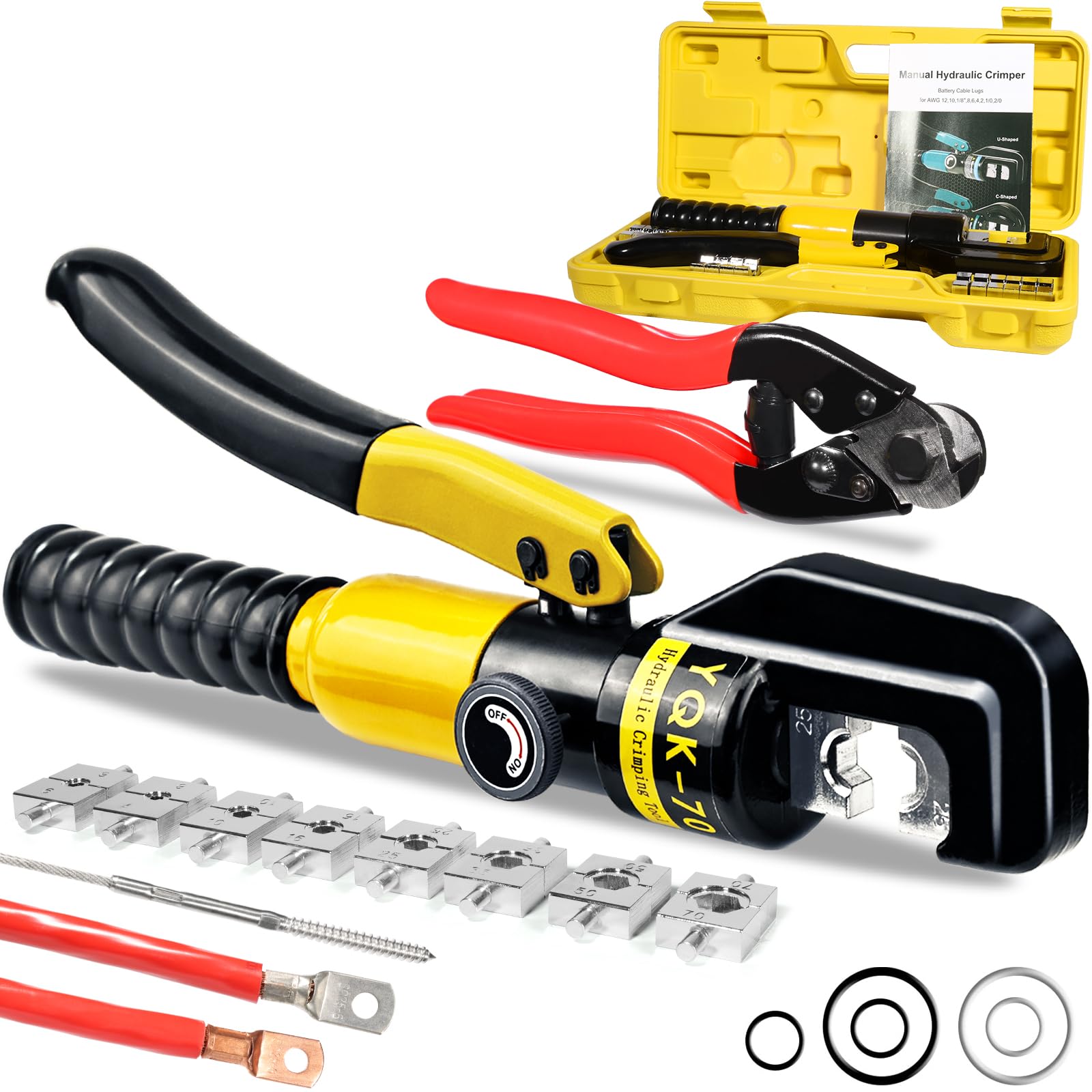
The Brileine 10T-U delivers the same 10-ton hydraulic class as the YUZES but packages it with a dedicated cable cutter and a larger die set in a molded carrying case. The crimper head uses a C-style jaw that simplifies die swaps, and the 180-degree rotating head again proves valuable when working around obstacles. The precision cast steel head receives a quench-and-temper heat treatment that gives it the toughness needed for repeated crimping without developing slop in the pivot.
This kit includes nine pairs of hexagonal dies spanning AWG 12 through 2/0, plus a wire rope cutter that handles battery cables up to substantial diameters. The cutter is a welcome addition because it eliminates the need for a separate tool when trimming cable to length. The vinyl-dipped handles provide a reasonable grip surface, though the material is less durable than the TPE or rubber found on some competitors. The on-off pressure control operates intuitively, and the auto-release mechanism retracts the ram smoothly after each crimp cycle.
Owner reports highlight the clean, uniform hexagonal crimps this tool produces and the convenience of having everything in one case. The OSHA specification compliance suggests the build meets industrial safety standards. Some users mention that the included cable cutter works well for copper but struggles slightly with thicker aluminum cable. At just over three kilograms, this is a heavier kit, but the trade-off is a tool that handles high-volume days without wearing out the operator.
What works
- Includes a capable cable cutter that saves buying a separate tool
- Heat-treated steel head resists wear and maintains alignment over time
- Molded storage case keeps all dies and the cutter organized
What doesn’t
- Vinyl handle grip is less durable than rubber or TPE alternatives
- Cable cutter struggles slightly with thicker aluminum wire
3. iCrimp Heavy Duty Copper Lug Crimping Tool IWS-0801C

The iCrimp IWS-0801C is a manual hex crimper built around a fixed-die design that eliminates loose dies entirely. The jaw contains polished and tempered dies for AWG 8, 6, 4, 2, and 1, machined directly into the tool body so there is nothing to misplace. The SCM-40 hardened steel construction provides the rigidity needed to produce a uniform hex shape around the terminal barrel, which is critical for low-resistance connections in high-current circuits like starter motor or inverter wiring.
A built-in cable cutter integrated into the handle tip adds practical utility — you can cut cable to length and crimp without switching tools. The adjustment screws and nuts on the pivot allow fine-tuning of the crimp pressure as the tool wears, a feature not found on many fixed-die manual crimpers. The ergonomic rubber-coated handles reduce hand fatigue during repetitive use, but the tool does demand two hands to operate effectively, especially on larger 1 AWG lugs where the required force approaches the upper limit of manual leverage.
Owner comparisons between this model and ratcheting alternatives consistently note that the iCrimp produces a more consistent hex crimp because the jaw closes fully without the ratchet mechanism introducing play. The cable cutter receives praise for cleanly shearing 4 AWG and 6 AWG cable without fraying. The main limitation is the crimp range — it tops out at 1 AWG, so it will not handle 1/0 or 2/0 lugs that some heavy-duty applications require.
What works
- Fixed dies eliminate loose parts and speed up workflow
- Adjustable pivot screws let you maintain crimp pressure over time
- Integrated cable cutter handles up to 1 AWG cleanly
What doesn’t
- Manual leverage requires significant hand force on larger gauges
- Maximum capacity stops at 1 AWG, no support for 1/0 or larger
4. Solsop Battery Cable Crimper Tool with Accessory Kit
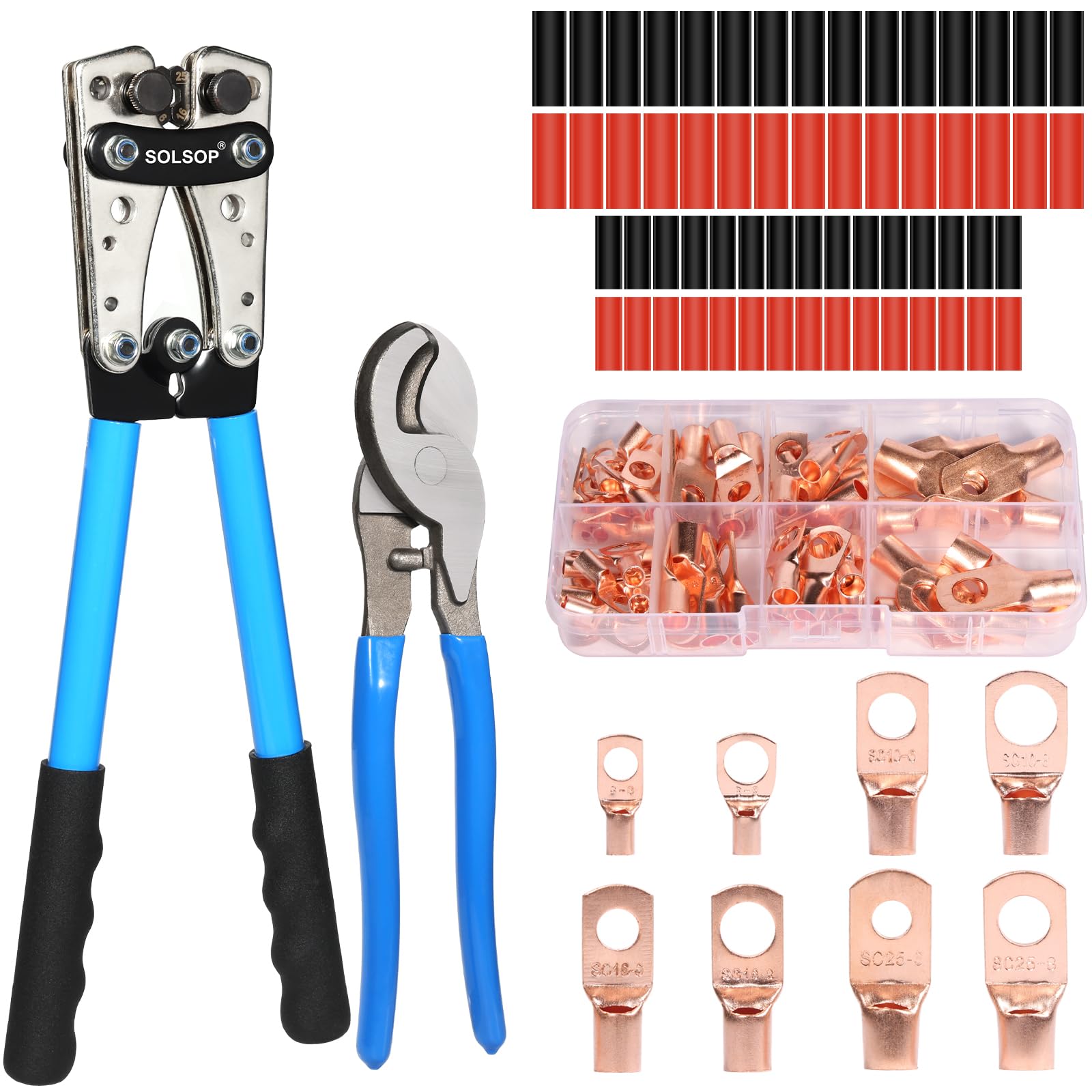
The Solsop kit bundles a manual hex crimper with a 10-inch cable cutter, 60 copper ring terminals, and 60 pieces of heat shrink tubing, creating a nearly complete setup for someone starting from scratch. The crimper itself uses a rotating turret with six die positions covering 6 mm² through 50 mm², which corresponds to roughly AWG 10 through 1/0. Turning the head to select the desired die size is fast and eliminates the frustration of tracking small individual dies during a job.
The tool body is formed from industrial-grade carbon steel with a rust-resistant treatment, and the rubber-coated handles provide a secure grip even when hands are sweaty or greasy. Owner feedback emphasizes that the hex crimp shape produced is tight and uniform, with several users comparing the result to factory-quality connections. The included cable cutter receives positive notes for its ability to shear through bundled cable without deforming the strands. The kit also ships with a user manual that clarifies which die matches each lug size, reducing guesswork for less experienced users.
The supplied copper lugs and heat shrink tubing work well for general automotive and marine use, though some users note that the terminals use standard-wall copper rather than heavy-wall stock. For high-amp applications where maximum current capacity matters, upgrading to thicker lugs may be worthwhile. The 18-month warranty provides reasonable coverage, and customer service responsiveness is noted positively in owner reports.
What works
- Rotating turret head enables fast die changes without loose parts
- Complete kit includes everything needed for most cable projects
- Carbon steel construction with rust treatment holds up to shop use
What doesn’t
- Included lugs use standard-wall copper, not ideal for maximum current draw
- Manual crimping requires significant hand strength on larger gauges
5. Tivorex Battery Cable Lug Crimping Tool with Rotary Die

The Tivorex crimper employs a hexagonal rotary mold design that achieves 360-degree silk-smooth rotation, with laser-etched size markings that remain legible over time. The turret holds six die positions covering 6 mm² through 50 mm², matching AWG 10 through 1/0. Engaging the desired size requires pressing a screw, rotating the turret to the correct mark, and releasing — a mechanism that feels more refined than some competing rotary designs. The ratcheting action on the handles ensures the crimp completes fully before the tool releases, preventing partial crimps that can slip under load.
The TPE-wrapped handle ends provide a tacky, non-slip grip that improves comfort during extended sessions. The long lever arm generates sufficient mechanical advantage to crimp 1/0 lugs without excessive hand strain, though the ratchet mechanism does add some handle travel compared to a direct-action crimper. The kit includes 64 copper ring terminals in sizes from 8 AWG through 2 AWG, plus 70 pieces of heat shrink tubing, giving a generous accessory supply for multiple projects.
Owner reviews consistently praise the cutter performance, with several calling the blade action exceptional for the price point. However, a recurring note is that the included copper terminals are thin-walled and not suited for applications demanding maximum current-carrying capacity. Users who plan to use the supplied lugs for non-critical connections find the value excellent, but those building high-amp battery banks often replace them with heavier terminals. The kit also lacks a dedicated storage case, which means the loose accessories need to be stored separately.
What works
- Smooth rotary die change with clear laser markings and positive detent
- TPE handle grip provides lasting comfort during repetitive crimping
- Ratcheting mechanism ensures full crimp completion before release
What doesn’t
- Bundled ring terminals are thin-walled and better replaced for high-amp work
- No included storage case for organizing the accessories
Hardware & Specs Guide
Crimping Force and Stroke
Manual crimpers rely on compound lever ratios that typically generate between 2 and 5 tons of force at the jaw, depending on handle length. Hydraulic models like the YUZES and Brileine produce a consistent 10 tons of force regardless of the user’s hand strength. The 11 mm stroke on most hydraulic units is sufficient to fully compress terminal barrels up to 2/0 AWG in a single pump cycle. A longer stroke reduces the number of pumps needed but increases the handle travel distance.
Die Materials and Precision
Die hardness determines how many crimps a tool can deliver before the profile degrades. Hardened steel dies rated to HRC 45-50 maintain their shape through hundreds of cycles on copper and aluminum. Chrome finishes add corrosion resistance and reduce friction during the crimp cycle. Hexagonal dies produce six-point compression that distributes force evenly around the lug barrel, creating a gas-tight joint with lower electrical resistance than indentation-style crimps.
Handle Ergonomics and Leverage
Handle length directly affects the mechanical advantage available to the user. Longer handles reduce the force required at the grip but increase the overall tool size. Rubber and TPE overmolds provide vibration damping and slip resistance that become important during high-volume work. Hydraulic tools trade handle length for a pump mechanism that builds pressure incrementally, which reduces instantaneous effort but adds pump cycles per crimp.
FAQ
What size battery cable crimper do I need for automotive work?
Is a hydraulic crimper worth the extra cost over a manual one?
Can I use a battery cable crimper for solar panel wiring?
How do I choose the right die size for my cable lug?
Final Thoughts: The Verdict
For most buyers, the best battery cable crimper winner is the YUZES Hydraulic Crimping Tool because it combines genuine 10-ton hydraulic force, a full die set from 12 AWG to 2/0, and one-handed operation at a mid-range investment. If you want a hydraulic kit with an integrated cable cutter and a storage case, grab the Brileine 10T-U. And for a compact manual tool that never loses a die and produces excellent hex crimps, nothing beats the iCrimp IWS-0801C.

Certification: BSc in Mechanical Engineering
Education: Mechanical engineer
Lives In: 539 W Commerce St, Dallas, TX 75208, USA
Md Amir is an auto mechanic student and writer with over half a decade of experience in the automotive field. He has worked with top automotive brands such as Lexus, Quantum, and also owns two automotive blogs autocarneed.com and taxiwiz.com.