A 40mm fan looks like a simple add-on until you compare bearing quality, RPM consistency, and connector compatibility across a dozen models. The wrong pick introduces noise that drowns out your drive or fails mid-run when the motor needs cooling most.
I’m Amir — the founder and writer behind Four Wheel Ask. I’ve spent years analyzing RC component specifications, comparing build quality across brands, and aggregating owner feedback to identify which fans actually deliver on their cooling claims.
After comparing airflow, bearing quality, and owner feedback across models, the best 40mm rc fan delivers serious cooling in a compact frame that lasts.
How To Choose The Best 40mm RC Fan
Selecting a 40mm cooling fan for your RC car or truck requires more than matching the mounting hole pattern. Factors like bearing type, voltage rating, and connector style directly determine whether the fan survives rough terrain or becomes a weak link in your build.
Bearing Type: Ball vs. Sleeve
Dual ball bearings handle vibration and heat better than sleeve bearings, making them the preferred choice for RC applications where the fan is mounted directly to a motor or ESC. Sleeve bearings are quieter initially but wear faster under sustained load and high temperatures. Look for fans rated with dual ball bearings if you run brushless systems or drive in dusty conditions.
RPM, CFM, and Noise Trade-offs
Higher RPM produces more airflow (measured in CFM) but increases noise. A fan spinning at 28000 RPM moves significant air but registers around 50 dB, which is audible during operation. A 5000–6000 RPM fan runs nearly silent but may not provide enough cooling for aggressive driving. Match the fan speed to your motor size and typical run duration.
Connector and Voltage Compatibility
Most RC fans use a 2-pin JST connector that draws power directly from the receiver. Some fans use a 4-pin PWM connector for variable speed control, which requires a compatible ESC or fan controller. Voltage rating is equally critical: a 24V fan running on a 12V system moves less air, while a 12V fan on 24V can fail quickly. Always verify your system voltage before purchasing.
Material and Build Quality
Fans with aluminum frames and CNC-machined housings dissipate heat more effectively than all-plastic designs. Aluminum construction also resists warping from heat and adds minimal weight. Plastic fans are lighter and cheaper but may deform under sustained thermal load, especially in enclosed RC chassis with limited airflow.
Quick Comparison
On smaller screens, swipe sideways to see the full table.
| Model | Category | Best For | Key Spec | Amazon |
|---|---|---|---|---|
| Hobby Fans 28000RPM | RC Motor Fan | High-speed RC cooling | 28000 RPM, heatsink included | Amazon |
| Noctua NF-A4x10 24V PWM | Quiet Fan | Silent 24V operation | 19.6 dB, SSO2 bearing | Amazon |
| Surpass Hobby 40mm Single | Performance Fan | CNC aluminum build | 16000 RPM, 6061-T6 | Amazon |
| 2-Pack Surpass Hobby 40mm | Value Pack | Dual fan setups | 2-pack, 16000 RPM | Amazon |
| ANVISION 2-Pack 24V | Budget Fan | Entry-level 24V cooling | 6000 RPM, ball bearing | Amazon |
In‑Depth Reviews
1. Hobby Fans RC Cooling Fan 28000RPM

This fan targets the core need of any RC basher: keeping the motor temperature in check during sustained full-throttle runs. At 28000 RPM, it moves a serious volume of air across the motor can, and the bundled aluminum heatsink improves thermal transfer compared to a fan alone. Owner feedback consistently notes that this combo drops motor temps noticeably on 1/10 and 1/8 scale setups with 540, 550, and 3650-size motors.
The JST 2-pin connector plugs directly into most standard receivers, eliminating the need for adapter cables or soldering. Build quality uses a mix of aluminum and reinforced plastic that keeps weight low at 18 grams while maintaining structural rigidity under vibration. The fan operates at around 50 dB, which is audible but reasonable for the airflow output it delivers.
Compatibility extends across brushed and brushless systems, covering 540, 550, F540, 3650, 3660, 3670, and 3674 motor sizes. The included heatsink has a low profile that fits under most stock bodies without modification. For hobbyists seeking a drop-in cooling solution that performs out of the box, this setup addresses the main pain points without extra shopping.
What works
- Very high 28000 RPM airflow for aggressive cooling
- Includes aluminum heatsink for better heat transfer
- Simple plug-and-play with standard receiver JST port
What doesn’t
- 50 dB noise level is noticeable during operation
- Plastic frame may not endure hard impacts as well as all-metal designs
2. Noctua NF-A4x10 24V PWM
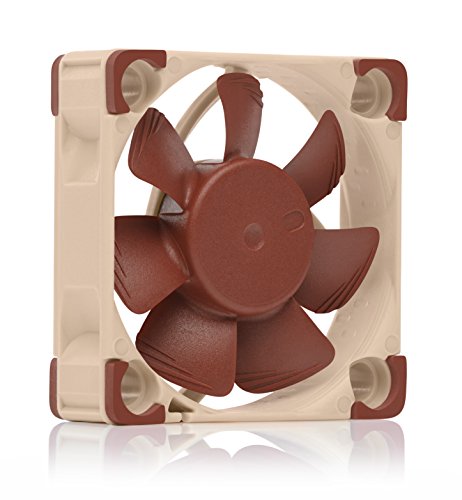
Noctua has built a reputation for quiet, reliable cooling across PC and industrial applications, and this 24V 40mm fan brings that engineering to the RC and 3D-printing world. The NF-A4x10 uses Noctua’s proprietary SSO2 bearing, which carries a mean time to failure exceeding 150,000 hours — a figure that dwarfs most RC-specific fans. At 5000 RPM max speed with PWM control, it prioritizes low noise (19.6 dB) over raw airflow, making it ideal for applications where silence matters.
The 4-pin PWM connector allows automatic speed regulation, so the fan runs slower during low-load conditions and ramps up when cooling demand increases. Noctua includes a wide accessory bundle: anti-vibration mounts, a Low-Noise Adaptor, extension cable, NA-AC9 adaptor for Creality and Anycubic 3D printers, and an OmniJoin set for custom connectors. This level of support makes installation flexible across different platforms.
For RC users running 24V systems — such as certain high-voltage ESCs or custom builds — this fan provides premium bearing reliability and extremely quiet operation. The fibre-glass reinforced PBT frame resists heat and vibration better than standard plastic. It is important to note that this is a 24V fan, so it requires a 24V power source to perform as designed; running it at 12V significantly reduces airflow.
What works
- Exceptionally quiet at 19.6 dB max noise
- SSO2 bearing rated for 150,000+ hours of life
- Comprehensive accessory kit for versatile mounting
What doesn’t
- 24V requirement limits direct use in standard 7.4V or 11.1V RC systems
- 5000 RPM peak may not provide enough airflow for high-heat motors
3. Surpass Hobby 40mm Motor Cooling Fan 16000RPM
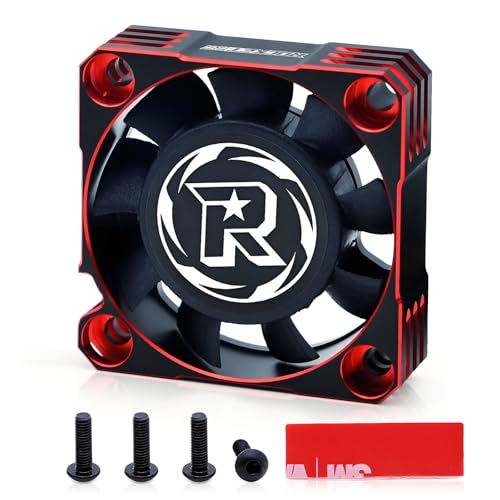
Surpass Hobby brings a machined-aluminum approach to the 40mm fan category with this 16000 RPM model. The housing is constructed from 6061-T6 aluminum, CNC-machined and anodized for precision fit and corrosion resistance. This all-metal design transfers heat away from the motor more effectively than plastic housings, and the rigid structure maintains consistent blade clearance even under thermal expansion.
The fan is designed specifically for 1/8 and 1/10 scale RC cars and trucks, compatible with 540, 550, and brushless motor sizes. It operates at up to 16000 RPM and produces around 50 dB of noise at full speed. The 4-pin connector supports PWM control, though the fan can also run on standard 2-pin connections with the correct wiring. Surpass Hobby includes a red-and-black color scheme that adds visual appeal to exposed motor mounts.
Weight remains low despite the aluminum construction, and the 24mm mounting hole pattern fits most stock brackets. The anodized finish resists scratches and looks clean after repeated installs. For builders who want a fan that doubles as a visual upgrade while delivering solid cooling performance, this Surpass Hobby unit balances aesthetics with function better than most plastic options.
What works
- Full CNC aluminum housing for superior heat dissipation
- 16000 RPM provides strong airflow for most RC motors
- Anodized finish resists wear and looks professional
What doesn’t
- 50 dB noise level is comparable to other high-speed fans
- Requires correct polarity wiring — reverse connection will not operate
4. 2-Pack Surpass Hobby 40mm RC Motor Cooling Fan 16000RPM
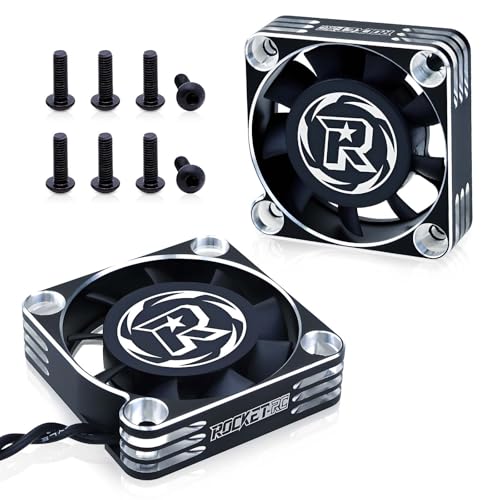
This two-pack from Surpass Hobby delivers the same CNC aluminum 40mm fan design in a bundle that suits multi-fan builds or spare-stock needs. Each fan spins at 16000 RPM and uses the same 6061-T6 aluminum construction with an anodized finish. The JST 4-pin connector simplifies wiring, and the fans are compatible with 1/8 and 1/10 scale RC cars and trucks.
Having two fans in the box allows simultaneous cooling for both motor and ESC, which is especially useful in high-power setups where both components generate significant heat. The aluminum housing on each unit provides consistent heat transfer and durability. Owner reports highlight that the fans run smoothly out of the box with minimal vibration, thanks to the precision machining of the frame and blade assembly.
The kit covers the same wide compatibility range as the single Surpass Hobby fan, fitting 540, 550, brushless, and 3650-size motors. The 40mm form factor and 24mm mounting pattern are standard across most RC platforms. For builders planning a dual-fan configuration or wanting a backup unit on hand, this two-pack offers better per-unit value without sacrificing the aluminum build quality.
What works
- Two aluminum fans at a combined value that beats buying singles
- Ideal for simultaneous motor and ESC cooling
- Same premium CNC construction as the single version
What doesn’t
- 16000 RPM may be insufficient for extreme high-power brushless systems
- Aluminum housing adds slight weight over plastic alternatives
5. ANVISION 2-Pack DC 24V 40mm Brushless Cooling Fan
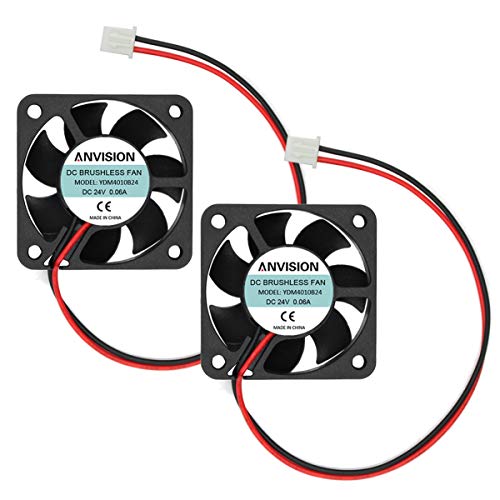
ANVISION offers a two-pack of 24V 40mm fans that serve as a budget-friendly entry point for cooling projects. Each fan uses dual ball bearings rated for 50,000 hours of life, which is a strong longevity claim at this level. The 2-pin XH2.54 connector is common in 3D printers and some RC applications, though it differs from the standard JST connector found on most RC receivers.
At 6000 RPM and 5.07 CFM, these fans produce modest airflow compared to higher-speed RC-specific options. The noise rating of 23.2 dB is very low, making them suitable for applications where quiet operation is prioritized over maximum cooling. The PBT plastic frame keeps weight minimal, and the 40mm x 10mm profile fits standard 40mm mounting patterns.
These fans work best in 24V environments such as specific ESC cooling ports, 3D printer hot-end assemblies, or custom RC builds that already run 24V power. The dual ball bearing design gives them a reliability edge over sleeve-bearing alternatives in the same price tier. For hobbyists who need a cost-effective 24V fan with decent build quality, this pack provides two units that cover basic cooling needs without breaking the budget.
What works
- Dual ball bearings for extended service life
- Very quiet at 23.2 dB during operation
- Two-pack offers excellent per-unit cost efficiency
What doesn’t
- 24V requirement limits direct RC receiver compatibility
- 6000 RPM provides less airflow than high-speed RC fans
Hardware & Specs Guide
Bearing Types and Longevity
Dual ball bearings use rolling elements that handle radial and axial loads better than sleeve bearings, especially under vibration from brushless motors. Sleeve bearings rely on a oil-impregnated bushing that wears faster in high-heat environments. For RC fans mounted directly to motors, dual ball bearings are the more durable choice and typically last 30,000 to 50,000 hours versus 10,000 to 20,000 hours for sleeve bearings.
RPM, CFM, and Noise Trade-offs
Airflow (CFM) increases roughly linearly with RPM, but noise follows a steeper curve. A 6000 RPM fan produces around 23 dB (nearly silent) but moves only about 5 CFM. A 28000 RPM fan moves four to five times more air but hits 50 dB, which is comparable to a conversation at normal volume. Select RPM based on your motor heat output and tolerance for fan noise.
Connector and Voltage Compatibility
RC fans commonly use 2-pin JST connectors that pull power from the receiver’s accessory port. Some fans use 3-pin or 4-pin connectors for PWM speed control, which requires a compatible ESC or fan controller. Voltage is critical: a 24V fan on a 12V system moves roughly half the rated CFM, while a 12V fan on 24V may burn out immediately. Always match the fan voltage to your system voltage.
Material Quality and Heat Dissipation
Aluminum fan housings conduct heat away from the motor and transfer it to the moving airstream more efficiently than plastic. CNC-machined aluminum also resists warping from sustained heat and provides a rigid mount that reduces blade vibration. Plastic frames are lighter and cheaper but can deform under continuous thermal load, reducing blade clearance and airflow over time.
FAQ
What voltage should my 40mm RC fan be?
How do I choose between ball bearing and sleeve bearing RC fans?
Final Thoughts: The Verdict
For most buyers, the 40mm rc fan winner is the Hobby Fans 28000RPM because it combines the highest airflow with a bundled heatsink and drop-in compatibility with standard RC receivers. If you want all-metal construction and precise CNC machining, grab the Surpass Hobby 40mm 16000RPM. And for quiet 24V applications where fan noise must stay minimal, nothing beats the Noctua NF-A4x10 24V PWM.

Certification: BSc in Mechanical Engineering
Education: Mechanical engineer
Lives In: 539 W Commerce St, Dallas, TX 75208, USA
Md Amir is an auto mechanic student and writer with over half a decade of experience in the automotive field. He has worked with top automotive brands such as Lexus, Quantum, and also owns two automotive blogs autocarneed.com and taxiwiz.com.