A leaking valve cover, weeping oil pan, or seeping timing cover turns a straightforward repair into a recurring headache. The wrong silicone breaks down on contact with fuel and hot oil, leaving you with drips on the driveway and a second trip to the workbench. Choosing a sealant built specifically for hydrocarbon resistance eliminates that cycle entirely.
I’m Amir — the founder and writer behind Four Wheel Ask. My research focuses on analyzing technical specifications, manufacturing consistency, and real-world owner feedback to separate marketing claims from genuine performance data.
After analyzing countless owner reports, only a select few sealants qualify as the best fuel resistant rtv silicone for long-term leak-free performance.
How To Choose The Best Fuel Resistant RTV Silicone
Fuel-resistant RTV silicone is a specialty sealant formulated to withstand prolonged exposure to gasoline, diesel, oil, coolant, and transmission fluid. Unlike general-purpose caulk, these compounds cure into a flexible solid that maintains its bond under thermal cycling and vibration. The wrong choice leads to chemical breakdown, hardening, or adhesion loss within months.
Oil and Fuel Resistance Rating
Look for sealants explicitly tested against ASTM D471 or similar immersion standards. Products labeled “oil resistant” or “fuel resistant” typically contain a higher percentage of polydimethylsiloxane polymers with added crosslinkers that resist hydrocarbon swelling.
Temperature Range
Most quality RTV silicones handle continuous exposure from -65°F to 500°F, with intermittent spikes up to 600°F. If your application sits near exhaust manifolds or turbochargers, verify the upper limit in the technical data sheet rather than relying on marketing copy.
Cure Time and Slump Resistance
Thixotropic (non-slumping) formulations stay in place on vertical surfaces like timing covers and valve rails. Fast-curing variants skin over in 5-10 minutes and reach full chemical resistance within 24 hours at room temperature. Slower cures often yield deeper gap-fill and better bond strength on porous surfaces.
Sensor-Safe and Low-Odor Chemistry
Modern engines rely on oxygen sensors and mass airflow meters. Acetic acid (vinegar-smell) cure RTV can outgas volatile compounds that contaminate these components. Neutral-cure, sensor-safe formulas eliminate that risk and are preferred for any engine bay application.
Quick Comparison
On smaller screens, swipe sideways to see the full table.
| Model | Category | Best For | Key Spec | Amazon |
|---|---|---|---|---|
| Loctite 5900 | RTV Silicone | Flange sealing on high-end engines | 300 mL Cartridge | Amazon |
| Permatex Ultra Black | RTV Silicone | Oil pan and valve cover sealing | 3.35 oz (Pack of 12) | Amazon |
| Permatex Ultra Grey | RTV Silicone | High-torque and vibration applications | 3 oz (Pack of 12) | Amazon |
| Ford TA-357 | OEM RTV Silicone | Ford and Lincoln engine repairs | 5 oz | Amazon |
| SILA-SEAL | RTV Silicone | Professional-grade sealing projects | 10.1 oz (Case of 12) | Amazon |
| ABRO | RTV Silicone | High-temp industrial use | 3 oz (Pack of 12) | Amazon |
| Stanley High-Temp | RTV Silicone | Budget-friendly sealing jobs | 2.36 oz (Pack of 12) | Amazon |
In‑Depth Reviews
1. Loctite 5900 Flange Sealant
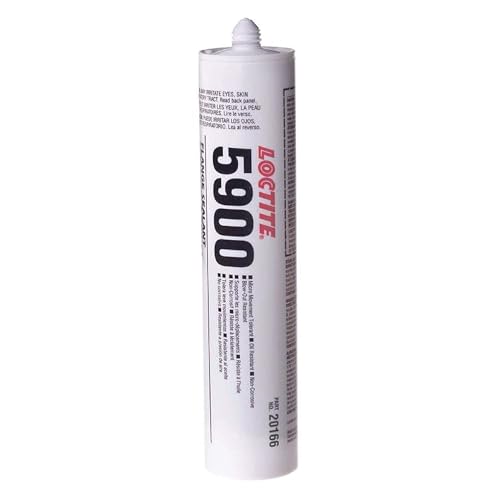
Loctite 5900 is a heavy-body RTV silicone formulated specifically for rigid flange sealing in high-stress assemblies. Its thixotropic consistency prevents sagging on vertical surfaces, making it a go-to choice for timing covers, oil pans, and valve rails on European and domestic engines where factory specs demand zero-leak performance. The non-corrosive, low-odor chemistry keeps oxygen sensors and catalytic converters safe during cure.
Owner reports from independent repair shops consistently highlight the instant seal capability — the compound skins over within minutes and resists washout even when the assembly is lightly torqued shortly after application. Multiple reviewers on Mercedes and BMW engine rebuilds note that Loctite 5900 held up where prior attempts with standard RTV failed, particularly on die-cast aluminum surfaces with varying coefficients of thermal expansion.
Quality control feedback is generally strong, though isolated cases of prematurely cured stock appear in owner comments. The cartridge format requires a standard caulk gun, which is a minor convenience trade-off for DIYers accustomed to squeeze tubes. For professional-grade flange sealing that meets OEM assembly standards, this formulation consistently ranks at the top.
What works
- Instant seal capability reduces assembly wait time
- Non-sagging formula stays put on vertical flanges
- Low-odor and sensor-safe during cure
What doesn’t
- Cartridge format requires a caulk gun
- Occasional reports of prematurely hardened stock
2. Permatex Ultra Black Maximum Oil Resistance

Permatex Ultra Black has earned a decades-long reputation as the workhorse RTV for oil-contact applications. Its patented adhesion system retains high flexibility and oil resistance across the full temperature range, from -65°F to 550°F intermittent. The fast-curing formula is sensor safe, low odor, and non-corrosive, meeting extended drivetrain warranty compliance standards that many shops require.
Commercial shop feedback shows Ultra Black as the default recommendation for valve covers, oil pans, intake manifold end seals, timing covers, and transmission pans. Multiple reviewers with automotive service businesses note that the 12-pack format provides better per-tube value compared to single retail tubes from local parts stores, and the smaller 3.35 oz size reduces waste on jobs that don’t need a full cartridge.
Consistency across batches is a strong point — long-term users report the same viscosity and cure behavior from tube to tube. The only recurring critique involves the nozzle design, which some users find prone to clogging if the tip isn’t cleared immediately after use. For a proven, widely available formula that balances performance with accessibility, this remains a top contender.
What works
- Proven oil resistance across wide temperature range
- Sensor-safe and non-corrosive chemistry
- Consistent batch-to-batch quality
What doesn’t
- Nozzle can clog if tip is left uncapped
- Not ideal for high-vibration or high-torque applications
3. Permatex Ultra Grey Rigid High-Torque

Permatex Ultra Grey is engineered specifically for high-torque and high-vibration assemblies where standard RTVs can flex too much and lose their bond. The rigid formulation provides maximum vibration resistance while maintaining outstanding protection against oils, cooling fluids, and shop chemicals. OEM-specified for many domestic powertrains, it is guaranteed not to leak when applied per factory torque sequences.
Shops specializing in heavy-duty truck and SUV repairs report Ultra Grey as the preferred sealant for differential covers, transmission pans, and oil pans on vehicles that see frequent off-road or towing duty. The low-odor, non-corrosive formula makes it suitable for enclosed engine compartments where vapor accumulation is a concern. Multiple owner reviews note successful long-term sealing on thermostat housings and water pumps where thermal cycling is extreme.
A minority of buyers have reported individual tubes that failed to cure properly, suggesting occasional quality variance in multi-pack runs. The rigid nature of the cured compound also means it is less forgiving on uneven or damaged flange surfaces compared to more flexible alternatives. For applications requiring structural integrity under sustained vibration, this silicone delivers a noticeably firmer hold.
What works
- Excellent vibration and high-torque resistance
- OEM-specified for many domestic powertrains
- Withstands thermal cycling on water pumps and housings
What doesn’t
- Occasional tubes with cure failure reported
- Less forgiving on uneven flange surfaces
4. Ford Genuine TA-357 High Performance RTV

Ford TA-357 is the OEM-specified silicone sealant for Ford and Lincoln powertrains, covering timing chain covers, oil pans, valve covers, and vacuum pump housings on EcoBoost and modular V8 engines. The 5 oz tube is formulated to match factory assembly requirements, including the specific viscosity and cure characteristics that Ford engineers designed around for their aluminum and composite engine components.
Owner feedback from DIYers and independent techs is consistently strong, particularly for 3.5L EcoBoost timing chain jobs where leaks are common with non-OEM sealants. Multiple reviewers report leak-free results after one year of daily driving on F-150 and Mustang applications. The material bonds well to both bare aluminum and factory coatings withoutpriming, which simplifies the repair process for home mechanics.
The primary limitation is the single 5 oz tube size — larger projects like full engine reseals may require multiple tubes. Some users also note that the OEM formulation cures slightly slower than aftermarket alternatives, requiring longer assembly wait times. For anyone working on a Ford product who wants factory-spec compatibility, this eliminates guesswork.
What works
- Exact OEM specification for Ford/Lincoln engines
- Bonds directly to aluminum without primer
- Proven long-term results on EcoBoost timing covers
What doesn’t
- Single tube size limits large project use
- Slightly slower cure than aftermarket options
5. SILA-SEAL Professional Grade RTV Silicone

SILA-SEAL is a professional-grade 100% RTV silicone made in the United States, offered in a distinctive aluminum color that blends well with metal engine components and exterior fixtures. The non-slumping formula adheres to clean metal, glass, ceramic, most non-oily woods, painted surfaces, and plastics without priming. Each 10.1 oz cartridge provides substantial coverage for large sealing projects.
HVAC contractors and automotive DIYers alike report using this silicone for mini-split line-set sealing and engine bay gaskets. The tough, flexible seal resists chalking, cracking, and shrinking over time, and the non-slumping behavior makes it suitable for vertical and overhead applications. Multiple owner reviews highlight the price advantage over equivalent products at local big-box retailers for the case quantity.
The one-piece nozzle is not removable, which means careful clean-up is required to reuse a partially used cartridge. Additionally, the aluminum color, while aesthetically pleasing for certain applications, does not match the traditional black or grey that many engine builders expect for visible gasket lines. For those who prioritize coverage, U.S. manufacturing, and a neutral metallic finish, this is a strong option.
What works
- Made in the U.S. with consistent quality
- Non-slumping for vertical and overhead use
- Competitive price for case quantity
What doesn’t
- Nozzle is not removable for reuse
- Aluminum color may not suit all engine bay aesthetics
6. ABRO RTV Silicone Sealant and Gasket Maker
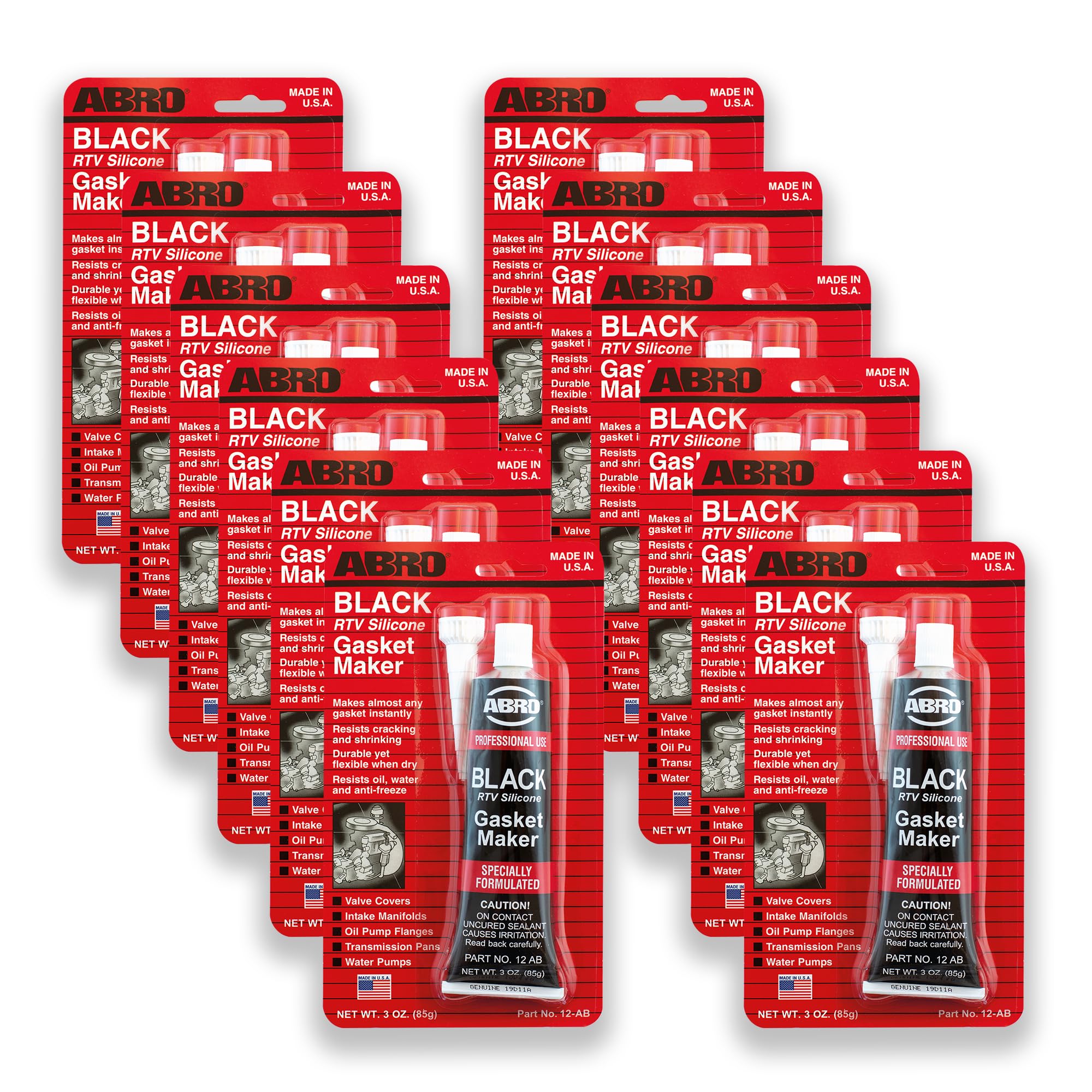
ABRO RTV Silicone is formulated for industrial-strength sealing with resistance up to 500°F, making it suitable for heavy-duty automotive, marine, and equipment applications. The fast-curing compound resists oil, water, antifreeze, and transmission fluid while maintaining flexibility through thermal cycling and vibration. It is designed to replace most cut gaskets on valve covers, intake manifolds, oil pump flanges, transmission pans, and water pumps.
Owner reviews highlight its versatility beyond automotive use — one reviewer successfully sealed a pool filter tri-port gasket, while another used it for a gas cooktop installation requiring high-temperature resistance. The 12-pack format provides a ready supply for shops or DIYers who work on multiple projects. Multiple users confirm that the cured seal remains flexible and does not become brittle over time.
Some users note that the tube size is relatively small at 3 oz, which may require multiple tubes for larger sealing surfaces. A few reviewers also mention that the black color can make it difficult to differentiate from the surface on dark engine components during application. For a well-rounded, high-temperature RTV with broad application scope, this delivers reliable performance.
What works
- Withstands up to 500°F continuous exposure
- Versatile for automotive, marine, and household use
- Fast-curing with good flexibility retention
What doesn’t
- Small tube size limits coverage per unit
- Black color blends into dark engine surfaces
7. Stanley High-Temp RTV Silicone Gasket Maker
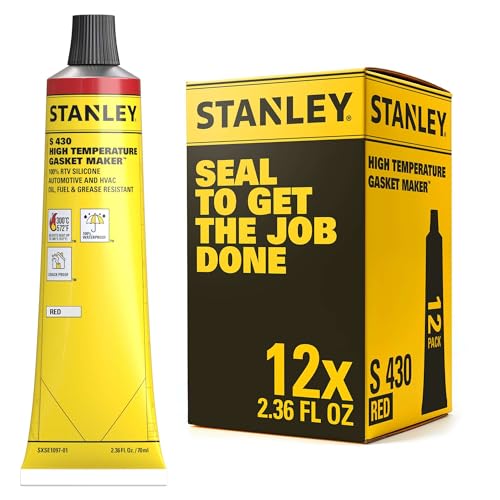
Stanley High-Temp RTV Silicone offers an entry-level price point for DIYers who need a reliable gasket maker for common sealing tasks. The red high-temperature formula withstands continuous exposure up to 478°F and intermittent exposure up to 594°F, covering valve covers, oil sumps, transmission pans, timing gear covers, and differential covers. It is waterproof and non-corrosive, with flexibility that resists cracking and shrinking under normal operating conditions.
User feedback shows successful applications ranging from oven panel repair to Sea-Doo two-stroke engine case sealing and Briggs & Stratton valve covers. One reviewer noted that a thin layer on a V-twin engine’s valve covers remained leak-free after weekly use over several months. The 12-pack format makes this a practical option for those who want spare tubes on hand for multiple projects.
Some users report that the tube can crack under pressure during application, which can be frustrating mid-job. The putty-like consistency requires firm, even pressure, and the red color may not be ideal for applications where a discreet seal is preferred. For budget-conscious buyers seeking a functional high-temperature RTV, this represents a sensible starting point.
What works
- High-temperature rating up to 594°F intermittent
- Waterproof and non-corrosive formula
- Cost-effective 12-pack for multiple projects
What doesn’t
- Tube may crack under pressure during application
- Red color stands out on engine components
Hardware & Specs Guide
Oil Immersion Resistance
The critical metric for fuel-resistant RTV is volumetric swell after immersion in ASTM #3 oil at 150°C for 70 hours. Premium formulations show less than 20% swell, while budget options can exceed 40%, leading to bond failure. Always check for OEM or third-party oil resistance certification rather than generic claims.
Temperature Operating Window
Continuous service temperature separates general-purpose silicones from high-performance sealants. Standard RTVs typically rate to 350°F, while fuel-resistant variants reach 500°F continuous and 600°F intermittent. For modern turbocharged engines with hot-running valvetrains, a 500°F+ rating is strongly recommended.
Cure Chemistry
Acetoxy (acetic acid) cure releases vinegar-like vapors that can corrode sensitive electronics and oxygen sensors. Neutral-cure formulations use oxime or alkoxy chemistry, producing minimal volatile byproducts. Sensor-safe labeling indicates compatibility with modern engine management systems.
Slump and Gap Fill
Thixotropic additives control how the silicone behaves on vertical surfaces. Non-slumping formulas stay in place without sagging, ideal for timing covers and valve rails. Maximum gap fill ratings range from 0.10 to 0.25 inches — larger gaps may require multiple passes or a backing material.
FAQ
What makes an RTV silicone fuel resistant?
Can I use fuel resistant RTV on plastic or composite parts?
How long should I wait before filling the engine with oil?
Is red, black, or grey RTV better for oil resistance?
Can I mix different brands of RTV silicone on the same assembly?
Final Thoughts: The Verdict
For most buyers, the best fuel resistant rtv silicone winner is the Loctite 5900 because it delivers professional-grade flange sealing with instant seal capability and broad compatibility across domestic and European engines. If you want maximum oil resistance in a widely available tube format, grab the Permatex Ultra Black. And for high-torque applications where vibration loosens standard sealants, nothing beats the Permatex Ultra Grey.

Certification: BSc in Mechanical Engineering
Education: Mechanical engineer
Lives In: 539 W Commerce St, Dallas, TX 75208, USA
Md Amir is an auto mechanic student and writer with over half a decade of experience in the automotive field. He has worked with top automotive brands such as Lexus, Quantum, and also owns two automotive blogs autocarneed.com and taxiwiz.com.