A flawed flare on a brake or fuel line doesn’t just leak — it fails under pressure, and that failure happens when you need the system most. The difference between a secure seal and a slow drip comes down to how consistently the tool forms the cone, clamps the tube, and holds alignment through every turn of the handle. After spending time studying the mechanical differences between cheap clamp-style units and professional vise-mounted or hydraulic systems, the gap in reliability becomes obvious before you even cut a piece of tubing.
I’m Amir — the founder and writer behind Four Wheel Ask. My approach focuses on breaking down product specifications, comparing build materials and die precision across brands, and aggregating real owner feedback to separate tools that deliver consistent results from those that introduce more frustration than they solve.
Understanding which flaring tool handles stainless versus soft copper, which die sets stay aligned over repeated use, and which designs actually simplify the process for a DIY builder or a shop mechanic saves both time and material. Our analysis of owner experiences and build quality across the category reveals the top picks for the best an flare tool available on the market today.
How To Choose The Best AN Flare Tool
Selecting the right flaring tool starts with understanding what type of lines you plan to build, the materials those lines are made from, and how many flares you expect to produce. A tool that works beautifully on soft nickel-copper tubing may struggle to form a consistent double flare on stainless steel, while a hydraulic unit built for high-volume shop use would be overkill for a single brake line repair at home. Matching the tool to the workload prevents wasted material and leak-prone connections.
Flare Type and Angle Compatibility
The most common specifications for automotive and hydraulic lines are 37-degree SAE flares and 45-degree inverted flares. 37-degree flares dominate aircraft and AN plumbing applications, while 45-degree double flares are standard on automotive brake systems from most manufacturers. Some tools offer bubble (ISO/DIN) flare capability for European vehicles and push-connect fittings. A tool that supports multiple flare angles and types provides more flexibility across different projects without requiring a separate head or adapter set.
Clamping Mechanism and Die Quality
The clamping design determines how securely the tool holds the tubing during the flaring process. Vise-mounted units with split die blocks and T-handle or lever-operated clamps offer the most stability because the entire assembly stays rigid while you apply force. Handheld clamp-style tools with wing nuts shift under pressure, especially on harder tubing materials. Die precision matters equally — dies machined from hardened steel with tight tolerances produce consistent flare diameters and reduce the chance of off-center or oval cones that lead to leaks.
Material Compatibility and Force Requirements
Soft tubing materials like copper and nickel-copper alloy deform easily with moderate force from any decent tool, but stainless steel and mild steel lines require significantly more clamping pressure and a rigid frame to prevent the die from walking during the forming stroke. Hydraulic flaring tools eliminate the manual force variable by using a ram to apply steady, repeatable pressure, which makes them ideal for stainless lines and high-volume work. Manual lever-action tools from reputable manufacturers can handle steel lines if the vise mount is solid and the dies are properly aligned, but cheap budget units often lack the structural stiffness to produce clean flares on anything harder than soft copper.
Quick Comparison
On smaller screens, swipe sideways to see the full table.
| Model | Category | Best For | Key Spec | Amazon |
|---|---|---|---|---|
| Mastercool 72475-PRC | Hydraulic | Professional-grade versatility | 3/16″ to 1/2″ tubing, 45° and ISO flares | Amazon |
| RIDGID 41162 377 | 37° Manual | Precision 37° SAE flares | 3/16″ to 1/2″ tubing, non-ratcheting | Amazon |
| TGR Professional HT-1600 | 45° Flaring Set | Easy manual operation | 3/16″ to 3/8″ tubing, single/double/bubble | Amazon |
| DPTOOL Y1012A | 37° Multi-Flare | Multi-material capability | 3/16″ to 3/8″ and 4.75mm tubing | Amazon |
| SEEKSELF FTOOL-45C | 45° Flaring Kit | Build quality at a mid-range price | 3/16″ to 3/8″ and 4.75mm tubing | Amazon |
| Lisle 33260 | Compact Manual | Flaring in tight spaces | 3/16″ and 1/4″ tubing only | Amazon |
| FLAREFIXeco KS Tools | Universal Set | Precision on 4.75mm lines | 4.75mm universal brake pipe | Amazon |
In‑Depth Reviews
1. Mastercool 72475-PRC Universal Hydraulic Flaring Tool Set

The Mastercool 72475-PRC sits at the top of the category because it eliminates the two biggest variables that cause bad flares — inconsistent hand force and die misalignment. The hydraulic ram applies steady, repeatable pressure so the cone forms evenly every time, regardless of whether the tubing is soft nickel-copper or harder stainless steel. The die set stabilizing arm and magnetic adapter holder keep components locked in position, which reduces the learning curve significantly compared to manual screw-type tools that require feel and experience to get right.
This kit covers 45-degree single and double flares, push connect flares, GM fuel line flares, and ISO bubble flares across tubing sizes from 3/16-inch up to 1/2-inch and 4.75 mm to 10 mm. The high-strength steel dies are precision-formed to minimize metal fatigue at the flare base, and the included Mastercool 70027 Mini Tube Cutter delivers clean square cuts before flaring. The custom-molded storage case keeps all adapters and dies organized, which matters when you are working on multiple line types in a shop environment.
Owner reports consistently highlight that the hydraulic action produces factory-quality flares on the first attempt, even for users with no prior flaring experience. The main trade-off is the bulk of the tool — it is not designed for in-vehicle use and requires bench space for setup. Some users note that the 72475-PRC lacks the specific dies and adapters for certain GM coolant lines that the 72485 kit includes, but for standard brake, fuel, and transmission work, the coverage is comprehensive.
What works
- Hydraulic ram removes manual force inconsistency for repeatable flares on every material type
- Covers multiple flare standards including 45°, ISO bubble, and push connect in one kit
- Magnetic adapter holder and stabilizing arm keep dies aligned during the flaring stroke
What doesn’t
- Bulky design limits use to bench mounting and makes it impractical for under-vehicle work
- Does not include die sets for specific GM coolant line applications found in the 72485 kit
2. RIDGID 41162 377 Precision Non-Ratcheting Pipe Flaring Tool

The RIDGID 41162 is the reference standard for 37-degree SAE flare work in professional settings, and its reputation among aircraft mechanics and hydraulic line fabricators is well earned. The non-ratcheting design uses a torque-limit handle that prevents over-forcing the cone against the tube, which eliminates the most common cause of cracked or malformed flares on stainless steel and thin-wall tubing. The steel construction and precision-machined yoke hold the die perfectly centered, so the flare forms symmetrically around the tube axis without the die walking off-center.
This tool handles tubing from 3/16-inch up to 1/2-inch outer diameter and produces consistent single flares for JIC and AN fitting connections. The low-profile yoke allows the tool to be used closer to bulkheads or fittings than many bench-mounted alternatives, though it still requires a vise for proper operation. The included internal deburring tool ensures the tube ID is clean before flaring, which prevents debris from contaminating the hydraulic system. RIDGID backs this unit with the brand’s typical quality control, and the handle mechanism delivers tactile feedback that experienced fabricators appreciate.
Feedback from long-term users emphasizes that this tool produces flawless flares on stainless steel lines that cheaper tools simply cannot form without tearing or cracking. The 37-degree specification makes it ideal for AN plumbing, fuel systems, and hydraulic circuits, but it does not produce inverted 45-degree double flares for automotive brake applications. The single-tube-size die changes require swapping components rather than rotating a turret, which slows down multi-size jobs slightly.
What works
- Torque-limit handle prevents over-forming and cracking on stainless and thin-wall tubing
- Precision steel yoke holds perfect die alignment for symmetrical 37° SAE flares
- Trusted by aircraft and hydraulic professionals for consistent long-term performance
What doesn’t
- Limited to 37° single flares and does not produce 45° inverted double or bubble flares
- Die changes require manual component swaps instead of a rotating turret head
3. TGR Professional Brake Line Flaring Tool HT-1600

The TGR Professional HT-1600 is built around a simple observation — most flaring failures come from the die not being held firmly enough during the forming process. The T-handle screw clamp applies substantial clamping force to lock the split die blocks around the tubing, which prevents the line from shifting when the cone is driven into the tube end. This design produces clean single, bubble, and double flares on 3/16-inch, 1/4-inch, 5/16-inch, and 3/8-inch tubing without the die gap issues that plague wing-nut style tools.
The tool body is machined from steel and mounts in a vise, providing the rigidity needed to work with steel and stainless lines. Users report that the learning curve is minimal — the operation sequence is clearly defined, and the T-handle provides mechanical advantage that makes clamping easier than lever-action designs. Each tool comes pre-tested from the factory with a sample flare included, which gives confidence that the die alignment was verified before shipping. The compact footprint means it stores easily in a tool box or drawer.
Owner reviews consistently note that this tool produces perfect double flares on the first attempt, even for users who struggled with clamp-style tools in the past. The main limitation is that it requires a vise to operate, so it is not suitable for roadside or in-vehicle repairs. Some users mention that the plastic storage case is minimal, but the tool itself holds up well under repeated use on steel lines.
What works
- T-handle screw clamp applies strong, even pressure to keep dies securely locked around tubing
- Factory pre-tested with sample flare included to verify die alignment before purchase
- Produces consistent single, bubble, and double flares across four common tubing sizes
What doesn’t
- Requires a vise for operation and cannot be used for under-vehicle flaring
- Included plastic storage case offers minimal protection compared to premium tool boxes
4. DPTOOL 37 Degree Brake Line Flaring Tool Kit Y1012A
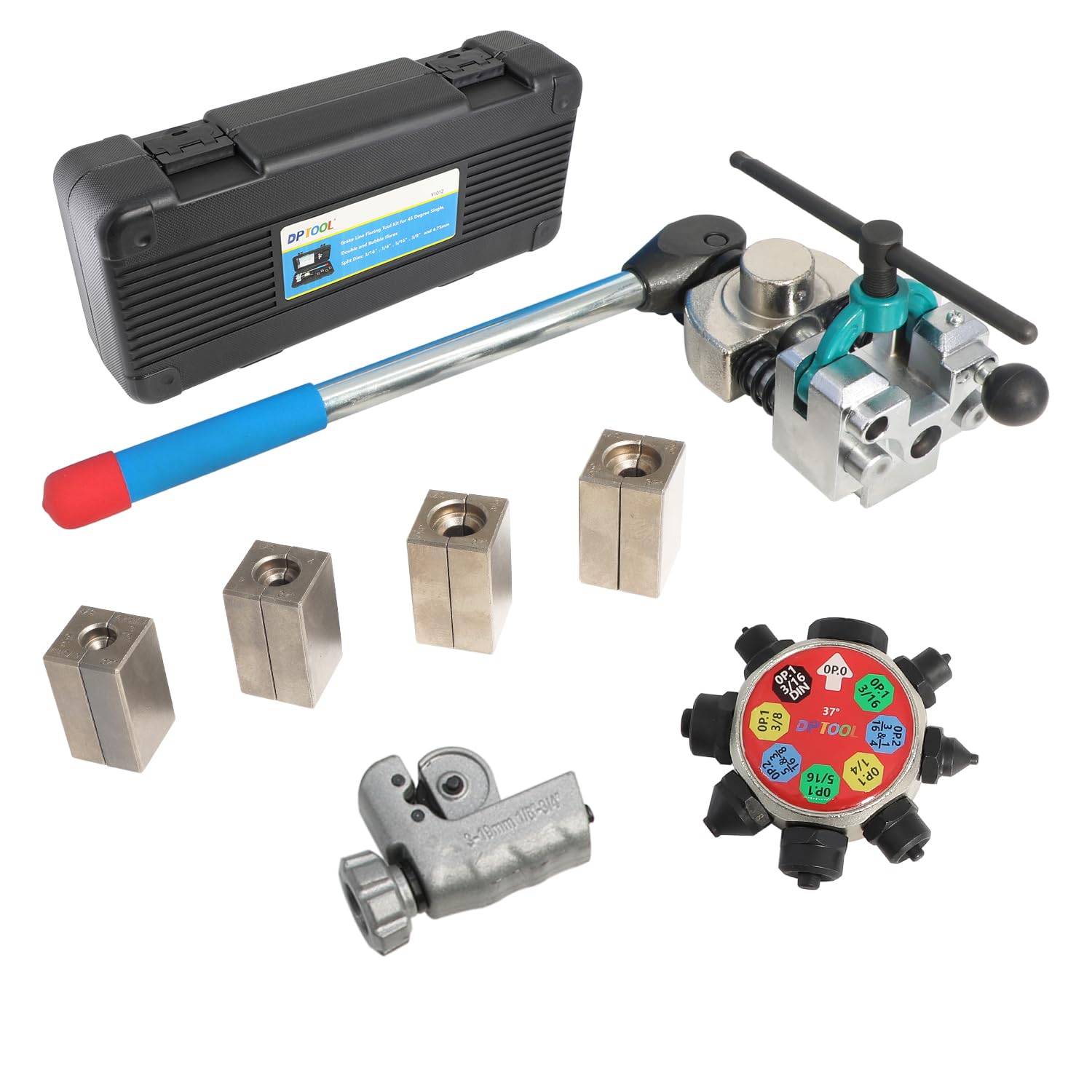
The DPTOOL Y1012A delivers an impressive range of capabilities for its position in the market, supporting 37-degree single, double, and bubble flares on tubing sizes from 3/16-inch up to 3/8-inch plus 4.75 mm. The rotating die head with indexed positions (OP.0, OP.1, OP.2) simplifies the multi-step process for double and bubble flares, which reduces the chance of skipping a forming stage. The tool body is made from heat-treated and oxidized steel for hardness and corrosion resistance, and the split die blocks are machined to consistent tolerances across all four included sizes.
One feature that stands out in owner feedback is the tool’s ability to handle stainless steel lines without the die slippage or frame flex that cheaper alternatives exhibit. The vise-mount design provides the necessary stability, and the lever handle gives enough mechanical advantage to form flares on harder materials without excessive effort. The kit includes a tubing cutter and a portable plastic suitcase for organization, which adds convenience for shop use. The instruction manual provides clear step-by-step guidance for each flare type.
Users who have made hundreds of flares with this tool report consistent results across both soft and hard tubing materials. The minor drawbacks include some slop in the turret mechanism that requires careful attention during indexing, and the instruction manual could benefit from more detailed diagrams for first-time users. Overall, the build quality and flare consistency rival tools at a higher price point, making this a strong contender for anyone who needs 37-degree flare capability without stepping up to premium pricing.
What works
- Rotating die head with indexed positions simplifies double and bubble flare sequences
- Heat-treated steel construction handles stainless tubing without flex or die slippage
- Includes tubing cutter and organized storage case for complete kit usability
What doesn’t
- Turret mechanism exhibits some play that requires careful alignment during indexing
- Instruction manual diagrams could be clearer for operators new to multi-step flaring
5. SEEKSELF 45 Degree Brake Line Flaring Tool Kit FTOOL-45C
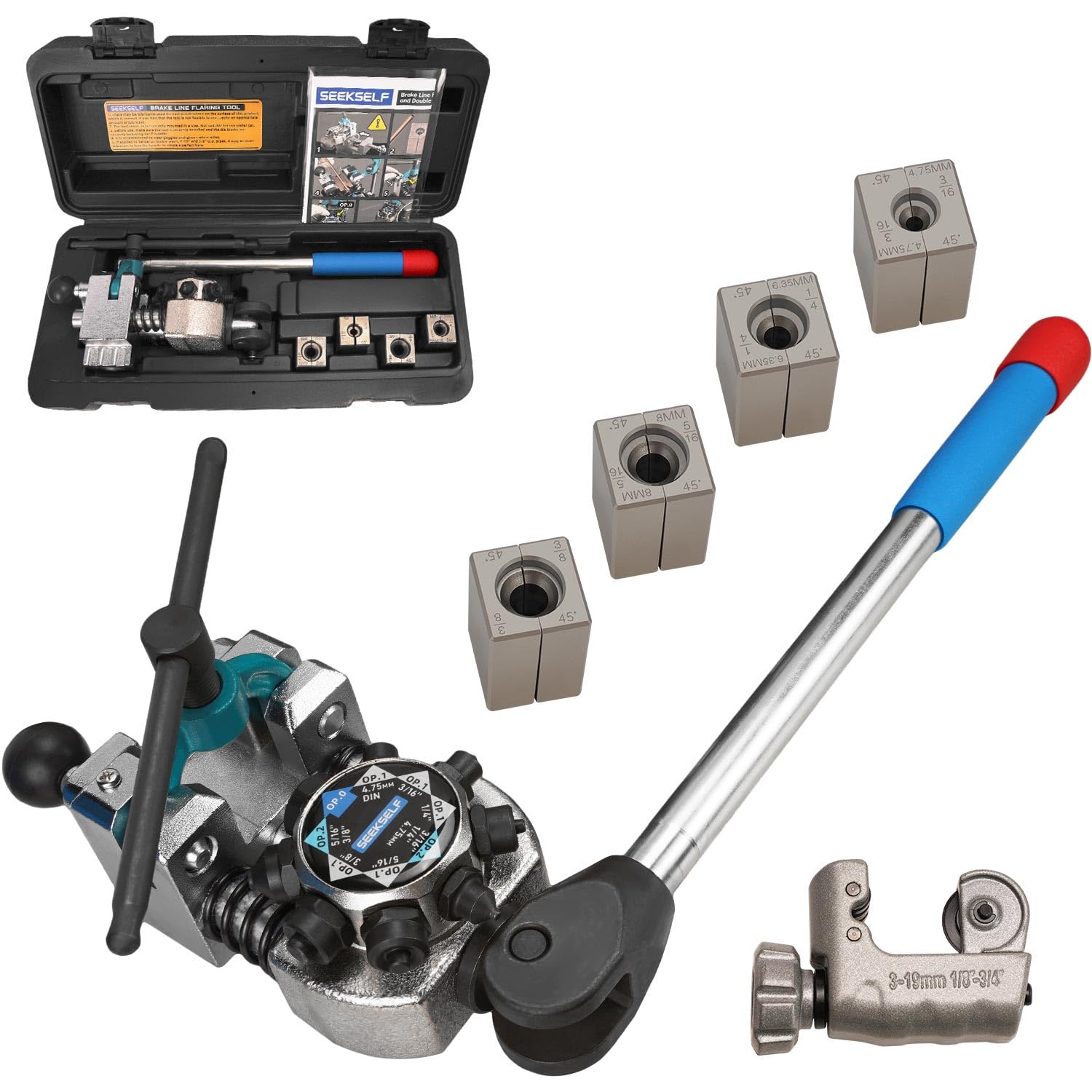
The SEEKSELF FTOOL-45C focuses on design refinements that address common frustrations with vise-mounted flaring tools. The split dies feature limiting holes that prevent them from slipping out of position during clamping, which eliminates one of the most frequent causes of off-center flares. The handle is designed to apply force by turning to the left, which makes the tool more comfortable for right-handed users and reduces the effort required to form flares on steel lines. The tool body is constructed from high-quality steel and produces 45-degree single, double, and bubble flares on tubing sizes from 3/16-inch to 3/8-inch plus 4.75 mm.
The kit includes four sets of split die blocks, a long lever handle, a tubing cutter, and a plastic storage case. The paper graphic instruction manual provides a visual reference for the flare sequence, which helps new users understand the step order without guessing. Owner feedback emphasizes that this tool produces perfect double flares on nickel-copper alloy lines on the first attempt, and several users report successful flares on 9.5 mm hydraulic steel line that would not budge in standard clamp-style tools. The vise-mount requirement is clearly stated and expected for this category.
The main downside reported by users is that the tool is designed for bench use only and cannot be adapted for in-vehicle flaring. Some users note that the finish on the die blocks could be smoother to reduce friction during the forming process, though this does not affect the final flare quality. For anyone working on automotive brake systems, transmission coolers, or fuel lines who wants a reliable 45-degree flaring solution with thoughtful ergonomic touches, this kit delivers consistent results.
What works
- Die limiting holes prevent block slippage during clamping for consistent die alignment
- Left-turn handle design reduces effort and improves ergonomics for right-handed users
- Successfully flares 9.5 mm hydraulic steel line where standard tools fail
What doesn’t
- Designed exclusively for bench use with no in-vehicle flaring capability
- Die block finish could be smoother to reduce friction during the forming process
6. Lisle 33260 Flaring Tool

The Lisle 33260 takes a completely different approach from the vise-mounted tools in this guide by prioritizing low-profile portability and ease of use in tight locations. The compact design allows the tool to be positioned close to bulkheads, frame rails, or other obstructions where a full vise-mounted unit would not fit. The vise assembly holds the tubing centered securely without marring the surface, and the integrated depth stop ensures the correct tubing length protrudes for proper flare formation every time. This tool creates single or double flares on 3/16-inch and 1/4-inch tubing.
Lisle includes a forming die, depth plug, grease, internal deburring tool, and a storage case in the package. The operation is straightforward — clamp the tool in a vise or hold it with a wrench, insert the prepared tubing, and turn the forming cone to create the flare. Owner reports consistently praise the tool’s ability to form perfect flares on OEM hard steel lines that have a thick plastic coating, which is a scenario where many other tools struggle. The simple, durable construction and lifetime warranty add to the value proposition for DIY users who need a reliable tool for occasional brake line repairs.
The primary limitation is the restricted tubing size range — the 33260 only works with 3/16-inch and 1/4-inch lines, which covers most automotive brake applications but leaves out 5/16-inch and 3/8-inch lines. The tool also does not work on stainless steel tubing, as stated clearly in the manufacturer specifications. For its intended use case of automotive brake line repairs on standard steel or nickel-copper lines, the Lisle 33260 delivers exceptional reliability in a compact package.
What works
- Low-profile design allows flaring in tight spaces where vise-mounted tools cannot reach
- Depth stop ensures correct tubing protrusion for consistent flare dimensions every time
- Handles hard OEM coated steel lines that defeat many other flaring tools
What doesn’t
- Limited to 3/16-inch and 1/4-inch tubing, excluding larger line sizes
- Not compatible with stainless steel tubing due to tool material limitations
7. FLAREFIXeco KS Tools Universal Brake Pipe Flaring Tool Set
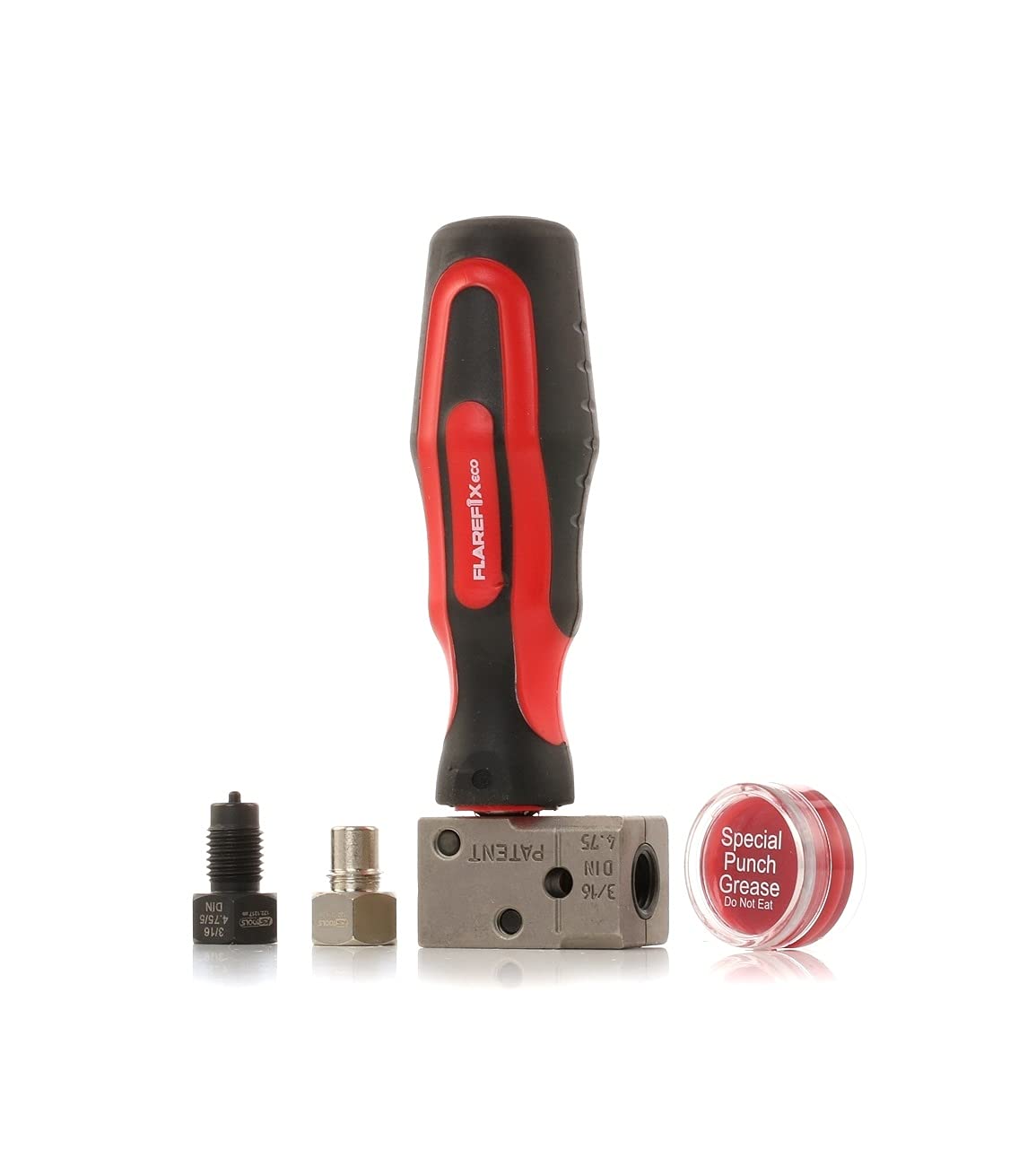
The FLAREFIXeco from KS Tools brings German manufacturing precision to the universal brake pipe flaring category. This 4-piece set is engineered around the 4.75 mm tubing size commonly found in European automotive brake systems, though its universal clamping mechanism accommodates slight variations in tube diameter without needing separate die blocks for every size. The compact design integrates the clamping and forming functions into a single tool body that can be used on the bench or in more confined spaces than full vise-mounted systems.
The set is designed for professional use and includes the tool body, forming adapters, and a storage case. The aluminum frame keeps the weight manageable while the stainless steel forming components provide the hardness needed for repeated use on steel and copper lines. Owner feedback from European vehicle owners and classic car restorers highlights the tool’s ability to produce perfectly formed ends on copper brake lines without effort, and the compact size makes it easy to store in a toolbox or glove compartment for mobile repairs.
The trade-off for the compact universal design is that it is optimized primarily for 4.75 mm tubing, and users working with common SAE sizes like 3/16-inch or 1/4-inch may find the fit less precise than dedicated die-based tools. Some owners have noted that the instruction materials could be more detailed for users unfamiliar with European flaring standards. For projects involving European vehicles, classic restorations, or 4.75 mm brake lines, this KS Tools set delivers precision and portability that larger kits cannot match.
What works
- German manufacturing delivers precision fit and consistent flare formation on 4.75 mm lines
- Compact and lightweight design allows storage in a toolbox and use in tighter spaces
- Universal clamping mechanism reduces the need for multiple die block changes
What doesn’t
- Optimized for 4.75 mm tubing and less precise with common SAE imperial sizes
- Instruction materials lack detail for users unfamiliar with European flaring standards
Hardware & Specs Guide
Flare Angle Standards
37-degree SAE flares are standard for AN fittings, aircraft plumbing, and high-pressure hydraulic systems. The cone angle creates a metal-to-metal seal that handles extreme vibration and pressure cycling. 45-degree inverted flares are the standard for automotive brake systems on domestic and Asian vehicles, where the flare is compressed against a matching seat in the fitting or component. European vehicles commonly use ISO/DIN bubble flares, which form a rounded bead rather than a cone. Confirming the flare angle required for your application before purchasing a tool prevents compatibility issues at installation.
Die Material and Machining
The dies that clamp around the tubing and guide the forming cone are the most critical component for flare quality. Hardened steel dies maintain their dimensional accuracy over hundreds of flares, while softer metals or poorly machined dies develop burrs and gaps that produce inconsistent flare diameters. Split die blocks should close tightly with no daylight between the halves when clamped, and the internal bore should match the tubing OD within a few thousandths of an inch. Dies with integrated alignment features, such as limiting holes or tapered entry guides, reduce setup errors and improve first-attempt success rates.
Clamping Mechanism Types
Three primary clamping designs dominate the flaring tool market. Wing-nut clamp tools are the most affordable but apply uneven pressure that allows the die to shift during forming, especially on harder tubing. T-handle screw clamps provide greater mechanical advantage and more even force distribution, keeping the die locked in position through the entire forming stroke. Hydraulic clamping systems on professional tools use a ram to apply consistent pressure independent of the user’s strength, which eliminates the variable of operator technique and produces identical flares across multiple cycles.
Torque and Force Management
Over-forcing the forming cone into the tubing is the most common cause of cracked flares, particularly on stainless steel and thin-wall lines. Tools with torque-limiting handles or ratcheting mechanisms that disengage at a preset force prevent the user from applying excessive pressure. Non-ratcheting tools rely on the operator’s feel and experience to know when the flare is fully formed. Hydraulic tools with pressure gauges offer the most precise force management, allowing the user to repeat the exact same pressure for every flare in a production run.
FAQ
What is the difference between a 37-degree and a 45-degree flare tool?
Can I use a vise-mounted flaring tool on the vehicle?
Do I need a hydraulic flaring tool as a home DIY user?
Why does my flare crack or split during forming?
Final Thoughts: The Verdict
For most buyers, the best an flare tool winner is the Mastercool 72475-PRC because the hydraulic ram eliminates the force inconsistency that causes failed flares, and the die set covers 45-degree, ISO bubble, and push connect applications in one organized kit. If you need precision 37-degree SAE flares for AN plumbing or hydraulic systems, grab the RIDGID 41162 377 for its torque-limited handle and aircraft-grade reliability. And for budget-conscious DIY users who want consistent double flares on standard automotive lines without stepping up to hydraulic pricing, nothing beats the value of the DPTOOL Y1012A.

Certification: BSc in Mechanical Engineering
Education: Mechanical engineer
Lives In: 539 W Commerce St, Dallas, TX 75208, USA
Md Amir is an auto mechanic student and writer with over half a decade of experience in the automotive field. He has worked with top automotive brands such as Lexus, Quantum, and also owns two automotive blogs autocarneed.com and taxiwiz.com.