Sim racing demands hardware that translates every kerb strike, every traction break, and every braking zone into tactile feedback. Without the right wheel, pedals, and shifters, even the best simulation titles feel numb.
I’m Amir — the founder and writer behind Four Wheel Ask. My analysis focuses on comparing hardware specifications, force feedback quality, material durability, and real-world owner experiences across the sim racing community.
After thoroughly evaluating specs and owner reviews, these best racing sim games setups offer the most realistic control and immersion for any budget.
How To Choose The Best Racing Sim Games Hardware
Sim racing is a gear-intensive hobby. The wheelbase, pedals, and even the mounting solution all shape the experience. Understanding three key areas will help you match the right kit to your skill level and budget.
Direct Drive vs. Gear-Driven Wheelbases
Direct drive (DD) eliminates belts and gears, connecting the wheel directly to a high-torque electric motor. This delivers instantaneous force feedback, finer road detail, and no cogging feel. Entry-level DD units like the MOZA R3 offer around 3.9 Nm—sufficient for smooth, controlled driving. Gear-driven wheels use a motor with a reduction gear; they’re cheaper but introduce friction and a less nuanced feel. If you want the fastest lap times and most immersive physics feedback, direct drive is the clear winner.
Pedal Sensor Technology
Pedal consistency separates a good sim setup from a frustrating one. Look for Hall effect sensors (non-contact magnetic measurement) rather than potentiometers. Hall effect pedals don’t wear out, deliver repeatable brake and throttle modulation, and maintain linearity over thousands of hours. The MOZA SR-P Lite pedals use Hall effect on the throttle and brake, while cheaper bundles often rely on potentiometers that can develop jitter over time.
Ecosystem & Software Integration
A dedicated sim dashboard like MOZA Pit House or Logitech G Hub allows you to tune force feedback curves, set rotation angles, and update firmware. This is critical for dialing in a game-specific feel. Also verify game compatibility: not all wheels work on all titles. For example, the Thrustmaster T98 is natively supported on PlayStation and PC, while MOZA hardware is PC-only. The best racing sim games on PC (iRacing, Assetto Corsa Competizione, rFactor 2) offer the deepest force feedback options, so choose a wheel that matches your primary games.
Quick Comparison
On smaller screens, swipe sideways to see the full table.
| Model | Category | Best For | Key Spec | Amazon |
|---|---|---|---|---|
| MOZA R5 | Direct Drive Wheel Set | Ultimate realism in PC sims | 5.5 Nm DD, PC only | Amazon |
| MOZA R3 | Direct Drive Wheel Set | Budget entry to direct drive | 3.9 Nm DD, PC only | Amazon |
| Thrustmaster T98 | Gear-Driven Wheel Set | PlayStation & PC at a lower price | 240° rotation, PS5/PC | Amazon |
| Logitech Driving Force Shifter | H-Pattern Shifter | Adding mechanical shifting to a wheel setup | 6-speed, push-down reverse | Amazon |
| Shift 2 – Unleashed | Sim Racing Game | Classic career-mode racing sim | Single player, PC disc | Amazon |
In‑Depth Reviews
1. MOZA R5 All-in-One PC Racing Simulator Bundle

The MOZA R5 bundle is the benchmark for entry-level direct drive sim racing. It combines a 5.5 Nm DD wheelbase, an 11‑inch ES steering wheel with microfiber leather and 22 customizable buttons, and a pair of SR‑P Lite pedals using Hall effect sensors. The base’s aviation‑grade aluminum housing and 15‑bit encoder deliver smooth, instant force feedback with ultra‑low torque ripple. Out of the box, the bundle includes a sturdy desk clamp, making it easy to mount on any table up to 1.8” thick.
Owner feedback consistently highlights the leap in realism compared to gear‑driven wheels. The force feedback reveals road texture and weight transfer that budget wheels mask. The ES wheel’s RGB shift lights and quick‑release system add a premium touch. The pedal set lacks a clutch pedal, but the brake and throttle offer decent adjustability via spring changes and angle tuning. The MOZA Pit House software enables detailed FFB curve editing and one‑click game launching.
For sim racers who want the gold standard of tactile feedback without jumping to + bases, the R5 delivers. Pair it with a dedicated rig for maximum stability, but the included clamp works well for beginners. The only catch: it’s a PC‑only system, and upgrading the pedals or adding a shifter increases the total cost. Still, the R5 remains the value champion for genuine direct drive performance.
What works
- True direct drive smoothness and detail
- All‑metal construction, no plastic feel
- Powerful software and app ecosystem
What doesn’t
- PC only — no console support
- No clutch pedal included
- Aftermarket upgrades push overall budget
2. MOZA R3 Racing Simulator Bundle (4‑Piece)

The MOZA R3 is a carefully crafted entry into direct drive racing at a lower torque level. Its 3.9 Nm DD motor keeps the force feedback lively and communicative without overwhelming new sim racers. The same X‑shaped aviation‑grade aluminum base and the 11‑inch ES Lite steering wheel (ISF PU grips, aluminum rim) appear from the R5 family, meaning you get the same quick‑release system and 22 customizable buttons. The SR‑P Lite pedals are identical to the R5’s, with Hall effect sensors on the accelerator and brake (no clutch).
Where the R3 shines is price accessibility. It includes a desk clamp, power adapter, and all necessary mounting hardware. The 3.9 Nm torque is adequate for sims like Assetto Corsa Competizione and iRacing at sensible FFB settings. Owners report zero cogging and smooth force transitions. The R3’s smart temperature control keeps the base reliable during long stints. MOZA Pit House works identically to the R5, allowing full tuning control.
This bundle is ideal for beginners who are certain they want direct drive but aren’t ready to invest in higher torque. The only downsides are the PC‑only ecosystem and the lack of a clutch pedal. That said, the R3’s construction and sensor quality surpass any gear‑driven wheel in its price tier, making it a smart long‑term investment that won’t need upgrading later.
What works
- Pure direct drive feel without belt friction
- Compact, easy to mount and store
- Reliable Hall sensor pedals
What doesn’t
- No clutch pedal included
- Limited to PC use only
- Lower torque may feel weak to experienced racers
3. Thrustmaster T98 Ferrari 296 GTB Racing Wheel & Pedal Set
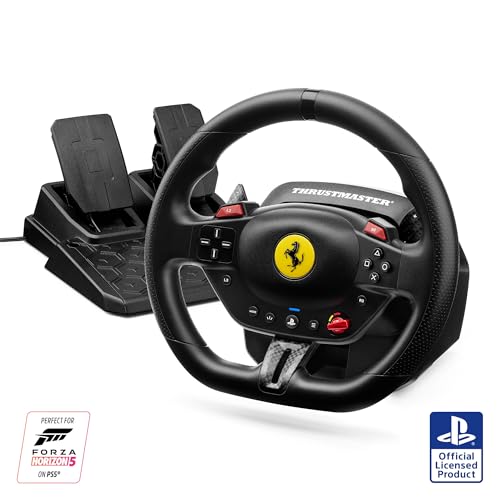
The Thrustmaster T98 brings an officially licensed Ferrari 296 GTB steering wheel to the sim racing scene. Its 10‑inch wheel features paddle shifters and a Manettino dial that lets you switch between three driving profiles on the fly. The bungee‑cord centering mechanism provides smooth resistance and automatic return, while the 240‑degree rotation allows for tighter steering than a typical console controller. The included pedal set uses Hall effect sensors for consistent input.
Compatibility is a strong point: the T98 works with PS5, PS4, and PC right out of the box. Setup involves a tool‑free clamp that fits desks up to 1.8 inches thick. The Ferrari aesthetics and ergonomic grip make it appealing for fans of the brand. The 10‑inch wheel size is comfortable for both arcade and simulation racing. Pedal adjustability allows you to change spacing and angle for a custom fit.
Where it falls short compared to direct drive options is feedback nuance. The bungee system lacks the fine detail of a DD motor, and the 240° rotation is less than the 900° or more found on higher‑end wheels. It also lacks force feedback vibration in the pedals. For casual or mid‑tier sim racing on console, however, it delivers a genuinely immersive step up from a standard controller. The Hall effect pedals are a welcome upgrade over resistive sensors.
What works
- Excellent console compatibility (PS5/PS4/PC)
- Licensed Ferrari design with quality grips
- Quick, tool‑less mounting
What doesn’t
- No direct drive — feedback lacks detail
- Only 240° steering rotation
- Pedal set is basic, no clutch pedal
4. Logitech G Driving Force Shifter
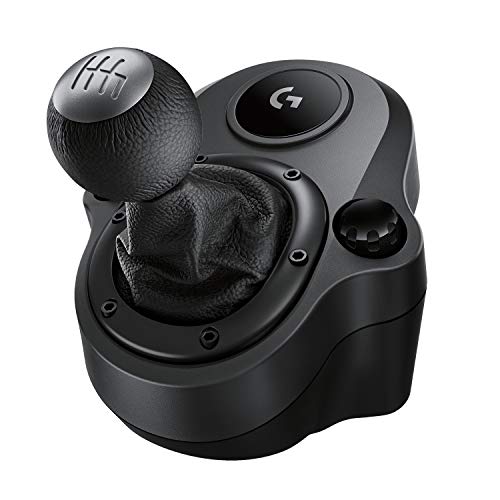
The Logitech G Driving Force Shifter is the dedicated six‑speed H‑pattern companion for the G29, G920, and G923 racing wheels. Its solid steel gear shaft and hand‑stitched leather knob mirror the feel of a real performance shifter. The push‑down reverse adds an authentic H‑pattern layout, and the positive click into each gate helps prevent missed shifts during intense corners.
Constructed to survive aggressive driving sessions, the shifter includes durable built‑in clamps and bolt‑down mounting points. It works with Windows 7 and newer, Xbox Series X|S, Xbox One, PlayStation 5, and PlayStation 4. Owners frequently note that it adds a surprising layer of immersion, especially in games that support manual gearboxes like iRacing, Assetto Corsa, and Forza Motorsport. The shift feel is mechanical and satisfying without being notchy.
The main limitation is that it only works with specific Logitech wheels — it cannot be adapted to Thrustmaster, MOZA, or other brands without third‑party adapters. Also, the shift knob cap can pop off easily, as some owners report. Despite that, as a companion piece, it completes a Logitech wheel setup without breaking the budget. For anyone building a G29/G920 rig, this shifter is a must‑have addition.
What works
- Solid build with steel shaft and leather boot
- Positive gear engagement prevents missed shifts
- Works across all major consoles and PC
What doesn’t
- Only compatible with Logitech G29/G920/G923 wheels
- Shift knob cap can come loose
- No sequential mode
5. Shift 2 – Unleashed (PC)
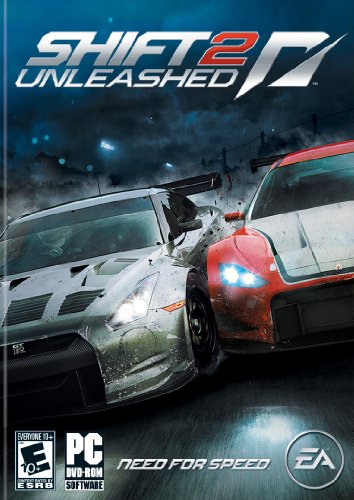
Shift 2 – Unleashed is a classic PC racing simulation from the EA stable that emphasizes helmet‑cam immersion and realistic crash physics. The game features the FIA GT1 World Championship and GT3 European Championship, along with a career mode that progresses from muscle cars and retro racers to endurance prototypes. The Autolog system connects friends competitively by comparing lap times and unlocked content.
What sets Shift 2 apart from arcade racers is its focus on driver‑head movement. The helmet cam tilts and leans into corners, giving a visceral sense of speed that works exceptionally well with a force feedback wheel and triple monitors. The car customization options are deep: you can modify engines, suspension, bodywork, and more, tailoring each vehicle to your driving style. Night racing adds another challenge layer, with reduced visibility and headlight tracking.
As a PC‑only release, Shift 2 shines on a dedicated sim rig, especially with a DD wheel and H‑pattern shifter. The physics model sits between simulation and simulation‑lite, making it accessible for newcomers while still rewarding precise driving. The downside is age — it was released in 2011 and lacks modern tire modeling, VR support, and online multiplayer depth. Still, for the cost, it’s a budget‑friendly way to build a career in a simulated racing series.
What works
- Immersive helmet‑cam view
- Licensed GT championships and real tracks
- Deep car customization options
What doesn’t
- Dated graphics and physics engine
- No VR support or modern multiplayer
- PC only — not available on consoles
Hardware & Specs Guide
Direct Drive vs. Gear Drive
Direct drive (DD) connects the steering wheel directly to the motor without belts or gears. This eliminates lag, cogging, and friction, delivering every road imperfection as the game intends. Gear‑driven systems use a reduction gear; they offer force feedback but with reduced detail and a slight notchiness. For the best racing sim games, DD is the gold standard for fast, precise lap times.
Torque Rating (Nm)
Torque determines the strength of force feedback. 3–5 Nm is considered entry to mid‑range, suitable for desk setups. 5–8 Nm is the sweet spot for consistent feedback without requiring a reinforced rig. Above 8 Nm is for dedicated cockpit owners. The MOZA R5’s 5.5 Nm provides enough detail for iRacing and ACC without rattling a desk.
Pedal Sensor Types
Hall effect sensors use magnetic fields to detect pedal position, offering infinite resolution and no wear. Potentiometers are cheaper but can develop dead spots over time. For consistent braking and throttle, Hall effect is strongly preferred. The MOZA SR‑P Lite pedals and Thrustmaster T98 pedals both use Hall effect for the accelerator and brake.
Rotation Angle
Steering rotation affects how many turns lock‑to‑lock. Sim racing wheels typically offer 240° to 1080°. For close‑course racing (GT3, Formula), 540° or less is common. For drifting or road cars, 900° is more realistic. The Thrustmaster T98’s 240° is tight for serious sim racing; DD bases allow full rotation up to 1080° with a software lock.
FAQ
What is the difference between direct drive and gear‑driven wheels?
Do I need a shifter for sim racing games?
What games are compatible with these wheels?
Can I use a sim wheel on a desk without a rig?
Final Thoughts: The Verdict
For most buyers, the best racing sim games winner is the MOZA R5 because it delivers genuine direct drive performance at a price that undercuts established premium brands while including all‑metal construction and expansive software control. If you want a budget‑friendly entry into direct drive, grab the MOZA R3 — it retains the same sensor quality and platform, just with lower torque. And for console racers seeking a complete wheel‑and‑pedal package, nothing beats the Thrustmaster T98 for its Ferrari design, plug‑and‑play PS5 compatibility, and Hall effect pedals.

Certification: BSc in Mechanical Engineering
Education: Mechanical engineer
Lives In: 539 W Commerce St, Dallas, TX 75208, USA
Md Amir is an auto mechanic student and writer with over half a decade of experience in the automotive field. He has worked with top automotive brands such as Lexus, Quantum, and also owns two automotive blogs autocarneed.com and taxiwiz.com.